

Some of the best engineering ideas do not begin in a laboratory. They begin under a tree, probably while someone is trying not to step on a crunchy pile of maple “helicopters.” The helicopter seed robot is one of those wonderful inventions that looks almost too simple to be serious. It spins like a maple seed, falls with grace, steers itself with tiny control changes, and, when needed, can stop floating politely and drop like a rock.
That last part is what makes the design so interesting. A normal samara seed, the winged fruit produced by maple and some other trees, survives by slowing its descent. It twirls downward, catches air, and lets the wind carry it away from the parent tree. A samara-inspired robot uses the same basic trick, but engineers have added control, electronics, sensors, and a clever diving mode. In other words, nature invented the tiny helicopter; robotics gave it a flight plan and a dramatic entrance.
The result is a bio-inspired aerial device that may help with environmental monitoring, distributed sensing, search operations, agricultural data collection, or emergency payload delivery. It is not a traditional drone with four loud propellers. It is closer to a smart falling leaf with ambitions.
What Is a Helicopter Seed Robot?
A helicopter seed robot is a small flying or falling robot inspired by samaras, especially maple seeds. These seeds have a heavy seed body and a thin wing. When they detach from the tree, their uneven shape makes them spin. That spin creates lift, slows their fall, and gives wind enough time to carry them farther.
Engineers have been fascinated by this natural design for decades because it solves a difficult problem with almost comic simplicity: how do you drop a small object from above without smashing it into the ground? A parachute works, but it adds fabric, cords, folding problems, and deployment risks. A powered drone works, but it adds motors, batteries, propellers, control systems, and cost. A samara-style robot uses the shape of the wing itself as the descent system.
The Samara Autorotating Wing, often shortened to SAW, is one well-known example. Researchers at the Singapore University of Technology and Design developed versions that can autorotate, steer, separate from a larger carrier structure, and in the diving version, switch between a slow spinning descent and a fast vertical drop. That diving version is often called dSAW, or diving Samara Autorotating Wing.
How Maple Seeds Turn Falling Into Flying
The magic of the maple seed is not magic at all, although it looks suspiciously enchanted when a child tosses one into the air. As the seed spins, air moves around the wing and forms a leading-edge vortex. This tiny tornado-like flow lowers pressure over the wing and increases lift. The seed does not fly upward, but it falls much more slowly than it would if it simply tumbled down like a pebble.
This matters because time in the air equals travel distance. The longer the seed stays airborne, the more opportunity wind has to move it away from the parent tree. For a tree, that means less competition between parent and seedling. For a robot, it means a low-energy way to distribute a payload over a wider area.
In robotics, this is a beautiful trade. A samara robot does not need to beat gravity entirely. It only needs to negotiate with gravity long enough to reach a useful landing zone. It is not trying to be a hawk. It is trying to be a very organized seed.
The “Drop Like a Rock” Trick
The phrase “drop like a rock” sounds like a failure in aviation. Usually, when a flying machine is compared to a rock, engineers start sweating. But in the case of the helicopter seed robot, dropping fast is a feature.
The dSAW can change the angle of its flap so aggressively that the wing stalls. When the wing stalls, the graceful autorotating descent turns into a steep dive. The robot falls much faster, reducing the time it spends being pushed around by wind. Then, by returning the flap to its autorotation position, the vehicle can recover its spinning descent and slow down again.
This is the key innovation: the robot does not merely fall slowly. It can choose between two useful behaviors. In autorotation mode, it descends gently and can be guided. In dive mode, it gives up lift temporarily and gets closer to the ground in a hurry. Then it can recover, spin back up, and land more safely.
That is a little like taking an elevator that occasionally becomes a fire pole, then becomes an elevator again before you hit the lobby. Not recommended for humans, but quite clever for a small aerial robot.
Why Would a Robot Need to Dive?
Wind is the obvious answer. A small, lightweight aerial robot can be pushed off course easily, especially if it spends a long time drifting downward. A slow descent is great when you want range, but it can be a problem when you want accuracy. If the robot is carrying a sensor that needs to land in a certain region, too much floating can become a liability.
By diving through troublesome air and then recovering near the ground, the robot may improve the balance between coverage and control. It can glide or steer when that helps, then rapidly lose altitude when staying aloft becomes risky. This is especially useful for missions in fields, forests, disaster zones, or remote landscapes where a single aircraft might release many small sensor units.
Imagine a fixed-wing drone flying over a burn area after a wildfire. Instead of landing repeatedly, it releases several samara-style sensor robots. Each one spins away toward a target zone, dives through gusty layers of air, recovers near the ground, and lands carrying a small environmental sensor. The carrier aircraft continues onward. The sensors begin collecting data. Nobody has to hike through ash, mud, or mosquito territory. Everybody wins, except perhaps the mosquitoes.
Inside the Samara-Inspired Design
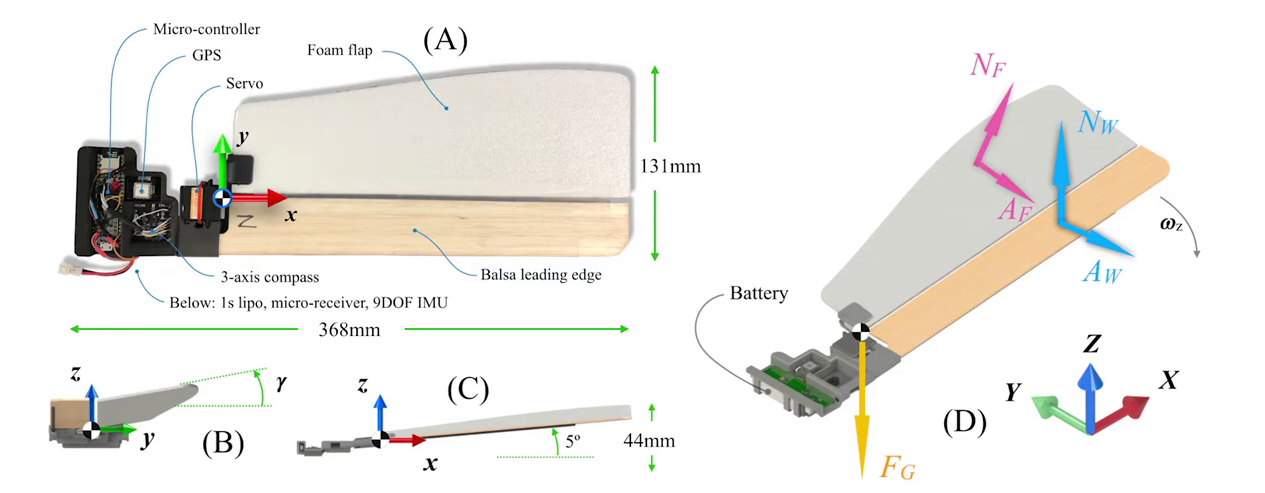
The dSAW design is elegantly minimal. It uses a wing, a seed-like body, a flap, a small actuator, and onboard electronics. Depending on the version, prototypes may include a microcontroller, magnetometer, GPS, inertial measurement unit, radio receiver, battery, and servo. The structure can use lightweight materials such as balsa, foam, carbon rods, and 3D-printed parts.
The flap is the star of the show. In ordinary autorotation, small flap adjustments can influence the direction of the descent. When the flap moves into a more extreme angle, the wing stalls and the vehicle enters a dive. This gives the same basic hardware two personalities: patient leaf and impatient rock.
The simplicity matters. Many drones become expensive because every function requires another subsystem. More motors mean more power. More propellers mean more failure points. More complexity means more cost. A samara robot aims for low-cost, lightweight deployment, which is especially important if the device is meant to be used in groups or in situations where retrieval is difficult.
From One Robot to Many
One of the most exciting ideas in samara robotics is distributed deployment. Researchers have explored systems where several autorotating wings attach together into a larger spinning structure, then separate in midair. The combined form can behave more like a larger rotor, while the separated units can spread out toward different landing areas.
This is where the helicopter seed robot becomes more than a neat physics demonstration. A single device is interesting. A swarm of simple, low-cost devices is potentially powerful. A carrier drone or model aircraft could release several units at once. Each unit could carry a small payload: a temperature sensor, soil moisture sensor, air-quality monitor, acoustic recorder, or tiny communication node.
Compared with landing a large drone in multiple locations, dropping many small autorotating robots could reduce risk and increase coverage. If one unit fails, the entire mission does not fail. This is the same logic behind seed dispersal in nature. A tree does not lovingly hand-deliver one seed to a perfect patch of soil. It releases many and lets physics do the first round of logistics.
Possible Uses for Helicopter Seed Robots
Environmental Monitoring
Forests, wetlands, farms, volcano slopes, and disaster areas often need measurements from many points. A helicopter seed robot could deliver small sensors without requiring roads, landing pads, or repeated human trips. Researchers studying microclimates, soil conditions, or post-fire recovery could benefit from low-cost distributed sensing.
Agriculture and Smart Farming
Large farms already use drones and satellite data, but ground-level measurements still matter. Small samara robots could help distribute sensor packages across fields to measure moisture, temperature, salinity, or crop stress. They would not replace tractors, agronomists, or the farmer’s suspiciously accurate weather knee, but they could add another useful data layer.
Disaster Response
After floods, earthquakes, landslides, or wildfires, sending people into unstable areas can be dangerous. Small aerial payloads could help map conditions, detect hazards, or create temporary sensor networks. A seed-inspired robot that can descend without needing a runway or powered landing has obvious appeal.
Remote Payload Delivery
Small medical supplies, emergency beacons, or communication devices might be delivered to hard-to-reach areas. The payload capacity is limited, so nobody should expect a samara robot to bring pizza. But for tiny, urgent, lightweight items, the concept is promising.
Challenges Still Facing the Technology
Despite its charm, the helicopter seed robot is not ready to replace conventional drones in every mission. Control remains difficult because autorotation is nonlinear. The vehicle spins, tilts, drifts, and reacts to wind in complicated ways. Accurate landing in real outdoor conditions is harder than a clean laboratory drop.
Payload weight is another limitation. The more electronics and sensors the robot carries, the more the wing design must compensate. Batteries add weight. Stronger structures add weight. Protective housings add weight. At small scales, every gram behaves like it has hired a lawyer.
Communication and recovery also matter. If devices are disposable, they must be inexpensive and environmentally responsible. If they are reusable, someone or something has to collect them. If they carry sensors, those sensors need power, data storage, or wireless communication. The flying seed is only one part of the mission system.
There are also ethical and regulatory issues. Small aerial devices can be useful for science, agriculture, and rescue, but they must be deployed responsibly. Airspace rules, privacy, environmental impact, and wildlife safety all deserve attention. “It’s tiny and cute” is not a complete regulatory strategy.
Why Bio-Inspired Robotics Keeps Winning Attention
Bio-inspired robotics succeeds because nature has already tested many designs through millions of years of trial and error. Engineers do not copy nature blindly; they translate useful principles. A bird does not become an airplane bolt-for-feather. A fish does not become a submarine with scales and an attitude problem. Likewise, a samara robot is not just a plastic maple seed. It is an engineering interpretation of autorotation, passive stability, and low-energy descent.
The helicopter seed robot is a perfect example of this approach. It borrows the seed’s one-wing spinning motion, then adds modern control. It accepts gravity instead of fighting it constantly. It uses falling as a mission phase, not as a disaster. That mindset is refreshing in a world where many machines try to brute-force their way through every problem with bigger motors and bigger batteries.
Experience Notes: What This Technology Feels Like in the Real World
Anyone who has played with maple seeds already understands the emotional appeal of this robot. Pick one up, toss it gently, and it turns a boring fall into a tiny performance. It does not simply drop. It dances. That familiar childhood experience makes the helicopter seed robot easy to explain, even when the engineering behind it is advanced.
In a practical setting, the first experience would likely be surprise at how quiet and simple the device seems compared with a quadcopter. A quadcopter announces itself with a buzzing swarm-of-bees soundtrack. A samara robot descends with a spinning, fluttering motion that feels more natural and less intrusive. For environmental monitoring, that quietness could be valuable. Wildlife may still notice it, but it is less dramatic than a powered drone hovering overhead like a mechanical hawk with a deadline.
The second experience would be watching the transition between modes. In autorotation, the robot looks controlled and almost relaxed. Then the flap changes, the wing stalls, and the vehicle suddenly dives. For a moment, your brain says, “Well, that’s broken.” Then it recovers into autorotation, and the design reveals the joke: it meant to do that. This controlled loss and recovery of lift is what makes the concept memorable.
For field researchers, the appeal would be logistical. Carrying sensors into remote terrain is slow. Landing larger drones in rough landscapes can be risky. Dropping small autorotating devices from a carrier aircraft could make certain data-gathering missions faster and safer. A team could map a hillside, wetland, or post-storm area with a network of tiny instruments instead of relying on a few isolated measurements.
For engineers and students, the helicopter seed robot is a wonderful teaching tool. It connects plant biology, aerodynamics, robotics, controls, materials, and environmental science in one visible object. You can explain leading-edge vortices, stability, stall, recovery, payload trade-offs, and sensor deployment without needing a giant wind tunnel or a boring slide deck. The robot itself is the lesson, and unlike many lessons, it spins.
The most important experience, however, is philosophical. This design reminds us that not every robot needs to look futuristic in the usual shiny-metal sense. Sometimes the future looks like a seed. Sometimes the smartest machine is not the one that overpowers nature, but the one that cooperates with it. The helicopter seed robot can float, steer, dive, and recover because it respects a simple truth: gravity is not always the enemy. Sometimes gravity is the engine, the guide, and, with the right wing, the punchline.
Conclusion
The helicopter seed robot shows how a small natural idea can become a serious engineering platform. Inspired by samara seeds, it uses autorotation to slow descent, a flap to steer, and a diving mode to drop rapidly when conditions demand it. That combination could make future aerial sensor deployment cheaper, quieter, and more flexible.
There is still work ahead. Engineers must improve precision, payload capacity, outdoor reliability, communication, and environmental responsibility. Yet the core idea is powerful because it is simple. A spinning seed can cross a forest. A robotic seed may one day map one.
And yes, it can also drop like a rock. But unlike most rocks, it has the good manners to recover before landing.