

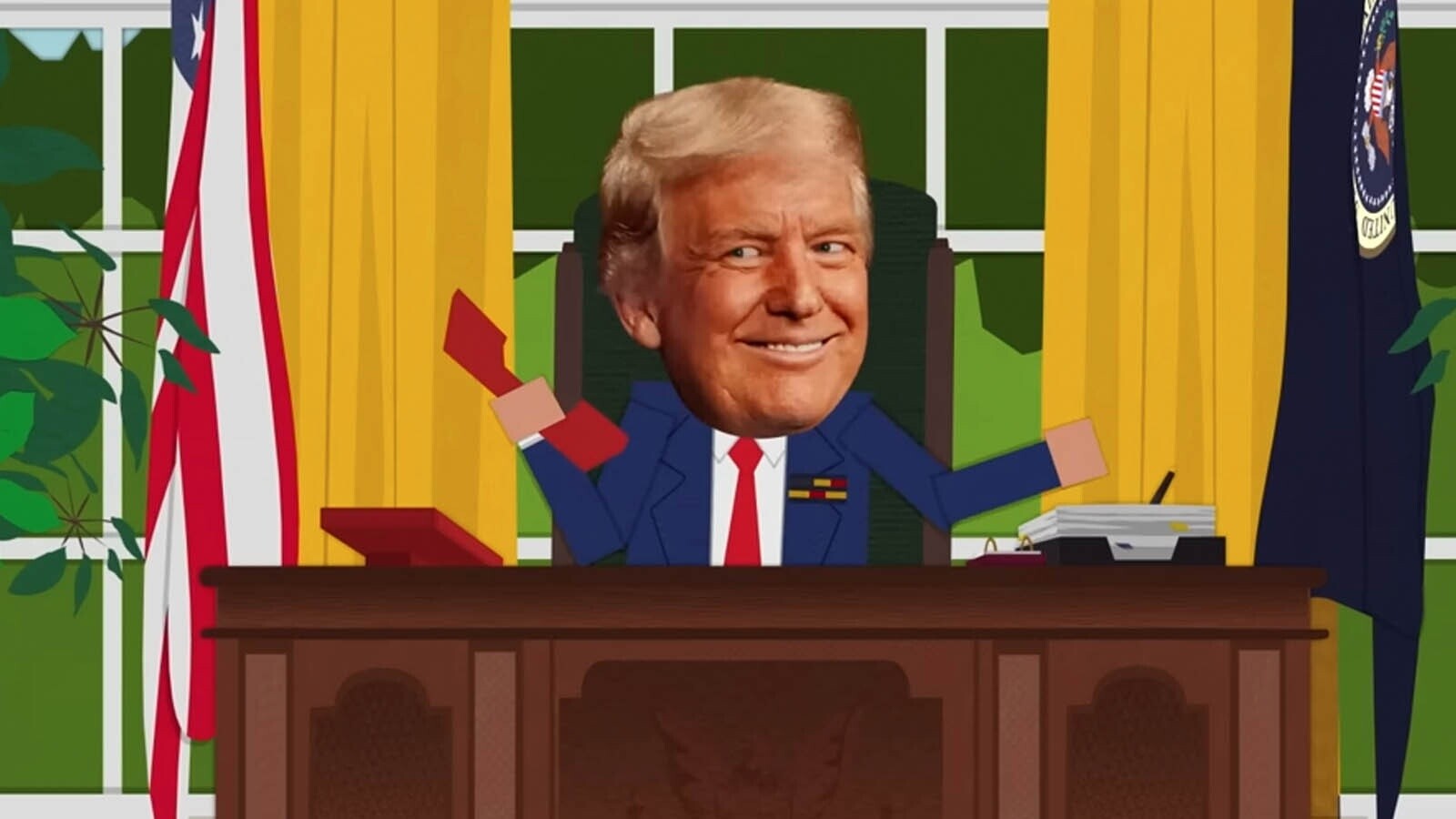
Donald Trump has never exactly been shy about criticizing comedians. Late-night hosts, cable satirists, award-show presenters, and anyone holding a microphone within roasting distance have all found themselves in the blast radius. But when South Park took aim at him with the subtlety of a flaming piano falling down a mountain, something unusual happened: Trump himself did not unload on the show with the same fury he often saves for late-night television.
That silence became its own punchline. Why would a president who regularly swings at Jimmy Kimmel, Stephen Colbert, Seth Meyers, and other comedy targets seem comparatively restrained when Trey Parker and Matt Stone turned him into one of the most outrageous running jokes in modern animation? Comedian Patton Oswalt has a theory, and it is not that Trump suddenly discovered a deep respect for crude political satire, adult animation, or Colorado children with vocabulary problems.
According to Oswalt, the explanation is simple: money talks, ratings roar, and South Park has both. In other words, Trump may not admire the joke, but he recognizes the scoreboard. And in the world of political comedy, that might be the strangest form of respect there is.
The Patton Oswalt Theory: Trump Respects Numbers
Patton Oswalt’s argument cuts straight to the business logic behind the culture-war noise. He suggested that Trump can dismiss late-night hosts by claiming their ratings are fading or their networks are struggling, but South Park is harder to brush aside because the franchise remains commercially powerful. The show is not merely a cartoon with foul-mouthed kids; it is a billion-dollar cultural machine with nearly three decades of brand equity, streaming value, audience loyalty, and a proven ability to make controversy profitable.
That matters because Trump has long treated popularity, ratings, wealth, and public dominance as proof of strength. In that worldview, the argument is not “Is this satire fair?” or “Is this joke artistically sharp?” The argument is closer to: “How big is the audience, and how much money does it make?” By that measurement, South Park is difficult to dismiss without sounding like a man yelling at a cash register.
Why That Makes ‘South Park’ Different From Late-Night TV
Late-night television has changed dramatically. The old model of millions watching a host at 11:35 p.m. has been weakened by streaming, YouTube clips, podcasts, TikTok, and the general modern habit of consuming media in little digital crumbs. Even successful hosts operate in a shrinking broadcast ecosystem. That gives critics an easy line of attack: “Nobody watches.” Whether fair or not, it is a convenient insult.
South Park, however, is not trapped in that exact box. It lives on cable, streaming, social media conversation, meme culture, and long-term licensing value. It is not just a weekly show; it is an entertainment asset. When the series returned with a Trump-heavy season premiere in 2025, the episode drew major attention, generated huge online discussion, and performed strongly across platforms. That made the show’s mockery harder to wave away as irrelevant.
The Billion-Dollar Cartoon in the Room
One reason Oswalt’s theory feels persuasive is timing. South Park returned to the center of political comedy just as Paramount was locking down a massive deal involving the franchise. The reported five-year agreement was valued around $1.5 billion and included new episodes as well as streaming rights. That is not exactly couch-cushion money. That is “Cartman bought the couch factory” money.
The deal underscored something longtime fans already knew: Trey Parker and Matt Stone are not rebellious outsiders begging for permission. They are enormously valuable creators with leverage. Their show helped define Comedy Central, outlasted countless media trends, and survived more “this show has gone too far” moments than most programs have seasons.
So when South Park mocked Trump, Paramount, CBS, corporate settlements, political pressure, and media cowardice all in the same chaotic swing, it did so from a position of unusual strength. The show could bite the hand that feeds it because, frankly, the hand had just signed a very expensive feeding agreement.
What ‘South Park’ Actually Did to Trump
The 2025 season premiere did not gently nudge Trump with a polite elbow. It portrayed him in wildly unflattering, surreal, and deliberately crude ways, including scenes involving Satan, lawsuits, public embarrassment, and a pointed parody of media institutions bending under political pressure. It also mocked Paramount’s relationship with Trump-related legal and corporate issues, creating a rare spectacle: a show savaging both the president and its own corporate home.
The White House responded by calling the show desperate for attention and suggesting it had not been relevant for years. That response created an immediate contradiction, because the episode was generating exactly the kind of attention that proves relevance in the modern media economy. It was like shouting, “Nobody cares!” through a megaphone at a packed stadium.
That tension is where Oswalt’s observation lands. Trump may not like South Park. He may not respect its politics, its taste, its language, or its jokes. But the show’s numbers make it harder to attack in the same way he attacks late-night hosts. If a target is visibly successful, the usual “failure” insult loses some of its teeth.
Why Ratings Are Political Currency
In the Trump era, ratings are not just entertainment data. They are political currency. Trump’s background in reality television shaped a public persona obsessed with audience size, spectacle, dominance, and winning the news cycle. From crowd sizes to television rankings, numbers have often been treated as symbolic proof of legitimacy.
That is why South Park presents an unusual challenge. The show’s satire is personal, vulgar, and relentless, but its popularity makes it difficult to frame as weak. A struggling comedian can be dismissed as bitter. A canceled program can be framed as unwanted. But a franchise with a huge streaming deal and record-breaking attention is harder to belittle without accidentally admitting it matters.
The Strange Respect of Being Too Big to Ignore
“Respect” in this context does not mean admiration. It does not mean Trump is secretly watching episodes while laughing into a Diet Coke. It means recognition of power. South Park has cultural power, financial power, and audience power. It can make a grotesque joke on Wednesday and become a national media story by Thursday morning.
That is the kind of power Trump understands. Oswalt’s point is not that Trump has become a fan of satire. It is that Trump understands winners, or at least the appearance of winning. And South Park continues to look like a winner.
How Trey Parker and Matt Stone Built Their Immunity
Trey Parker and Matt Stone have spent nearly three decades cultivating a specific comic identity: nobody is safe, every sacred cow may be launched into orbit, and if you are offended, please take a number behind the last 10,000 offended people. This has made South Park unusually difficult to categorize politically. The show has mocked liberals, conservatives, celebrities, corporations, religions, activists, tech billionaires, teachers, parents, children, Canada, and occasionally itself.
That history gives the show a protective layer. When South Park attacks Trump, it does not appear to be a sudden partisan conversion. It appears to be the latest target in a long-running satirical demolition derby. Parker and Stone have been annoying powerful people since the 1990s. At this point, outrage is not a bug in the machine; it is part of the operating system.
The creators have also explained that politics has become impossible to avoid because politics itself has become pop culture. That is an important distinction. South Park did not become a policy seminar with fart jokes. Rather, the political world became so theatrical, meme-driven, and personality-based that it wandered directly into the show’s natural habitat.
Why Political Comedy Feels Riskier Now
The Oswalt theory also lands because it came during a tense period for political comedy. Late-night hosts faced criticism, corporate pressure, and public fights over speech, ratings, and network decisions. Jimmy Kimmel’s suspension in 2025 became a flashpoint in debates over government pressure and broadcast power. Stephen Colbert’s cancellation drew scrutiny because it followed Paramount’s settlement with Trump over a 60 Minutes dispute, even though CBS said the decision was financial.
Whether one sees those events as business decisions, political pressure, corporate caution, or some messy cocktail of all three, the result was clear: comedians felt the ground shifting. Jokes about Trump were no longer just jokes about Trump. They became tests of institutional courage. Who would stand by the comic? Who would fold? Who would suddenly discover “financial reasons” in the supply closet?
South Park’s Advantage: Chaos as a Brand
That is where South Park has a unique advantage. Its brand is chaos. A tame South Park episode would be more suspicious than an outrageous one. If the show suddenly became polite, viewers would assume someone at corporate had locked Cartman in a compliance training seminar.
Because the audience expects brutality, the creators can push harder without seeming off-brand. The shock is part of the contract. This gives South Park more room than many late-night shows, which still depend on monologues, advertisers, affiliates, and a more traditional broadcast structure.
The Business Lesson Behind the Joke
For media companies, the lesson is uncomfortable: creative independence is easier to defend when it is profitable. A show with weak numbers can be labeled risky. A show with giant numbers becomes “bold,” “important,” and “a valuable franchise.” The same joke that terrifies executives at one rating level becomes visionary at another.
That does not mean art should be judged only by money. In fact, Oswalt’s larger point is partly a critique of that worldview. But it does explain why South Park can occupy a protected space. It has the money shield. It has the ratings shield. It has the legacy shield. It has the “we have been doing this since your dial-up modem screamed at you” shield.
Trump may attack comedians he believes can be framed as failing. But South Park is difficult to place in that category. It is crude, controversial, and often offensive by design, but it is not marginal. It is a major American satire brand with serious commercial weight.
Why Audiences Still Care
Audiences care because South Park often says the quiet part with a kazoo solo. It takes the absurdity already floating around public life and exaggerates it until the absurdity admits defeat. In the Trump years, that job became harder because reality kept outrunning parody. The challenge for satirists was no longer inventing ridiculous scenarios; it was keeping up with Tuesday.
When South Park works, it does not simply insult a politician. It captures the weird machinery around the politician: media fear, corporate calculation, public obsession, online outrage, and the way everyone involved claims not to care while clearly caring very much.
That is why Oswalt’s theory resonates. The joke is not only that Trump might respect South Park because it makes money. The bigger joke is that American culture often treats money as the final fact-checker. If the ratings are big enough, the cartoon suddenly becomes serious business.
Experience Notes: Watching a Joke Become a Power Test
Anyone who has followed political comedy over the past decade has probably felt the shift. At first, Trump jokes seemed endless because Trump himself seemed built from late-night monologue material: catchphrases, feuds, nicknames, golden interiors, dramatic entrances, and a relationship with television so intense it could have filed joint taxes. The jokes practically wrote themselves, which was convenient until everyone realized they had written themselves into a corner.
After a while, the problem was not a shortage of jokes. It was exhaustion. Audiences had heard every version of the orange joke, the hair joke, the tiny-hands joke, the “many people are saying” joke. Political comedy began to feel like a treadmill: lots of movement, same wall. That is why South Park returning with a massive, obscene, corporate-aware Trump parody felt different. It was not merely laughing at Trump’s appearance or speech patterns. It was laughing at the entire ecosystem around him.
From a viewer’s perspective, that is what made the moment interesting. The episode arrived inside a real-world media drama involving Paramount, CBS, streaming rights, late-night cancellations, government pressure concerns, and a public hungry for someone to say the rude thing out loud. The show did not float above the controversy; it cannonballed into it wearing goggles.
There is also a strange satisfaction in watching a comedy institution test the limits of its own corporate parent. Most viewers assume big media companies are allergic to risk, and often they are. They prefer controversy that can be monetized but not litigated, discussed but not boycotted, edgy but not expensive. South Park has always made that balance ridiculous. It is a show that sells itself as unsupervised trouble, yet it exists inside one of the most supervised industries in America.
That contradiction is part of the fun. When Parker and Stone mock the company paying them, the joke becomes more than a gag. It becomes a stress test. Will the corporation defend the valuable troublemakers, or will it sand down the edges until the show becomes another safe content tile in a streaming menu? So far, the answer appears to be that South Park remains too valuable to tame easily.
Oswalt’s theory captures something many viewers instinctively understand. Power does not always respect truth, taste, or cleverness. But power notices leverage. If a comedian has leverage, the room changes. If a show has leverage, executives speak softly. If a cartoon has a billion-dollar deal, even the loudest political figure may choose a different target.
That does not make South Park untouchable. No show is. Public opinion changes, corporate leadership changes, and comedy ages faster than milk in a hot car. But the current moment proves that satire backed by audience demand can still punch upward. It can still make powerful people uncomfortable. It can still turn a crude joke into a national conversation about ratings, censorship, media consolidation, and political ego.
And maybe that is the real reason people keep watching. Beneath the profanity and cartoon chaos, South Park reminds audiences that comedy can still be dangerous when it lands in the right place. Not dangerous because it is polite, balanced, or approved by a committee, but because it says the thing everyone else is nervously calculating whether they can afford to say.
Conclusion: Respect, Ratings, and the Last Laugh
So, why does Trump appear to “respect” South Park, according to Patton Oswalt? Because the show represents a kind of success that is difficult to mock away. It has ratings, money, cultural force, and a fan base that expects it to offend. Trump may not respect the satire itself, but Oswalt’s point is that he respects visible dominance. In the entertainment economy, South Park has plenty of it.
The bigger takeaway is that political comedy still matters when it has courage, timing, and leverage. South Park did not just make fun of Trump. It exposed the nervous system around him: corporations, networks, politicians, audiences, and comedians all reacting to the same pressure. That is why the joke lasted longer than the episode. It was not only about Trump. It was about who still has permission to laugh.