

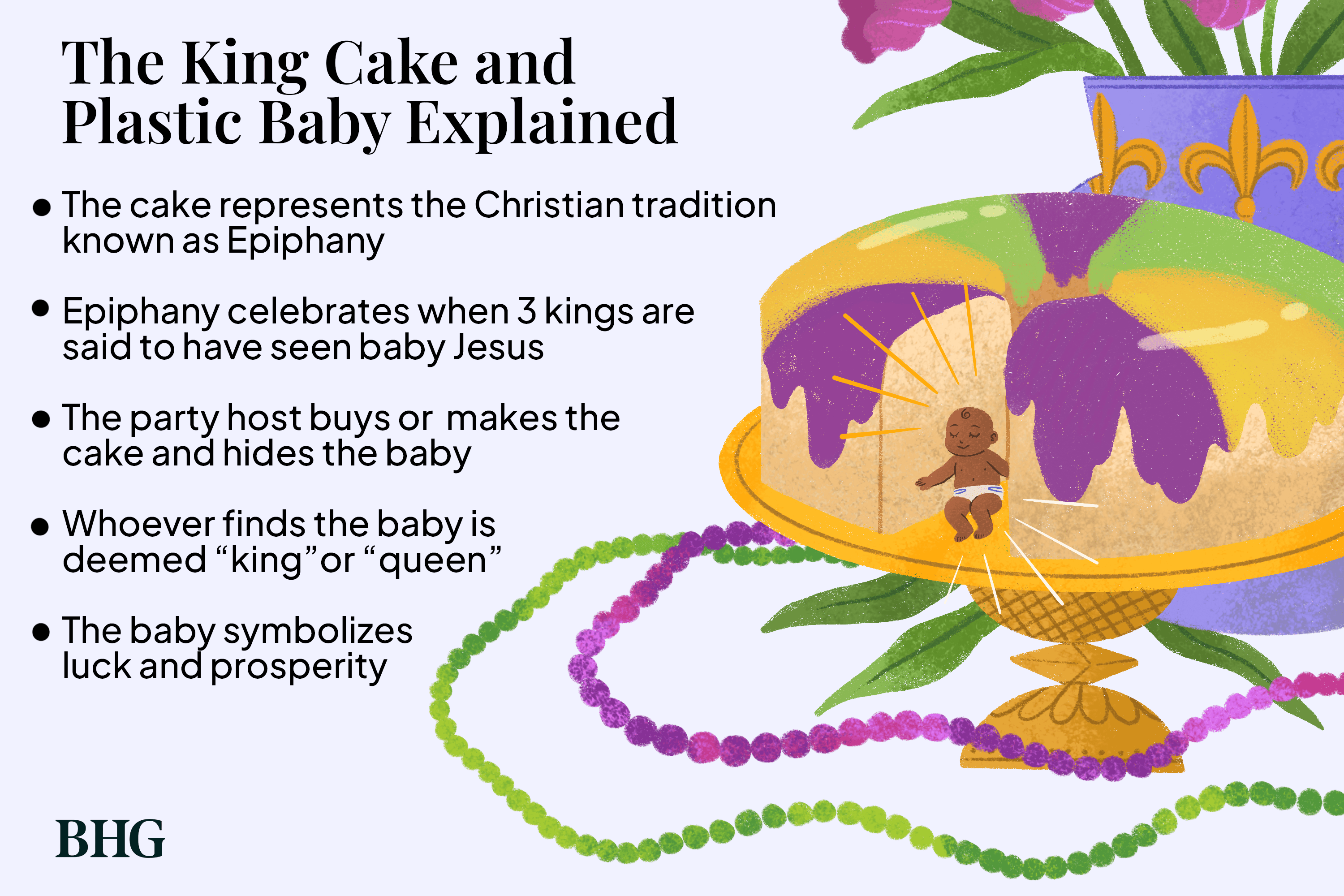
If Mardi Gras had an edible mascot, it would not be a delicate little cookie politely waiting on a porcelain plate. It would be king cake: loud, colorful, sticky with icing, dusted in purple, green, and gold sugar, and hiding a tiny baby inside like the world’s most festive surprise party. The king cake tradition is one of those customs that feels playful on the surface but carries centuries of religious history, European foodways, New Orleans identity, and a very serious rule: whoever gets the baby buys the next cake.
The story of how the king cake began is not as simple as “someone baked a cake and got creative with sprinkles.” It winds through ancient celebrations, medieval Christian feasts, French and Spanish traditions, Catholic Epiphany customs, and the uniquely joyful chaos of New Orleans Carnival. And the famous king cake baby? That tiny plastic figure has a history of its own, evolving from beans and small charms into one of the most recognizable symbols of Mardi Gras season.
So grab a napkin, because this story comes with icing. Here is how the king cake tradition began, why a baby ended up inside, and how one seasonal pastry became a beloved symbol of celebration, community, and sweet responsibility.
What Is King Cake?
King cake is a sweet, festive pastry most closely associated in the United States with Mardi Gras and Carnival season in Louisiana, especially New Orleans. The classic New Orleans king cake is usually made from a soft, yeasted dough, often braided or twisted into an oval ring. It may taste like a cross between a cinnamon roll, coffee cake, and brioche-style pastry, depending on the bakery and recipe.
Traditional versions are topped with icing and colored sugar in the famous Mardi Gras colors: purple, green, and gold. Modern king cakes may be filled with cinnamon, cream cheese, praline, strawberry, apple, chocolate, pecan, or just about anything a baker can tuck into dough without causing a minor structural emergency. In New Orleans, the yearly lineup of new king cake flavors has become part bakery art show, part local sport.
The cake is typically eaten from January 6, known as Epiphany, King’s Day, or Twelfth Night, through Mardi Gras, also called Fat Tuesday. Mardi Gras is the final day before Ash Wednesday, which begins the Christian season of Lent. In other words, king cake belongs to that glorious window when celebration is still on the calendar and dessert is practically a civic duty.
The Religious Roots: Epiphany and the Three Kings
The name “king cake” comes from the Christian celebration of Epiphany, which honors the visit of the Magi, or Three Wise Men, to the baby Jesus. Epiphany falls on January 6, twelve days after Christmas, which is why the date is also known as Twelfth Night. In many Christian traditions, this day marks the revelation of Jesus to the wider world and the symbolic arrival of royal visitors bearing gifts.
That is where the “king” part comes in. The cake is not named after a random monarch with a sweet tooth. It is connected to the biblical kings who traveled to honor the Christ child. Over time, people in parts of Europe began celebrating the day with special cakes, breads, and pastries. These desserts were more than treats; they were edible rituals that brought families and communities together.
In France, the holiday became associated with galette des rois, or “cake of kings.” In Spain and Latin America, a similar tradition developed around rosca de reyes, a ring-shaped sweet bread often decorated with candied fruit. Portugal has bolo rei, another festive king cake variation. Each version reflects local tastes, but the shared idea is the same: celebrate Epiphany with a special cake that contains a hidden surprise.
Before the Baby: Beans, Fèves, and Hidden Charms
Long before plastic babies arrived on the scene, king cakes often contained a hidden bean, pea, almond, coin, or small charm. In French tradition, the hidden object was called a fève, which originally meant fava bean. Whoever found the fève in their slice might be crowned king or queen for the day, receive a small prize, or take on a special role in the celebration.
This idea of choosing a “king” through a hidden object may have roots in older European and even ancient customs, including winter feasts and seasonal celebrations where social roles were temporarily reversed. By the Middle Ages, Christian Europe had folded many festive food traditions into the Epiphany calendar. The hidden bean became both a game and a symbol, turning dessert into a moment of suspense.
That suspense is part of the tradition’s genius. A plain cake says, “Here is dessert.” A cake with a secret inside says, “Here is dessert, but also destiny.” It turns every slice into a tiny lottery, except the prize is often the responsibility of hosting the next party. Congratulations, you found the baby. Your wallet has been summoned.
How King Cake Reached New Orleans
New Orleans was the perfect place for king cake to become something bigger than dessert. The city’s history is deeply shaped by French and Spanish colonial influence, Catholic ritual, African and Caribbean cultural currents, immigrant communities, and a love of public celebration that can make a Tuesday feel like a national holiday.
French settlers brought Carnival customs to Louisiana, and New Orleans developed its own style of pre-Lenten celebration over generations. Carnival season begins on January 6 and builds toward Mardi Gras. During this festive stretch, parades, balls, parties, music, costumes, and food all become part of the city’s rhythm.
King cake fit naturally into this calendar. It was tied to Epiphany, easy to share, visually festive, and flexible enough to evolve with local tastes. By the late nineteenth and early twentieth centuries, king cake had become increasingly associated with New Orleans Mardi Gras culture. Over time, it moved from private family celebrations into offices, schools, bakeries, parties, and neighborhood gatherings.
Today, king cake is more than a seasonal sweet in New Orleans. It is a cultural signal. When the first king cakes appear, locals know Carnival has officially begun. It is the pastry equivalent of a marching band warming up in the distance.
Why King Cake Is Purple, Green, and Gold
The eye-catching colors on a New Orleans king cake are not random, even if the sugar sometimes looks like it was applied by a very enthusiastic glitter cannon. Purple, green, and gold are the traditional colors of Mardi Gras. Their meanings are commonly given as purple for justice, green for faith, and gold for power.
These colors became closely associated with New Orleans Carnival through the Rex organization, one of the city’s most famous Mardi Gras krewes. In 1892, the Rex parade theme “Symbolism of Colors” helped assign the now-familiar meanings to the trio. Since then, purple, green, and gold have appeared on floats, beads, masks, flags, costumes, storefronts, and, of course, king cakes.
On the cake, the colors do more than decorate. They connect the dessert to the wider Mardi Gras world. A plain cinnamon pastry might be delicious, but a purple-green-and-gold king cake announces itself from across the room. It does not whisper, “Would you like a slice?” It shouts, “Carnival is here, and we brought sugar.”
How the King Cake Baby Tradition Began
The famous king cake baby developed from the older custom of hiding a bean or fève inside the cake. In Christian interpretations, the hidden object came to symbolize the baby Jesus. Eventually, in New Orleans, small porcelain baby figures began replacing beans or charms in some cakes. By the mid-twentieth century, local bakeries helped popularize the baby figurine as a standard feature.
One commonly repeated story credits New Orleans baker Donald Entringer Sr. of McKenzie’s bakery with helping spread the baby tradition after receiving small porcelain dolls and placing them in king cakes. As the custom grew, porcelain figures were eventually replaced by plastic babies, which were cheaper, easier to produce, and more widely available.
The baby became more than a religious symbol. It turned into a social mechanism. In many New Orleans circles, the person who finds the baby in their slice is considered lucky, crowned king or queen for the moment, and expected to provide the next king cake or host the next gathering. This rule is part honor, part joke, and part beautifully efficient dessert distribution system.
Because plastic and ovens are not exactly best friends, many bakeries now place the baby outside the cake box and let the buyer hide it after baking. This also helps avoid choking hazards and accidental plastic melting. Safety may not be as glamorous as Carnival beads, but nobody wants their traditional dessert served with a side of emergency room paperwork.
What Does It Mean If You Find the Baby?
Finding the king cake baby can mean different things depending on the family, office, bakery, or party. Traditionally, it brings luck or prosperity. The finder may be named king or queen of the celebration, receive bragging rights, or wear a paper crown. In Louisiana, however, the most famous meaning is practical: you are responsible for buying the next king cake.
This custom keeps the party going throughout Carnival season. One cake leads to another, and another, and suddenly a break room that usually contains stale coffee and printer complaints becomes a rotating festival of cinnamon, icing, and friendly suspicion. People cut slices carefully. Someone asks, “Who got the baby?” Someone else looks suspiciously quiet. The office detective work begins.
In the best way, the baby makes king cake communal. The cake is not meant to be admired in solitude like a museum object. It is meant to be shared, sliced, laughed over, and used as an excuse to gather again. The hidden baby transforms a dessert into a ritual of continuation.
King Cake Beyond New Orleans
Although New Orleans is the American city most famously associated with king cake, the tradition belongs to a much wider family of Epiphany foods. France has its flaky galette des rois, often made with puff pastry and almond cream. Spain and many Latin American countries celebrate with rosca de reyes, a ring-shaped bread decorated with fruit. Portugal’s bolo rei includes candied fruit and nuts. Across these traditions, the cake or bread marks the same season and often includes a hidden token.
In the United States, Louisiana’s version has become the most iconic, partly because New Orleans Carnival is so visually and culturally powerful. The New Orleans king cake is instantly recognizable: oval, iced, colorful, and festive. But regional variations continue to grow. Some bakeries lean toward classic cinnamon. Others create filled king cakes with cream cheese, praline, fruit, or even savory inspirations.
Modern king cake culture also reflects New Orleans itself. Vietnamese bakeries, neighborhood institutions, old family bakeries, upscale pastry shops, grocery stores, and home bakers all contribute to the evolving tradition. Dong Phuong Bakery, for example, has become famous for a distinct style of king cake that shows how immigrant communities can become central to a city’s food identity. That is one reason king cake remains alive rather than frozen in history. It keeps absorbing the creativity of the people who make and eat it.
Why King Cake Became a Symbol of New Orleans
New Orleans has many famous foods: gumbo, jambalaya, beignets, po’ boys, red beans and rice, muffulettas, crawfish étouffée, and more. So why did king cake become such a powerful Carnival symbol?
First, it is seasonal. Foods tied to a specific time of year create anticipation. You may technically find king cake outside Carnival season these days, but for many people, the real thrill begins on January 6. The first slice feels like permission to celebrate.
Second, it is shareable. King cake is built for groups. It appears at offices, classrooms, family tables, parade parties, church gatherings, and neighborhood events. Sharing is not an optional bonus; it is part of the design.
Third, it is interactive. The baby gives the cake a story. People remember who found it. They tease the finder. They expect another cake. A dessert that creates social memory has staying power.
Finally, king cake looks like Carnival. The bright sugar, the ring shape, the icing, and the hidden charm all make it feel festive before anyone takes a bite. It is New Orleans in pastry form: layered, colorful, historic, a little dramatic, and impossible to keep entirely neat.
Common King Cake Traditions Today
Eating It During Carnival Season
The most traditional time to eat king cake is between January 6 and Mardi Gras. Some purists insist that eating king cake before Twelfth Night is bad form. Others happily bend the rule if a bakery opens early. Food traditions often come with rules, but hunger has excellent legal representation.
Hiding the Baby After Baking
Because many babies are plastic, modern bakeries often include the baby separately. The person serving the cake can hide it underneath or inside a slice before guests dig in. This preserves the surprise while avoiding melted plastic or safety issues.
Buying the Next Cake
The person who finds the baby usually brings the next king cake. This tradition helps extend the season and spreads the hosting responsibility around. It also ensures that one lucky person cannot simply enjoy victory without consequences.
Choosing Classic or Creative Flavors
Classic cinnamon king cake remains beloved, but modern bakeries offer a parade of fillings and toppings. Cream cheese, praline, strawberry, blueberry, chocolate, pecan, apple, and caramel are common. Some versions are elegant; others are wonderfully excessive. Both have a place at the table.
Experiences Related to the King Cake Tradition
One of the best ways to understand king cake is not by reading about it, but by watching what happens when one appears in a room. A king cake has a strange power. Place it on a table, and people drift toward it as if drawn by a cinnamon-scented lighthouse. Someone will ask where it came from. Someone else will judge the amount of icing. A third person will immediately begin discussing which bakery is superior, because in Louisiana, bakery opinions are not small talk; they are personality tests.
Imagine a family gathering in early January. The holiday decorations are barely packed away, but Carnival season has already tapped on the door wearing beads. A king cake sits in the center of the table, bright enough to make ordinary desserts feel underdressed. The youngest children want the slice with the most sugar. The adults pretend to be mature, then quietly choose the slice with the most sugar. Everyone knows the baby is hiding somewhere, and suddenly dessert feels like a treasure hunt.
When someone finds the baby, the room changes. There is laughter, applause, maybe a dramatic groan from the winner who now owes the next cake. The tiny figure is held up like evidence in a courtroom. “You got it!” someone says, as if the baby personally selected its champion. In that moment, the tradition works exactly as intended. The cake has created a story people will retell.
In an office, the experience is even funnier. King cake can turn coworkers into careful archaeologists. People cut slices with suspicious precision. A person who normally eats lunch silently at their desk suddenly becomes deeply invested in pastry justice. If the baby is found, the winner may try to deny it for three seconds before everyone spots the tiny plastic proof. Then comes the friendly sentence: bring the next cake.
For visitors to New Orleans, trying king cake during Carnival season can feel like stepping into a living tradition. It is not just a tourist snack. It is something locals debate, gift, ship, compare, and line up for. Some people prefer a traditional cinnamon version. Others chase the most famous bakery releases of the season. Some families order from the same bakery every year because nostalgia is one of the main ingredients.
Making king cake at home offers a different kind of experience. The dough takes patience, and the decorating invites joyful imperfection. Purple, green, and gold sugar rarely land in perfect stripes unless the baker has a steady hand and the emotional focus of a parade marshal. But that is part of the charm. A homemade king cake does not need to look bakery-perfect. It needs to taste good, carry the tradition, and bring people to the table.
The king cake baby also teaches a small lesson about hospitality. The person who finds it does not simply “win.” They become responsible for continuing the celebration. That is a very New Orleans idea: joy is not meant to stop with you. Pass it along. Bring another cake. Invite more people. Keep the season moving.
For many families, king cake memories become annual markers. People remember the year a child found the baby three times in a row. They remember the bakery box in the school classroom, the slice eaten after a parade, the cake carried carefully through an airport, or the first time a friend from out of town asked, “Wait, there is a baby inside?” These moments are funny, small, and deeply human.
That is why king cake has lasted. It is delicious, yes, but plenty of desserts are delicious. King cake survives because it creates participation. It gives people a reason to gather, laugh, tease, share, and look forward to the next round. The baby may be tiny, but the tradition it carries is huge.
Conclusion: A Cake With a Crown, a Baby, and a Story
The king cake tradition began as part of Epiphany celebrations honoring the Three Kings and gradually traveled through European customs into the cultural life of Louisiana. In New Orleans, it became inseparable from Carnival season, decorated in the colors of Mardi Gras and shared from Twelfth Night through Fat Tuesday. The hidden baby evolved from older fève traditions, especially the practice of hiding a bean or charm inside the cake. Over time, the baby came to symbolize luck, the Christ child, and the joyful responsibility of keeping the party going.
Today, king cake is history you can eat. It is religious symbolism, European tradition, New Orleans flair, bakery creativity, and community ritual wrapped in dough and sugar. Whether you love the classic cinnamon version or chase the latest cream cheese-praline masterpiece, every slice carries the same message: celebration is better when it is shared.
And if you find the baby, congratulations. You are royalty now. Also, please pick up the next cake.