

Converting meters to millimeters may sound like something only engineers, architects, science teachers, and people who own suspiciously complicated tape measures need to know. But the truth is much simpler: if you can multiply by 1,000, you can convert meters to millimeters like a tiny measurement wizard. The meter is the standard SI unit for length, and widely used metric references list 1 meter as 1,000 millimeters. Based on standard SI length references from NIST, USMA, and math education resources.
Whether you are solving homework, measuring furniture, planning a DIY project, reading a blueprint, checking product dimensions, or trying to understand why a “small” part ordered online looks like it was designed for a dollhouse, knowing how to convert meters to millimeters is genuinely useful. This guide breaks it down into seven easy steps, with examples, common mistakes, quick tricks, and practical experience-based tips to make the process stick.
Why Meters and Millimeters Matter
Meters and millimeters are both metric units used to measure length, distance, height, width, and thickness. The difference is scale. A meter is large enough for measuring rooms, doors, people, tables, gardens, and short distances. A millimeter is much smaller and is better for measuring tiny details, such as screws, paper thickness, machine parts, jewelry dimensions, phone screen bezels, model kits, and gaps that mysteriously appear after assembling furniture.
The beauty of the metric system is that it is based on powers of ten. That means conversions usually involve moving the decimal point instead of wrestling with strange numbers like 12 inches per foot or 5,280 feet per mile. In the metric world, things behave politely. One meter equals 100 centimeters, and one centimeter equals 10 millimeters, so one meter equals 1,000 millimeters. Simple, tidy, and refreshingly drama-free.
The Basic Formula for Converting Meters to Millimeters
The main formula is:
millimeters = meters × 1,000
That is the entire secret. No secret handshake. No advanced calculator. No need to stare into the distance pretending you remember middle school math. Just multiply the number of meters by 1,000.
For example:
- 1 meter = 1 × 1,000 = 1,000 millimeters
- 2 meters = 2 × 1,000 = 2,000 millimeters
- 0.5 meters = 0.5 × 1,000 = 500 millimeters
- 3.75 meters = 3.75 × 1,000 = 3,750 millimeters
The standard American English spelling is “meter,” not “metre,” and NIST guidance for SI writing uses spellings such as meter and liter in U.S. style.
How to Convert Meters to Millimeters: 7 Steps
Step 1: Identify the Measurement in Meters
Start by finding the value given in meters. This is the number you want to convert. It might appear as “m,” which is the standard symbol for meter. For example, you may see 4 m, 0.25 m, 12.8 m, or 1.6 m.
Before doing anything else, make sure the measurement is actually in meters. This sounds obvious, but it is where many mistakes begin. If the original measurement is in centimeters, kilometers, inches, feet, or yards, you need a different conversion process first. For this guide, the starting point must be meters.
Example: A desk is listed as 1.2 m wide. Your starting measurement is 1.2 meters.
Step 2: Remember That 1 Meter Equals 1,000 Millimeters
The conversion factor from meters to millimeters is 1,000. A conversion factor is simply the number used to change one unit into another. Since a millimeter is one-thousandth of a meter, it takes 1,000 millimeters to make 1 full meter.
Think of it like breaking a dollar into pennies. One dollar equals 100 pennies because pennies are smaller units. In the same way, one meter equals 1,000 millimeters because millimeters are smaller units. When you move from a larger unit to a smaller unit, the number gets bigger.
That is why 2 meters becomes 2,000 millimeters, not 0.002 millimeters. If your answer gets smaller when converting meters to millimeters, your math has probably taken a wrong turn and should be gently redirected.
Step 3: Multiply the Meter Value by 1,000
Now apply the formula:
millimeters = meters × 1,000
Let’s say you need to convert 6 meters to millimeters:
6 × 1,000 = 6,000
So, 6 meters equals 6,000 millimeters.
Here is another example:
2.4 × 1,000 = 2,400
So, 2.4 meters equals 2,400 millimeters.
Multiplying by 1,000 works for whole numbers, decimals, and even very small meter values. Once you understand the pattern, it becomes one of the easiest conversions in the metric system.
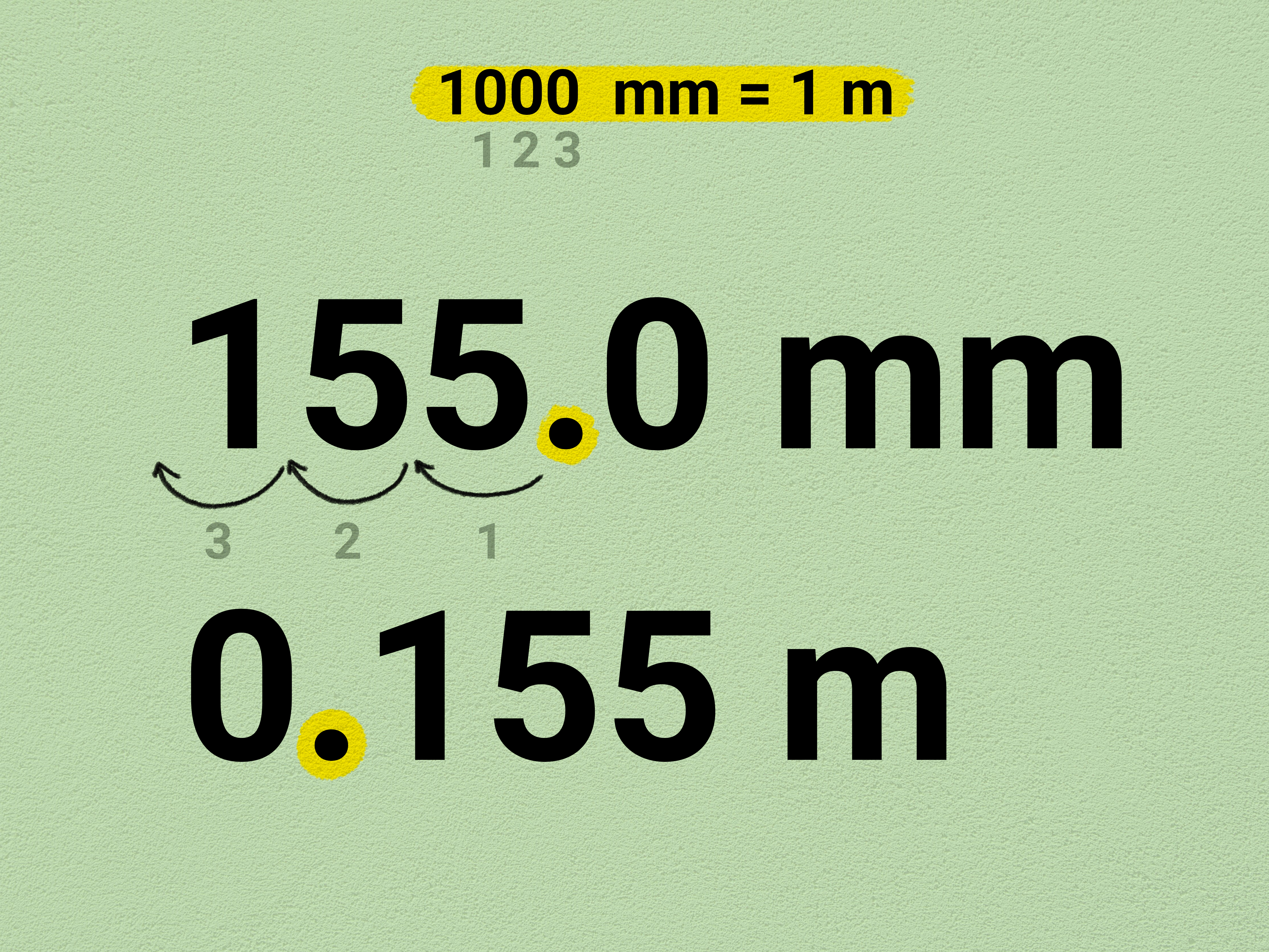
Step 4: Move the Decimal Point Three Places to the Right
If you want a faster mental math trick, move the decimal point three places to the right. This works because multiplying by 1,000 is the same as shifting the decimal three places.
For example:
- 1.5 m becomes 1,500 mm
- 0.8 m becomes 800 mm
- 3.125 m becomes 3,125 mm
- 0.045 m becomes 45 mm
When there are not enough digits, add zeros. For example, 0.7 meters becomes 700 millimeters. The decimal point in 0.7 moves three places right: 0.7 → 7.0 → 70 → 700.
This trick is especially useful when you are working without a calculator. Just remember: meters to millimeters means moving toward a smaller unit, so the number gets larger.
Step 5: Write the Correct Unit Symbol: mm
After calculating the number, write the answer in millimeters using the symbol “mm.” Unit symbols matter because 500 m and 500 mm are wildly different. One is about the length of five football fields. The other is half a meter. That is not a small typo; that is a measurement disaster wearing a fake mustache.
Correct example:
0.5 m = 500 mm
Incorrect example:
0.5 m = 500 m
Always label the final answer. In schoolwork, engineering notes, product descriptions, and DIY plans, the number alone is not enough. A measurement without a unit is like a recipe that says “add 3.” Three what? Cups? Teaspoons? Pumpkins? Chaos.
Step 6: Check Your Answer With Estimation
After converting, take a moment to estimate whether the answer makes sense. This is the simplest way to catch errors. If you convert 2 meters and get 20 millimeters, something has gone wrong. Two meters is taller than many children and some ambitious houseplants. Twenty millimeters is about the width of a small coin. Those are not close.
A good rule is this: when converting from meters to millimeters, your number should become 1,000 times larger. The physical length does not change, only the unit used to describe it.
Example:
- Original: 2 m
- Converted: 2,000 mm
- Check: Since millimeters are much smaller than meters, it makes sense that the number is much larger.
Estimation is especially helpful when working with decimals. For example, 0.03 meters should become a small number of millimeters, not thousands. The correct answer is 30 mm.
Step 7: Practice With Real-World Examples
The best way to remember how to convert meters to millimeters is to practice with measurements you can picture. Real-world examples help your brain connect the numbers to actual objects instead of floating math fog.
Example 1: A table is 1.8 meters long.
1.8 × 1,000 = 1,800 mm
The table is 1,800 millimeters long.
Example 2: A garden path is 4.25 meters wide.
4.25 × 1,000 = 4,250 mm
The garden path is 4,250 millimeters wide.
Example 3: A metal rod is 0.35 meters long.
0.35 × 1,000 = 350 mm
The rod is 350 millimeters long.
Example 4: A wall panel is 2.05 meters high.
2.05 × 1,000 = 2,050 mm
The wall panel is 2,050 millimeters high.
Once you practice a few times, the conversion becomes automatic. You will see meters and instantly think, “Multiply by 1,000.” Congratulations: your inner metric calculator has entered the chat.
Quick Conversion Chart: Meters to Millimeters
| Meters | Millimeters |
|---|---|
| 0.001 m | 1 mm |
| 0.01 m | 10 mm |
| 0.1 m | 100 mm |
| 0.5 m | 500 mm |
| 1 m | 1,000 mm |
| 2 m | 2,000 mm |
| 5 m | 5,000 mm |
| 10 m | 10,000 mm |
Common Mistakes When Converting Meters to Millimeters
Mistake 1: Dividing Instead of Multiplying
The most common mistake is dividing by 1,000 instead of multiplying. Remember, meters are larger than millimeters. When you convert to a smaller unit, you need more of those smaller units to cover the same length. That means the number increases.
Wrong: 3 m ÷ 1,000 = 0.003 mm
Right: 3 m × 1,000 = 3,000 mm
Mistake 2: Moving the Decimal the Wrong Way
Moving the decimal point left converts millimeters to meters. Moving it right converts meters to millimeters. If you are going from m to mm, move right three places.
Example: 1.25 m = 1,250 mm
Mistake 3: Forgetting Zeros
Zeros are small, quiet, and easy to ignore, but they are extremely important. For example, 0.04 m is not 4 mm; it is 40 mm. When shifting the decimal, add zeros as placeholders.
Mistake 4: Mixing Up mm and cm
Centimeters and millimeters often appear together, so it is easy to confuse them. One meter equals 100 centimeters, but one meter equals 1,000 millimeters. If you multiply by 100, you are converting meters to centimeters, not millimeters.
How to Convert Millimeters Back to Meters
Sometimes you need to reverse the process. To convert millimeters to meters, divide by 1,000.
meters = millimeters ÷ 1,000
Examples:
- 1,000 mm = 1 m
- 500 mm = 0.5 m
- 2,750 mm = 2.75 m
- 45 mm = 0.045 m
This is useful when product dimensions are listed in millimeters but your project plan uses meters. Furniture, hardware, electronics, construction materials, and manufacturing parts often use millimeters because they allow for more precise measurements.
Why Millimeters Are Useful for Precision
Millimeters are excellent when small differences matter. A cabinet gap of 5 mm may be noticeable. A machine part that is 2 mm too wide might not fit. A phone case that is off by 3 mm can become a tiny plastic disappointment. In detailed work, millimeters provide a level of precision that meters cannot express conveniently.
Imagine saying a screw is 0.006 meters wide. Technically correct? Yes. Convenient? Absolutely not. Saying 6 mm is clearer, faster, and less likely to make everyone at the workbench silently question your life choices.
Simple Practice Problems
Try converting these before checking the answers:
- 7 m = ? mm
- 0.9 m = ? mm
- 12.4 m = ? mm
- 0.025 m = ? mm
- 3.333 m = ? mm
Answers:
- 7 m = 7,000 mm
- 0.9 m = 900 mm
- 12.4 m = 12,400 mm
- 0.025 m = 25 mm
- 3.333 m = 3,333 mm
Experience-Based Tips for Converting Meters to Millimeters
In real life, meter-to-millimeter conversions often show up when you least expect them. You may not wake up thinking, “Today feels like a great day to multiply by 1,000,” but then you order a shelf, read a product diagram, or help someone with homework, and suddenly the metric system is sitting at the kitchen table demanding attention.
One practical experience many people encounter is assembling furniture. Product listings may describe a desk as 1.4 meters wide, while the assembly instructions list parts in millimeters. At first, this feels like the manual is trying to be mysterious. But once you know that 1.4 meters equals 1,400 millimeters, the drawing becomes much easier to understand. You can compare the listed part sizes with your room measurements and avoid the classic mistake of buying furniture that technically fits but spiritually dominates the entire room.
Another common situation is home improvement. Suppose you measure a wall opening as 2.1 meters wide, but a panel supplier lists materials in millimeters. Converting 2.1 meters to 2,100 millimeters helps you speak the same measurement language as the supplier. This reduces confusion, especially when cuts need to be accurate. In DIY projects, a few millimeters can be the difference between “perfect fit” and “why is there a gap big enough for a cookie crumb civilization?”
Students also benefit from connecting conversions to physical objects. A meter stick contains 1,000 millimeters, but that number feels abstract until you look closely at a ruler. Seeing the tiny millimeter marks makes the relationship obvious. A meter is not magically different from millimeters; it is simply a larger unit made from many smaller units. When learners understand this, they stop memorizing blindly and start reasoning through the conversion.
In design and manufacturing, millimeters are often preferred because they communicate precision clearly. A product that is 0.032 meters thick sounds awkward, while 32 millimeters sounds clean and practical. This is why many technical drawings, product specifications, and hardware descriptions use millimeters even when the object itself may be large enough to measure in meters. The smaller unit gives more detail without forcing people to use long decimal numbers.
A useful habit is to write both versions during planning. For example, if a board is 1.8 m long, write “1.8 m = 1,800 mm” in your notes. This simple habit prevents mistakes later, especially if you switch between rough room measurements and precise material dimensions. It also helps when working with other people. One person may think in meters, another in millimeters, and writing both keeps everyone from entering the measurement confusion Olympics.
When checking your work, always ask whether the final number feels reasonable. A doorway might be about 2 meters tall, so in millimeters it should be about 2,000 mm. If your answer is 20 mm, that would be a doorway for a very ambitious ant. If your answer is 200,000 mm, that would be a doorway for a building-sized giraffe. Estimation gives you a quick reality check before you trust the final result.
The most important experience-based lesson is this: do not rush the unit label. Many errors happen not because the math is hard, but because the unit is forgotten, copied incorrectly, or mixed with another unit. Always finish the conversion by writing “mm.” That tiny label carries a lot of meaning.
Conclusion
Converting meters to millimeters is one of the simplest and most useful metric conversions. The rule is easy: multiply the number of meters by 1,000. You can also move the decimal point three places to the right. Since millimeters are smaller than meters, the converted number becomes larger, even though the actual length stays the same.
This conversion is helpful in school, science, construction, design, engineering, shopping, crafting, and everyday problem-solving. Once you understand the relationship between meters and millimeters, you can read measurements more confidently and avoid costly or comical mistakes. Whether you are measuring a table, cutting a board, reviewing a product specification, or helping with homework, the formula is always the same: meters × 1,000 = millimeters.
Note: This article is based on standard metric-system relationships and widely used educational measurement guidance, rewritten in original language for web publication.