

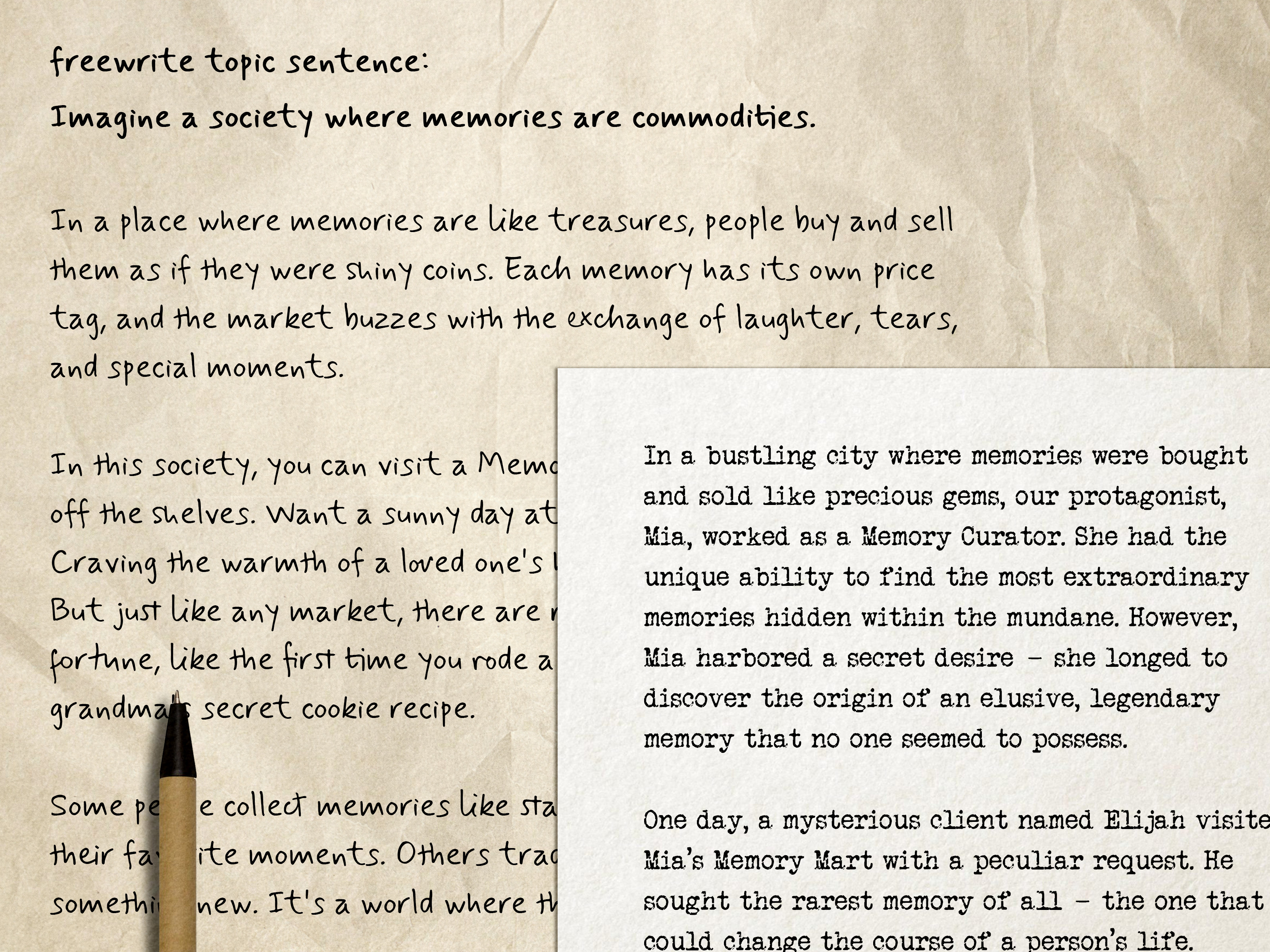
Freewriting is the writing equivalent of opening a messy closet, letting everything tumble out, and then calmly deciding what is actually worth keeping. It is simple, slightly chaotic, and surprisingly effective. Instead of staring at a blank page until it starts staring back, you write continuously for a set amount of time without stopping to edit, judge, organize, or polish.
The goal is not to produce a perfect paragraph. In fact, perfection is politely escorted out of the room before freewriting begins. The goal is to generate raw material: ideas, phrases, memories, examples, questions, jokes, complaints, half-sentences, and the occasional sentence so good you wonder who broke into your brain and wrote it.
Writers use freewriting to beat writer’s block, discover topics, warm up before drafting, think through confusing ideas, and develop a more natural writing voice. Students use it before essays. Bloggers use it before articles. Novelists use it before scenes. Professionals use it before emails, reports, proposals, speeches, and anything else that requires words to behave in public.
This guide explains how to freewrite in 13 practical steps, with examples, tips, and a few friendly warnings from the land of smudged notebooks and overconfident coffee mugs.
What Is Freewriting?
Freewriting is a prewriting technique where you write nonstop for a short period of time, usually five to twenty minutes. You do not pause to correct grammar. You do not delete sentences. You do not worry about structure. You keep your hand moving or your fingers typing, even if the only sentence you can produce is, “I have no idea what to write next.” Strangely enough, that sentence often opens the door to something better.
Unlike brainstorming, which often appears as a list of words or fragments, freewriting usually happens in sentences and paragraphs. Unlike outlining, it does not require a neat order. Unlike drafting, it is not supposed to look finished. Think of it as the dirt under the garden. It may not be pretty, but it is where the good stuff grows.
Why Freewriting Works
Freewriting works because it separates idea generation from editing. Most writers struggle when they try to invent, organize, and polish at the same time. That is like trying to cook dinner, wash the dishes, photograph the meal, and write a restaurant review while the pasta is still boiling. No wonder the brain panics.
By writing without stopping, you give your mind permission to move faster than your inner critic. The critic may still sit in the corner muttering, but freewriting does not hand it the microphone. This helps you uncover ideas that might never appear if every sentence had to pass inspection before reaching the page.
Freewriting also lowers the pressure of beginning. Starting is often the hardest part of writing because the first sentence feels too important. Freewriting solves that problem by making the first sentence intentionally unimportant. It can be clumsy. It can be boring. It can be the literary equivalent of sweatpants. Its job is simply to get you moving.
How to Freewrite: 13 Steps
1. Choose a Simple Purpose
Before you begin, decide why you are freewriting. Are you trying to find a topic? Explore an argument? Start a blog post? Understand a character? Warm up before a long writing session? Your purpose does not need to be fancy. In fact, the simpler it is, the better.
For example, instead of telling yourself, “I must produce a brilliant article introduction that will make readers gasp and share it with their aunt,” try: “I want to explore why freewriting helps people write.” That is enough direction to begin without turning the exercise into a high-stakes courtroom drama.
2. Pick a Prompt or Starting Point
A prompt gives your freewriting session a place to begin. It can be a question, a phrase, a memory, a problem, or a topic. If you are writing an essay, your prompt might be, “What do I really think about this subject?” If you are writing fiction, it might be, “What does my character want but refuse to admit?” If you are writing marketing copy, it might be, “What problem does this product actually solve?”
Useful freewriting prompts include:
- “The main thing I want to say is…”
- “I am stuck because…”
- “The reader needs to understand…”
- “The most surprising part of this topic is…”
- “I used to think this, but now I think…”
You can also start with no prompt at all, but a small prompt is like a flashlight in a dark garage. It does not clean the garage for you, but it helps you avoid stepping on a rake.
3. Set a Timer
Freewriting works best inside a clear time limit. Five minutes is great for beginners. Ten minutes is the classic sweet spot. Fifteen to twenty minutes can produce deeper insights once you are comfortable with the process.
The timer matters because it gives your brain a finish line. Without one, freewriting can feel endless, and endless tasks are where motivation goes to buy a one-way ticket out of town. A timer says, “You only have to keep going until the bell rings.” That small promise makes the exercise much easier to start.
4. Remove Obvious Distractions
You do not need a mountain cabin, a fountain pen, or a dramatic thunderstorm to freewrite. You do need a few minutes of reasonable focus. Silence your phone, close unnecessary tabs, and resist the urge to check one tiny notification that will somehow become a 27-minute tour through your inbox, weather app, and a video about raccoons opening refrigerators.
If you are writing by hand, choose a notebook or loose paper. If you are typing, open a blank document. Some writers prefer a plain text editor because formatting options are little traps wearing nice shoes. During freewriting, bold fonts and perfect headings can wait.
5. Start Writing Immediately
When the timer begins, write the first words that come to mind. Do not wait for the perfect opening. Do not clear your throat in your head for three minutes. Begin with something ordinary: “I am writing about freewriting, and I am not sure where to start.” That sentence may not win a literary prize, but it gets the engine running.
The key is motion. Once you start, momentum takes over. Many good ideas appear only after several dull sentences. The dull sentences are not failures; they are the warm-up lap. Nobody judges a runner for not sprinting while tying their shoes.
6. Do Not Stop Writing
The most important rule of freewriting is simple: keep writing. If you pause to think, write about the pause. If you run out of ideas, write, “I am out of ideas.” If your brain serves you a completely unrelated thought about laundry, write that too. The point is not to stay elegant. The point is to stay in motion.
This nonstop movement prevents your inner editor from taking control too early. The editor is useful later, but during freewriting it behaves like a nervous parent at a playground: “Careful! Not that sentence! Fix your comma! Is that idea academically respectable?” Thank it for its concern and keep going.
7. Ignore Grammar, Spelling, and Style
Freewriting is not the time to fix typos, adjust punctuation, or wonder whether your sentence needs a semicolon. A freewrite full of errors can still be successful if it reveals useful thinking. In fact, messy writing often contains more energy than careful writing because it has not been flattened by over-polishing.
Give yourself permission to write badly. This is not a moral failing. It is a method. Bad first words often lead to good later words. If every sentence had to be polished before the next one arrived, most writing would never get past the first paragraph.
8. Follow Strange Connections
During freewriting, your mind may jump from your topic to a memory, from a memory to a question, from a question to an example, and from that example to a sentence that suddenly feels important. Follow the trail. Freewriting is valuable precisely because it allows unexpected connections to appear.
Suppose you are freewriting about productivity and suddenly remember your grandmother labeling jars in her pantry. At first, that may seem irrelevant. But maybe the memory leads to a useful metaphor about organizing tasks. Maybe it reveals that productivity is really about reducing decision fatigue. Or maybe it is just about jam. Either way, let the thought finish before judging it.
9. Avoid Deleting or Crossing Out
Deleting turns freewriting into editing, and editing is a different job. When you delete, you interrupt the flow and invite judgment into the session. Instead of removing words, keep going. If you dislike a sentence, write the next sentence. If you change your mind, write, “Actually, I think the opposite might be true.”
This is especially helpful for writers who get stuck trying to make each sentence perfect. Freewriting teaches you that words are not rare diamonds. They are more like pancakes. The first one may look suspicious, but you keep making them and eventually breakfast improves.
10. Keep Your Freewriting Private at First
Freewriting works best when you know nobody has to see it. Privacy lowers the pressure. If you believe every sentence might be judged, graded, published, or quoted at a family dinner, you will naturally become cautious. Cautious writing has its place, but it rarely produces surprising ideas.
Treat your freewrite as a private workspace. Later, you can choose what to share. Most of it may stay hidden forever, and that is perfectly fine. A chef does not serve the onion peels, eggshells, and cutting board. The finished dish is what matters.
11. Read It After the Timer Ends
When the timer rings, stop writing. Take a short breath. Stretch your fingers. Tell your shoulders they can come down from your ears. Then read what you wrote with curiosity, not cruelty.
Look for anything useful: a strong phrase, an honest question, a possible thesis, a vivid example, a new angle, or a sentence that sounds more alive than the rest. You are not grading the freewrite. You are mining it. Even one good line can make the session worthwhile.
12. Highlight the Best Material
After reading, mark the parts that stand out. Highlight, underline, copy, or bold them. Look for what some writing teachers call a “center of gravity”: the sentence or idea that seems to pull energy toward itself. It might be the beginning of an argument, the heart of a scene, or the real topic hiding underneath the assigned topic.
For example, you might begin by freewriting about “healthy morning routines” and discover that your most interesting sentence is, “Most people do not need a perfect morning; they need a less chaotic one.” That sentence could become the main idea of an article, speech, or essay.
13. Loop Into a Second Freewrite
Looping means taking the best idea from one freewrite and using it as the starting point for another. This is where freewriting becomes especially powerful. The first round clears the mental clutter. The second round goes deeper. The third round may reveal the point you were trying to make all along.
To loop, copy your strongest sentence to the top of a new page and set the timer again. Then write nonstop about that sentence. Repeat the process until your idea becomes clearer, sharper, and more specific. This technique is excellent for essays, blog posts, personal narratives, speeches, and creative projects.
Freewriting Example
Here is a short example of what a freewrite might look like:
I want to write about why people avoid writing, and I think it is not because they have no ideas but because they expect the first version to be too good. That is strange because nobody expects the first sketch of a house to be the final house. Maybe writing is hard because the draft looks like proof of who we are, even though it is only proof that we started. I like that idea. A draft is evidence of starting, not evidence of talent. Maybe the article should say that freewriting gives writers a low-pressure way to start before fear gets organized.
This freewrite is not polished, but it contains several useful ideas. The strongest line may be: “A draft is evidence of starting, not evidence of talent.” That sentence could become a heading, an introduction, or the central message of a larger piece.
Common Freewriting Mistakes
Trying to Sound Smart
Freewriting is not a performance. If you try to sound brilliant, you may block the natural movement of thought. Write plainly first. You can add elegance later, assuming elegance is invited and does not arrive wearing too much cologne.
Stopping Too Soon
The first few minutes often feel awkward. That does not mean the exercise is failing. It means your brain is switching from “judge mode” to “generate mode.” Stay with it until the timer ends.
Editing During the Session
Fixing a typo may seem harmless, but it can break the flow. During freewriting, your job is to produce material. Editing comes later, wearing a different hat and possibly carrying a red pen.
Expecting Every Session to Produce Gold
Some freewrites produce great insights. Others produce complaints about being tired and a suspicious number of references to snacks. That is normal. Freewriting is a practice, not a vending machine.
Freewriting Prompts You Can Use Today
When you do not know where to begin, use one of these prompts:
- What am I really trying to say?
- What confuses me about this topic?
- What would I explain to a beginner?
- What is the most common mistake people make here?
- What story or example proves my point?
- What do I believe now that I did not believe before?
- What would make this topic useful, funny, or surprising?
For creative writing, try these:
- A character walks into a room and immediately wants to leave.
- The object on the table is not important, except it absolutely is.
- Someone tells the truth, but too late.
- The place looks familiar, but something is wrong.
How to Turn a Freewrite Into a Draft
A freewrite is raw material, not a finished product. After you highlight the best parts, ask three questions: What is the strongest idea? Who needs to read this? What shape should it take?
Then organize the useful pieces. A sentence may become your thesis. A story may become your introduction. A question may become a section heading. A messy paragraph may contain three separate ideas that deserve their own space. This is where the writing process shifts from discovery to structure.
For a blog post, pull out the strongest angle and build a reader-friendly outline. For an essay, identify your claim and supporting points. For fiction, look for tension, desire, and conflict. For professional writing, search for the clearest message and the reader’s most urgent need.
Freewriting by Hand vs. Typing
Both methods work. Writing by hand can slow you down in a useful way, making the process feel more reflective and personal. Typing can help you capture thoughts quickly, especially if your brain moves like a squirrel on espresso.
Try both. If typing tempts you to delete and edit, use pen and paper. If handwriting makes your hand cramp after three heroic sentences, type. The best method is the one that helps you keep going.
How Often Should You Freewrite?
You can freewrite daily, weekly, or whenever you feel stuck. A ten-minute daily freewriting habit can improve fluency, confidence, and idea generation over time. But you do not need to turn it into a dramatic lifestyle brand. No special candle required.
Use freewriting before difficult writing tasks, after reading research, when planning a project, or when you sense that your ideas are tangled. It is also a useful warm-up before serious drafting, much like stretching before exercise, except with fewer lunges and more questionable punctuation.
Freewriting for Students
Students can use freewriting to understand assignments, develop essay topics, and move past the fear of the blank page. Before outlining an essay, freewrite about what you already know, what you still need to learn, and what question interests you most.
After reading a source, freewrite in your own words about the main idea. This helps you process information instead of merely copying phrases. It can also reveal gaps in understanding, which is useful because it is better to discover confusion before the night a paper is due and your laptop starts making judgmental fan noises.
Freewriting for Bloggers and Content Creators
Bloggers can use freewriting to find fresh angles in familiar topics. Many articles fail because they begin with the same obvious points everyone else has already made. Freewriting helps you move past the obvious and reach the more specific, useful, human version of the idea.
For example, if your topic is “how to save money,” your first thoughts may be predictable: budget, cut expenses, avoid debt. But after ten minutes of freewriting, you might discover a sharper angle: “People do not fail at budgeting because they are lazy; they fail because their budgets do not match their real lives.” That is a much more interesting article.
Freewriting for Creative Writers
Creative writers use freewriting to discover characters, scenes, settings, and emotional truths. If a scene feels flat, freewrite from a character’s point of view. If a plot feels stuck, freewrite about what each character is afraid to lose. If dialogue sounds wooden, freewrite the conversation without worrying about tags, punctuation, or whether anyone is making a dramatic entrance near a window.
Freewriting can also help writers access voice. Because the method encourages speed and honesty, it often produces sentences that sound more alive than carefully planned prose. You may not keep every line, but you may find the rhythm your story needs.
Personal Experiences and Practical Lessons From Freewriting
The first time many people try freewriting, they expect it to feel magical. They imagine the page filling with luminous thoughts, elegant metaphors, and sentences ready to be framed above a desk. What usually happens is more humble: a few awkward lines, a complaint about not knowing what to write, and a sudden awareness that the chair is uncomfortable. This is not failure. This is the doorway.
One of the most useful experiences with freewriting is learning that resistance often disappears after movement begins. Before writing, the task may feel enormous. The mind says, “This article is too complicated,” or “This essay needs a perfect argument,” or “This chapter has too many problems.” But after three minutes of freewriting, the problem becomes smaller. Not solved, necessarily, but smaller. You can see one thought, then another, then a possible next step. The monster under the bed turns out to be a laundry pile with ambition.
Another practical lesson is that freewriting reveals what you actually think. Many writers begin with a borrowed opinion, a vague assumption, or a safe idea. After writing nonstop, they often discover a more honest position underneath. For example, someone freewriting about productivity may begin with tips about schedules and apps, then realize they are more interested in guilt, attention, and unrealistic expectations. That discovery can turn a generic piece into a meaningful one.
Freewriting also teaches patience with messy beginnings. A polished article, story, or essay can make writing look smooth from the outside. Readers do not see the false starts, abandoned paragraphs, strange notes, or sentences that were clearly written by someone who needed lunch. Freewriting normalizes that mess. It reminds you that rough language is not the enemy. Rough language is the material you shape.
In professional writing, freewriting is especially helpful when the topic feels boring. A report, proposal, or email may seem dry at first, but a short freewrite can uncover the human purpose behind it. Who needs this information? What decision does it support? What confusion does it solve? What would happen if the reader misunderstood it? Suddenly the writing has a job to do, and the writer has a reason to care.
In creative work, freewriting often produces surprises. A character may say something unexpected. A setting may gain a detail that changes the mood. A scene may reveal that the real conflict is not the argument happening on the page but the silence underneath it. These discoveries are hard to plan because they emerge through motion. You write your way into them.
The most important experience is this: freewriting builds trust. You learn that you do not need to feel ready before you begin. You do not need the whole structure. You do not need the perfect sentence. You only need a timer, a page, and the willingness to keep moving for a few minutes. Some sessions will be dull. Some will be useful. A few will feel like opening a window in a stuffy room. All of them train the same habit: start before you are certain.
Conclusion
Freewriting is one of the simplest and most reliable ways to begin writing when your thoughts feel tangled, shy, or temporarily out of office. By setting a timer, writing without stopping, ignoring mistakes, and reviewing your work afterward, you create a safe space for ideas to appear before judgment arrives with a clipboard.
The 13 steps are easy to practice: choose a purpose, pick a prompt, set a timer, remove distractions, start immediately, keep writing, ignore grammar, follow strange connections, avoid deleting, keep it private, read afterward, highlight the best material, and loop into another session. Together, these steps turn freewriting from a random exercise into a practical writing tool.
Whether you are writing an essay, blog post, novel, speech, journal entry, or business document, freewriting can help you find momentum. It will not make every sentence perfect, and it will not do the hard work of revision for you. But it will give you something far better than a blank page: a beginning. And sometimes, a beginning is exactly what the writer ordered.
Note: This HTML article is written as an original, publication-ready draft based on widely accepted writing-center guidance and practical writing-process methods.