

A dead car battery has a dramatic sense of timing. It never quits in your driveway on a sunny Saturday when you have nowhere to be. No, it waits until you are late for work, leaving the grocery store with ice cream, or standing in a parking lot wondering whether your car has decided to become modern sculpture.
The good news is that learning how to jumpstart a car battery with jumper cables is one of the most useful driving skills you can have. The better news? It is not complicated when done correctly. The important word is “correctly,” because car batteries may look harmless, but they store enough electrical energy to create sparks, damage electronics, or make your day much worse if you connect things in the wrong order.
This guide walks you through the safe, practical way to use jumper cables, what to check before connecting anything, which clamp goes where, what to do after the engine starts, and when to stop pretending you are a roadside mechanic and call a professional.
What You Need Before Jumpstarting a Car
Before you start waving jumper cables around like spaghetti with metal teeth, make sure you have the right setup. You need a vehicle with a charged battery, a vehicle with the dead battery, a set of jumper cables in good condition, and enough space to park the two vehicles close enough for the cables to reach without the cars touching.
Most gasoline-powered passenger vehicles use a 12-volt battery system. That matters because you should only jumpstart a car using a compatible battery voltage. If you are dealing with a hybrid, electric vehicle, diesel truck, older classic car, or luxury vehicle with special jump terminals, check the owner’s manual first. Some vehicles have remote positive and negative jump points under the hood even when the battery is in the trunk, under a seat, or buried somewhere only engineers and raccoons can reach.
Use the Right Jumper Cables
Cheap, thin jumper cables can work in mild situations, but they may struggle with larger engines or cold weather. A heavier-duty set is a smart investment. Look for cables that are long enough to reach comfortably, have sturdy insulated clamps, and are not cracked, melted, corroded, or frayed. If the cables look like they survived a pirate shipwreck, retire them.
Safety Gear Helps
Safety glasses and gloves are a good idea. Car batteries can vent hydrogen gas, and sparks near a battery are not something you want near your face. You do not need a full astronaut suit, but protecting your eyes and hands is sensible.
When You Should Not Jumpstart a Car
Do not jumpstart a battery that is cracked, leaking, swollen, frozen, extremely hot, or giving off a rotten-egg smell. That odor can indicate battery gas or overcharging, and sparks around that situation are bad news. Also avoid jumpstarting if you see major corrosion, damaged cables, loose terminals, smoke, or signs of electrical burning.
If the vehicle was recently in a crash, exposed to flooding, or has unknown electrical damage, call roadside assistance. The same goes if you are unsure where the battery terminals or jump points are. Confidence is great; guessing around electricity is not.
Step-by-Step: How to Jumpstart a Car Battery With Jumper Cables
The safest jumpstart method follows a specific connection order. The goal is to move power from the good battery to the dead battery while reducing the chance of sparks near the dead battery.
Step 1: Park Both Vehicles Safely
Park the vehicle with the working battery close to the vehicle with the dead battery. The cars should be close enough that the jumper cables can reach, but they should not touch. Put both vehicles in Park if they have automatic transmissions, or Neutral if they have manual transmissions. Set the parking brakes on both vehicles.
Turn off both ignitions. Switch off headlights, interior lights, the radio, air conditioning, heated seats, phone chargers, windshield wipers, and every other electrical accessory. Your battery needs help, not a concert and climate-control party.
Step 2: Find the Positive and Negative Terminals
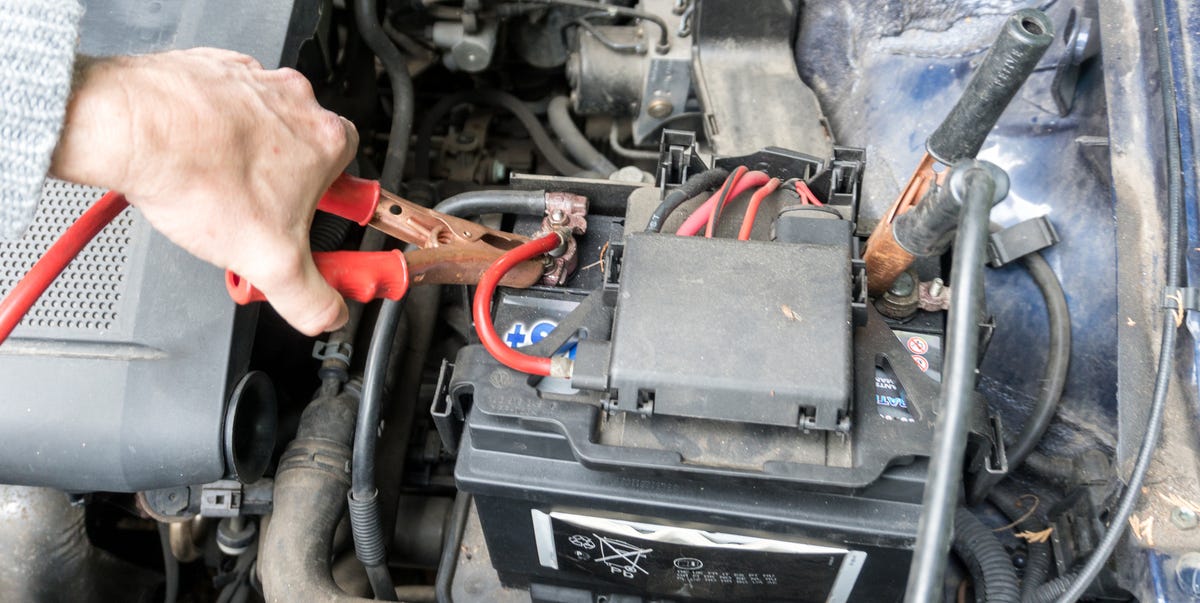
Open both hoods and locate the batteries or designated jumpstart points. The positive terminal is usually marked with a plus sign (+) and often has a red cover or red cable. The negative terminal is marked with a minus sign (-) and is usually connected to a black cable.
If the battery terminals are hidden, do not start disassembling mystery parts. Check the owner’s manual for approved jump points. Many modern vehicles provide a clearly marked positive post and a grounding point under the hood.
Step 3: Connect the First Red Clamp to the Dead Battery
Attach one red positive clamp to the positive (+) terminal on the dead battery. Make sure the clamp grips firmly onto clean metal. If it wiggles loosely, the connection may fail.
Step 4: Connect the Second Red Clamp to the Good Battery
Attach the other red positive clamp to the positive (+) terminal on the charged battery. At this point, keep the loose black clamps away from each other and away from metal parts. Never let the positive and negative clamps touch while connected to a battery.
Step 5: Connect the First Black Clamp to the Good Battery
Attach one black negative clamp to the negative (-) terminal on the good battery. Again, make sure the connection is secure.
Step 6: Connect the Final Black Clamp to a Ground on the Dead Vehicle
Attach the final black negative clamp to an unpainted metal surface on the vehicle with the dead battery. Good grounding points include a clean metal bracket, bolt, or engine block area away from the battery, fuel lines, belts, fans, and moving parts.
This final connection should not go directly to the negative terminal of the dead battery unless your vehicle’s owner’s manual specifically instructs you to do so. Connecting to a ground away from the battery helps reduce the risk of sparks near battery gases.
Starting the Vehicles
Once all four clamps are connected in the correct order, start the vehicle with the good battery. Let it run for a few minutes. This gives the dead battery a little time to receive power.
Next, try starting the vehicle with the dead battery. If it starts, excellent. You have officially defeated the parking-lot gremlin. Let both vehicles run for a short time before disconnecting the cables.
If the dead vehicle does not start, wait a few more minutes and try again. Do not crank the engine for long periods. Short attempts are safer for the starter and electrical system. If the vehicle still will not start after a few tries, stop. The problem may be a severely discharged battery, bad starter, faulty alternator, corroded terminal, blown fuse, or another issue that jumper cables cannot fix.
How to Remove Jumper Cables Safely
Disconnect the jumper cables in the reverse order of connection. This keeps the process controlled and reduces the chance of accidental sparks.
- Remove the black clamp from the grounded metal point on the vehicle that was dead.
- Remove the black clamp from the negative terminal of the good battery.
- Remove the red clamp from the positive terminal of the good battery.
- Remove the red clamp from the positive terminal of the battery that was dead.
As you remove each clamp, keep it from touching the other clamps, battery terminals, or random metal parts. Jumper cables are useful tools, not medieval nunchucks.
What to Do After the Car Starts
After a successful jumpstart, keep the revived vehicle running. Driving for at least 20 to 30 minutes can help the alternator begin recharging the battery. Highway driving is better than idling because the charging system can work more efficiently under normal driving conditions.
However, a jumpstart is not the same as fully charging or repairing a battery. If the battery died because you left the headlights on overnight, a good drive may be enough. If the battery is old, weak, or failing, the car may start now and betray you again tomorrow morning with the same lifeless click.
Have the battery and charging system tested soon, especially if the battery is more than three years old, the car cranks slowly, the dashboard battery light appears, or you have needed multiple jumpstarts. A healthy battery should hold a charge. If it cannot, replacing it is usually cheaper than repeatedly begging strangers for electrical mercy.
Common Mistakes to Avoid
Connecting the Clamps in the Wrong Order
The proper order matters: red to dead positive, red to good positive, black to good negative, black to grounded metal on the dead vehicle. Reversing polarity can damage electrical components and create dangerous sparks.
Letting the Cars Touch
The vehicles should be close, not cuddling. If the metal bodies touch, you increase the risk of unintended electrical pathways.
Jumpstarting a Damaged Battery
A leaking, cracked, frozen, swollen, or overheated battery is not a jumpstart candidate. It is a “step away and call a professional” candidate.
Ignoring the Owner’s Manual
Modern vehicles are packed with sensitive electronics. Hybrids, EVs, luxury vehicles, and cars with batteries in unusual locations may require special jumpstart procedures. The owner’s manual is not thrilling literature, but in this case, it is more useful than guessing.
Driving Away Without Testing the Battery
If your vehicle needed a jump because the battery is weak, you have only solved the symptom. Testing the battery, alternator, and terminals helps prevent the sequel nobody asked for: “Dead Battery 2: The Grocery Store Strikes Back.”
Why Car Batteries Die in the First Place
A battery may die for many reasons. The most common include leaving lights on, extreme heat or cold, short trips that do not allow the alternator to recharge the battery, dirty or loose terminals, an aging battery, a parasitic electrical drain, or a failing alternator.
Cold weather makes engine oil thicker and reduces battery output, which is why many drivers discover battery problems on winter mornings. Heat can be just as destructive because it accelerates internal battery wear. In other words, batteries are dramatic in both summer and winter. They are equal-opportunity complainers.
Jumper Cables vs. Portable Jump Starters
Jumper cables are reliable, affordable, and simple, but they require another vehicle. A portable jump starter, also called a jump box or battery booster, can start a car without a second vehicle. Many modern jump starters include safety features that warn against reverse connections, plus extras like flashlights and USB charging ports.
That said, jumper cables are still worth keeping in your emergency kit. They do not need to be charged, they are easy to store, and they can help you or another driver when a battery quits at the worst possible moment.
What to Keep in Your Car Emergency Kit
A basic car emergency kit should include quality jumper cables, gloves, safety glasses, a flashlight, reflective triangles or road flares, a tire pressure gauge, a phone charger, a first-aid kit, water, and a blanket in colder climates. If you often drive alone or travel through remote areas, a portable jump starter is also a smart upgrade.
Keep the jumper cables somewhere easy to access. If they are buried under six beach chairs, three reusable grocery bags, and a mysterious hoodie from 2019, you may regret your trunk organization strategy.
Real-World Experience: What Jumpstarting a Car Teaches You
Anyone who has jumpstarted a car in real life knows the process feels much more serious when you are actually standing in front of two open hoods. On paper, it is four clamps and a few steps. In a parking lot at night, with wind trying to fold your hood into a taco and someone saying, “Are you sure that goes there?” it suddenly feels like a final exam in electrical engineering.
The first practical lesson is to slow down. Most mistakes happen because people rush. They grab the cables, connect whatever clamp looks closest, and hope the car magically forgives them. A better approach is to pause, identify the positive and negative terminals, check the battery condition, and say the connection order out loud if needed. Red to dead. Red to good. Black to good. Black to ground. It may sound silly, but silly is better than sparks.
The second lesson is that clean connections matter. A battery terminal covered in crusty corrosion may not transfer power well. If the clamp cannot bite onto clean metal, the jump may fail even if everything else is correct. In real-world situations, people often think the battery is completely dead when the actual problem is a poor connection. A gentle wiggle of the clamp can sometimes make the difference, but do not yank or force anything.
The third lesson is that not every no-start problem is a battery problem. If the engine cranks strongly but will not start, fuel, ignition, or sensor issues may be involved. If you hear a single click, the battery may be weak, but the starter or cable connections could also be suspect. If nothing happens at all, the battery may be deeply discharged, or there may be another electrical fault. Jumper cables are helpful, but they are not magic wands with copper teeth.
The fourth lesson is social: most people are happy to help, but not everyone knows how to jumpstart a car safely. If someone offers their vehicle, explain the steps calmly and make sure both of you agree before connecting cables. It is better to sound careful than to look confident while doing something expensive.
The fifth lesson is preparation. Once you have experienced a dead battery, you understand why experienced drivers keep jumper cables in the vehicle. A dead battery turns a normal errand into an unexpected roadside seminar. Having the right tools turns panic into a manageable inconvenience. Add a flashlight, gloves, and a portable jump starter, and you become the calm person in the parking lot instead of the person staring at the dashboard like it owes you an apology.
Finally, a jumpstart should remind you to investigate the cause. If you left the dome light on, fine, lesson learned. If the battery is old or the car needs frequent jumps, do not ignore it. Batteries rarely improve through positive thinking. Test it, charge it properly, clean the terminals, or replace it before it strands you again. Your future self, probably holding groceries, will be grateful.
Conclusion
Knowing how to jumpstart a car battery with jumper cables is a simple skill that can save time, money, and stress. The safest method is to inspect the battery first, park both vehicles correctly, turn everything off, connect the cables in the proper order, start the working vehicle, start the dead vehicle, and remove the cables in reverse order.
The golden rule is to be careful, not heroic. Never jumpstart a damaged or suspicious battery, never let clamps touch, and always check the owner’s manual when the vehicle has special jump points or advanced electronics. Once the car starts, drive long enough to help recharge the battery and get the battery tested if the problem repeats.
A dead battery may be annoying, but with good jumper cables and a calm step-by-step approach, it does not have to ruin your day. It just becomes a small roadside adventure, preferably one you only have to star in once.
Note: This original article was written for web publication and synthesized from reputable U.S. automotive, battery, roadside-assistance, manufacturer, and consumer-safety guidance. Always follow the specific instructions in your vehicle owner’s manual.