

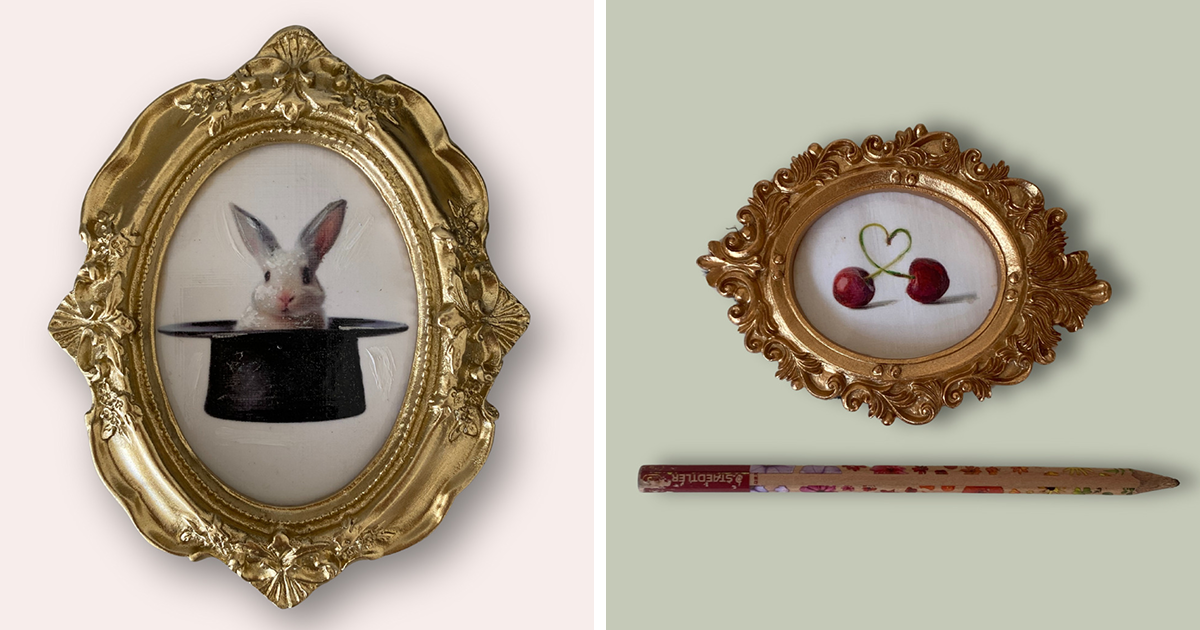
Some people collect big art with big price tags and big attitudes. I collect tiny art with tiny frames and
tiny dramabecause nothing says “masterpiece” like a landscape you could accidentally misplace in your hoodie pocket.
These are miniature framed paintings designed to fit in the palm of your hand. They’re not sketches pretending to be
finished (we’ve all met that guy). They’re fully composed, fully painted, carefully framed worksjust scaled down
until your eyes have to lean in like they’re listening to gossip.
If you’ve ever looked at a dollhouse room or a perfectly scaled miniature object and felt your brain go,
“Wait… why is this so satisfying?”welcome. Tiny art has that effect. It turns everyday scenes into little treasures,
and it makes viewers slow down long enough to notice brushwork, color choices, and those itty-bitty highlights that
should honestly qualify for a tax credit.
Why Palm-Size Paintings Feel Weirdly Magical
Miniature art creates a “lean-in” moment. Large paintings can overwhelm a room; miniature paintings invite attention.
They’re approachable. They’re intimate. They’re also a sneaky way to get people to stop doom-scrolling and start
actually looking.
There’s also something timeless about small-scale craftsmanship. Museums and miniature exhibitions celebrate
fine-scale work because the skill is unmistakable: the smaller the canvas, the fewer shortcuts you can hide behind.
Every decision showscomposition, edges, color temperature, and whether your “straight” line is secretly doing the
Macarena.
And yes, scale matters. Fine-scale miniatures are often created in proportional formats (like classic 1:12 scale in
the miniature world), which is part of what makes them feel coherent and “real,” even when they’re tiny enough to
ride on a postage stamp like it’s public transit.
The Tiny Toolkit: What Miniature Painting Actually Takes
1) Surfaces That Don’t Fight Back
The surface is everything when you work small. Texture that feels “pleasant” on a normal canvas can look like a
gravel driveway in miniature. I prefer smooth or semi-smooth surfaces such as hot-press watercolor paper, high-quality
illustration board, or properly primed panels. The goal is crisp lines and clean transitionswithout the paper’s tooth
turning your detail brush into a tiny broom.
2) Paint That Behaves at Micro-Scale
Mini paintings love paint that stays opaque, controllable, and consistent. Traditional gouache is gorgeousmatte,
velvety, and punchybut it can be sensitive once dry. That’s where acrylic gouache and matte acrylics shine for small
framed pieces: they can give you that flat, graphic look while drying into a more durable film.
For miniature work, matte finishes are a secret weapon. Gloss can bounce light and hide your value shifts, while matte
makes the painting read clearly in tiny formatespecially under bright photography lights.
3) Brushes: Small, But Not Fragile
Everyone thinks “I need the tiniest brush on Earth.” Sometimes you do. But often you need a brush with a
reliable point more than you need a microscopic size. A high-quality round that snaps back, a liner for
controlled strokes, and a couple of miniature/detail brushes will cover most needs.
Also: brush care isn’t optional when your whole painting depends on a single hair behaving itself. Rinse often, reshape
the tip, and store them like they’re tiny divasbecause they are.
4) Lighting and Magnification (A.K.A. “Let Me See My Own Mistakes”)
A bright desk lamp with diffused light is a game-changer. Magnification helps toowhether it’s a simple clip-on
magnifier, reading glasses, or a headset lens. The goal isn’t to paint under a microscope; it’s to reduce eye strain
and improve precision so your highlights don’t turn into accidental confetti.
How I Build a Miniature Painting From Start to Finish
Step 1: Thumbnail First, Ego Later
When you paint small, composition has to work immediately. I sketch a thumbnail that’s barely bigger than a couple of
postage stamps. If the scene reads at that size, it will sing in the finished piece.
Step 2: A Light Drawing That Won’t Haunt Me
I keep the drawing simple: big shapes, horizon lines, key silhouettes. Over-drawing is the fast lane to muddy
micro-details. The fewer graphite lines I have to fight later, the happier the painting will be.
Step 3: Block In Values Like a Tiny Architect
Tiny paintings still need structure. I block in the main value shapessky, ground, shadow masses, the general “light
direction.” This is where the painting becomes readable. If the values are strong, detail becomes a bonus, not a
rescue mission.
Step 4: Color Temperature and Edge Control
In miniature work, edges do a lot of storytelling. Soft edges create atmosphere; crisp edges pull focus. I choose
where the viewer should look and sharpen edges there. Everywhere else gets gentler transitions so the scene feels
deep, not cluttered.
Step 5: Details (But the Useful Kind)
Miniature detail isn’t about painting every leaf. It’s about painting the idea of leavesclusters, light
patterns, and a few strategic accents. I aim for “convincing at arm’s length,” and “delightful up close.” That’s the
sweet spot.
Step 6: Dry Time, Flattening, and Surface Protection
Small paper pieces can warp if you soak them. I work in controlled layers and let them dry fully. If needed, I press
them flat between clean sheets under weight once dry. For acrylic-based pieces, a suitable protective layer may be
used depending on the final look I wantespecially because these are framed works meant to be handled and displayed.
Framing Tiny Paintings Like They’re Museum Pieces
The frame isn’t just decorationit’s protection. Tiny art is still art on paper, which means it can be affected by
light, humidity, and poor-quality materials. I treat every miniature like it’s going into a collection, even if it’s
headed to someone’s bookshelf next to a candle that’s doing its best.
What I Look For in a Mini Frame Setup
- Archival matting/backing: acid-free, stable materials that won’t discolor the art over time.
- Safe attachment methods: photo corners or proper hinging methods instead of aggressive adhesives.
- Space from the glazing: the artwork shouldn’t touch glass/acrylic; a window mat or spacers help.
- UV protection: helpful for slowing fading, especially for pieces displayed in brighter rooms.
- Smart placement: away from direct sunlight, vents, and temperature swings.
Miniature art communities and exhibitions often have size and framing standards (including maximum image area and
framed dimensions). Even when I’m not submitting to a show, those standards are a helpful reminder: small art still
deserves professional presentation.
How I Photograph Mini Paintings So They Look Great Online
Tiny art is adorable in real lifeand weirdly tricky on camera. Phones can do a great job if you help them out.
My go-to photo setup
- Soft, even light: bright window light or diffused lamps to avoid harsh glare on glazing.
- One “scale” shot: the painting in my palm (because the internet loves proof).
- One straight-on shot: for color accuracy and clean viewing.
- One angled shot: to show texture and the frame profile.
- Close-up detail crop: for brushwork, tiny highlights, and “how is that even possible?” moments.
If you’re publishing these on the web, descriptive image filenames and natural alt text help accessibility and SEO.
(Think: “miniature-framed-painting-sunset-lake.jpg” instead of “IMG_4927.jpg.”)
The 31 Pics Gallery: Palm-Size Paintings, Big Personality
Below are 31 image placeholders with ready-to-use caption ideas and SEO-friendly alt text. Swap in your real images
and keep the structure. Each piece is designed to feel like a complete worldjust compact enough to fit in your hand.
-

01. “Sunset Pocket” A lake scene that looks like it’s whispering, not shouting. -

02. “Cabin in a Thumbprint” Cozy lighting, tiny snowfall, maximum serotonin. -

03. “Lemon, Actually” Still life, but make it snack-sized. -

04. “Night Lights” Tiny bokeh that took suspiciously non-tiny patience. -

05. “Wave Study” Seafoam is basically lace, and I chose chaos. -

06. “Hovercraft” A hummingbird, frozen in time, powered by pure caffeine energy. -

07. “Desert Blush” Proof the desert can be soft (emotionally, not physically). -

08. “Spines & Stories” The smallest library you’ll ever need. -

09. “Goodest Boy, Mini Edition” Fur texture at this scale is a lifestyle choice. -

10. “Rain on Glass” Because painting droplets is normal and healthy. -

11. “Cherry Pop” Highlights so small they practically squeak. -

12. “Morning Layers” Atmospheric perspective, now in travel size. -

13. “Jar of July” A bouquet that won’t wilt (or demand water). -

14. “Supervisor” Every artist has one. Mine has whiskers. -

15. “Neon Nostalgia” Tiny typography, big attitude. -

16. “Tiny Fuel” A still life tribute to survival. -

17. “Keep Watch” Ocean spray, but make it polite and framed. -

18. “Parked” A whole story in one quiet corner. -

19. “Wing Study” Micro patterns that made my eyes negotiate with me. -

20. “Comfort in a Frame” The tiniest meal you can’t eat. -

21. “Barn Song” Americana vibes, palm-size delivery. -

22. “Forest Snacks (Do Not Consume)” Nature is cute and also suspicious. -

23. “Tulip Chorus” Petals: soft, but with boundaries. -

24. “Pocket Sky” A whole galaxy that fits next to your keys. -

25. “Weekend Stack” Breakfast, but make it collectible. -

26. “Koi Drift” Ripples are just tiny lies told convincingly. -

27. “Quiet Portrait” A face in miniature still deserves dignity (and good lighting). -

28. “October Path” Tiny crunchiness implied. -

29. “Beach in a Bottle” Souvenir energy, no luggage required. -

30. “Greenhouse Glow” Reflections, plants, and tiny geometry doing the most. -

31. “Cliff Notes” A big view, reduced to a small thrill.
Where These Mini Paintings Belong in Real Life
Miniature framed paintings are surprisingly versatile. They look great stacked on shelves, leaned on windowsills,
tucked into gallery walls as “tiny surprises,” or gifted like a secret handshake between art lovers.
- Gifts: Tiny art feels personallike you commissioned a whole universe, but politely.
- Gallery groupings: A grid of mini frames can look modern, playful, and intentional.
- Workspaces: A palm-size painting beside your monitor is a tiny mood reset.
- Miniature worlds: Dollhouse collectors love fine-scale art detailsmini paintings are the crown jewels.
Miniature Painting FAQs (The Questions People Actually Ask)
Do you paint these at “real” size or do you scale down?
Both. I start with tiny thumbnails and make composition decisions at scale. Sometimes I reference a larger sketch,
but the painting is built for miniature readability from the beginningvalues simplified, edges planned, details
carefully rationed like they’re the last snacks on a road trip.
How do you keep details from turning into a muddy blob?
I keep the palette controlled, let layers dry, and focus on value separation. Also, I don’t detail everything.
Selective detail is the difference between “wow, tiny!” and “what am I looking at, exactly?”
Is the framing really that important?
Yes. The frame is a protective housing, not just a fashion choice. Good materials and spacing help prevent long-term
damage and keep the art looking crispespecially when these pieces are meant to be handled, displayed, and
photographed.
My Miniature Painting Experiences (The Part Where I Tell the Truth)
The first time I tried painting miniature framed art, I thought, “How hard can it be? It’s just a smaller painting.”
That’s the kind of sentence the universe hears and immediately responds to with chaos.
My earliest mini piece was a simple sky-and-field landscape. In my head, it was going to look airy, effortless, and
poeticlike a tiny painting that casually belonged in a museum. In reality, I discovered that one brushstroke at
miniature scale can contain the emotional energy of a full-sized mistake. A line that would feel “thin” on a normal
canvas becomes a telephone pole in a tiny scene. A highlight meant for a cloud becomes a suspicious white comma that
refuses to leave.
But that’s also what makes miniature painting addictive. It forces you to slow down and become intentional. You can’t
rely on big, dramatic gestures to save you. You have to think in value shapes. You have to plan edges. You have to
decide what matters mostand let the rest fade into suggestion. That discipline, weirdly, makes my larger work better
too. Miniature painting is like strength training for your artistic decision-making, except the dumbbells are tiny and
also emotionally demanding.
The most satisfying moment is when the painting “clicks.” It usually happens late in the process, right after I’ve
questioned every life choice that brought me to this point. I’ll add a single crisp highlight on a window. Or a thin
dark line under an eave. Or a warm accent in the sky. Suddenly the piece goes from “small painting” to “tiny world.”
It gains depth. It gains atmosphere. It starts to feel like you could step into itif you were, you know, two inches
tall and not afraid of tiny weather.
Framing is its own adventure. Regular framing is already full of opinions; miniature framing is like regular framing
but with more tweezers. I’ve learned to treat the frame like part of the artwork’s personality. A clean black frame
can make a tiny painting feel modern and graphic. A warm wood frame can make it feel like a little heirloom you found
in an antique shop. A tiny mat can give the art breathing room so it doesn’t look crampedbecause yes, even small
paintings need personal space.
And then there’s the “palm shot,” the holy grail of proving scale online. Every time I photograph a finished piece in
my hand, I get that small rush of pridelike, “Look! I made a whole scene and it fits in my hand!” It’s the same
satisfaction you get from a perfectly organized drawer or a neatly frosted cupcake: small, contained excellence.
The funny part is how people react. Some viewers get quiet and lean in close, like they’re reading a secret. Others
laugh and say, “I’d lose that.” (Valid concern. I once set a finished mini frame down and immediately spent three
minutes looking for it on a table that was not even cluttered. Humbling.) And some people get genuinely emotional,
because tiny art can feel personal in a way big art sometimes doesn’t. It’s close. It’s intimate. It feels like it
was made for you, not just displayed at you.
If you’ve ever wanted to try miniature painting, my biggest advice is this: keep it simple at first. Pick a subject
with clear shapes. Focus on values. Let details be intentional, not automatic. And embrace the weird joy of making
something small that still feels complete. Because honestly? The world is loud. A tiny painting is a small, framed
reminder that quiet can be powerfulespecially when it fits in the palm of your hand.