

Note: This article is written in original American English and synthesized from reputable U.S. sources, including historical institutions, national archives, film-industry records, and current AI copyright guidance. Direct source links are intentionally not displayed for publication-ready use.
When History Looks Back at You
I did not set out to make “pretty” AI pictures about J. Robert Oppenheimer. Pretty felt too small for a story that begins with chalk dust, desert wind, wartime secrecy, and one of the most consequential scientific breakthroughs in modern history. The goal was to create images that felt like memory: dramatic, imperfect, symbolic, and slightly uncomfortable to stare at for too long.
The title, I Made The Pictures That Tell The Story Of Oppenheimer With AI, sounds playful at first, almost like a creative weekend project. But the more I worked on it, the more it became a visual essay about ambition, genius, guilt, government power, and the strange bargain humans make with technology. You ask a machine to create an image, and suddenly you are asking bigger questions: What should be shown? What should be left in shadow? Can art honor history without turning tragedy into wallpaper?
Oppenheimer’s life is already cinematic. Born in New York City in 1904, he became a brilliant theoretical physicist, studied in Europe, taught at Berkeley and Caltech, and then was pulled into the Manhattan Project during World War II. In 1943, he became the first director of the secret Los Alamos Laboratory in New Mexico, where scientists worked under intense pressure to design the first atomic bombs. That alone could fill a museum. It has, actually.
But AI image generation adds a modern twist. Instead of simply retelling Oppenheimer’s story in paragraphs, I wanted to build a gallery of emotional scenes: the scientist surrounded by equations, the hidden city of Los Alamos, the desert before dawn, the blinding moral shock of Trinity, and the cold political theater of his 1954 security hearing. The pictures became a way of asking what happens when human imagination meets machinestwice: once in the atomic age, and again in the AI age.
Why Oppenheimer Is Such a Powerful Subject for AI Art
Some historical figures resist visual interpretation. Oppenheimer practically invites it, then judges you for trying. He was elegant, intense, restless, and famously difficult to summarize. He was not merely “the father of the atomic bomb,” though that label follows him like a long shadow. He was a scientist, teacher, organizer, public intellectual, and later a warning sign about what can happen when science becomes entangled with war and politics.
That makes him ideal for AI storytelling because AI art works best when the prompt has tension. “A scientist in a room” is boring. “A theoretical physicist carrying the moral weight of a world-changing weapon while surrounded by equations, cigarette smoke, and wartime secrecy” gives the machine something to chew on. It is the difference between ordering toast and asking for a five-course meal prepared by a robot chef with dramatic lighting.
The visual language around Oppenheimer is also rich. There are chalkboards, desert landscapes, black suits, military files, lab equipment, coded documents, Los Alamos mesas, mushroom-cloud symbolism, hearing-room fluorescent gloom, and the lonely posture of a man who helped open a door that could never be closed again. AI image tools can combine these symbols quickly, but the human creator still has to decide what the image means.
Picture One: The Enigmatic Scientist
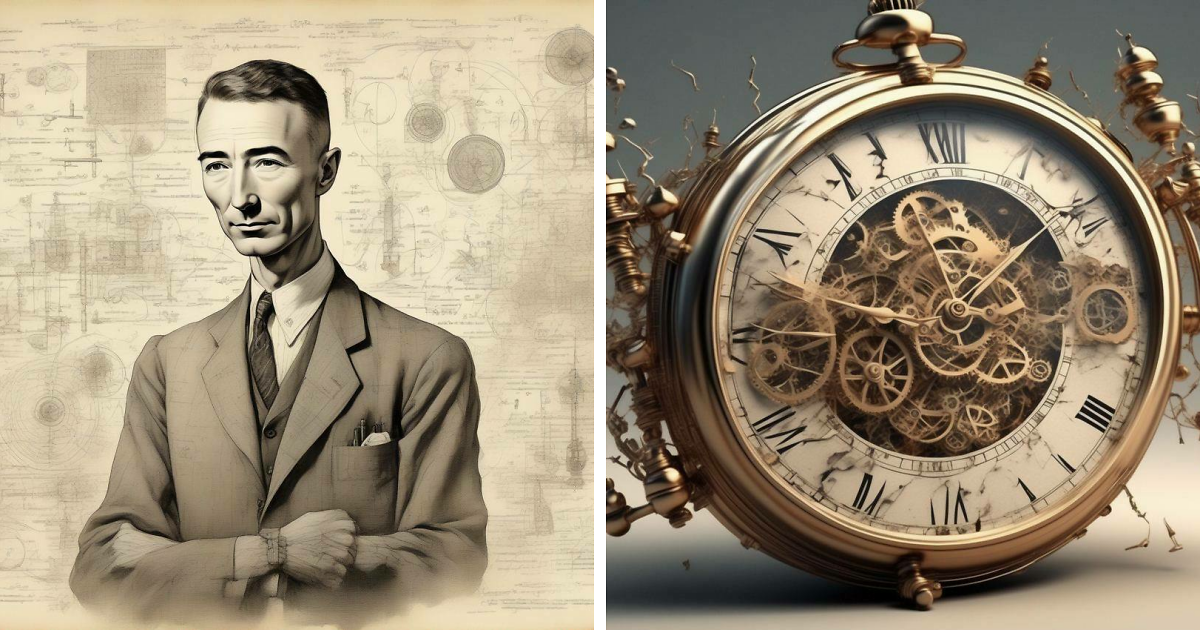
The first image I made showed Oppenheimer in his intellectual element: a narrow face, sharp eyes, a dark suit, and a chalkboard crowded with equations behind him. I wanted him to look brilliant but not triumphant. This was not a superhero poster. No cape, no glowing “science powers,” no dramatic pose that says, “Relax, everyone, I have discovered atoms.”
The prompt focused on pressure. I used phrases like “intense focus,” “weight of responsibility,” “wartime laboratory,” and “mathematical schematics.” The AI initially made him look too polished, almost like a fashion editorial titled Quantum Mechanics, But Make It Moody. So I refined the prompt. I added “tired eyes,” “paper clutter,” “dim light,” and “subtle anxiety.” That helped.
Historically, this image connects to Oppenheimer’s real role. He was not the lone inventor of the bomb. The Manhattan Project involved thousands of workers and many major sites, including Los Alamos, Oak Ridge, and Hanford. But Oppenheimer’s gift was synthesis. He could gather difficult personalities, understand complex science, and push a secret research city toward a terrifying deadline. That leadership quality mattered as much as any equation.
Picture Two: Shadows Over Los Alamos
The second picture moved from the man to the place. Los Alamos was not simply a laboratory; it was a hidden wartime community built around secrecy. Families lived there. Scientists debated there. Military officials monitored it. Mail was censored. Names were guarded. The desert landscape became both a shelter and a stage.
For this image, I imagined low buildings under a huge New Mexico sky, guarded roads, distant mountains, and light leaking from windows late at night. I wanted the viewer to feel that history was being assembled behind closed doors. AI is excellent at atmosphere, sometimes too excellent. The first version looked like a luxury desert retreat for physicists with suspiciously good landscaping. I had to pull it back toward wartime austerity: dust, utility poles, plain structures, practical clothing, and that quiet “something enormous is happening” mood.
This is where AI image-making becomes less about typing and more about directing. A prompt is not a magic spell; it is a conversation with a very fast, very literal intern who occasionally gives every historical scientist six fingers. You correct, refine, reject, and try again.
Picture Three: The Duality of Science
The most important image in the series was the one I called The Duality of Science. It showed Oppenheimer split between light and darkness. On one side: discovery, knowledge, equations, curiosity. On the other: fire, destruction, political power, and human consequence.
This was the image that made the whole project feel worthwhile. Oppenheimer’s story is not a neat lesson about “science bad” or “science good.” Science is a method. Humans decide how to use it. The Manhattan Project was driven by fear that Nazi Germany might develop nuclear weapons first. After Germany surrendered, the project continued. In July 1945, the Trinity test detonated the first nuclear weapon in the New Mexico desert. Weeks later, atomic bombs were dropped on Hiroshima and Nagasaki.
That sequence is why Oppenheimer remains so haunting. His achievement was scientifically extraordinary and morally catastrophic. The image needed to contain both facts at once. Too much glow, and it becomes propaganda. Too much darkness, and it becomes a cartoon of guilt. I wanted something in between: a face lit by discovery and burned by consequence.
Picture Four: Trinity Before Dawn
The Trinity test is one of the hardest scenes to visualize responsibly. Everyone knows the iconic language: flash, fireball, cloud, desert, silence. But turning it into a beautiful AI image can feel dangerous. Beauty can blur the horror.
So I focused on the moment before the explosion. The desert at 5:29 a.m. The tower in the distance. Observers waiting. A sky that had not yet been rewritten by human invention. In the prompt, I avoided words like “awesome” or “epic.” I used “ominous,” “still,” “historical,” “restrained,” and “dawn tension.” The result was quieter and better.
That choice mattered because Oppenheimer’s story is not just about the bomb going off. It is about the breath before it. The human pause. The final second when theory is still theory. Once the test succeeded, the world changed category. Nuclear weapons were no longer possible; they were real.
Picture Five: The Security Hearing
The final image in the historical arc was not a laboratory scene. It was a hearing room. After the war, Oppenheimer became an advisor on atomic energy and spoke critically about aspects of nuclear policy, including the development of the hydrogen bomb. In 1954, during the Cold War and the Red Scare, his security clearance was revoked after a controversial Atomic Energy Commission hearing.
Visually, this chapter required a different palette: gray walls, files, microphones, stiff suits, and a sense of public humiliation conducted through paperwork. If the Trinity image was fire, the hearing image was ice.
I wanted Oppenheimer seated, not standing. Not heroic. Not defeated either. Just trapped in the machinery of politics. The AI kept trying to make the scene look like a dramatic courtroom from a crime thriller. I had to specify “administrative hearing,” “mid-century government office,” “muted lighting,” and “restrained realism.” Sometimes the most historically accurate word is the least glamorous one.
What AI Gets Rightand Very WrongAbout History
AI can create mood at remarkable speed. It can turn abstract themes into visual drafts in seconds. It can help a creator explore composition, lighting, symbolism, and narrative order without hiring a studio, renting costumes, or asking a physicist to look emotionally devastated near a chalkboard.
But AI also has a bad habit of confidence. It can invent details with a straight face. It may produce historically inaccurate uniforms, impossible laboratory equipment, wrong architecture, or faces that resemble real people too closely without being accurate portraits. That is why AI historical art needs human research. Otherwise, the result becomes “vibes with a hat.”
For this Oppenheimer project, I treated AI as a visual sketch partner, not a historian. I checked the timeline: New York birth, academic rise, Los Alamos leadership, Trinity, Hiroshima and Nagasaki, postwar advisory work, the security hearing, later life at the Institute for Advanced Study, and death in 1967. Then I built images around emotional truth while avoiding claims that any AI picture was documentary evidence.
The Ethics of Making Oppenheimer Pictures With AI
Using AI to tell a serious historical story creates responsibilities. First, transparency matters. If images are AI-generated, say so. Do not present them as archival photographs. A fake “historic photo” is not clever; it is a tiny misinformation machine wearing a vintage jacket.
Second, avoid glamorizing devastation. The atomic bomb is not just a symbol of genius; it represents real human suffering. An image can be dramatic without becoming disaster décor. I tried to keep the tone reflective rather than sensational.
Third, understand authorship. Current U.S. copyright guidance emphasizes human creativity when AI is involved. A person can contribute through selection, arrangement, editing, writing, and creative direction, but purely machine-generated output raises different copyright questions. In practical terms, that means the human process matters: the prompts, revisions, curation, sequencing, and written interpretation are part of the work.
Finally, AI art should not replace learning. It should invite it. If a picture of Oppenheimer makes someone ask, “What really happened at Los Alamos?” or “Why was his clearance revoked?” then the image has done more than decorate a screen. It has opened a door.
Why the Oppenheimer Story Still Feels Modern
The reason Oppenheimer still grips people is not only the bomb. It is the pattern. A powerful new technology emerges. Experts warn that it could transform society. Governments race to control it. Public understanding lags behind technical capability. Ethical questions arrive late, wearing wrinkled clothes and carrying a very long bill.
That pattern feels familiar in the AI age. No, AI image generators are not nuclear weapons. Let’s not be dramatic enough to require a congressional hearing before breakfast. But the comparison is useful because both stories involve invention outrunning wisdom. Oppenheimer’s world asked what humans should do with atomic power. Our world asks what humans should do with synthetic media, automated creativity, deepfakes, data-hungry models, and tools that can reshape public trust.
That is why making AI pictures about Oppenheimer felt strangely appropriate. The subject and the medium argued with each other. A machine helped me visualize the story of a man who helped build a machine-age weapon. Every prompt felt like a small echo: human intention goes in, world-changing output comes out, and then we must deal with what we made.
My Creative Process: From Prompt to Visual Essay
Step 1: Choosing the Emotional Chapters
I began by breaking Oppenheimer’s life into visual chapters rather than strict biography. The chapters were: the brilliant theorist, the secret laboratory, the moral split, the Trinity test, the wartime aftermath, and the political fall. This structure kept the images from becoming random portraits. Each picture had a job.
Step 2: Writing Prompts Like a Director
A basic AI prompt might say, “Oppenheimer in a lab.” That is not enough. A stronger prompt includes atmosphere, historical period, lighting, emotional tone, composition, and symbolism. For example: “1940s theoretical physicist in a secret wartime laboratory, surrounded by chalk equations and classified schematics, tired eyes, dim tungsten light, cinematic but restrained, realistic texture.”
Step 3: Editing Out the Nonsense
AI image generators are powerful, but they can be wonderfully weird. I rejected images with sci-fi reactors, glowing blue magic equations, modern laptops, impossible military badges, and faces that looked like Oppenheimer’s cousin from a toothpaste commercial. Curation was half the work.
Step 4: Sequencing the Images
The order mattered. I did not want a gallery that began with the explosion. That would be too easy. The story needed to build from mind to machine to consequence. By the time the viewer reached Trinity, they had already seen the intellectual intensity and secrecy that made it possible.
500 More Words From the Experience: What I Learned While Making the Oppenheimer AI Pictures
The most surprising part of this project was how quickly the AI gave me impressive imagesand how slowly it gave me meaningful ones. At first, I was dazzled. Every generation looked dramatic. There were glowing chalkboards, cinematic shadows, desert skies, and serious men looking like they had just discovered both quantum theory and excellent cheekbones. But after the initial excitement, I realized that drama is not the same as storytelling.
That became the central lesson: AI can produce beauty faster than it can produce judgment. Judgment still belongs to the human creator. I had to decide when an image felt too glamorous, too vague, too modern, or too emotionally simple. Oppenheimer’s story does not fit into a single expression. He was not only haunted, not only brilliant, not only arrogant, not only tragic. He was all of those things at different moments, sometimes before lunch.
One image taught me this especially well. I had asked for Oppenheimer standing in front of a desert test site, his face half-lit by an unseen blast. The result was visually stunning. It also felt wrong. It made him look like a mythic prophet, almost worshipful. The real history is more complicated than that. Oppenheimer was important, but he was not the whole Manhattan Project. Thousands of people built the infrastructure, refined materials, ran calculations, machined parts, cooked meals, guarded gates, typed reports, and lived inside the secrecy. A single dramatic portrait can accidentally shrink a collective history into one face.
So I changed the series. I added more environmental images: anonymous workers in shadow, laboratory corridors, desert roads, stacks of files, and rooms that suggested systems rather than lone genius. That made the visual story more honest. It also made it more interesting. The less I treated Oppenheimer as a poster, the more the story breathed.
I also learned that AI rewards specificity but punishes laziness. When I asked for “historical realism,” I got something that looked historical in the way a theme restaurant looks historical. When I asked for “1940s New Mexico military research site, temporary structures, dusty roads, muted work clothes, distant mesas, no futuristic equipment,” the results improved. The machine needed boundaries. Honestly, same.
The ethics stayed with me too. Making AI art about a painful subject means resisting the urge to make everything “cool.” Nuclear history is not an aesthetic filter. The Trinity test was a scientific milestone, but it also led directly into a world where civilians lived under the shadow of nuclear weapons. That is not something to flatten into a gorgeous orange sky and call it a day.
In the end, the project changed how I see AI creativity. It is not a shortcut around thinking. Used well, it is a pressure test for thinking. Every generated image asks, “Is this what you meant?” With Oppenheimer, my answer was often, “Not yet.” That “not yet” became the real creative process: revise, research, remove the cheap drama, keep the moral weight, and let the pictures become less like posters and more like questions.
Conclusion: The Picture Is Never Just the Picture
Making AI pictures that tell the story of Oppenheimer taught me that visual storytelling is not about pressing a button and collecting impressive results. It is about choosing what deserves attention. The scientist at the chalkboard, the secrecy of Los Alamos, the dawn of Trinity, and the gray machinery of the security hearing all reveal different parts of the same uncomfortable truth: technology magnifies human intention, but it does not absolve human responsibility.
Oppenheimer’s legacy remains powerful because it refuses to be simple. He helped lead one of history’s greatest scientific projects, and that project helped create a weapon that changed civilization. AI art, when used thoughtfully, can help modern audiences feel the tension of that story without pretending to replace the historical record.
The best images I made were not the most beautiful ones. They were the ones that made me pause. They asked whether genius can outrun conscience, whether progress can be separated from power, and whether a machine-made picture can still carry a deeply human question. That, to me, is the real point of creating Oppenheimer pictures with AI: not to decorate history, but to look at it againcarefully, curiously, and with the lights turned low.