

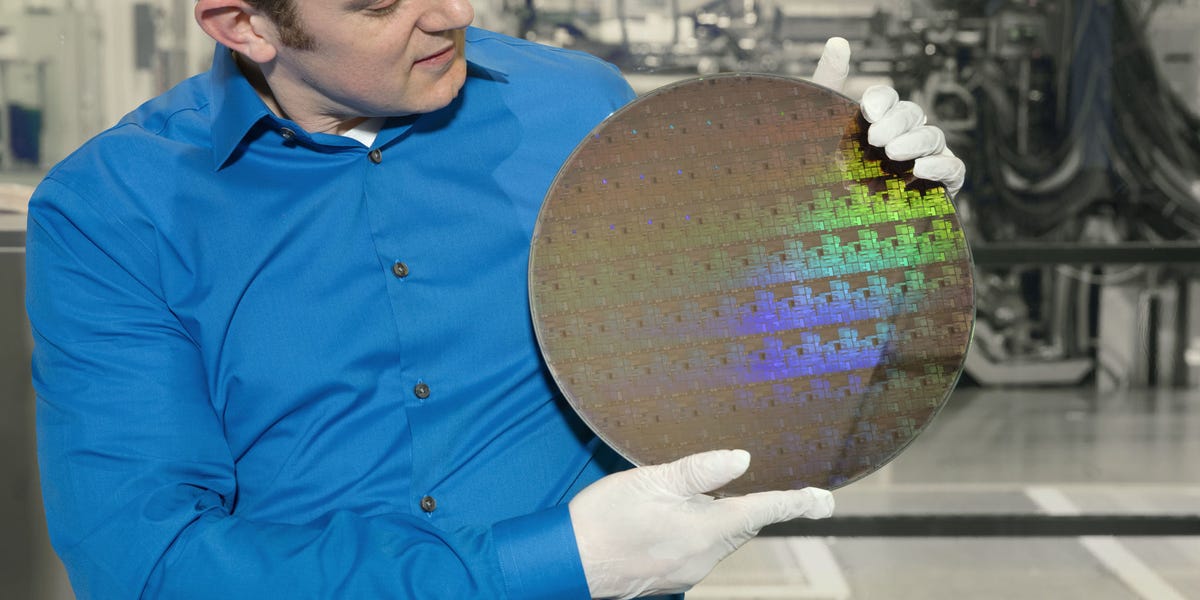
Imagine holding a computer chip about the size of your fingernail and being told it can contain 30 billion tiny switches. Not 30 million. Not “a lot, trust us.” Thirty billion. That is the kind of number that makes your calculator sigh dramatically and ask for a coffee break. Yet IBM and its research partners made exactly that kind of semiconductor breakthrough possible with a 5 nanometer transistor architecture built around silicon nanosheets.
IBM’s fingernail-sized semiconductors are more than a cool laboratory flex. They represent a major step in the long-running race to make chips smaller, faster, and more energy efficient. The breakthrough matters because modern life runs on transistors: smartphones, cloud servers, artificial intelligence systems, gaming consoles, cars, medical devices, satellites, and the humble laptop that somehow still has 47 browser tabs open.
At the center of the story is the transistor, the microscopic on-off switch that allows computers to process information. When engineers can fit more transistors into the same area, chips can perform more work without becoming physically larger. IBM’s 5 nm nanosheet transistor technology showed a path toward packing 30 billion switches onto a chip roughly the size of a fingernail, pushing semiconductor design into a new era.
What Did IBM Actually Build?
IBM, working with partners including GlobalFoundries and Samsung, announced an industry-first process for building silicon nanosheet transistors designed for 5 nanometer chips. The achievement followed IBM’s earlier 7 nm test chip work, which demonstrated about 20 billion transistors. The 5 nm nanosheet design raised the possibility of fitting roughly 30 billion switches on a similar fingernail-sized surface.
In plain English, IBM found a way to make the switch inside a chip smaller and better controlled. That is a big deal because shrinking transistors is not like shrinking a photo on your phone. At nanometer scales, physics starts acting like a picky landlord. Electrons leak, heat builds up, manufacturing becomes brutally difficult, and tiny imperfections can cause major problems. Making smaller chips requires new architecture, new materials knowledge, and incredibly precise manufacturing tools.
IBM’s approach used silicon nanosheets. Instead of relying only on the FinFET transistor design that powered many advanced chips for years, nanosheet transistors give the gate more control over the channel where current flows. Think of FinFET as a gate controlling current from three sides. A nanosheet or gate-all-around structure improves that control by surrounding the channel more completely. Better control means less leakage, stronger switching, and improved efficiency.
Why 30 Billion Switches on a Fingernail Matters
A computer chip is not powerful because it looks impressive. Most chips are visually about as exciting as a very expensive gray cracker. The magic happens inside, where billions of transistors switch on and off at extraordinary speeds. Each switch helps represent and manipulate information. More switches can mean more computing power, better parallel processing, and smarter energy use.
IBM’s 5 nm technology was projected to offer up to 40 percent better performance at the same power level or up to 75 percent power savings at matched performance when compared with advanced 10 nm chips. For consumers, that kind of progress can translate into faster phones, longer battery life, cooler laptops, and smarter devices. For businesses, it can mean more efficient data centers, lower energy bills, and stronger performance for cloud computing and artificial intelligence workloads.
The number 30 billion is important because it shows how far semiconductor scaling had come. Not long ago, a billion transistors on a chip sounded outrageous. Now the industry talks about tens of billions as the price of admission for advanced computing. It is the technological equivalent of going from a bicycle to a rocket-powered bicycle, except the rocket is invisible and smaller than dust.
How Silicon Nanosheets Changed the Game
Traditional chip scaling relied heavily on making transistor features smaller. For decades, Moore’s Law described the pattern of transistor counts increasing dramatically over time. But as chips approached single-digit nanometer nodes, the industry could not simply keep shrinking old designs forever. FinFET technology, which uses fin-shaped silicon channels, helped extend scaling, but even FinFET began running into limitations.
Silicon nanosheets offered a fresh path. Instead of one fin, the transistor can use stacked horizontal sheets of silicon. The gate wraps around these sheets, giving better electrical control. This helps reduce unwanted current leakage and allows engineers to tune the width of the sheets for different circuit needs. In other words, nanosheets give chip designers more knobs to turn without making the whole chip larger.
IBM’s nanosheet work also relied on extreme ultraviolet lithography, or EUV, a manufacturing technique that uses very short-wavelength light to print incredibly tiny patterns on silicon wafers. EUV is one of the superhero tools of modern chipmaking. It is also expensive, complex, and not the kind of thing you casually install in a garage unless your garage happens to have billions of dollars and a team of physicists.
IBM, Samsung, GlobalFoundries, and the Research Ecosystem
One of the most important parts of IBM’s semiconductor story is collaboration. The 5 nm breakthrough was not a lone inventor moment with someone shouting “Eureka!” over a messy workbench. It came from a research alliance involving IBM, Samsung, GlobalFoundries, and equipment suppliers. Advanced semiconductor development is a team sport, and the field is so complex that no single company does everything alone.
IBM has long played a major role in semiconductor research, even though it is no longer known primarily as a mass-market chip manufacturer. Its Albany, New York research presence has become an important hub for advanced chip development. IBM’s labs have contributed to innovations in nanosheets, EUV patterning, and node scaling beyond 2 nm. This research helps shape the technologies that later appear in commercial manufacturing roadmaps.
Samsung later moved into gate-all-around chip production with its 3 nm process, while TSMC’s 2 nm roadmap adopted nanosheet transistor technology as well. Intel has its own version of gate-all-around architecture called RibbonFET, paired with backside power delivery under its advanced foundry plans. In other words, the basic idea IBM helped demonstrate in the 5 nm era became part of the broader direction of the semiconductor industry.
The Link Between IBM’s 5 nm and 2 nm Breakthroughs
IBM’s 5 nm nanosheet breakthrough did not happen in isolation. It was part of a longer research arc. In 2021, IBM announced what it called the world’s first 2 nanometer chip technology, designed to fit up to 50 billion transistors on a chip about the size of a fingernail. That later milestone built on the same broad theme: better transistor structures, better control of current, and more computing power in smaller spaces.
The 2 nm announcement helped prove that nanosheet technology was not just a clever 5 nm experiment. It pointed toward the future of high-density, energy-efficient computing. Chips at these advanced nodes are especially important for artificial intelligence, cloud infrastructure, mobile devices, and high-performance computing. When AI models grow larger and data centers consume more electricity, chip efficiency becomes more than a spec sheet brag. It becomes an economic and environmental issue.
This is why transistor architecture matters. The world does not merely need faster chips. It needs faster chips that do not melt power budgets, drain batteries, or turn server farms into toaster ovens. IBM’s nanosheet work helped show one path toward that balance.
Why Smaller Chips Are So Hard to Build
The phrase “5 nanometer” sounds simple, but it hides an absurd amount of engineering pain. A nanometer is one-billionth of a meter. Human hair is tens of thousands of nanometers wide. At these dimensions, manufacturing a chip means creating patterns so small that ordinary intuition gives up and leaves the room.
Engineers must deal with quantum effects, heat, variability, power leakage, material limits, and astronomical equipment costs. A tiny defect can ruin part of a wafer. A slight patterning error can affect performance. Every step, from deposition to etching to lithography, must be controlled with almost ridiculous precision.
That is why IBM’s 30 billion-switch claim mattered. It was not just “we made it smaller.” It was “we found a transistor structure that may scale in a manufacturable way.” In semiconductors, laboratory breakthroughs are exciting, but manufacturability is where dreams either become products or become footnotes with nice diagrams.
What This Means for Everyday Technology
The average person does not wake up and say, “I hope gate-all-around transistor electrostatics are improving nicely today.” Fair enough. But everyone notices when a phone lasts longer, a laptop runs cooler, a game loads faster, or a car’s driver-assist system responds more intelligently. Those improvements often start with semiconductor advances years earlier.
IBM’s fingernail-sized semiconductors point toward devices that can do more without demanding more space. Smartphones can gain better performance without becoming pocket-sized bricks. Wearables can become more capable while staying small. Cloud servers can process more data with better energy efficiency. AI accelerators can handle larger workloads. Cars can use more powerful chips for sensing, navigation, and safety systems.
The benefits are not limited to flashy consumer gadgets. Medical imaging, scientific simulations, cybersecurity systems, financial modeling, logistics networks, and climate research all rely on computing power. When chips become more efficient, entire industries can do more with less energy and less hardware.
Moore’s Law Is Not Dead, But It Has Changed Outfits
IBM’s 5 nm nanosheet transistor announcement was widely discussed as evidence that Moore’s Law still had room to run. Strictly speaking, Moore’s Law is an observation about transistor density increasing over time, not a magical law of nature. For decades, the industry kept that pattern alive through relentless innovation. But modern scaling is no longer just about shrinking the same transistor again and again.
Today, Moore’s Law survives through architectural creativity. Nanosheets, gate-all-around transistors, advanced packaging, chiplets, backside power delivery, EUV lithography, and new materials all contribute. The future is less about one simple shrink and more about a toolbox of clever tricks. Moore’s Law has not retired; it has simply started wearing a lab coat with more pockets.
IBM’s 30 billion-switch semiconductor breakthrough fits perfectly into that story. It showed that when one transistor architecture approaches its limits, another can take over. That is the pattern of chip history: planar transistors gave way to FinFETs, FinFETs are giving way to nanosheets and gate-all-around designs, and future technologies may push even further.
Challenges Still Ahead
None of this means the road is easy. Advanced chips are extremely expensive to design and manufacture. EUV machines cost enormous sums. Fabrication plants require huge capital investment. Supply chains span continents. Even when a transistor design works, turning it into reliable high-volume production can take years.
There is also the problem of heat. More transistors packed into a small area can create thermal challenges. Power delivery becomes harder. Signal delays matter. Software must be optimized to take advantage of new hardware. And as AI demand grows, the industry must balance performance with energy consumption.
Another challenge is that node names are not always literal physical measurements anymore. A “5 nm” or “2 nm” label does not mean every transistor feature measures exactly 5 or 2 nanometers. Node names have become industry markers for generations of technology, density, performance, and power improvements. This can confuse readers, but the practical point remains: each generation aims to deliver more capability per unit area and per watt.
Why IBM’s Breakthrough Still Matters Today
Even though IBM’s 5 nm nanosheet announcement happened in 2017, it remains relevant because the semiconductor industry has moved in the direction it suggested. Gate-all-around and nanosheet designs are now central to advanced chip roadmaps. Samsung, TSMC, and Intel all treat these structures as key technologies for next-generation nodes.
IBM’s work also highlights the value of deep research. The chips consumers buy in a given year are often built on ideas tested many years earlier. The phone in your hand, the server answering your search query, and the AI system generating text all depend on a long chain of experiments, prototypes, failures, redesigns, and breakthroughs.
The 30 billion-switch chip is a reminder that semiconductor progress is not automatic. It takes patient engineering, expensive tools, and a willingness to rethink the tiny structures that make digital life possible. It is not glamorous in the celebrity sense, but it is the reason your devices keep getting smarter instead of just getting warmer.
Experience-Based Reflections: What This Breakthrough Feels Like in Real Life
The easiest way to appreciate IBM’s fingernail-sized semiconductors is to connect them to everyday experience. Think about the difference between an old laptop that groans when opening a spreadsheet and a modern machine that edits video, streams music, runs browser tabs, syncs files, and still has enough power left to notify you about an update you did not ask for. That improvement did not happen because computers learned yoga. It happened because chips became denser, faster, and more efficient.
Anyone who has carried a smartphone through a long travel day understands why power efficiency matters. You check maps, answer messages, take photos, scan boarding passes, translate signs, and maybe watch a movie while pretending airport food is a reasonable financial decision. By evening, battery life becomes emotional. A chip that can deliver the same performance with dramatically less power is not just a technical achievement; it is the difference between staying connected and hunting for an outlet like a caffeinated raccoon.
The same experience applies to heat. Older devices often became hot when pushed hard. Gaming laptops could sound like tiny jet engines. Phones could slow down during heavy use. Servers in data centers needed massive cooling systems. Better transistor control, like what nanosheet designs aim to provide, helps reduce wasted power and leakage. Less wasted power usually means less heat, longer battery life, and more consistent performance.
For creators, students, engineers, and office workers, the impact shows up as smoother multitasking. A dense, efficient chip can handle complex workloads without turning every task into a waiting game. Video calls become clearer. AI tools respond faster. Large files open more quickly. Software feels less like a stubborn vending machine and more like a helpful assistant.
For businesses, the experience is even bigger. A company running thousands of servers cares deeply about performance per watt. Saving power across a single device is nice. Saving power across a data center is a budget line item with real environmental consequences. IBM’s nanosheet breakthrough matters because it points toward computing that can scale without energy use growing at the same frightening pace.
There is also a psychological experience to this kind of progress. The chip itself is almost invisible, but its effects are everywhere. You do not see 30 billion switches working when you unlock your phone with your face, ask a voice assistant a question, or upload a video. Yet those invisible switches are performing tiny decisions at impossible speed. It is like discovering that the quietest person in the room has been organizing the entire city.
IBM’s 30 billion-switch semiconductor is impressive because it compresses a civilization’s worth of engineering into a tiny square of silicon. It represents years of materials science, physics, design, manufacturing, and collaboration. The next time a device feels fast, cool, and effortless, it is worth remembering that somewhere inside, billions of microscopic switches are flipping with perfect discipline. They do not ask for applause. They just make the modern world work.
Conclusion
IBM’s fingernail-sized semiconductors packing in 30 billion switches mark a major chapter in the story of modern computing. The breakthrough showed how silicon nanosheet transistors could extend chip scaling beyond the limits of older designs, opening the door to faster, smaller, and more energy-efficient processors. It also helped point the semiconductor industry toward gate-all-around architectures now shaping advanced chip roadmaps.
The real lesson is simple: the future of computing depends on making tiny things work better. IBM’s 5 nm nanosheet technology, followed by later 2 nm research, proves that innovation at the atomic edge can change what everyday devices, data centers, AI systems, and connected machines are capable of doing. Thirty billion switches on a fingernail-sized chip may sound like science fiction, but it is also the quiet foundation of tomorrow’s technology.
Note: This article is written for web publishing in standard American English and synthesizes real semiconductor research, industry context, and practical examples without inserting source links into the body content.