

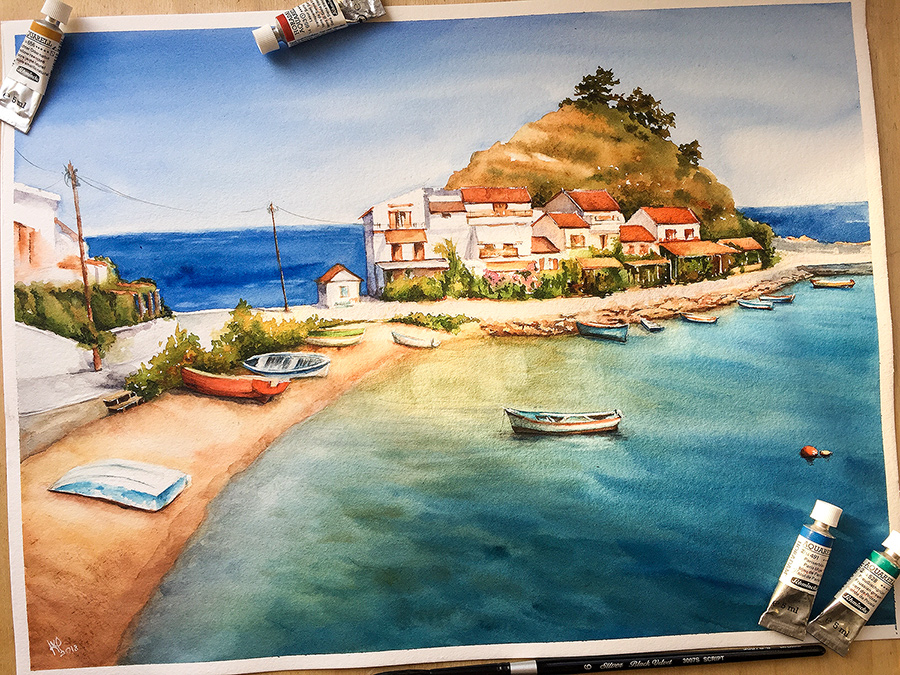
Some people greet the new year by buying a planner, writing “drink more water” on page one, and then abandoning it by January 8. Artists, however, have a more dramatic relationship with calendars. We look at twelve empty months and think, “What if each one demanded a tiny emotional landscape, a deadline, and several cups of coffee?” That is the spirit behind the 2019 watercolor calendar challenge: creating twelve watercolor paintings in less than two months, each designed to represent a month, a place, and a mood.
This challenge is not just about painting quickly. It is about building a complete visual story under pressure. A calendar is a practical object, but when it is filled with original watercolor landscapes, it becomes something warmer: a portable gallery, a travel diary, and a gentle reminder that art can live on a desk, wall, or kitchen counter without requiring museum lighting or someone whispering, “Please do not touch.”
The project that inspired this article featured twelve countries and twelve landscape scenes, from Riga, Latvia, to Brussels, Belgium. The idea was ambitious but simple: finish a full watercolor calendar before the year began. That meant planning themes, selecting reference locations, sketching compositions, painting in batches, correcting mistakes, preparing files, and somehow not turning into a puddle of ultramarine blue by the end.
Why a Watercolor Calendar Challenge Is So Addictive
A watercolor calendar challenge works because it combines creativity with structure. Watercolor can feel unpredictable. Pigment blooms, edges soften, washes dry lighter than expected, and one enthusiastic drop of water can turn a tidy sky into weather drama. A calendar, on the other hand, is organized, measured, and tidy. Put them together and you get a delightful creative contradiction: chaos inside a grid.
For artists, that contrast is powerful. The calendar gives the project a clear finish line. Instead of saying, “I want to paint more this year,” the challenge says, “I need twelve finished paintings, one for each month, before the deadline.” Suddenly the vague dream of being more creative becomes a schedule. Not always a merciful schedule, but a schedule nonetheless.
The format also helps viewers connect with the work. A single painting can be admired and then forgotten, but a calendar returns every day. January may carry a snowy city scene. April may glow with warm architecture. July may open into a sunlit ancient landscape. October may bring lakes, forests, and autumn colors. Month by month, the viewer travels with the artist.
The Concept: 12 Paintings, 12 Months, 12 Little Escapes
The most successful watercolor calendar projects usually have a strong theme. A random collection of paintings can still be beautiful, but a calendar feels more complete when the images talk to one another. In the 2019 challenge, the unifying idea was travel: twelve countries, twelve landscapes, and a visual trip around the world.
A travel-based watercolor calendar offers endless possibilities because every place has a distinct personality. Riga can bring elegant streets and northern charm. Blausee Lake in Switzerland naturally invites clear blue water and mountain reflections. Seville’s Plaza de España suggests warm earth tones, arches, and patterned details. Malta can glow with limestone, sea air, and golden light. Bagan in Myanmar offers silhouettes, temples, and atmospheric haze. Hokkaido’s flower fields are practically begging for color, while Plitvice Lakes in Croatia deliver waterfalls and layered greens. Moritzburg Castle in Germany brings fairytale architecture, and Brussels closes the calendar with old-world city beauty.
That is the magic of a themed watercolor calendar: each page has its own identity, but the collection still feels like one artistic journey. Viewers do not just flip pages; they move through seasons, climates, memories, and tiny vacation fantasies. It is cheaper than airfare and much less likely to involve lost luggage.
Planning the Calendar Before Picking Up a Brush
Before painting begins, the calendar needs a roadmap. This may sound boring, but planning is what prevents the artist from reaching December with eleven blue seascapes and one confused pumpkin. A strong watercolor calendar begins with three big decisions: subject, style, and format.
Choosing a Theme That Can Survive 12 Pages
The best theme is broad enough to offer variety but specific enough to feel cohesive. “Beautiful places around the world” works well because it allows cityscapes, lakes, villages, castles, mountains, and flower fields. “Seasonal gardens” could work too. So could “coastal towns,” “national parks,” “famous cafés,” “botanical studies,” or “birds of each month.”
The key question is simple: can this idea produce twelve strong images without feeling repetitive? If the answer is yes, the theme is calendar-worthy. If the answer is no, it may be better as a three-print mini-series, which is still respectable and far less likely to cause late-night staring contests with blank paper.
Building a Monthly Mood Board
Once the theme is chosen, each month needs a mood. January might be quiet and cool. March can feel fresh and transitional. June may be bright and open. September often wants warm fields or harvest colors. December can be festive without becoming a glitter explosion. A mood board helps keep the calendar balanced.
For watercolor landscapes, the artist should think about color temperature, season, composition, and visual rhythm. If February is icy blue and March is also icy blue, the calendar may feel sleepy. If every painting has the horizon line in the exact same place, the whole collection may look like it was assembled by a very polite robot. Variety matters.
Watercolor Techniques That Make a Calendar Feel Professional
Watercolor is loved for its softness, glow, and occasional refusal to obey. To finish twelve paintings quickly, an artist needs techniques that are reliable, repeatable, and flexible.
Wet-on-Wet for Skies, Lakes, and Atmosphere
Wet-on-wet painting is ideal for skies, mist, reflections, and distant landscapes. By adding wet pigment to damp paper, colors spread into soft transitions. This is useful when painting places like lakes, mountains, or atmospheric city backgrounds. The technique can create dreamy effects that make watercolor landscapes feel luminous rather than stiff.
Dry Brush for Texture and Architectural Details
A calendar often needs small details because the final image may be printed at a modest size. Dry brush can suggest stone walls, tree bark, rooftops, grass, and distant windows without overworking the painting. The trick is restraint. A few broken strokes can say “historic European street.” Two hundred tiny strokes can say “artist has not slept.”
Layering and Glazing for Depth
Because watercolor is transparent, layers can build depth gradually. A first wash sets the general light. Later glazes strengthen shadows, adjust color, and define forms. In a calendar challenge, glazing is especially helpful because it allows the artist to work on several paintings in rotation. While one page dries, another receives its next layer. This is the watercolor version of multitasking, except prettier and with more paper towels.
Saving the Whites
White areas in watercolor usually come from the paper itself. That means highlights must be planned before the first wash goes down. Sparkling water, bright flowers, snow, clouds, and sunlit walls all depend on preserving light. Some artists use masking fluid; others paint carefully around highlight shapes. Either way, the calendar benefits when each image has a clear light source and a few crisp bright notes.
Choosing the Right Paper for a Fast Watercolor Challenge
Paper can make or break a watercolor calendar. Lightweight paper buckles, tears, and makes washes harder to control. For a serious project, many artists prefer watercolor paper around 140 lb or 300 gsm because it can handle wet washes better than ordinary drawing paper. Cold press paper is a popular choice because it offers a balanced texture: not too smooth, not too rough, and friendly to both washes and details.
Hot press paper can be useful for precise architectural work because it has a smoother surface. Rough paper creates dramatic texture and can make landscapes feel expressive. For a calendar project with twelve images, consistency matters. Using the same paper type for all paintings helps the collection look unified when scanned, photographed, and printed.
That said, artists should test before committing. A tiny color chart, a sky wash, and a dark-to-light gradient can reveal whether the paper behaves well. This test may feel like a delay, but it saves time later. Nothing is more character-building than discovering on painting number nine that your paper has the absorbency of a paper towel and the emotional stability of a soap bubble.
How to Finish 12 Paintings in Less Than 2 Months
The calendar challenge becomes much less scary when broken into phases. Two months may sound generous until you remember that twelve finished paintings require sketching, painting, drying, editing, scanning, layout work, and final proofing. The secret is not heroic inspiration. The secret is a workflow.
Week 1: Research and Rough Sketches
The first week should focus on references, thumbnail sketches, and monthly assignments. Choose all twelve subjects early. Create small composition sketches for each one. Decide which months need warm colors, which need cool palettes, and which will provide visual contrast.
Weeks 2–5: Paint in Batches
Batch painting keeps momentum alive. Instead of fully finishing January before starting February, work in stages. Sketch several pieces. Paint base washes on three or four. Add shadows to another batch. Reserve detailed finishing for the end. This rhythm helps the calendar feel cohesive because the same artistic energy flows across multiple pages.
Weeks 6–7: Finish, Scan, and Correct
When all paintings are nearly complete, compare them as a set. Are some too dark? Are two months too similar? Does one painting look unfinished next to the others? Make final adjustments carefully. Watercolor corrections are possible, but aggressive fixing can create muddy areas. The goal is polish, not panic.
Final Days: Calendar Layout and Print Preparation
After the artwork is complete, the design stage begins. A clean calendar layout should let the paintings shine. Use readable dates, consistent margins, and enough white space. If printing professionally, check image resolution, bleed, trim, safe zones, and color settings. Calendar design is not glamorous, but it is the difference between “beautiful art product” and “why is July being attacked by the hole punch?”
Why the 2019 Watercolor Calendar Challenge Connects With Readers
Part of the appeal is the finished artwork, but another part is the story. People love creative challenges because they reveal the human side of art. A polished painting says, “Look what I made.” A challenge says, “Look what I survived while making it.” That is more relatable.
Artists often battle perfectionism. A deadline forces decisions. You cannot repaint the same doorway forever when eleven other months are tapping their feet. The calendar format teaches discipline because each painting must serve the whole project. A single page can be charming, but the full set must feel balanced.
Readers also enjoy seeing places transformed through watercolor. Travel photography shows what a place looks like. Watercolor shows how a place feels after passing through an artist’s memory, mood, and hand. A castle becomes softer. A lake becomes more luminous. A street corner becomes nostalgic, even if the viewer has never been there.
Lessons Artists Can Learn From a Calendar Challenge
The first lesson is that constraints can improve creativity. Twelve months, one format, one deadline, and one medium may sound restrictive, but those limits reduce decision fatigue. Instead of asking, “What should I paint today?” the artist asks, “What does May need?” That small shift makes progress easier.
The second lesson is that consistency beats intensity. Painting for ten hours once and then disappearing for three weeks rarely builds a finished calendar. Short, regular sessions are more effective. Even fifteen or twenty focused minutes can move a sketch forward, deepen a shadow, or test a palette.
The third lesson is that a finished series teaches more than a perfect single painting. By the twelfth page, the artist has practiced composition, color harmony, perspective, scanning, editing, and presentation. The project becomes a compact art education disguised as a calendar.
Experience Notes: What It Feels Like to Create 12 Paintings in Less Than 2 Months
Starting a watercolor calendar challenge feels exciting for approximately six minutes. Then reality appears wearing reading glasses and holding a checklist. Twelve paintings means twelve chances to succeed, but also twelve chances to spill paint, misjudge perspective, choose the wrong green, or realize that architecture contains more windows than any reasonable person should have to paint.
The first few days are usually full of optimism. You gather references, sharpen pencils, clean your palette, and imagine the finished calendar glowing on someone’s wall. January looks promising. February behaves. March has a small issue with the sky, but nothing dramatic. Then April arrives with complicated buildings, and suddenly you understand why some artists paint abstract shapes and call it emotional geometry.
The biggest experience from this kind of challenge is learning to make decisions faster. Watercolor rewards confidence. If you hesitate too long, the wash dries. If you keep poking at a shadow, it turns muddy. If you try to control every bloom, the painting loses life. A calendar deadline teaches you to trust the first good solution instead of chasing the imaginary perfect one.
Another important experience is discovering how physical the process can be. Your hand learns the rhythm of repeated washes. Your eyes become better at spotting value problems. You start noticing that every scene has a skeleton: big shapes first, details later. This is especially true with landscapes. A mountain is not painted rock by rock. A city is not painted window by window. You simplify, suggest, and let the viewer’s imagination finish the job.
There is also an emotional rhythm. Some paintings become instant favorites. Others behave like stubborn pets. One month may look finished after two layers; another may require several rescue operations and a quiet apology to the paper. The trick is not to let one difficult painting poison the whole project. Put it aside, work on another month, and return when your brain is less dramatic.
By the final stage, the challenge becomes surprisingly satisfying. Seeing twelve paintings together creates a feeling that one artwork cannot provide. The collection proves that small efforts can accumulate into something substantial. Each page carries a memory: the wash that worked beautifully, the tree that almost ruined everything, the rooftop that took three tries, the lake that finally sparkled after one lucky brushstroke.
Creating a watercolor calendar also changes how you think about time. Months stop being empty boxes and become moods, colors, and places. January can be pale blue. May can be golden stone and sea breeze. September can smell like flowers and late sun. December can hold city lights and cool shadows. The calendar becomes more than a product. It becomes a year you built by hand.
For anyone considering a similar challenge, the best advice is to begin before you feel fully ready. Choose a theme, make a list, prepare the paper, and start with the easiest month. Momentum is kinder than perfection. The finished calendar will not only show twelve paintings; it will show patience, problem-solving, courage, and the wonderful ability of watercolor to make even a deadline look dreamy.
Conclusion
The 2019 watercolor calendar challenge is a beautiful reminder that art grows when it has both freedom and form. Twelve paintings in less than two months may sound intimidating, but the structure turns a large dream into manageable steps. With a strong theme, reliable materials, smart scheduling, and a willingness to accept a few artistic surprises, a watercolor calendar can become one of the most rewarding projects an artist creates.
It is part travel journal, part design project, part painting marathon, and part personal growth experiment. Most of all, it proves that a calendar does not have to be boring. It can be a year of tiny windows: one month at a time, one landscape at a time, one brushstroke at a time.