

“`
There was a time when James Franco seemed to be everywhere. He was the sensitive guy from Freaks and Geeks, the smirking villain in Spider-Man, the Oscar-nominated survivalist in 127 Hours, the stoner-comedy king of Pineapple Express, the novelist, the professor, the art-world experimenter, the guy collecting graduate degrees like they were loyalty stamps at a coffee shop. For years, the entertainment industry treated him as a charming oddball geniusHollywood’s multitasking wizard with perfect bedhead.
Then the public conversation changed. The “quirky genius” brand began to look less quirky and more like a fog machine covering up a pattern of troubling behavior. Allegations, awkward apologies, legal filings, settlements, and fractured friendships turned Franco’s image from “restless artist” into a cautionary tale about fame, power, accountability, and how long Hollywood will let a talented man act like the rules are merely light suggestions.
This article is not a courtroom verdict. It is a public-history overview of the controversies that reshaped James Franco’s career, from social media scandals to allegations connected to his acting school, from his denials to his later admissions that he had behaved wrongly with students. The story is messy, uncomfortable, and very Hollywoodwhich is to say, there are red carpets, publicists, legal language, and a shocking amount of bad judgment wearing designer shoes.
The Rise Of James Franco: Talent, Charm, And The “Genius” Costume
Before the controversies became impossible to ignore, James Franco had one of the strangest and most fascinating careers in modern celebrity culture. He could move from prestige drama to broad comedy, from indie films to blockbuster franchises, from soap opera guest spots to art installations. He played James Dean, Harry Osborn, Allen Ginsberg, Tommy Wiseau, and a man trapped under a boulder. That last one became an oddly useful metaphor later: Franco’s public image eventually became pinned beneath the weight of his own choices.
Part of Franco’s appeal was that he appeared impossible to categorize. He was handsome, but not bland. Funny, but not merely a comedian. Serious, but also willing to make himself ridiculous. He published books, directed films, taught classes, made short films, and enrolled in academic programs. Entertainment profiles often framed this as proof of intellectual hunger. The problem was that “ambition” can be charming until it starts looking like entitlement with a library card.
As Franco’s influence grew, so did the power imbalance around him. Young actors wanted access. Students wanted mentorship. Collaborators wanted opportunity. Fans wanted proximity. That kind of celebrity gravity matters. When a famous actor also becomes a teacher, director, producer, and gatekeeper, the question is not simply “Was everyone an adult?” The better question is: “Who had the power, and how was it used?”
The 2014 Instagram Incident: When “Bad Judgment” Went Public
One of Franco’s earlier public controversies came in 2014, when screenshots circulated showing messages between Franco and a 17-year-old girl he had reportedly met outside a Broadway performance. The messages appeared to show Franco asking personal questions and trying to arrange a meeting. Franco later acknowledged on television that the exchange had happened and described it as poor judgment.
Legally, defenders pointed out details about age of consent in New York. But public reaction was not limited to courtroom-style technicalities. The optics were grim: a famous man in his mid-thirties messaging a teenager and apparently trying to meet her privately. It was the kind of scandal that made people say, “Surely a grown celebrity with a publicist, a phone, and at least one functioning adult friend would know better.” Apparently not.
Franco’s explanation leaned on embarrassment and a lesson learned. Yet the incident became a marker in the public record because it suggested a pattern critics would later point to: blurred boundaries, questionable judgment, and a tendency to treat uncomfortable situations as if they were strange little performance-art exercises rather than real interactions with real people.
The Time’s Up Pin And The Backlash That Followed
In January 2018, Franco won a Golden Globe for The Disaster Artist. On the red carpet and during the ceremony, he wore a Time’s Up pin, aligning himself visually with a movement created to address sexual harassment and workplace abuse. For many celebrities, the pin was a symbol of solidarity. For Franco, it became a lightning rod.
Almost immediately, criticism surfaced online. Actress Ally Sheedy posted and then deleted comments that drew attention to Franco. Other women also spoke publicly. The contrast was too sharp to ignore: Franco standing with a movement against sexual misconduct while women were saying, in effect, “Wait a minutelet’s talk about this guy.”
Franco later appeared on late-night television and denied allegations that had surfaced at the time, while saying he supported people speaking out. That careful balancing actdeny specifics, support the movement, promise to listenwas familiar celebrity-crisis choreography. It was polished enough for television, but it did not resolve the deeper issue. The questions were no longer about one awkward Instagram episode. They were about power, mentorship, and what happened around Franco’s acting school.
The Los Angeles Times Report: Five Women Come Forward
In 2018, the Los Angeles Times published a major report in which five women accused Franco of inappropriate or sexually exploitative behavior. Several were former students; another described Franco as a mentor. The allegations centered on discomfort, pressure, nudity, professional opportunity, and the belief that proximity to Franco could lead to career advancement.
That context is essential. Hollywood is built on access. A small role, a recommendation, a short film, or even a few minutes with the right person can feel like a door cracking open. When the person holding that door is also teaching, directing, producing, and starring, the imbalance becomes enormous. Nobody needs to announce, “I hold the keys.” The keys are visible.
Franco’s attorneys disputed allegations, and he publicly denied certain claims. But the report changed how many people viewed his career. What once looked like eccentric productivity began to look, to critics, like a sprawling personal ecosystem in which younger performers orbited a celebrity teacher with far more power than they had.
Studio 4: The Acting School At The Center Of The Storm
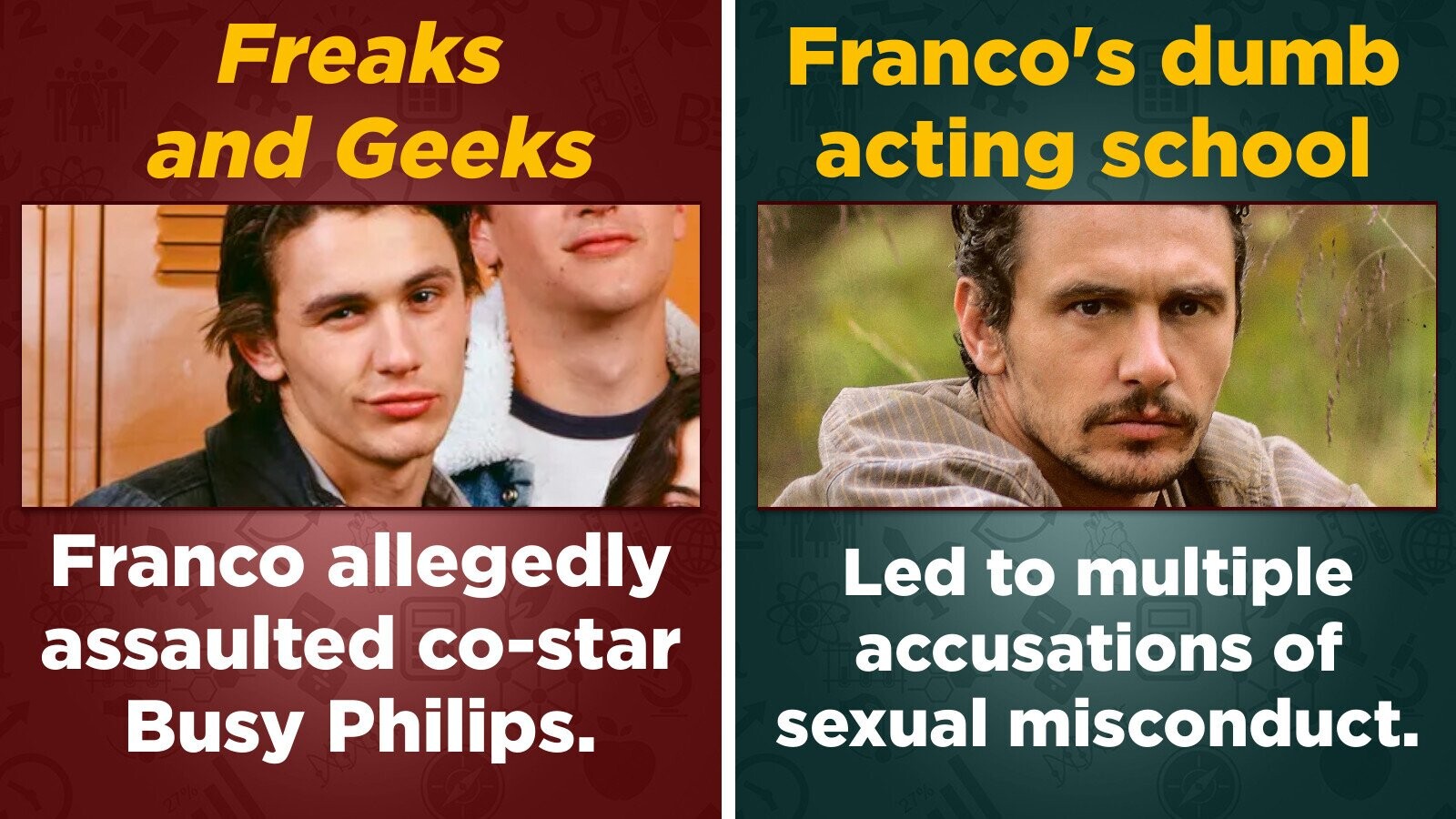
Studio 4, Franco’s acting and film school, operated in Los Angeles and New York. On paper, it sounded like a dream for aspiring actors: learn from working professionals, connect with productions, and maybe gain access to real projects. For students trying to break into Hollywood, that pitch had obvious appeal. After all, “James Franco might put you in a movie” is a stronger marketing hook than “Please enjoy our fluorescent classroom and folding chairs.”
But former students later alleged that the school created situations where women felt pressured into sexualized performances or uncomfortable scenes. Some allegations involved promises or implications of professional opportunity. The accusations raised a broader concern about acting programs attached to celebrity power: when education, auditioning, and personal access overlap, students can struggle to know whether they are learning, networking, auditioning, or being tested in ways that have nothing to do with craft.
The school eventually closed. But the questions it raised did not disappear with the lease. In fact, the Studio 4 allegations became the core of the legal and reputational fallout that followed Franco for years.
The 2019 Lawsuit And The $2.235 Million Settlement
In 2019, former students Sarah Tither-Kaplan and Toni Gaal filed a lawsuit against Franco and associated parties, alleging sexual exploitation and fraud connected to Studio 4. The lawsuit accused Franco and his associates of using the school and related projects in ways that exploited female students who were seeking acting opportunities.
Franco and the other defendants denied the allegations. In 2021, the parties reached a settlement, with reported terms totaling $2.235 million. A settlement is not the same thing as a legal finding of guilt, and that distinction matters. But settlements still become part of the public story, especially when the allegations involve power, sex, education, and career access.
The case also revealed a painful truth about the entertainment business: many aspiring performers are trained to be “bold,” “open,” “fearless,” and “willing.” Those words can be useful in art. They can also be misused by people with authority. The difference between creative risk and coercive pressure often depends on consent, transparency, safety, and whether saying “no” carries a professional cost.
Franco’s Later Admission: “That Was Wrong”
After years of relative silence, Franco addressed the controversy in a 2021 interview. He acknowledged that he had slept with students and said that doing so was wrong. He also discussed addiction and personal problems, framing his behavior as part of a larger pattern in his life that he said he had been working to change.
That admission was significant because it moved the conversation beyond blanket denial. Even if Franco continued to reject certain allegations, he conceded a central ethical point: a teacher having sexual relationships with students is a serious boundary problem. In ordinary workplaces, that kind of conduct can trigger policy violations, investigations, and lawsuits. In acting schools, where students may be asked to be emotionally vulnerable and physically expressive, the stakes can be even higher.
His comments did not magically repair the harm alleged by former students. Nor did they erase years of public concern. Accountability is not a confetti cannon: you do not pull the string once and declare the room clean. For many observers, Franco’s admission was only a beginning, not a conclusion.
Seth Rogen Steps Away
For years, Franco and Seth Rogen were one of Hollywood’s most recognizable comedy duos. Their collaborations included Pineapple Express, This Is the End, The Interview, and other projects built around their odd-couple chemistry. Rogen’s warm, schlubby sincerity made Franco’s chaotic intensity feel more playful. They were a buddy-comedy brand, and the brand workeduntil it didn’t.
After the allegations, Rogen publicly said he had no plans to work with Franco again and expressed regret for past jokes that had minimized earlier concerns. That distancing mattered because it signaled that Franco’s consequences were not limited to headlines. A long-running creative partnership had fractured. The guy who once seemed like Franco’s safest professional harbor was no longer volunteering to steer the boat.
Franco later said the friendship appeared to be over, while expressing affection for Rogen and gratitude for their past work. The breakup of that partnership became one of the clearest cultural signs that Franco’s reputation had changed. Hollywood friendships can survive bad reviews, box-office bombs, and questionable facial hair. Surviving a public misconduct scandal is much harder.
The Hollywood Comeback Question
In recent years, Franco has returned gradually to film work, especially in international and independent projects. By 2024 and 2026, entertainment outlets were again reporting on his appearances, interviews, festival activity, and roles, including a part in the John Rambo prequel. That reentry has revived a familiar debate: when, if ever, should a public figure be welcomed back after serious allegations and admitted misconduct?
The answer depends on whom you ask. Some audiences believe people can change and should not be permanently frozen at the worst chapter of their lives. Others argue that Hollywood has a habit of treating accountability like a short vacation, especially for famous men with bankable names. The industry’s reset button is suspiciously large, shiny, and usually located near a producer’s wallet.
Franco has spoken about living positively and focusing on work. But public redemption is not something a celebrity can simply announce. It is something audiences evaluate over time, based on honesty, repair, humility, and whether the person appears to understand the harm rather than merely the inconvenience of consequences.
Why The James Franco Story Still Matters
The James Franco controversy matters because it is not just about one actor. It is about the systems that let celebrity power become educational authority, professional access, sexual pressure, and personal myth all at once. It is about how easily “genius” can become a costume that excuses behavior other people would never get away with. It is about the difference between being interesting and being accountable.
Franco’s case also shows how public opinion has changed. Years ago, a scandal might have been dismissed as gossip, awkward flirting, or “that’s just Hollywood.” Today, audiences are more willing to ask structural questions: Who benefits? Who is vulnerable? Who gets believed? Who gets another chance? Who gets quietly pushed out of the industry while the famous person waits for a comeback profile?
The uncomfortable answer is that fame still protects people. But it protects them less automatically than it once did. That shift is imperfect, uneven, and occasionally exhausting, but it is real.
A Closer Analysis: Talent Does Not Cancel Harm
One reason Franco’s story became so widely discussed is that he is undeniably talented. That complicates the public conversation, but it should not confuse it. Talent can explain why someone became powerful; it does not excuse how that power was used. A brilliant performance does not function like a moral coupon. You cannot trade one Oscar nomination for one ethical freebie.
Hollywood has long struggled with this distinction. The industry loves difficult men when they are profitable, eccentric men when they are marketable, and apologetic men when they are ready for awards season. Franco’s history challenges audiences to separate art from image and image from conduct. You can acknowledge that someone made memorable work while also recognizing that their behavior, by their own later admission in some areas, crossed important lines.
The better cultural habit is not pretending talent never existed. It is refusing to let talent become a shield. A serious actor can still behave unseriously. A successful director can still misuse influence. A charming celebrity can still make choices that hurt people. That is not contradiction; that is reality wearing sunglasses indoors.
Experiences And Reflections Related To “James Franco: A History Of Being Terrible”
The broader experience of following the James Franco story is a familiar one for modern audiences: first comes admiration, then confusion, then the slow and awkward process of rewatching old public moments with new context. People who grew up watching Franco in comedies or superhero films may remember him as funny, magnetic, and slightly mysterious. Then they encounter the allegations, the lawsuit, the settlement, and his own later acknowledgment that sleeping with students was wrong. Suddenly, the old image does not disappear, but it changes shape.
That experience can be frustrating because celebrity culture trains audiences to form emotional attachments to strangers. We quote their movies, follow their interviews, laugh at their jokes, and treat their public personas like familiar furniture in the living room. When troubling information emerges, it can feel like discovering the couch is full of raccoons. You may still remember liking the couch. You may even have good memories of sitting on it. But now there are raccoons, and pretending otherwise is not a serious option.
For writers, editors, and readers, the Franco story is also a lesson in careful language. It is easy to write a headline that swings a hammer. It is harder to tell the story accurately: what was alleged, what was denied, what was settled, what was admitted, and what remains disputed. Responsible coverage does not need to be boring. It simply needs to avoid turning complexity into fog. The facts are already strong enough; they do not need extra fireworks taped to them.
For people in creative industries, the lesson is even more practical. Mentorship must have boundaries. Teachers should not blur professional guidance with sexual access. Directors should not create confusion about whether intimacy is required for opportunity. Schools and workshops should have transparent policies, real reporting systems, and clear separation between education and casting. “Art is uncomfortable” should never become a magic spell that makes consent disappear.
For audiences, the experience is about deciding what accountability means. Some people will never watch Franco again. Others may separate the work from the person. Some may believe in the possibility of growth but still expect clear evidence of repair. None of those responses are strange. The important thing is not to let the comeback narrative arrive before the accountability narrative has been honestly understood.
James Franco’s history is not merely a celebrity downfall story. It is a reminder that charisma can distract, institutions can fail, and famous people can benefit from confusion. It is also a reminder that public memory matters. When the entertainment machine begins polishing the comeback trophy, audiences are allowed to ask what was broken, who paid for it, and whether the person holding the trophy has done more than wait for the room to stop talking.
Conclusion
James Franco’s public image once rested on talent, intelligence, and artistic eccentricity. Over time, that image was overtaken by allegations, admissions of boundary-crossing, legal settlement, damaged professional relationships, and a long debate about accountability in Hollywood. His story is not just about scandal; it is about power. It asks whether fame should soften consequences, whether talent should distract from harm, and whether a comeback can be meaningful without serious public understanding of what happened.
The phrase “James Franco: A History Of Being Terrible” is intentionally sharp, but the deeper point is more serious. The public record shows a celebrity whose choices raised significant ethical concerns and whose later attempts at explanation did not erase the questions. In an industry famous for second acts, Franco may continue working. But audiences do not owe any celebrity automatic forgiveness, applause, or amnesia. Sometimes the credits roll, the lights come up, and the most important review is not about the movie at all.