

Some movie titles explain themselves before the popcorn even gets cold. Jaws? Big shark. Titanic? Big boat, bigger problem. Licorice Pizza? That one sounds like either a daring snack invented by a sleep-deprived college student or a menu item that should come with a written apology. Yet Paul Thomas Anderson’s 2021 coming-of-age film is not about candy, pizza, or a restaurant with dangerously creative toppings.
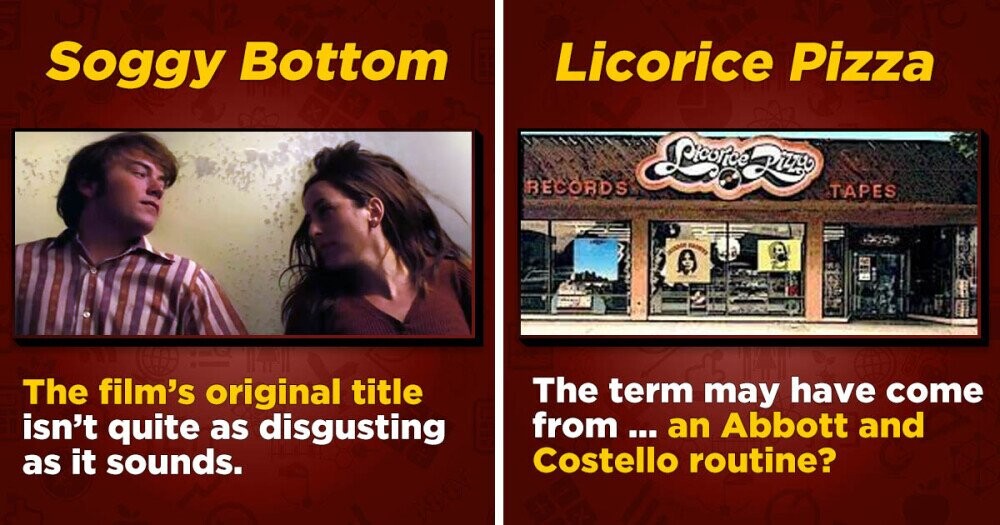
The title Licorice Pizza comes from a real Southern California record-store chain that was part of Los Angeles youth culture in the 1970s and 1980s. Anderson chose the name because it evoked the San Fernando Valley of his childhood: music, storefronts, teenage freedom, shaggy ambition, and the feeling that the world was both enormous and strangely local. In other words, the title is less a literal clue and more a mood ring.
To understand where Paul Thomas Anderson got the name Licorice Pizza, we need to look at the slang behind the phrase, the old record-store chain, the movie’s original working title, and why Anderson’s best titles often work like half-remembered dreams. Let’s gently drop the needle.
What Does “Licorice Pizza” Mean?
The phrase “licorice pizza” has long been associated with vinyl records. Think about it: a vinyl LP is round like a pizza and often black like licorice. It is the kind of joke that could only come from people who spent too much time around records and not enough time around nutritionists.
The expression became famous in Southern California because of a record-store chain called Licorice Pizza. The store name was playful, odd, and instantly memorable. It sounded like a secret password for music lovers, a place where teenagers could drift in after school, flip through album bins, argue about bands, and maybe pretend they were cooler than they were. Which, to be fair, is half the purpose of youth.
The name also carries a convenient abbreviation: LP. That matters because “LP” stands for “long-playing record.” So the store name worked on several levels: it described the look of a record, nodded to the format, and had the weird charm of a phrase nobody would forget after seeing it on a sign.
The Real Licorice Pizza Record Store Chain
Licorice Pizza was not invented for the movie. It was a real record-store chain that began in Southern California in 1969. Founded by James Greenwood, the business grew from its first location into a regional chain that became a familiar part of the Los Angeles music scene. At its height, it had dozens of locations around Southern California.
For teenagers in the 1970s and early 1980s, record stores were more than shops. They were cultural headquarters. Before streaming turned every song into a tap on a glass rectangle, buying music required geography. You had to go somewhere. You had to browse. You had to make a decision with actual money. You might discover David Bowie, Pink Floyd, Led Zeppelin, Nina Simone, or Bruce Springsteen because a clerk was playing something loud enough to make the walls feel opinionated.
Licorice Pizza stores were remembered for their relaxed, hangout atmosphere. They had records, tapes, posters, music talk, and, yes, the store reportedly leaned into the candy part of the name by keeping licorice around. The experience was not just retail; it was social. You could go there to buy an album, but you could also go there to listen, loiter, flirt badly, and form a personality one record sleeve at a time.
Why Paul Thomas Anderson Chose the Title
Paul Thomas Anderson has said that Licorice Pizza reminded him of growing up in Southern California. The words “licorice” and “pizza” gave him an immediate memory response, the kind that does not need a clean definition to feel right. That is the key to the title: it is not a plot summary. It is an emotional shortcut.
The movie is set in the San Fernando Valley in 1973 and follows Gary Valentine, a confident teenage actor and young hustler, and Alana Kane, a restless young woman who gets pulled into his orbit. They start businesses, run through the Valley, collide with adults behaving badly, and chase versions of themselves they do not fully understand yet. The film moves like memory: episodic, funny, awkward, sunlit, and occasionally ridiculous.
In that context, Licorice Pizza is the perfect title because it feels like something from the world of the movie even though the store itself does not appear on screen. It belongs to the atmosphere. It suggests records, adolescence, storefront culture, Los Angeles, and a specific pre-digital way of being young. The movie is not about the record store. It is about the kind of world where that record store could be a landmark.
Why the Movie Was Almost Called “Soggy Bottom”
Before Licorice Pizza became the official title, many film watchers knew the project by another name: Soggy Bottom. That phrase appears in the film as the name of Gary Valentine’s waterbed company. As a title, it is certainly memorable. It is also hard to say with a straight face in a prestigious awards conversation. “And the Oscar goes to… Soggy Bottom” sounds like a prank pulled by a mischievous teleprompter.
Anderson ultimately decided that he could not live with that title for the movie. The choice makes sense. Soggy Bottom points to one piece of the plot, but Licorice Pizza opens the film outward. It creates curiosity instead of narrowing the story to waterbeds. More importantly, Licorice Pizza sounds like the 1970s Valley as Anderson remembers and imagines it: colorful, odd, commercial, musical, and slightly unserious in the best possible way.
The San Fernando Valley Connection
Paul Thomas Anderson has returned to the San Fernando Valley again and again in his films. Boogie Nights, Magnolia, Punch-Drunk Love, and Licorice Pizza all draw from the geography, mood, and mythology of the Valley. For Anderson, the Valley is not a generic suburb. It is a living cinematic landscape full of strip malls, restaurants, gas stations, theaters, production offices, and homes where Hollywood feels both nearby and slightly out of reach.
Licorice Pizza uses that landscape as more than a backdrop. The Valley shapes the story. Gary and Alana are constantly moving through it: running, driving, selling, waiting, scheming, and bumping into strange adults. Their world has real historical texture. The oil crisis, waterbed craze, child acting culture, local politics, restaurants, and Hollywood-adjacent characters all help create a Los Angeles that feels lived-in rather than decorated.
That is why the title works. A straightforward title like Gary and Alana would tell us who the story follows, but it would miss the atmosphere. Licorice Pizza tells us where the movie lives emotionally. It is a phrase from the cultural wallpaper of the time.
Does the Title Connect to the Plot?
The title does not connect to the plot in the obvious way viewers might expect. There is no grand scene in which Gary discovers a record store, buys a rare LP, and learns the meaning of life from a wise clerk with a mustache. Nobody dramatically bites into licorice while holding a slice of pizza under a disco ball. The film is not hiding a snack-based mystery.
Instead, the title connects through mood, setting, and memory. Anderson’s film is about youth as a series of half-planned adventures. Gary is always launching new schemes: acting, selling waterbeds, running a pinball business, trying to impress Alana. Alana is searching for direction, trying on identities, resisting adulthood while wanting its power. Together, they move through a world where everything feels possible because neither of them has enough experience to know how badly things can go.
That energy is exactly what the phrase Licorice Pizza captures. It is sweet, strange, nostalgic, and slightly off-center. It sounds like a thing a teenager would accept immediately and an adult would overanalyze for two hours. Naturally, here we are.
The Title as a Paul Thomas Anderson Signature
Anderson’s titles often resist easy explanation. There Will Be Blood sounds biblical and thunderous. Phantom Thread suggests hidden emotional stitching. Magnolia appears simple until the film’s web of coincidence, place, and mystery expands around it. Punch-Drunk Love feels like romance after being hit in the head by a rainbow.
Licorice Pizza belongs in that tradition. It does not behave like a label. It behaves like a texture. It gives the viewer a feeling before the story begins. The phrase is funny, tactile, and faintly absurd. It tells us the movie will not be a polished nostalgia museum. It will be messy, human, affectionate, embarrassing, and alive.
This is especially important because Licorice Pizza is one of Anderson’s gentler films. It still contains tension, bad behavior, and unease, but it is warmer than some of his darker works. The title helps set that tone. It promises a film that may be odd, but not cruel. It invites viewers into a memory rather than warning them about disaster.
Why the Record-Store Reference Matters
Record stores were once places where culture gathered in physical form. Album art was big. New releases felt like events. Clerks could be intimidating, brilliant, bored, or all three before lunch. You did not simply “access content.” You entered a room full of opinions pressed into vinyl.
That matters because Licorice Pizza is a film about a time when identity was built in public spaces. Gary and Alana do not scroll through private feeds. They meet people face to face. They sell things. They embarrass themselves in restaurants. They run down streets. They try to become somebody in front of other people, which is both healthier and much more humiliating.
By naming the film after a record-store chain, Anderson ties it to an era when music, movies, fashion, and local business blended into everyday life. The title reminds us that growing up used to involve wandering into places without knowing exactly what you were looking for. Sometimes you found an album. Sometimes you found trouble. Sometimes, if cinema is feeling generous, you found Alana Haim sprinting across the Valley like destiny had forgotten to wear sensible shoes.
What the Title Says About Nostalgia
Nostalgia can be lazy when it simply says, “Wasn’t the past adorable?” Licorice Pizza is more complicated than that. The movie loves the texture of the 1970s, but it also shows the confusion, arrogance, racism, sexism, oil anxiety, and adult irresponsibility of the period. The title may sound playful, but the film is not pretending the past was perfect.
Instead, Anderson uses nostalgia as a way to explore memory. Childhood and adolescence rarely return to us as clean timelines. They come back as names, smells, songs, storefronts, jokes, cars, restaurants, and arguments. A phrase like Licorice Pizza may not explain an event, but it can unlock the feeling of a whole era.
That is why the title has stuck with audiences. It is strange enough to invite a Google search, but meaningful enough to reward one. Once you know the record-store history, the title becomes richer. Once you understand Anderson’s relationship to the Valley, it becomes even more precise.
Experience Section: Watching “Licorice Pizza” Through Its Title
One of the best ways to experience Licorice Pizza is to stop waiting for the title to “pay off” in a conventional sense. Many viewers enter the movie expecting the phrase to appear as a line of dialogue, a business name, a neon sign, or at least a slice of pizza placed suspiciously near a bowl of licorice. That expectation is understandable. Movies train us to look for clues. Anderson, however, is playing a different game.
The title starts working before the plot does. It puts the viewer in a state of curiosity. What kind of movie has a name this weird? That question becomes part of the viewing experience. The film itself then answers indirectly: this is a movie about odd combinations. Gary and Alana are mismatched. Youth and adulthood are mismatched. Hollywood glamour and Valley boredom are mismatched. Big dreams and tiny businesses are mismatched. Even the tone is a mix of sweetness, discomfort, comedy, and melancholy.
Watching the movie with the title in mind makes its rhythm easier to appreciate. The story does not move like a tightly engineered machine. It moves like someone remembering a summer that got out of hand. One moment Gary is selling waterbeds. Another moment Alana is backing a truck downhill without gas. Then Bradley Cooper storms through the film as Jon Peters with the energy of a man who has never once said, “Maybe I should calm down.” The episodes may seem loose, but they accumulate into a portrait of young people trying to invent themselves.
The title also encourages viewers to pay attention to the film’s sensory details. The warm light, the music cues, the old storefronts, the cars, the restaurants, and the clothing all matter. They are not just decoration. They are the emotional infrastructure. Anderson wants the audience to feel how a particular place at a particular time could shape people’s ambitions. The San Fernando Valley becomes a playground, a trap, a stage, and a memory palace.
For anyone writing about the film, the title is a gift. It opens a door into discussions of vinyl culture, 1970s Los Angeles, Anderson’s biography, youth, nostalgia, and the difference between plot meaning and emotional meaning. A plain title might have made the movie easier to summarize, but it would have made it less interesting to revisit. Licorice Pizza sounds like nonsense until you realize that memory often arrives as nonsense first. Then, slowly, it becomes a map.
In the end, the title works because it behaves exactly like the film: it runs on instinct. It is funny, local, specific, and hard to explain without telling a story. That is also why it remains one of Anderson’s most memorable titles. You may forget a plot detail or two, but you are unlikely to forget the name. Like a great record-store sign glowing in the Valley night, Licorice Pizza sticks in the mind.
Conclusion: So, Where Did Paul Thomas Anderson Get That Name?
Paul Thomas Anderson got the name Licorice Pizza from a real Southern California record-store chain that helped define the music-shopping culture of the 1970s and 1980s. The phrase itself refers playfully to vinyl records: black like licorice, round like pizza, and conveniently abbreviated as LP.
But Anderson did not choose the title only because of trivia. He chose it because it captured the feeling of his movie: the San Fernando Valley, teenage momentum, oddball businesses, music, memory, and the bright confusion of becoming yourself. Licorice Pizza is not a literal title. It is a time machine with a weird name and excellent taste in atmosphere.
The result is a title that sounds strange at first, then becomes hard to replace. Soggy Bottom may have described the waterbed plot, but Licorice Pizza describes the whole world of the film. It is sweet, awkward, nostalgic, and just peculiar enough to be unforgettablemuch like youth, Los Angeles, and Paul Thomas Anderson’s best work.