

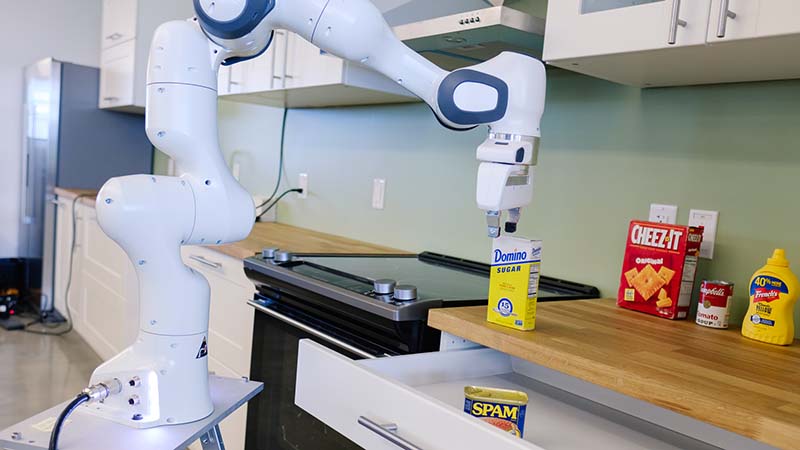
Somewhere between “please pass the salt” and “why is there a spatula in the cereal drawer,” the modern kitchen became one of the toughest final bosses in robotics. NVIDIA, best known for graphics chips, AI accelerators, and powering a suspicious amount of the machine-learning universe, has spent years exploring a deceptively simple question: can robots learn to work in ordinary human spaces, starting with something as familiar as an IKEA kitchen?
The phrase Nvidia teaching robots to master IKEA kitchens sounds like a tech headline that escaped from a Scandinavian furniture warehouse, but the idea is serious. Kitchens combine cabinets, drawers, clutter, slippery objects, soft food, shiny surfaces, unpredictable humans, and the occasional rogue banana peel. For humans, this is Tuesday. For robots, it is a physics exam, a vision test, a planning challenge, and a trust exercise rolled into one countertop.
NVIDIA’s robotics work uses kitchens not because the company secretly wants a robot to assemble flat-pack cabinets while whispering “Allen wrench supremacy,” but because kitchens offer a standardized yet messy environment where robots can learn skills that transfer to homes, hospitals, warehouses, factories, and service settings. An IKEA kitchen is affordable, modular, repeatable, and globally recognizable. That makes it useful as a shared benchmark: one lab’s robot can be tested against another lab’s robot without everyone inventing a different universe of cabinets.
Why an IKEA Kitchen Is a Perfect Robot Classroom
Industrial robots have traditionally thrived in spaces designed for them. They weld, pick, package, and assemble with impressive speed, often inside fenced-off work cells where lighting, object position, and task order are tightly controlled. A kitchen is the opposite. A mug may be inside a cabinet, behind a bowl, next to a glass, half-covered by a towel, while a person stands nearby asking the robot to “grab the blue one.” The robot must understand language, objects, geometry, safety, and context.
IKEA kitchens are especially useful because they are standardized. Cabinets, drawers, handles, shelves, and storage layouts can be reproduced in labs around the world. In robotics, reproducibility matters. If a research team claims its robot can open a drawer, retrieve a cup, and place it on a table, other researchers need a way to test that claim under similar conditions. A modular kitchen provides that shared stage.
The kitchen also scales in difficulty. A clean countertop with one cereal box is relatively manageable. Add cabinet doors, drawer slides, reflective appliances, soft produce, a flour bag, stacked dishes, and a human reaching for coffee at the same time, and suddenly the robot has entered the “expert mode” of household robotics. This is exactly why the kitchen is valuable: it lets researchers move from simple manipulation to complex, long-horizon behavior.
From GPU Power to Physical AI
NVIDIA’s role in robotics is tied to the same engine that pushed deep learning forward: accelerated computing. Training AI models requires massive amounts of data and computation. Robots add another layer of difficulty because they must understand the physical world, not just text, images, or audio. They need what NVIDIA calls physical AI: models that can perceive, reason, and act in real environments.
Physical AI is not only about recognizing a mug. It is about knowing how to approach the mug, avoid the cabinet door, grasp the handle without crushing it, move around a person, and place the mug down without creating a ceramic tragedy. That requires computer vision, motion planning, object tracking, simulation, reinforcement learning, imitation learning, and reliable on-robot computing.
In NVIDIA’s Seattle robotics work, the kitchen has served as a real-world testing ground for mobile manipulators that detect objects, track doors and drawers, and use learned perception systems to interact with furniture. These systems combine multiple technologies: object pose estimation, depth sensing, articulated-object tracking, reactive motion control, and simulation-trained neural networks. In plain English: the robot is trying to see the kitchen, understand what moves, figure out where its arm can go, and avoid behaving like a metal octopus at brunch.
Isaac Sim: The Virtual Kitchen Before the Real Kitchen
A major reason NVIDIA is influential in robotics is Isaac Sim, a robotics simulation platform built on NVIDIA Omniverse. Simulation matters because real-world robot training is slow, expensive, and risky. If a robot must learn by physically dropping plates, slamming drawers, and bumping into countertops, progress becomes both costly and loud. Very loud.
Isaac Sim lets developers create realistic virtual environments where robots can practice perception, movement, manipulation, and decision-making before touching real hardware. Developers can import 3D assets, define physics properties, simulate sensors, generate synthetic data, and test robot software under many lighting conditions, object placements, and layouts.
This is especially important for kitchens. A virtual IKEA-style kitchen can be rearranged endlessly. The robot can practice opening drawers, reaching into cabinets, picking objects from shelves, navigating around tables, and handling clutter. Researchers can randomize lighting, textures, object colors, positions, and camera noise so the AI does not memorize one perfect scene. Instead, it learns patterns that have a better chance of surviving contact with the real world.
The Sim-to-Real Problem: Where Robots Meet Reality
The great villain of robot learning is the simulation-to-reality gap. A robot may perform beautifully in a simulated kitchen, then fail in a real one because the cabinet hinge has more friction, the lighting is warmer, the mug is glossier, or someone left a dish towel in the worst possible place. Reality is rude like that.
NVIDIA’s approach uses domain randomization, synthetic data, real-world feedback, and physically accurate simulation to narrow that gap. Instead of pretending the virtual kitchen is perfect, researchers intentionally vary conditions. They change materials, lighting, object locations, physics parameters, camera angles, and clutter. The idea is to make the robot robust enough that the real world looks like just another variation it has already survived.
This is why the IKEA kitchen concept is clever. Standardization gives researchers a repeatable baseline, while everyday messiness gives robots the chaos they need to master. The goal is not to build a robot that works in one showroom kitchen under one camera angle. The goal is to build systems that can generalize: different cabinets, different objects, different homes, same basic competence.
What Robots Must Learn in a Kitchen
1. Seeing Objects Clearly
Robots need to recognize objects and estimate their position in 3D space. A cereal box is easier than a transparent glass. A can is easier than a half-full flour bag. A shiny spoon can confuse cameras. A banana changes shape, color, and softness over time, because apparently fruit believes in software updates too.
2. Understanding Doors, Drawers, and Cabinets
Kitchens are full of articulated objects. Drawers slide. Cabinet doors rotate. Appliances open in different directions. A robot must track not only where an object is, but how that object moves. Opening a drawer requires finding the handle, pulling along the correct axis, adjusting force, and stopping before the drawer becomes a dramatic floor ornament.
3. Planning Safe Motion
A robot arm cannot simply move in a straight line from point A to point B. It must avoid collisions with shelves, cups, cabinet edges, people, and itself. NVIDIA research on motion policies and neural planning focuses on generating smooth, collision-free movement from sensor observations, helping robots react in dynamic environments.
4. Grasping Different Materials
Picking up a rigid can is one problem. Picking up a strawberry without bruising it is another. Household robots must handle hard, soft, slippery, flexible, heavy, light, full, empty, fragile, and oddly shaped items. This is why kitchen tasks are so valuable for robot learning: they compress the weirdness of the physical world into one room.
5. Following Human Instructions
A useful robot cannot require a robotics PhD every time someone wants toast. It must understand natural instructions such as “put the clean cup in the upper cabinet” or “wipe the counter near the sink.” Newer vision-language-action models, including NVIDIA’s GR00T family, point toward robots that can connect language, visual perception, reasoning, and motor actions.
GR00T, Cosmos, and the New Robot Brain
NVIDIA’s newer robotics stack expands beyond classic simulation. The company’s Isaac GR00T models are designed as foundation models for humanoid robots, combining visual understanding, language instructions, and action generation. In simple terms, GR00T is meant to help robots reason about what they see and translate that reasoning into movement.
This matters for kitchen robotics because household tasks are not single-step commands. “Make breakfast” may involve opening a cabinet, finding a bowl, locating cereal, checking whether milk is available, pouring carefully, avoiding spills, and cleaning up. Even “put away the cup” may require identifying whether it is clean, choosing the right cabinet, opening the door, placing it safely, and closing the door.
NVIDIA Cosmos adds another piece to the puzzle: world foundation models and synthetic data tools for physical AI. These systems can help generate diverse visual and physical scenarios for training. For a kitchen robot, that means more examples of clutter, lighting, object arrangements, and household layouts without requiring researchers to manually stage every scene. The robot can virtually experience thousands of kitchens before entering one real kitchen and acting like it has been there before.
How Stanford BEHAVIOR-1K and RoboCasa Fit the Story
NVIDIA is not working alone in the broader robotics ecosystem. Stanford’s BEHAVIOR-1K benchmark focuses on 1,000 everyday activities grounded in what people actually want robots to help with, such as cooking, cleaning, folding laundry, and tidying rooms. It uses realistic simulation to test long-horizon household tasks, which are exactly the kinds of challenges kitchens reveal.
RoboCasa, another major research effort, focuses heavily on realistic kitchen environments for generalist robots. It includes diverse kitchen scenes, thousands of assets, interactable furniture and appliances, and many everyday manipulation tasks. Together, projects like BEHAVIOR-1K and RoboCasa show that the kitchen is becoming more than a cute demo location. It is turning into a serious proving ground for embodied AI.
These benchmarks are important because household robotics needs measurable progress. A video of a robot making toast is fun, but researchers need standardized tasks, repeatable environments, success metrics, and failure analysis. Otherwise, every robot demo becomes a magic trick: impressive, mysterious, and suspiciously edited right before the toaster scene.
Why Kitchens Matter Beyond the Home
Teaching robots to master IKEA kitchens is not only about future home assistants. The same skills apply to hospitals, eldercare, restaurants, warehouses, laboratories, and manufacturing. A robot that can open a cabinet, retrieve supplies, avoid humans, handle delicate objects, and adapt to clutter could be useful far beyond the breakfast nook.
In healthcare, robots may need to fetch items from shelves or assist with routine logistics. In warehouses, they may need to handle mixed inventory rather than identical boxes. In labs, they may manipulate containers, drawers, instruments, and samples. In retail, they may restock shelves. The kitchen is a compact training arena for these broader skills.
That is why NVIDIA’s kitchen research is less about selling a robot chef and more about solving general manipulation. A robot that can survive a kitchen may be better prepared for the rest of the human-built world. After all, if it can find the correct lid in a drawer full of mismatched plastic containers, it deserves at least an honorary engineering degree.
The Safety Question: Robots Near Humans
Safety is the non-negotiable part of household robotics. Industrial robots often operate away from people because they are powerful, fast, and not designed to interpret human body language. A home robot must be different. It needs to move carefully, detect people, yield space, avoid pinching fingers, and understand when uncertainty should trigger caution.
Kitchen safety is especially complicated. The environment may include hot surfaces, sharp tools, liquids, fragile glass, pets, children, and humans who change their minds mid-task. A robot must not only complete a command; it must know when not to act. Sometimes the smartest robot behavior is pausing, asking for clarification, or choosing the slower but safer motion.
Simulation helps here too. Developers can test edge cases that would be risky or annoying in the real world. What happens if a person reaches into the cabinet while the robot is moving? What if the drawer sticks? What if the object slips? What if the robot’s camera view is blocked? Answering these questions in simulation can reduce the number of unpleasant surprises in physical deployment.
The Business Impact of Robot Learning
The race to build useful robots is also a race to create the computing infrastructure behind them. NVIDIA’s robotics strategy connects cloud-scale training, simulation platforms, synthetic data generation, and edge computing. A robot may train in data centers, practice in Isaac Sim, improve through synthetic data, and then run inference on onboard hardware such as Jetson-class systems.
For developers, the value is speed. Instead of collecting every training example in the physical world, they can generate synthetic scenes, run many experiments, and test policy updates before deployment. For businesses, the value is reliability. Robots that are trained and validated across many virtual scenarios may be easier to adapt to real operations.
The long-term opportunity is enormous, but the timeline should be treated realistically. Household robots are not suddenly going to replace every chore next Tuesday. Kitchens remain hard. General-purpose robots must become cheaper, safer, more reliable, easier to maintain, and better at handling unpredictable mess. Still, the direction is clear: robotics is moving from scripted machines toward learning systems that can adapt.
Common Misconceptions About NVIDIA and Kitchen Robots
Misconception 1: NVIDIA Is Building an IKEA Assembly Robot
The IKEA kitchen story is not mainly about assembling furniture. It is about using a standardized kitchen as a test environment for manipulation, perception, and human-robot interaction. If a robot eventually assembles cabinets too, wonderful. Humanity will applaud with sore wrists and missing screws.
Misconception 2: Simulation Alone Solves Robotics
Simulation is powerful, but not magic. Real-world testing remains essential because physical environments contain friction, wear, noise, imperfect sensors, unexpected human behavior, and countless tiny variations. The best approach combines simulation, real data, synthetic data, and careful deployment.
Misconception 3: A Robot That Opens One Drawer Understands Kitchens
Opening a drawer is a useful skill, but kitchen mastery requires chaining many skills together. The robot must perceive, plan, manipulate, recover from mistakes, and understand goals. True competence is not a single trick; it is reliable performance across messy variations.
What the Future Kitchen Robot Might Actually Do
The most realistic near-term kitchen robots may not be full robotic chefs. Instead, they may handle narrow but useful chores: unloading certain dishwasher items, wiping counters, retrieving objects, sorting pantry goods, carrying items, or helping people with mobility limitations. These tasks sound modest, but each one requires serious robotics.
Over time, the capabilities may expand. A robot could learn where objects belong, adapt to a family’s habits, assist with meal preparation, clean spills, and monitor whether the stove area is clear. The challenge is not only technical but social. People must trust the robot, understand its limits, and feel comfortable sharing space with it.
If NVIDIA’s simulation-first robotics ecosystem succeeds, developers will be able to train more capable robots faster and safer. The IKEA kitchen, in that sense, becomes a bridge: ordinary enough to matter, structured enough to benchmark, and complicated enough to expose weak spots. It is not the destination. It is the training gym.
Experience Notes: What This Topic Feels Like in the Real World
Anyone who has spent time in a real kitchen understands why robots struggle there. A kitchen is not a neat computer file. It is a living archive of human habits. The good knife is never in the same place twice. The measuring cups migrate like tiny plastic birds. Someone puts a mug on the counter, someone else moves it to the sink, and suddenly the “known environment” has become a crime scene for object tracking.
That is what makes NVIDIA’s kitchen robotics work so interesting from a practical point of view. The challenge is relatable. You do not need to be a robotics engineer to understand why picking up a tomato is different from picking up a soup can. One is firm, predictable, and geometrically polite. The other is soft, slippery, and capable of becoming pasta sauce if the robot gets too enthusiastic.
The IKEA angle also feels oddly perfect. Anyone who has assembled IKEA furniture knows the mix of order and chaos: standardized parts, clear diagrams, and yet somehow one leftover screw that looks at you with judgment. For robotics researchers, standardization is gold. If labs can reproduce similar kitchen layouts, they can compare results more fairly. But unlike a sterile lab bench, an IKEA kitchen still resembles a real home. It has drawers, cabinet doors, shelves, appliances, handles, corners, and awkward reach zones.
Imagine watching a robot learn to unload a cabinet. At first, it might move like someone trying to play piano while wearing oven mitts. It pauses, recalculates, reaches, misses, adjusts, and tries again. In simulation, that awkward learning process can happen thousands or millions of times without breaking your favorite bowl. In the real kitchen, every small success matters: opening a drawer smoothly, avoiding a collision, recognizing a cup despite glare, placing an object without wobble.
The most valuable experience-related lesson is humility. Kitchens remind us that human intelligence is deeply physical. We casually estimate weight, texture, balance, heat, sharpness, and motion without naming the calculations. A robot has to learn those patterns explicitly or through massive training. When we say “just grab the bowl,” we are compressing years of human sensorimotor learning into four words. The robot hears the command and faces a mountain of decisions.
There is also a human-centered side. The best kitchen robot will not be the flashiest one. It will be the one that behaves predictably, asks for help when confused, moves safely, and makes daily life easier without turning breakfast into a software demo. If a future NVIDIA-powered robot can quietly put dishes away, find the cereal, avoid the cat, and not panic when someone rearranges the spice rack, that will be a bigger achievement than it sounds.
In that sense, teaching robots to master IKEA kitchens is not just a robotics project. It is a rehearsal for machines entering ordinary human spaces. The kitchen is where engineering meets crumbs, clutter, routine, and family life. If robots can learn there, they may eventually learn to help almost anywhere.
Conclusion
Nvidia teaching robots to master IKEA kitchens is more than a quirky tech story. It represents a major shift in robotics: from machines that repeat fixed motions in controlled spaces to AI-powered systems that learn, adapt, and operate around people. The IKEA kitchen works because it is standardized enough for research and realistic enough to reveal hard problems.
NVIDIA’s work with Isaac Sim, Isaac Lab, GR00T, Cosmos, synthetic data, and physical AI points toward a future where robots train extensively in virtual worlds before entering real ones. Projects like BEHAVIOR-1K and RoboCasa show that household tasks are becoming serious benchmarks for embodied AI. The journey is still difficult, but the kitchen may be one of the best classrooms robotics has ever had.
So the next time you open an IKEA drawer and find three spatulas, one battery, and a mysterious screw, remember: you are not just looking at clutter. You are looking at a robotics research challenge with cabinets.