

Romantic relationships are built on trust, affection, communication, aown to pick something up.
A viral social media conversation invited people to reveal the harmless routines they repeat mainly because their partners find them mildly unbearable. The responses celebrated a strangely recognizable form of intimacy: the long-running joke that one person claims to hate but would probably miss if it suddenly disappeared. habits are rarely grand pranks. They are smaller, stranger, and far more persistent. Think deliberately mispronouncing a familiar word, singing an improvised theme song whenever your partner enters the kitchen, or asking whether they are asleep while actively watching them sleep.
Researchers have found that shared humor, rather than simply being “the funny one,” is associated with stronger romantic connection. Couples tend to benefit when they laugh together and create a private comic language that belongs to the relationship. note: The entries below are original, tweet-style paraphrases inspired by the online discussion. They are not verbatim reproductions of individual social media posts.
Why Annoying Your Partner Can Feel Weirdly Romantic
There is an important difference between affectionate annoyance and behavior that causes genuine distress. In the affectionate version, both people understand the joke, the stakes are low, and the annoyed partner remains emotionally safe. One person may sigh dramatically, but the sigh is part of the performance.
These repeated jokes can function like tiny invitations to connect. Relationship researchers sometimes describe small attempts to gain a partner’s attention as “bids.” A silly voice, an unnecessary sound effect, or a recycled joke can essentially mean, “Please enter our private little world for ten seconds.” s not always laughter. Sometimes it is an eye roll, a groan, or the sentence, “Please stop doing that.” For the person performing the bit, that familiar reaction may be exactly what makes the routine satisfying.
30 Things People Do Just to Annoy Their Partners
Household Habits Designed for Maximum Irritation
- The Dishwasher Consultant: “Whenever my partner loads the dishwasher, I stand nearby and quietly say, ‘Interesting choice,’ without offering any useful information.”
- The Empty-Container Surprise: “I leave exactly one teaspoon of juice in the carton so I can honestly say I did not finish it.”
- The Thermostat Historian: “Every time she changes the temperature, I remind her what the thermostat was set to on the day we first met.”
- The Laundry Narrator: “When he folds towels, I provide live sports commentary and describe each fold as either courageous or technically disappointing.”
- The Cabinet Mystery: “I leave one kitchen cabinet open and wait. He can sense it from three rooms away.”
- The Vacuum Chauffeur: “When my wife vacuums, I walk ahead of her like I am guiding a very slow ceremonial parade.”
- The Grocery Interrogator: “Whenever my partner returns from the store, I hold up every item and ask, ‘And what exactly is the plan here?’”
- The Pillow Inspector: “I carefully arrange the decorative pillows and then lie directly on top of all of them while maintaining eye contact.”
- The Spoon Problem: “My husband has a favorite spoon. I do not hide it. I simply use it before he can.”
- The Light-Switch Supervisor: “Whenever she turns off a light, I turn it back on and announce that the room was still using it.”
Verbal Bits That Refuse to Retire
- The Deliberate Mispronunciation: “I pronounce ‘quesadilla’ differently every time. None of my versions are legal in any language.”
- The Human Echo: “When my partner says something serious, I repeat the final three words in the voice of a concerned documentary narrator.”
- The Unnecessary Nickname: “His name is Daniel. I have called him ‘Danathan’ for six years. He has stopped correcting me, but I know the battle continues inside.”
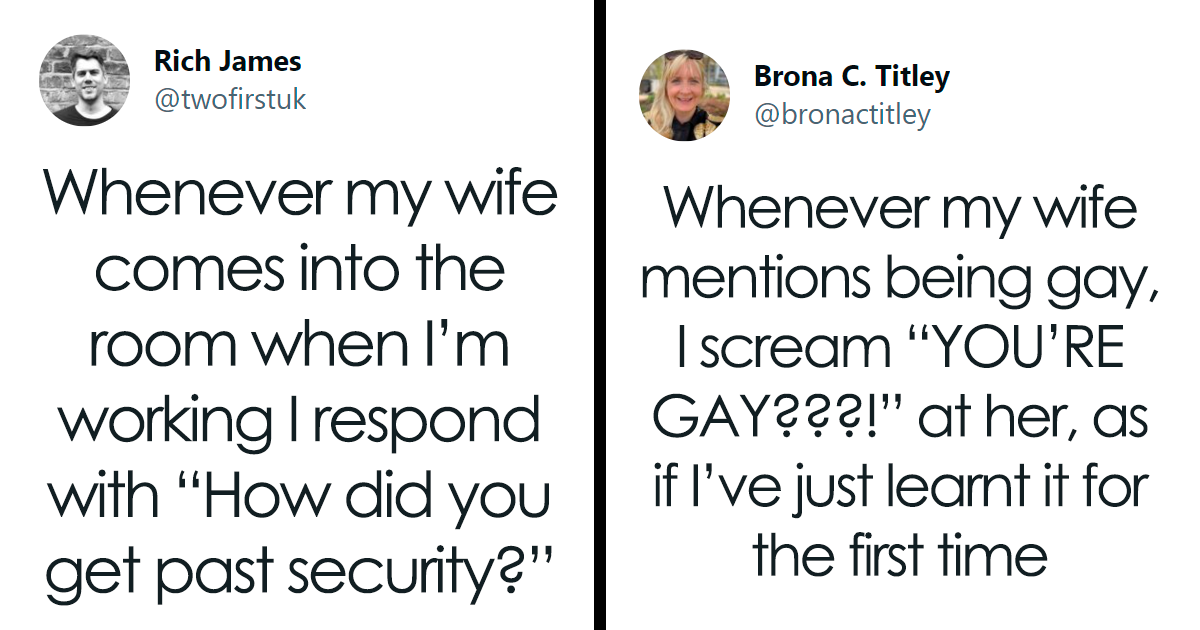
- The Suspicious Greeting: “Whenever my wife enters a room, I ask, ‘What are you doing here?’ We own the house together.”
- The Movie Predictor: “Ten minutes into every movie, I confidently predict an ending that makes absolutely no sense.”
- The Fake Fact: “I invent historical trivia about ordinary objects until she reaches for her phone to check whether Thomas Edison really patented the throw pillow.”
- The Song-Replacement Program: “I replace one word in every love song with the word ‘lasagna’ and perform it with complete emotional commitment.”
- The Customer-Service Voice: “When my husband asks where something is, I say, ‘Thank you for contacting Household Support. Your request is important to us.’”
- The Wrong Expression: “I intentionally mix sayings, then act confused when she tells me it is not ‘the early bird gets the whole nine yards.’”
- The Dramatic Farewell: “Whenever he goes outside to get the mail, I hug him like he is leaving for a dangerous expedition.”
Physical Comedy, Technology and Strategic Nonsense
- The Cold-Hand Ambush: “I warm neither my hands nor my conscience before placing them on my partner’s back.”
- The Bedtime Interview: “The moment she gets comfortable, I ask a complicated question about our five-year financial goals.”
- The Pause-Button Criminal: “When he pauses a show to get a snack, I wait several seconds and then resume it for exactly one line.”
- The Photo Saboteur: “Whenever my wife tries to take a serious picture, I appear in the background looking deeply alarmed.”
- The GPS Rival: “I repeat the navigation instructions half a second after the phone says them, as though I am personally guiding the vehicle.”
- The Notification Impersonator: “I make his text-message sound with my mouth and watch him check his phone.”
- The Tiny Dance: “Every time the microwave has fewer than ten seconds remaining, I perform a countdown dance that nobody requested.”
- The Escalator Rule: “Whenever we ride an escalator, I stand one step above her and announce that I am now the taller partner.”
- The Sleeping Survey: “I whisper, ‘Are you asleep?’ If he does not answer, I ask again because the first study was inconclusive.”
- The Longest Running Bit: “Whenever my partner says, ‘I hate when you do that,’ I calmly reply, ‘This is valuable feedback,’ and schedule the bit for tomorrow.”
Why These Repeated Jokes Become Relationship Rituals
Repetition Turns Nonsense Into Shared History
A joke may begin as a random moment, but repetition gives it meaning. The fifth appearance is predictable. The fiftieth becomes tradition. After several years, the couple may no longer remember how the joke started, yet both partners know the correct response.
This is one reason inside jokes can feel intimate. They compress a long history into a phrase, expression, or sound that would mean nothing to anyone else. A stranger hears a person say “the ceremonial banana has arrived” and becomes concerned. The partner hears it and remembers a disastrous grocery trip from 2019.
Research on long-term relationships suggests that humor is most valuable when couples create and appreciate it together. It is not merely about one partner delivering impressive jokes. It is about both people recognizing the same absurdity and participating in the same playful culture. on Is Part of the Performance
Many affectionate annoyances follow a dependable script. One partner performs the behavior. The other protests. The first person looks delighted. Both know their roles.
The theatrical eye roll does not necessarily mean rejection. It may be a form of participation. The supposedly irritated partner is providing the traditional response that completes the joke, much like an audience shouting a familiar line during a cult movie.
However, the performer must remain observant. A playful groan and a genuinely distressed request can sound similar. Tone, timing, context, and the overall health of the relationship matter.
Social Media Gives Private Humor a Public Stage
Phones and social platforms now capture countless pieces of couple life, from affectionate texts to embarrassing videos and public jokes. Technology can help partners feel connected, but it can also become a source of distraction, jealousy, or disagreement about privacy. Pew Research Center has documented both positive and negative effects of digital technology on committed relationships. feels harmless in the kitchen may feel humiliating when posted for thousands of viewers. Before turning a partner’s strange sleep habit, cooking mistake, or emotional reaction into content, it is wise to ask whether they want to be part of the performance.
When Playful Annoyance Stops Being Playful
The safest relationship humor invites both people into the joke. Harmful humor places one person beneath it.
A Clear “Stop” Is Not an Invitation to Try Harder
Healthy boundaries protect physical comfort, emotional safety, privacy, and personal dignity. When someone clearly says that a behavior hurts, frightens, embarrasses, or overwhelms them, continuing is not affectionate persistence. It is a refusal to respect the boundary. should be easy to pause. The person performing the joke should care more about their partner’s comfort than about completing the bit.
Sensitive Subjects Should Not Become Comedy Targets
Body image, health concerns, family trauma, professional insecurity, finances, fertility, grief, and deeply held beliefs are rarely safe targets unless both partners have clearly established otherwise.
Hostile sarcasm, mockery, and humor that communicates superiority can become expressions of contempt. Relationship guidance from the Gottman Institute identifies contemptuous communication as particularly destructive because it replaces warmth with disrespect. uld Not Be a Disguised Complaint
Sometimes a partner jokes repeatedly about dirty dishes, spending habits, lateness, or household responsibilities because direct conversation feels uncomfortable. The humor may sound playful, but resentment is doing the writing.
When the same joke keeps targeting a real disagreement, replace the performance with a calm request. “You are hilariously incapable of finding the laundry basket” is less useful than “Could you please put your clothes in the basket tonight?”
How to Annoy Your Partner Affectionately
- Choose low-stakes material. Silly voices, harmless songs, and absurd nicknames are safer than insecurities or past mistakes.
- Notice the real response. Laughter, playful retaliation, and exaggerated groaning suggest participation. Withdrawal, anger, fear, or repeated objections suggest the joke should end.
- Keep private moments private. Do not post your partner’s embarrassment without permission.
- Let the joke target you sometimes. Self-directed humor keeps the relationship from becoming a one-person roast.
- Retire unsuccessful material. Even legendary comedians abandon jokes that do not work. Your kitchen is not an exception.
- Balance teasing with appreciation. Make sure your partner hears sincere compliments more often than comic criticism.
Play and shared recreation can support communication, bonding, positive emotion, and relationship satisfaction. The goal is not to eliminate irritation completely. It is to keep the irritation wrapped in affection, consent, and mutual enjoyment. ction>
Relatable Experiences From Couples Who Keep the Joke Going
The following composite experiences reflect common relationship patterns rather than the private story of any single identifiable couple.
The Joke That Accidentally Became a Greeting
One couple began a recurring bit after a tired partner returned home and dramatically announced, “The mayor has arrived.” There was no mayor, no election, and no reason for the statement. Nevertheless, it survived.
Soon, every arrival required an official announcement. Coming home with groceries became a press conference. Walking into the bedroom required ceremonial music. Returning from taking out the trash received a full standing ovation.
The partner being announced initially described the routine as ridiculous. Years later, a quiet entrance felt strangely incomplete. What began as an irritating joke had become a signal: You are home, I noticed, and your presence changes the room.
The Mispronounced Word That Nearly Started a Dictionary War
Another couple disagreed over the pronunciation of a restaurant’s name. One partner checked the company’s official advertisement and proved the correct pronunciation. The other responded by creating an even less accurate version.
That new version multiplied. Menus, street names, actors, vegetables, and household appliances were all given wildly incorrect pronunciations. The partner who valued linguistic accuracy protested every time, which only supplied the routine with more energy.
The joke remained harmless because it stayed away from accents, identities, speech difficulties, and other personal sensitivities. It targeted ordinary words rather than people. Most importantly, the supposedly annoyed partner eventually began intentionally mispronouncing words too. The victim had joined the criminal organization.
The Snack Tax With an Elaborate Legal System
A third couple developed a “snack tax.” Whenever one partner opened chips, cookies, or candy, the other claimed a small portion as a mandatory household fee.
Over time, the snack tax acquired imaginary legislation. There were exemptions, appeals, late penalties, holiday surcharges, and an enforcement department consisting entirely of one hungry person standing beside the couch.
The routine occasionally caused real irritation, particularly when the snack owner had purchased exactly enough food for themselves. The couple solved the problem by creating one serious rule inside the ridiculous system: asking for the final bite was permitted, but taking it without permission was not.
That boundary preserved the fun. The joke could continue because both partners knew where the performance ended and genuine consideration began.
The Bit That Needed to Be Retired
Not every experience ends with a beloved tradition. One person enjoyed startling their partner by appearing silently in doorways. The startled reactions were dramatic, and the prank initially produced laughter.
During a stressful period, however, the surprise became upsetting rather than funny. The partner explained that they were already tense and no longer enjoyed being frightened at home.
The prankster initially felt disappointed because the routine had once been mutual fun. Still, they stopped. Later, they replaced it with a safer ritual: entering the room while singing an absurd warning song.
This experience captures the difference between affection and entitlement. A loving joke is not valuable merely because it has history. It remains valuable only while both people can enjoy it. Changing the bit did not weaken the relationship. It showed that the relationship mattered more than the bit.
The Quiet Day That Revealed What the Jokes Meant
One couple spent years exchanging miniature annoyances. He moved her coffee mug two inches to the left. She changed his phone background to increasingly formal portraits of their dog. He called every pasta shape “spaghetti.” She applauded whenever he successfully plugged in a USB cable.
Then one partner traveled for work, and the apartment became unusually quiet. Nobody misnamed the pasta. Nobody interfered with the coffee mug. Nobody issued an award for basic technological competence.
The silence revealed that the habits were not merely attempts to irritate. They were repeated acknowledgments of attention. Each joke communicated familiarity: I know how you arrange your things. I recognize your routines. I remember what reaction this will produce.
When the traveling partner returned, the first greeting was warm and sincere. The second was an immediate complaint that the coffee mug had been left in the correct position for far too long.
Conclusion: Love Is Patient, Love Is Kind, Love Makes the Notification Sound With Its Mouth
People annoy their partners for many reasons, but affectionate teasing often survives because it creates recognition, predictability, and shared history. A ridiculous nickname or recycled joke can become a tiny relationship ritualone that says, beneath all the nonsense, “I know you well enough to know exactly how you will react.”
The healthiest version of this humor remains mutual. Both partners can participate, sensitive subjects remain protected, public sharing requires permission, and a genuine request to stop is respected immediately.
So go ahead and sing the microwave countdown song. Call the family dog “regional management.” Announce your partner’s return from the mailbox like a breaking news event. Just make sure the person rolling their eyes is also trying not to laugh.