

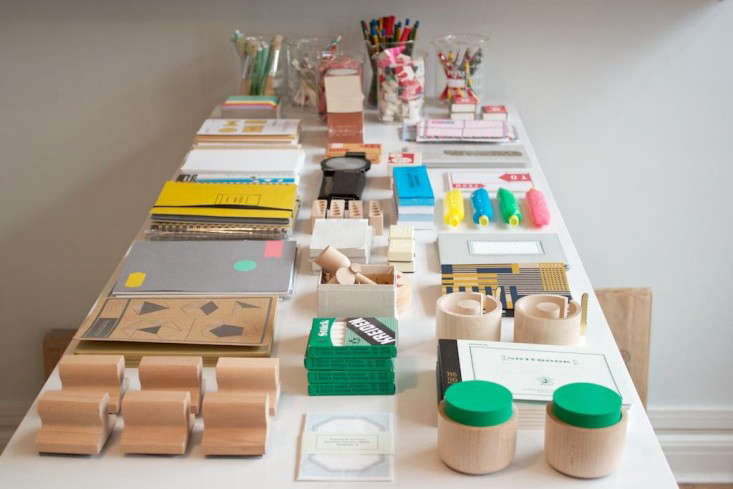
Some stores sell things you need. Others convince you that your life has been tragically incomplete without a German invoice pad, a perfectly weighted brass ruler, or an eraser shaped like a piece of modern sculpture. Present & Correct belongs firmly in the second category.
The independent London stationery shop has developed a devoted following by treating everyday office supplies as objects worthy of attention. Its shelves bring together new designer stationery, original in-house products, vintage paper goods, educational materials, postal ephemera, and curious desk accessories sourced from around the world.
The result is less like walking into a conventional office-supply store and more like entering the beautifully organized mind of a graphic designer. Everything appears deliberate. Pencils line up as though expecting inspection. Paper clips behave themselves. Even the staplers seem unusually confident.
Present & Correct first gained international attention as an online destination before establishing a physical presence in London. Its journey from market stalls and digital retail to a carefully designed brick-and-mortar shop demonstrates how a strong visual identity can turn modest objects into a memorable shopping experience.
From a Stationery Obsession to a London Design Destination
The roots of Present & Correct stretch back to occasional market stalls near Brick Lane, where handmade stationery appeared alongside unusual products discovered during trips abroad. The brand formally opened its virtual doors in 2009, giving stationery enthusiasts access to an assortment that looked refreshingly different from the predictable products found in chain stores.
Graphic designers Neal Whittington and Mark Smith shaped the business around objects they genuinely admired. Their professional background influenced everything from product selection and photography to packaging, typography, merchandising, and the restrained presentation of the online shop.
Rather than organizing merchandise solely by manufacturer or price, Present & Correct approached retail with a designer’s eye. A humble rubber stamp might be chosen for its shape. An old ledger could be valued for its typography. A box of labels might earn shelf space because its faded colors were too good to ignore.
The online store developed an audience among designers, illustrators, architects, collectors, writers, and people who simply experience an unreasonable amount of happiness when opening a fresh notebook. In 2012, Present & Correct opened its first permanent London shop, eventually becoming closely associated with its Arlington Way location in Clerkenwell.
That physical store allowed the brand’s carefully arranged digital world to become three-dimensional. Customers could finally touch the paper, test the pens, inspect the vintage objects, and discover just how many varieties of clips humanity has apparently required.
Why the Original London Store Attracted So Much Attention
When the Arlington Way shop appeared, the owners did not abandon the visual language that had made their website distinctive. Instead, they translated it into the interior.
Birch plywood, pegboard, graph-paper references, movable display units, and simple workshop-style materials created a setting that felt functional without becoming cold. The furniture was designed to support the merchandise rather than compete with it. Even inexpensive, ordinary components were used inventively, including rolling pins adapted into table legs.
The approach was clever because it reflected the products themselves. Present & Correct has never depended on traditional luxury signals such as marble counters, velvet cases, or dramatic spotlights. Its appeal comes from proportion, color, usefulness, history, and the pleasure of seeing familiar tools presented in unfamiliar ways.
The store made a convincing argument that a pair of scissors can be beautiful without becoming precious and that a pencil sharpener deserves thoughtful design even when its primary responsibility is producing tiny piles of wood shavings.
A Physical Version of the Online Brand
Many retailers struggle to make their websites and physical stores feel like parts of the same business. Present & Correct achieved that connection by using a consistent visual vocabulary.
The orderly compositions seen in its product photography reappeared on shelves and walls. Materials used as photographic backgrounds became interior surfaces. Products were spaced carefully enough to be appreciated individually but grouped intelligently enough to create visual rhythm.
This continuity mattered. Customers who had followed the brand online did not enter a generic store with a familiar logo attached to the window. They stepped into the environment they already recognized from photographs, newsletters, and social media.
What Present & Correct Actually Sells
Calling Present & Correct a stationery shop is accurate, but it does not fully describe the assortment. The inventory moves between practical office tools, contemporary product design, graphic ephemera, nostalgic school supplies, and collectible curiosities.
Writing and Drawing Tools
The writing selection may include pencils, mechanical pencils, colored leads, markers, fountain pens, ballpoint pens, chalk, crayons, and sharpeners. These are not chosen merely because they perform adequately. Many stand out through their construction, packaging, history, color, or regional design traditions.
A basic pencil becomes more interesting when it comes from an unfamiliar manufacturer, carries decades-old typography, or has a shape rarely seen in an American office-supply aisle. Present & Correct understands that stationery enthusiasts often care about such details more than is strictly reasonableand wisely refuses to judge them.
Notebooks, Paper, and Postal Goods
Paper products form another major part of the store’s identity. Shoppers may encounter graph pads, writing sets, memo blocks, calendars, envelopes, labels, planners, index cards, notebooks, and filing supplies.
Postal imagery is a recurring influence. Stamps, airmail graphics, sorting labels, address systems, and old forms provide an enormous source of visual material. An obsolete office document can reveal the typography, bureaucracy, manufacturing methods, and working habits of another era.
At Present & Correct, such material is not treated as dusty administrative debris. It is presented as graphic history that happens to fit neatly inside a desk drawer.
Desk Accessories and Organizational Objects
The shop also carries rulers, trays, brushes, clips, tape dispensers, staplers, scissors, storage boxes, pencil cases, desktop organizers, and other tools for maintaining orderor at least creating the appearance of order five minutes before a video meeting.
Some products are new interpretations of classic office equipment. Others are vintage discoveries acquired through markets, collectors, old stockrooms, or international sourcing trips. That mixture prevents the store from feeling like a showroom for a single design trend.
The Role of Vintage Stationery
Vintage stationery is central to the personality of Present & Correct. The owners have sourced old office supplies and paper ephemera from European markets and collections, often finding objects that were never intended to become decorative or collectible.
That original ordinariness is part of their charm. A decades-old attendance card, calculation tool, receipt book, or envelope may reveal an unexpectedly beautiful color combination. Packaging designed for a routine industrial product might contain lettering that feels more inventive than the branding of a modern lifestyle company.
Vintage goods also make the inventory unpredictable. A mass-market retailer can reorder thousands of identical notebooks. A shop dealing in deadstock and old ephemera may have only a few examples of a particular object. Once they are gone, they may be gone for good.
This encourages exploration rather than simple purchasing. Customers are not merely checking items off a list. They are hunting, comparing, and occasionally wondering whether buying a 40-year-old administrative form counts as a responsible financial decision.
A New Chapter in Bloomsbury
In 2023, Present & Correct moved from Clerkenwell to a larger home at 12 Bury Place in Bloomsbury. The location places the shop near the British Museum and amid an area strongly associated with publishing, literature, education, bookshops, architecture, and cultural institutions.
It is an appropriate neighborhood for a business devoted to paper, printed matter, and the tools used to fill blank pages.
The Bloomsbury interior was developed with Architecture for London inside a heritage retail unit. The design introduced bespoke joinery, improved storage, maple plywood, ash timber, quarry tiles, adaptable shelving, and updated lighting.
One of the most thoughtful elements is the demountable construction. Displays can be adjusted or potentially reused rather than treated as permanent decorative scenery. This extends the useful life of the shop fittings and gives the store flexibility as its inventory changes.
Design Inspired by Graph Paper
The architectural concept continues the brand’s fascination with grids. Graph paper is both a practical tool and a visual system, making it an ideal reference for a stationery store founded by graphic designers.
The interior uses repeated compartments and carefully measured alignments to create a sense of order. Yet the store avoids looking rigid. Warm wood, vintage objects, colorful packaging, and playful products soften the geometry.
The design works particularly well because the merchandise contains many small items. Without a clear structure, hundreds of pens, cards, rulers, erasers, and clips could quickly turn into retail confetti. The grid provides discipline while allowing each object enough space to be noticed.
Why Analog Stationery Still Matters
Present & Correct operates in a world filled with project-management platforms, digital calendars, note-taking apps, cloud documents, and electronic signatures. Yet physical stationery continues to attract buyers because analog tools offer experiences that screens cannot fully reproduce.
Writing by hand creates a direct relationship between thought and movement. Paper has texture and resistance. Different pens change the pace and appearance of writing. A notebook can become a record of crossed-out ideas, coffee stains, sudden sketches, and decisions made before the battery reached 2 percent.
Physical tools also have visible boundaries. A paper calendar displays time without notifications. A filing box stores information without suggesting another video. A handwritten list does not suddenly ask whether you would like to upgrade to a premium subscription.
This does not make paper superior to digital technology in every situation. Present & Correct’s appeal comes from showing that analog objects still deserve a place alongside digital systems. The best desk may contain both a powerful computer and a beautifully made pencil.
Lessons for Independent Retailers
The success of Present & Correct offers several useful lessons for small retail businesses.
- Develop a recognizable point of view: The shop does not attempt to stock every office product. It selects items that fit a clear visual and cultural identity.
- Make curation valuable: Customers can buy pens almost anywhere. They visit Present & Correct because someone has already searched through thousands of possibilities and selected the most interesting ones.
- Connect online and physical experiences: The website, photography, packaging, social content, and store interiors all feel related.
- Use storytelling: A vintage form becomes more compelling when customers understand where it came from and why its design matters.
- Respect inexpensive objects: Good retail design does not require every product to be costly. Presentation can reveal beauty in ordinary tools.
Most importantly, the shop demonstrates that specialization can be a strength. A small business does not need to satisfy everyone. It needs to become unforgettable to the right people.
Experiencing Present & Correct in London
A visit to Present & Correct typically begins before you enter. The window display offers an immediate preview of the brand’s personality: precise arrangements, strong color relationships, oversized graphic objects, or collections of familiar supplies presented with enough confidence to make them look newly invented.
Inside, the atmosphere encourages slower browsing. This is not the ideal shop for rushing in while shouting, “Any blue pen will do.” Technically, a blue pen probably will do, but the shelves may persuade you to compare its barrel, ink, nib, country of origin, packaging, and emotional compatibility with your notebook.
The first surprise is how interesting small objects become when they are given space. In a typical office store, erasers are packed into plastic containers and rulers hang in crowded rows. Here, each item feels considered. A group of clips may be arranged by shape. Boxes may form a quiet color study. Vintage labels sit beside contemporary notebooks as if the two were designed decades apart specifically to meet on this shelf.
The experience is especially rewarding for visitors with an interest in graphic design. Packaging is often as engaging as the product inside it. Old typefaces, numerical systems, institutional colors, geometric symbols, and practical diagrams appear throughout the displays. A person could arrive intending to buy a notebook and leave mentally redesigning every form used at work.
Writers may be drawn toward paper and pens. Architects may linger over rulers, grids, and proportional tools. Teachers may recognize echoes of classroom materials. Collectors will naturally examine vintage items, while casual visitors may simply enjoy finding a gift that feels distinctive without being unnecessarily extravagant.
There is also pleasure in handling objects before buying them. The weight of a stapler, smoothness of a notebook cover, scale of a memo pad, or action of a mechanical pencil cannot be understood completely through a product photograph. The store restores a tactile element that online shopping often removes.
One sensible strategy is to complete a first circuit without immediately purchasing anything. This requires discipline, emotional strength, and perhaps supervision. The assortment is compact enough to inspect but varied enough that overlooked objects often appear during a second pass.
Another useful approach is to choose one practical item, one gift, and one completely unnecessary curiosity. The practical item justifies the trip. The gift proves you are thoughtful. The curiosity is the object you will still be talking about six months later.
The Bloomsbury location also makes the shop easy to include in a broader cultural afternoon. Visitors can combine it with nearby museums, independent bookshops, cafés, architectural walks, and other specialist retailers. Present & Correct does not require an entire day, but stationery enthusiasts should avoid making overly optimistic dinner reservations.
Even visitors who purchase very little can leave with ideas. The displays demonstrate how to organize a desk using color, repetition, trays, small containers, and purposeful spacing. A home workspace does not need hundreds of accessories. A few well-chosen tools, arranged thoughtfully, can make routine tasks feel more inviting.
That may be the most memorable part of the experience. Present & Correct does not merely sell supplies. It makes visitors want to return to their desks, clear away the clutter, sharpen a pencil, open a blank page, and begin something.
Conclusion: A Small Shop with a Big Design Influence
Present & Correct has succeeded by recognizing something most people overlook: office supplies shape the way we work, learn, plan, draw, communicate, and remember. These objects may be small, but they participate in thousands of daily decisions.
From its early market-stall roots and 2009 online launch to its first London shop and current Bloomsbury location, the brand has remained remarkably consistent. It celebrates utility, graphic history, international design, playful nostalgia, and the quiet satisfaction of a well-organized desk.
For stationery collectors, it is a destination. For designers, it is a source of visual research. For gift shoppers, it is a reliable escape from the usual candles and coffee mugs. For everyone else, it is proof that even a paper clip can have charisma when it finds the right shop.
Note: Store addresses, opening hours, available products, and temporary closures may change. Visitors should confirm current information through Present & Correct’s official website before traveling.