

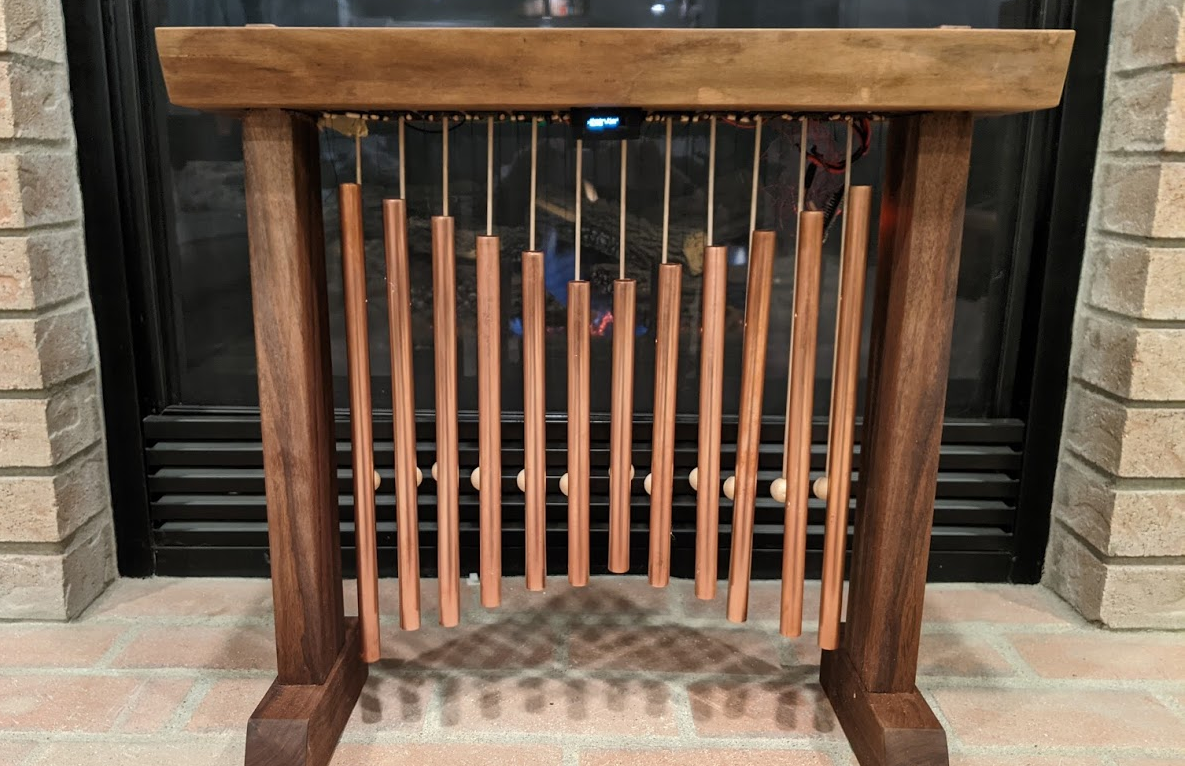
The holidays have a very specific sound. It is not just wrapping paper being attacked by excited children, or somebody in the kitchen asking where the “good scissors” went. It is bells, chimes, tiny melodies, and those cheerful notes that seem to float through December like they own the place. Now imagine that warm seasonal sound upgraded with a little maker magic: self-playing chimes that strike real metal bars automatically, play MIDI holiday songs, and look charming enough to sit proudly on a mantel instead of hiding in a box labeled “miscellaneous wires.”
That is the appeal behind self-playing chimes. They bring together the old-school joy of mechanical music with modern electronics, microcontrollers, solenoids, software, woodworking, and just enough holiday sparkle to make even the grumpiest extension cord feel festive. The idea is simple in spirit: each chime is struck by a small actuator, usually an electromagnetically controlled mallet, while a controller such as an ESP32 tells the system when to play each note. In practice, it is a delightful collision of music theory, electronics, timing, acoustic design, and patience. Lots of patience. The kind of patience normally reserved for untangling Christmas lights.
What Are Self-Playing Chimes?
Self-playing chimes are musical devices that produce sound from physical chime bars, bells, tubes, or similar resonant objects without a human performer striking them by hand. Instead, a mechanical system does the playing. In a modern maker build, the “musician” is often a microcontroller, and the “fingers” are solenoids or small electromagnetic mallets. When the controller sends a signal, the actuator moves, taps the chime, and then gets out of the way quickly enough to let the metal ring freely.
This matters because real chimes are not just speakers wearing a holiday sweater. They create sound through vibration. A struck metal bar or tube produces a bright attack, a ringing decay, and a mix of overtones that gives the note its personality. That physical resonance is why a simple melody played on real chimes can feel warmer and more nostalgic than the same tune coming from a tiny plastic speaker. Digital audio says, “Here is a sound file.” A chime says, “I have been waiting all year to emotionally ambush your living room.”
A Modern Take on a Very Old Idea
The concept of automatic music is not new. Long before microcontrollers, people built music boxes, clock chimes, barrel organs, player pianos, and carillons that could perform patterns using pins, drums, rolls, gears, and levers. Town clocks used chime mechanisms to announce the hour. Music boxes used pinned cylinders or discs to pluck tuned metal teeth. The technology changed, but the dream stayed the same: make a machine that can play music even when nobody is standing there with sheet music and a determined expression.
Self-playing holiday chimes sit right in that tradition. They feel old-fashioned because the sound is acoustic and bell-like, yet they feel modern because the control system can read digital note data, display song titles on an OLED screen, and store multiple tunes. It is a little like inviting a Victorian music box and a Wi-Fi-enabled microcontroller to the same Christmas party. Somehow, they get along beautifully.
How the System Works
1. The Chimes Provide the Voice
The heart of the instrument is the chime set itself. These may be metal tubes, bars, bells, or tuned resonant objects arranged by pitch. For holiday music, a small range can still do a surprising amount. Tunes like “Jingle Bells,” “Deck the Halls,” or “Silent Night” rely on recognizable melodic shapes, so even a modest collection of notes can trigger instant seasonal recognition. The chimes do not need to sound like a concert hall carillon; they just need to ring clearly, sustain nicely, and avoid sounding like a fork dropped into a toolbox.
2. Solenoids Act Like Mechanical Fingers
A solenoid is an electromagnetic actuator. When current flows through its coil, it creates a magnetic field that pulls or pushes a plunger. In a self-playing chime setup, that motion can be used to swing or launch a small mallet toward a chime. The controller energizes the solenoid briefly, the mallet strikes, and the chime rings.
The timing has to be clean. If the mallet stays pressed against the chime, it dampens the sound. If it hits too softly, the note disappears like a cookie left unattended near relatives. If it hits too hard, the result can be harsh, noisy, or mechanically stressful. Good self-playing chimes are not just about making things move; they are about making them move musically.
3. A Microcontroller Keeps Time
The controller is the conductor. An ESP32, Arduino-compatible board, Raspberry Pi Pico, or similar device can read note data and trigger outputs at the right moments. The ESP32 is popular because it is powerful, affordable, compact, and friendly to projects that need multiple outputs, displays, storage, or wireless features. Running MicroPython can make the software side more approachable because it lets makers write readable scripts instead of wrestling every idea into lower-level code.
In a polished build, the controller may read MIDI files, interpret note events, map those notes to individual chimes, and fire the appropriate actuator. Add a small OLED screen, and suddenly the instrument can show the current song title, status, or menu options. This is how a handmade chime project starts looking less like a science fair survivor and more like a finished holiday centerpiece.
Why MIDI Makes So Much Sense
MIDI is useful because it stores musical instructions rather than recorded sound. A MIDI file does not contain audio like an MP3. Instead, it describes notes, timing, duration, and related performance information. For a self-playing chime instrument, that is perfect. The machine does not need a recording of bells; it needs to know which physical chime to strike and when.
Using MIDI also makes the system flexible. A maker can arrange a holiday tune on a computer, simplify the melody to fit the available chimes, export it, and let the instrument perform it. If the chime set only has eight or twelve notes, the arrangement can be adapted. If the instrument grows later, the music can grow with it. This is the part where the project quietly whispers, “What if next year I had harmony?” and your weekend disappears.
The Holiday Charm: Why This Project Feels Special
There are many ways to play Christmas music. A phone can do it. A smart speaker can do it. A department store ceiling speaker can do it 4,000 times until everyone develops emotional calluses. But self-playing chimes offer something different: visible music. You can see the mallets move. You can hear the metal respond. You can watch a song become a sequence of tiny physical events.
That visibility is part of the magic. Holiday decorations often work because they turn ordinary spaces into small theaters. Lights blink. Trains circle miniature villages. Nutcrackers stand guard with suspiciously serious faces. Self-playing chimes fit perfectly into that world because they are both decoration and performance. They make music, but they also invite people to lean closer and ask, “Wait, how is it doing that?”
Design Details That Separate “Cute” From “Wow”
Clean Mechanical Layout
The best self-playing chimes look intentional. The chimes are evenly spaced. The mallets line up neatly. Wires are managed instead of forming a festive copper spaghetti nest. A frame made from walnut, maple, plywood, acrylic, or 3D-printed parts can transform the whole build. Beautiful framing matters because holiday objects are usually displayed in living rooms, not hidden on workbenches next to the emergency soldering sponge.
Careful Strike Position
Where the mallet hits the chime changes the tone. Strike too close to a support point and the note may sound weak. Strike at a lively resonant area and the tone opens up. Makers often need to experiment with mounting, spacing, mallet material, and impact distance. Felt, rubber, plastic, or wood tips can all change the character of the strike. This is where engineering becomes part science, part music, and part “tap it again and squint thoughtfully.”
Power and Protection
Solenoids draw more current than a microcontroller pin can safely provide, so practical designs use driver circuits, MOSFETs, external power supplies, and flyback protection. A flyback diode or similar protection method helps handle voltage spikes caused when an electromagnetic coil is switched off. This kind of protection is not decorative; it is what keeps the electronics from performing their own tiny holiday smoke show.
For a home project, low-voltage power is the sensible path. Enclosures, strain relief, proper insulation, and adult supervision for soldering or tool use are all part of doing the project responsibly. A self-playing chime should ring in the holidays, not teach the family a surprise lesson about electrical troubleshooting at 11:47 p.m.
Song Arrangement: The Secret Ingredient
A self-playing chime instrument is only as charming as the music it can perform. Holiday melodies are ideal because they are familiar. Even if the arrangement is simple, listeners fill in the missing harmony with memory. The first few notes of “Jingle Bells” can make a room instantly understand the assignment.
Still, arranging for chimes requires restraint. Chimes sustain, so fast note clusters can blur. Repeated notes may need enough spacing for the actuator to reset. Big chords may demand more current than the power supply wants to deliver all at once. A good arrangement leaves room for the instrument to breathe. Instead of trying to imitate a full orchestra, it leans into the delicate, bell-like personality of the chimes.
Why Makers Love Projects Like This
Self-playing chimes are satisfying because they combine many skills in one object. There is electronics in the driver circuits. There is programming in the timing and MIDI parsing. There is mechanical design in the mallets and mounts. There is acoustic experimentation in the chime placement. There is woodworking or fabrication in the frame. There is music in the arrangement. It is not a one-discipline project; it is a tiny holiday orchestra of disciplines, each politely elbowing the others for space.
That mix is exactly why the finished result feels rewarding. Anyone can buy a decoration that plays a tune. Building one means the tune carries a story. Every note says, “Someone measured this.” Every strike says, “Someone adjusted this seven times.” Every successful melody says, “Someone resisted the urge to throw the prototype into a snowbank.”
Practical Examples of What Self-Playing Chimes Can Do
A simple version might play one melody at a time from a small list of stored songs. A more advanced version could include a display, buttons, a rotary encoder, Wi-Fi updates, or a web interface for selecting songs. Some builders may add LEDs that glow with each note, turning the chimes into both a musical and visual display. Others might design the frame to resemble a vintage mantel clock, a miniature carillon, or a modern art piece.
Seasonal playlists are an obvious use, but the same instrument can play lullabies, video game themes, wedding tunes, school songs, or gentle ambient patterns. The holiday theme is a wonderful entry point because chimes already sound festive, but the core idea is not limited to December. A well-built self-playing chime system can stay charming long after the ornaments return to storage.
Common Challenges and How Builders Think Through Them
The first challenge is note range. If the chimes do not include the notes required by a song, the arrangement must be transposed, simplified, or edited. The second challenge is timing. Solenoids are fast, but they are still physical devices, and physical things need time to move. The third challenge is volume balance. One chime may ring loudly while another barely speaks. Small changes in mallet position, strike force, or mounting can help even out the sound.
Noise can also be an issue. A solenoid makes its own click, and if the frame resonates with mechanical thumps, the music may sound less like “holiday magic” and more like “tiny robot in a drawer.” Soft mallet materials, careful mounting, and isolation can reduce unwanted mechanical noise. The goal is to hear the chime, not the machine complaining about its job.
Experience Section: Living With a Self-Playing Holiday Chime Project
The first time you hear self-playing chimes perform a recognizable holiday melody, the reaction is different from hearing a speaker. A speaker plays at you. Chimes happen in the room with you. There is a tiny delay between the visible motion and the ringing note, and that physical connection makes the sound feel alive. You see a mallet twitch, hear the note bloom, and suddenly the project becomes more than parts. It becomes a little performer with excellent seasonal timing.
One of the best experiences is watching guests discover it. At first, they may assume it is a normal decoration. Then a song begins, the mallets start moving, and someone inevitably leans in as if the chimes are about to reveal state secrets. Children often understand it immediately: “The machine is playing the bells!” Adults usually ask more complicated questions, such as “Did you build this?” followed by the classic maker compliment, “Why?” The correct answer is, of course, “Because it needed to exist.”
There is also a cozy ritual to using it. You choose a tune, dim the room lights, and let the chimes fill the space with a gentle metallic sparkle. It works especially well in the evening, when the house is quieter and the ringing decay can hang in the air. Unlike loud holiday music, chimes do not need to dominate the room. They can sit in the background, adding atmosphere without turning dinner into a mall soundtrack endurance test.
Building or owning one also changes the way you listen to familiar songs. You notice which melodies fit naturally on chimes and which ones need adjustment. You realize that simple tunes are often the strongest. A sparse version of “Silent Night” can sound surprisingly emotional because every note has space to fade. A playful tune like “Jingle Bells” benefits from crisp timing and bright strikes. The instrument teaches restraint, which is not always easy during the holidays, a season famous for putting glitter on objects that were already glitter.
The maintenance experience is part of the charm too. You may tweak mallet alignment, update song files, adjust volume balance, or add a new tune each year. That annual improvement cycle turns the project into a tradition. Some families add ornaments; a maker family adds firmware notes. One year the display gets a cleaner menu. The next year the frame gets a better finish. Later, maybe the chimes gain harmony or a new lower note. The project grows with the household.
Most importantly, self-playing chimes create a kind of handmade wonder that mass-produced decorations rarely match. They are imperfect in the best way. A note may ring a little longer than expected. A mallet may click faintly. The frame may show the hand of the builder. Those details make the object feel personal. During a season often packed with disposable noise, a real acoustic machine playing real chimes feels refreshingly sincere. It is technology, yes, but technology with a warm scarf and a cup of cocoa.
Conclusion
Ringing In The Holidays With Self-Playing Chimes is more than a clever maker project. It is a reminder that technology does not have to feel cold, flat, or hidden behind glass. Sometimes the best use of a microcontroller is to make a piece of metal sing at exactly the right moment. By combining chimes, solenoids, MIDI files, careful timing, and thoughtful design, builders can create a holiday instrument that feels nostalgic and futuristic at the same time.
Self-playing chimes work because they turn code into motion and motion into music. They make the invisible logic of software visible, audible, and charming. Whether displayed as a festive centerpiece, a family tradition, or a conversation-starting maker build, they prove that the holidays still have room for handmade wonder. And if that wonder happens to involve an ESP32, custom mallets, and a suspicious number of test strikes, all the better.