

A spacecraft does not always need to roar, burn, rumble, or behave like a caffeinated dragon to move through space. Sometimes, it only needs a thin reflective sheet, a smart little satellite, and sunlight doing what sunlight does best: showing up everywhere without asking for a parking spot.
That is the surprisingly elegant idea behind a small lightsail that can propel a CubeSat. Instead of carrying heavy rocket fuel for every maneuver, a solar sail uses the tiny but steady push of photons from the Sun. Each photon carries momentum. When those photons bounce off a reflective sail, they nudge the spacecraft. The push is extremely gentle, but in space, where there is no ocean, no road, and no grumpy traffic jam, gentle can become powerful over time.
The title “Small Lightsail Will Propel Cubesat” sounds almost like science fiction, but the technology is very real. NASA, The Planetary Society, universities, private aerospace companies, and small spacecraft teams have already shown that CubeSats can deploy sails, survive in orbit, and test propulsion by light. Missions such as LightSail 2, NanoSail-D, NEA Scout, and NASA’s Advanced Composite Solar Sail System, often called ACS3, have turned the solar sail from a charming dream into a serious tool for future exploration.
What Is a CubeSat?
A CubeSat is a small satellite built around a standardized unit. The classic “1U” CubeSat is about 10 centimeters on each side, roughly the size of a small box that looks too innocent to be involved in orbital mechanics. Larger CubeSats can be built by stacking units, such as 3U, 6U, or 12U designs. This modular format helps researchers, students, startups, and space agencies build missions faster and more affordably than traditional large satellites.
The CubeSat revolution matters because small spacecraft can test bold ideas without demanding a blockbuster movie budget. A CubeSat can carry cameras, radios, sensors, computers, solar panels, and sometimes propulsion systems. The challenge is that propulsion is difficult to squeeze into a tiny spacecraft. Fuel takes up mass and volume. Thrusters need plumbing, tanks, valves, and safety systems. In a small satellite, every cubic centimeter is precious real estate. You do not casually waste space inside a CubeSat; that is like trying to pack for a two-week vacation using only a sandwich bag.
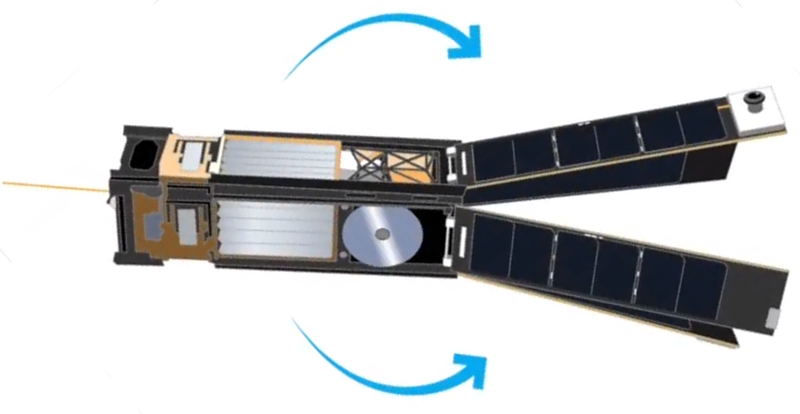
This is where the lightsail becomes exciting. A sail can be packed tightly inside a small spacecraft, deployed in orbit, and then used to maneuver without conventional propellant. For CubeSats, that is a big deal. It gives tiny spacecraft a way to become more than passive passengers.
How a Small Lightsail Propels a CubeSat
A solar sail, or lightsail, works by using solar radiation pressure. Sunlight may feel weightless on your face, but it is not useless. Photons carry momentum. When they strike a reflective sail and bounce away, they transfer a tiny push. One photon is not impressive. Trillions upon trillions of photons, arriving nonstop, become a quiet engine.
The push from sunlight is small, so the sail must be large compared with the spacecraft. That is why solar sail missions look so dramatic after deployment. A CubeSat may be the size of a microwave oven, yet its sail can spread into a broad square, turning the tiny spacecraft into something that looks like a shiny kite that escaped from a very advanced picnic.
The key advantage is endurance. A chemical rocket produces strong thrust for a short time and then runs out of fuel. A solar sail produces weak thrust, but it can keep working as long as sunlight reaches it and the spacecraft can control its orientation. Over days, weeks, and months, that tiny acceleration can change a spacecraft’s orbit. In deep-space missions, the same principle could help small probes travel to asteroids, monitor space weather, or serve as communication relays.
Why the Lightsail Idea Matters for Small Satellites
Small satellites are useful because they are affordable, focused, and fast to develop. But they often face a mobility problem. Getting into orbit is only the beginning. A spacecraft may need to raise or lower its orbit, adjust its attitude, maintain a position, or travel toward a target. Without propulsion, a CubeSat is partly at the mercy of its launch trajectory and the orbital environment.
A lightsail gives CubeSats a propellant-free mobility option. That does not mean a solar sail is perfect for every mission. It is not a magic carpet with a NASA logo. The spacecraft must deploy the sail correctly, control its attitude, manage thermal changes, and navigate with patience. Still, the potential is enormous. A successful sail can extend mission possibilities while avoiding the mass penalty of fuel.
For Earth orbit, a lightsail can demonstrate orbit raising and lowering. For future deep-space work, larger sail systems could support missions to asteroids, the Moon, Mars, or regions near the Sun that are difficult to reach with conventional propulsion alone. A fleet of low-cost CubeSats with solar sails could one day act like scouts, spreading across the solar system to gather data from many places at once.
NASA ACS3: A Modern Example of CubeSat Solar Sailing
NASA’s Advanced Composite Solar Sail System is one of the most important recent demonstrations of this technology. ACS3 launched in April 2024 aboard a Rocket Lab Electron rocket. The mission uses a 12U CubeSat spacecraft bus, roughly microwave-sized, and a solar sail that unfolds to about 80 square meters, or about 860 square feet.
The star of ACS3 is not only the sail material but also the boom system that deploys it. A solar sail needs support structures to stretch and hold its shape. Traditional metallic booms can work, but they may be heavier or more sensitive to thermal distortion. ACS3 tests composite booms designed to be lighter and stiffer, helping future missions deploy larger sails with better shape control.
Once deployed, the ACS3 sail forms a square roughly 30 feet on a side. That is a hilarious contrast: a spacecraft small enough to compare with a kitchen appliance unfurls a reflective surface large enough to make skywatchers pay attention. NASA has described the mission as a technology demonstration, meaning the point is not to visit a distant planet immediately. The point is to learn how well the sail deploys, how the boom system behaves, and how the spacecraft can eventually perform controlled maneuvers using sunlight.
Why Composite Booms Are a Big Deal
Solar sails are simple in concept but tricky in engineering. A sail must be thin enough to pack inside a small spacecraft, strong enough to survive deployment, and stable enough to provide predictable thrust. If the sail wrinkles, bends, twists, or flutters in unexpected ways, navigation becomes harder. Imagine trying to steer a canoe with a pool noodle. Technically possible? Maybe. Elegant? Not exactly.
Composite booms help solve this by giving the sail a lightweight frame. The better the sail shape, the easier it is to predict how sunlight will push the spacecraft. Better prediction means better navigation, and better navigation means solar sails can become practical tools rather than shiny space origami.
LightSail 2: The Public’s Solar Sailing Superstar
The Planetary Society’s LightSail 2 is one of the best-known CubeSat solar sail missions. Launched in 2019, LightSail 2 successfully demonstrated controlled solar sailing for a small spacecraft. It used a CubeSat body and deployed a reflective sail to change its orbit using sunlight. The mission became a crowd-funded symbol of what small spacecraft can do when engineering, public enthusiasm, and a little cosmic stubbornness work together.
LightSail 2 did not become an interstellar spaceship, and it did not need to. Its purpose was to prove that a small spacecraft could use sunlight for propulsion in Earth orbit. The mission showed that solar sailing could be performed with a compact spacecraft architecture. It also helped educate the public about a technology that is both physically subtle and emotionally dramatic. After all, “we moved a spacecraft with sunlight” is a sentence that still feels like it should come with orchestral music.
The mission reentered Earth’s atmosphere in November 2022 after completing its demonstration. That ending was expected for a spacecraft in low Earth orbit, where atmospheric drag eventually wins the tug-of-war. But LightSail 2 left behind something more durable than hardware: confidence. It proved that small solar sail spacecraft are not just pretty renderings on a PowerPoint slide.
NanoSail-D and NEA Scout: Lessons From NASA’s Earlier Solar Sail Work
NASA’s NanoSail-D was an earlier milestone. It deployed NASA’s first solar sail in low Earth orbit after launching in 2010. NanoSail-D helped demonstrate that a sail could be packed, carried, and deployed from a small spacecraft platform. It also contributed to knowledge about drag sails and deorbiting technologies, showing that thin deployable structures could have multiple uses in space operations.
NEA Scout, short for Near-Earth Asteroid Scout, was another ambitious CubeSat solar sail mission. It launched as a secondary payload on Artemis I in 2022 and was intended to use a solar sail to travel toward asteroid 2020 GE and take images. Unfortunately, after launch, the mission team was unable to establish communication with the spacecraft. That outcome was disappointing, but it also illustrates a truth about cutting-edge CubeSat missions: small does not mean easy.
In fact, small spacecraft can be brutally difficult because they offer little room for redundancy. Every system must be compact, efficient, and reliable. When a CubeSat carries a solar sail, the challenge grows: the team must manage deployment, communications, power, attitude control, thermal behavior, and navigation. A solar sail mission is not just a satellite with a shiny blanket. It is a full spacecraft system squeezed into a tiny frame.
The Engineering Challenges Behind a Small Lightsail
The most obvious challenge is deployment. A sail must unfold correctly after launch, often after being tightly packed for months. The material must not tear, snag, or jam. The booms must extend in the right sequence. Cameras and sensors may need to confirm shape and alignment. If one corner misbehaves, the entire sail can become harder to control.
The second challenge is attitude control. To sail with sunlight, the spacecraft must point the sail at useful angles. Pointing straight at the Sun may push the spacecraft one way; tilting the sail changes the direction and effect of the force. This is similar to sailing on water, but with less splashing and more orbital math. Reaction wheels, magnetorquers, onboard computers, and navigation algorithms all play roles in keeping the spacecraft oriented.
The third challenge is patience. Solar sail thrust is tiny. You do not hit the accelerator and spill coffee into your lap. Instead, mission operators track gradual changes over time. This slow-motion style is ideal for missions where efficiency matters more than instant speed. A lightsail is not a drag racer. It is more like a marathon runner who never has to stop for fuel.
Real-World Uses for Lightsail CubeSats
Asteroid Reconnaissance
Small solar sail spacecraft could visit near-Earth asteroids, especially small targets that do not require large spacecraft. A CubeSat with a sail could perform reconnaissance, take images, study surface properties, and help scientists understand objects that may be scientifically valuable or potentially hazardous.
Space Weather Monitoring
Solar sails could help position spacecraft in useful locations for monitoring the Sun. Space weather affects satellites, communications, power grids, and navigation systems on Earth. A sail-equipped spacecraft might maintain unusual orbits that give earlier warnings of solar storms.
Communications Relays
Future crewed exploration missions may need flexible communication networks. Solar sail CubeSats could serve as small relay nodes, especially if they can maneuver without carrying large amounts of propellant. A swarm of small sailcraft could support missions around the Moon or deeper into the solar system.
Low-Cost Technology Testing
CubeSats are excellent testbeds. Engineers can try new materials, onboard software, sensors, deployment systems, and navigation strategies at lower cost. Every successful test makes the next mission smarter. Every failure, while painful, also teaches valuable lessons. Space engineering has never been a hobby for people who dislike homework.
Why Sunlight Is an Attractive Propellant
Sunlight is free, abundant, and already available across much of the solar system. A solar sail does not need to carry propellant, which reduces launch mass and can simplify long-duration mission planning. The spacecraft still needs power for electronics, communication, and control systems, but it does not need fuel in the same way a chemical propulsion system does.
This is especially useful for small spacecraft. A CubeSat has limited mass and volume, so every gram saved can be used for instruments, radios, batteries, processors, or structural systems. Solar sailing shifts part of the propulsion burden from stored fuel to external energy. The Sun becomes the engine; the sail becomes the interface.
Of course, sunlight weakens with distance from the Sun. A solar sail is most effective in the inner solar system, where solar radiation pressure is stronger. Beyond that, mission designers must carefully evaluate whether a sail is practical. Still, for Earth orbit, lunar space, Venus, Mercury, near-Earth asteroids, and some solar observation missions, the concept is highly attractive.
What Makes “Small Lightsail Will Propel Cubesat” Such a Big Story?
The phrase matters because it captures a shift in space exploration. For decades, deep-space capability belonged mostly to large spacecraft backed by massive budgets. CubeSats changed that by making space access more modular and affordable. Solar sails may push the change further by giving those small satellites a way to move, explore, and operate longer without carrying bulky fuel systems.
A small lightsail propelling a CubeSat is not merely a cute experiment. It is a preview of a different mission architecture. Instead of one giant spacecraft doing everything, future missions may use many small spacecraft, each with a focused job. Some could map asteroids. Some could inspect planetary environments. Some could monitor the Sun. Some could relay communications. If one fails, the whole mission does not collapse like a badly assembled lawn chair.
This distributed approach could make exploration more resilient and flexible. It could also invite more universities, small companies, and international teams into serious space science. When the cost of testing drops, the number of ideas rises. Some ideas will be strange. Some will be brilliant. Some will be strange and brilliant, which is basically the unofficial dress code of aerospace innovation.
Experience-Based Reflections: What Working Around the Topic Teaches Us
When people first hear about a small lightsail propelling a CubeSat, the reaction is often a mix of wonder and suspicion. It sounds too poetic to be engineering. A spacecraft pushed by sunlight? That feels like something a science teacher would say right before pulling out a glittery classroom demonstration. But the deeper one looks, the more practical the idea becomes.
The first experience this topic teaches is that scale can be deceptive. A CubeSat looks small, but it can carry serious ambition. A sail looks delicate, but it can influence an orbit. A photon looks irrelevant, but billions of them can create measurable force. In space technology, small effects often become important when they are consistent. That is a useful lesson far beyond aerospace: steady pressure, applied in the right direction, can move surprisingly large things.
The second lesson is that simple ideas are rarely simple to build. “Unfold a shiny sail in space” sounds easy until you ask the engineering questions. How do you fold the sail? How do you keep it from sticking? What happens when the spacecraft heats and cools? How do you confirm deployment from hundreds of miles away? How do you steer when the force is tiny and the sail is huge compared with the spacecraft body? Suddenly, the shiny sail is not a blanket. It is a precision structure.
The third lesson is that failure is part of technology maturation. NEA Scout’s communication problem, for example, does not make solar sailing a bad idea. It reminds us that ambitious small spacecraft missions operate with tight constraints. CubeSats are cheaper than flagship spacecraft, but they are not toys. They must survive launch vibration, orbital radiation, thermal cycles, and unforgiving communication windows. The margin for error can be thin, and space is not known for offering refunds.
The fourth lesson is about public imagination. Missions like LightSail 2 mattered partly because people could understand them. A sail is visual. Sunlight is familiar. A CubeSat is small enough to imagine. When the public sees a reflective sail unfurled above Earth, space exploration becomes less abstract. It is not just equations and acronyms; it is a visible machine doing something almost magical, even though the magic is physics wearing a neat little tie.
The fifth lesson is that future space missions may become more patient. Modern culture loves speed: fast downloads, fast shipping, fast replies, fast everything. Solar sailing is different. It rewards long-term thinking. The sail gathers momentum slowly, adjusts gradually, and proves its worth over time. That mindset fits many exploration goals. Not every mission needs brute force. Some missions need endurance, elegance, and the discipline to let sunlight do its quiet work.
Finally, the small lightsail CubeSat story teaches us that innovation often happens at the boundary between old dreams and new tools. Solar sailing has been imagined for centuries in one form or another, but CubeSats, miniaturized electronics, better materials, improved cameras, and modern mission software have made the idea more testable. The dream did not suddenly become useful by itself. It needed better hardware, lower launch costs, and teams willing to fold a giant sail into a tiny box and trust it to bloom in orbit.
That is why this topic is worth watching. The next generation of sail-powered CubeSats may not look dramatic at launch. They may ride quietly as secondary payloads, tucked away inside deployment systems. But after release, once a sail opens and sunlight starts pushing, the little spacecraft becomes part of a much bigger story: a future where exploration can be lighter, cheaper, cleaner, and surprisingly graceful.
Conclusion
A small lightsail that propels a CubeSat is more than a clever engineering trick. It represents a practical path toward fuel-free maneuvering for small spacecraft. By using solar radiation pressure, CubeSats can potentially adjust orbits, explore asteroids, support space weather monitoring, and test technologies for larger future missions.
NASA’s ACS3, The Planetary Society’s LightSail 2, NASA’s NanoSail-D, and the ambitious NEA Scout mission all show different parts of the same story. Solar sailing is not easy, but it is real. The physics works. The engineering is improving. The future is wide open, and it may be powered by the same sunlight that ruins your phone screen visibility at noon.
Note: This publish-ready article is based on publicly available information from reputable U.S. space organizations and mission updates, including NASA, NASA JPL, and The Planetary Society. Source-link markup and citation placeholders have been intentionally excluded from the HTML body for clean web publication.