

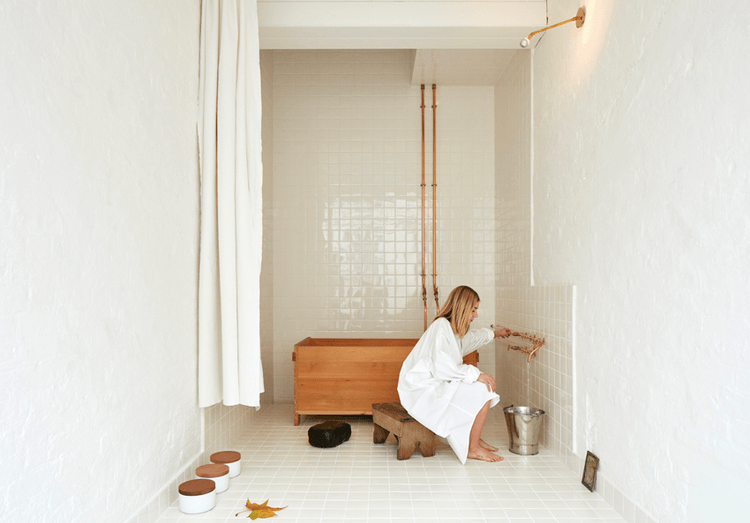
Some bathrooms are built for speed. In, out, towel, goodbye. This one is built for exhaling. The kind of space that makes you want to put your phone in another room, lower your shoulders, and suddenly become the sort of person who says things like “I’m embracing ritual now.” In other words: dangerous, but chic.
The inspiration behind this look is a remarkable London mews conversion by designer Maureen Doherty and architect Jonathan Tuckey, where half of the ground floor was turned into a Japanese-inspired bathhouse complete with radiant heating, integrated drainage, and a custom wooden tub. The genius of the project is not just that it looks beautiful. It is that it translates the spirit of a Japanese bathhouse into a tiny, urban, historically quirky footprint without making the result feel theme-y, forced, or like a hotel lobby with commitment issues.
That is exactly why this space still feels fresh. It pairs Japanese bathing principles, which prize quiet, immersion, and material honesty, with the practical realities of a London mews house, where square footage is limited and natural light has to be coaxed into existence like a shy cat. The result is serene, tactile, and incredibly smart.
If you want to steal this look, the good news is that you do not need a centuries-old London building or a design-world Rolodex. You need a strong edit, a respect for restraint, and a willingness to let the bathroom be more than a utility room with plumbing. Here is how the look works, why it works, and how to adapt it in a real home without accidentally creating a damp beige bunker.
Why This Bathroom Works So Well
The real magic of this Japanese bathhouse-in-a-mews look is contrast handled with discipline. It balances old and new, dense city living and deep relaxation, rough architecture and smooth ritual. The mews setting matters because these homes are often compact, enclosed by neighboring buildings, and short on light. That means every design move has to earn its keep.
Instead of fighting those limitations with visual noise, the design leans into them. The bathhouse becomes cocoon-like rather than cramped. A smaller footprint becomes an argument for a deeper soaking tub rather than a standard lounge-style bathtub. Fewer windows become a reason to emphasize warm surfaces, layered lighting, and texture. In other words, the room stops trying to behave like a sprawling suburban primary suite and starts behaving like a retreat.
That is a lesson worth stealing. Great small-space design does not imitate larger rooms; it sharpens its own identity. In this case, the identity is part bathhouse, part monastery, part stylish secret hideaway. Very little about it begs for attention, yet everything feels considered.
The Japanese Bathhouse Influence
Japanese bathing culture centers less on rushed washing and more on deliberate soaking. The ofuro tradition favors deeper tubs that allow the body to sit upright and immerse fully, making them ideal for compact spaces. This is one reason the style translates so well to urban homes: you get drama, comfort, and ritual without requiring the square footage of a tennis court.
Just as important is the emotional tone. Japanese-inspired bath design often uses wood, stone, plaster, and muted natural colors to create calm. The room is meant to feel grounded rather than glossy. That means the surfaces do a lot of the aesthetic heavy lifting. Instead of relying on busy patterns or flashy fixtures, the room lets grain, tone, and shadow create interest. It is less “look at my faucet” and more “notice how good silence looks in here.”
The London Mews Influence
A mews house brings its own personality to the party. These former service buildings and stables often have odd proportions, limited frontage, and a hidden-away quality that makes them feel intimate even before a designer touches them. That tucked-in character is perfect for a bathhouse concept. The architecture already suggests privacy, retreat, and a little mystery.
But mews homes also demand efficiency. Light has to travel. Storage has to disappear. Circulation has to be elegant. In a compact bath, bulky partitions or clunky furniture can make the whole room feel apologetic. That is why this look depends on integrated planning: good drainage, seamless surfaces, warm floors, minimal visual barriers, and a layout that feels almost effortless even when the engineering certainly was not.
The Elements to Steal
1. A Deep Soaking Tub Instead of a Standard Tub
If there is one non-negotiable move, it is this: choose a tub that feels immersive rather than sprawling. A Japanese-style soaking tub has greater depth, a smaller footprint, and a more upright posture. That changes the whole mood of the room. You are not flopping around in lukewarm regret; you are sinking into a contained, restorative soak.
Wood tubs are especially evocative because they bring warmth, scent, and softness to a room full of water. But you do not have to source a custom wooden bath carved by woodland saints. A compact soaking tub in stone resin, composite, copper, or cast material can capture the same spirit. The point is depth, proportion, and presence.
2. A Wet Room Mindset
This look works best when the bath area feels unified. A wet-room approach, with integrated drainage and minimal barriers, creates that seamless effect. It also helps a small room look larger because your eye reads the space as one continuous volume instead of a tub zone, a shower zone, a tile zone, a why-did-they-do-that zone.
Use a subtle floor slope, a linear drain, and as few thresholds as possible. If you need a divider, keep it light: a glass panel, a low partition, or a simple change in material. The less visual chopping, the calmer the room feels.
3. Natural Materials With a Slightly Imperfect Finish
Perfection is not the goal here. Character is. Think plaster walls with movement, timber with visible grain, stone with tonal variation, brushed or unlacquered metals that age gracefully, and textiles that look better when they are a little rumpled. Wabi-sabi is not about making a room look unfinished; it is about letting materials feel alive.
If you want the look without high-maintenance panic, tadelakt or another waterproof plaster-style finish can deliver beautiful softness with fewer grout lines. Charred wood, slatted wood, cedar, hinoki-inspired finishes, natural stone, river rock, and textured ceramics all fit the mood. Choose fewer materials overall, then let them repeat. Repetition creates peace.
4. A Restrained Palette
This is not the moment for eleven shades of greige arguing with black hardware and a surprise navy vanity. Keep the palette close to nature: chalk, clay, warm white, mushroom, smoke, sand, pale oak, charcoal, and muted green. These colors make the room feel timeless because they are rooted in material rather than trend.
And yes, you can go darker. In fact, a cocooning bathhouse can look stunning in deep plaster, smoked timber, or inky tile. The trick is to keep the undertones harmonious and the finish matte or softly reflective rather than shiny enough to check your teeth in.
5. Warmth Underfoot
The original London bathhouse featured radiant heating, and honestly, that detail deserves a standing ovation. A room inspired by bathing ritual should not punish bare feet. Heated floors, or at least materials that do not feel icy and hostile at 7 a.m., are central to the experience.
If radiant heat is not in the budget, use dense bath mats, teak platforms, wood slats, or textured runners designed for damp spaces. The goal is tactile comfort. Bathhouse design is not just visual; it is physical.
6. Quiet, Clever Storage
A Japanese-inspired bath cannot function if every serum, razor, and backup toothpaste is out in public like it is making a campaign speech. Minimalism is not about owning three things and one morally superior bar of soap. It is about editing what stays visible.
Recessed niches, built-in benches, wall hooks, concealed drawers, and simple shelving in wood or plaster tones will help the room stay calm. Let one beautiful object stay out, maybe a stool, a ceramic bowl, or a brush. Everything else needs a home. Clutter is the quickest way to turn “serene bathhouse” into “fancy utility closet.”
How to Recreate the Look at Home
Start with the architecture you actually have. If your bathroom is tiny, that is not a deal breaker; it is practically on theme. Focus on three priorities: the tub, the surfaces, and the feeling of continuity. A compact room can carry this style beautifully if you avoid overfurnishing it and keep the eye moving across uninterrupted planes.
For a small renovation, swap a standard tub for a deeper soaking model, reduce color contrast, and use one dominant material for walls and another for the floor. Add a handheld shower, a timber bath caddy, soft lighting, and better storage. Suddenly, the room reads less “builder-basic” and more “private retreat behind a discreet London door.”
For a larger renovation, think spatially. Can you create a wet room? Can you lower visual clutter by recessing storage? Can you use a skylight, frosted glazing, or a lighter upper wall finish to increase the sense of air? Can you make the tub the focal point and treat everything else as support cast? These choices matter more than whether your faucet has an artisanal backstory.
Also remember that stealing a look does not mean copying every detail. The spirit of this bathhouse is what matters most: stillness, warmth, modest luxury, and a deep sense of retreat. If your version uses a plaster-look porcelain tile instead of true tadelakt, or a modern composite soaking tub instead of wood, that is fine. Good design is not cosplay.
What to Buy for the Look
Prioritize a compact soaking tub, wall-mounted or deck-mounted fittings with clean lines, warm dimmable lighting, natural-fiber towels, a wood stool, a stone or ceramic tray, and storage that disappears into the architecture. Add one sensory note, such as hinoki, cedar, eucalyptus, or unscented mineral soap. The room should feel intentional, not over-accessorized.
If you are tempted to throw in bamboo signage, a buddha statue, and twelve pebbles in a glass vase, step away slowly. This look is refined because it avoids obvious clichés. It nods to Japanese bathing culture through proportion, material, and mood, not through souvenir-shop symbolism.
The Experience of This Look: Why People Fall for It
What makes a Japanese bathhouse in a London mews so compelling is not just the way it photographs. It is the way it seems to change time. The outside world might still be loud, gray, and aggressively emailing, but inside the room, everything slows down. The shift happens the second you cross the threshold. The materials are quieter. The light is softer. The acoustics are gentler. Even before the water runs, the room has already started doing its job.
That experience is a huge part of why this look has staying power. It offers something people increasingly want from home: restoration rather than mere function. The best version of this bathhouse style does not feel decorated so much as tuned. The tub is deep enough to feel immersive. The floor is warm enough to welcome bare feet. The plaster, stone, or wood surfaces absorb visual noise instead of bouncing it around. A towel feels like part of the architecture rather than an afterthought tossed over a hook.
There is also something wonderfully cinematic about the mews setting itself. A London mews already carries a sense of privacy and discovery. It is tucked away, slightly hidden, a little mysterious. Pair that with the ritualized calm of a Japanese-inspired bath and the whole experience feels like finding a secret room in the city where nobody expects you to answer a notification. It is less “bathroom break” and more “temporary disappearance.” Frankly, that is a luxury all on its own.
And then there is the emotional appeal of the design language. So many modern bathrooms try to impress with size, shine, or gadgets. This one is persuasive in a different way. It whispers. It uses restraint to create intimacy. It makes natural materials do the talking. That can feel surprisingly personal. A room like this does not perform wellness; it actually supports it. You are not buying a fantasy of a spa resort in the mountains. You are building a daily ritual that fits into real life.
Imagine a winter evening: the room is dim, the plaster walls are glowing softly, steam gathers in the corners, and the tub water is deep enough to cover your shoulders. Or imagine early morning light catching a wood edge, with the room still cool and quiet, before the day has had a chance to become ridiculous. In both cases, the design is doing the same thing. It is turning routine into ceremony.
That may be the smartest thing to steal from this look. Not the exact tub. Not the exact hardware. Not even the exact palette. The real lesson is that a bathroom can be a place with emotional architecture. It can make you feel sheltered, steadied, and slightly more human. In a compact home, that matters even more. When every square foot has to work hard, one room devoted to calm can become the space that changes how the whole house feels.
So yes, steal the warm wood. Steal the deep soak. Steal the quiet colors, the wet-room logic, the built-in storage, the disciplined editing, and the sense that every finish was chosen to support rest. But above all, steal the attitude: less clutter, more ritual; less showroom, more sanctuary. Your bathroom may never become a hidden bathhouse in a London mews, but it can absolutely borrow the mood. And that mood is doing a lot of heavy lifting in the best possible way.
Final Takeaway
“Steal This Look: A Japanese Bathhouse in a London Mews” works because it proves that luxury does not have to be loud, large, or dripping in polished stone. It can be compact, deeply considered, and rooted in how a room feels rather than how much it shows off. The formula is deceptively simple: a deep soaking tub, natural materials, seamless planning, hidden storage, and a palette that lets the mind unclench.
If you want a bathroom that feels timeless, restorative, and just a little bit smug in its quiet elegance, this is a look worth borrowing. Not because it is trendy, but because it understands something fundamental: the best rooms do not just serve your life. They slow it down long enough for you to enjoy it.