

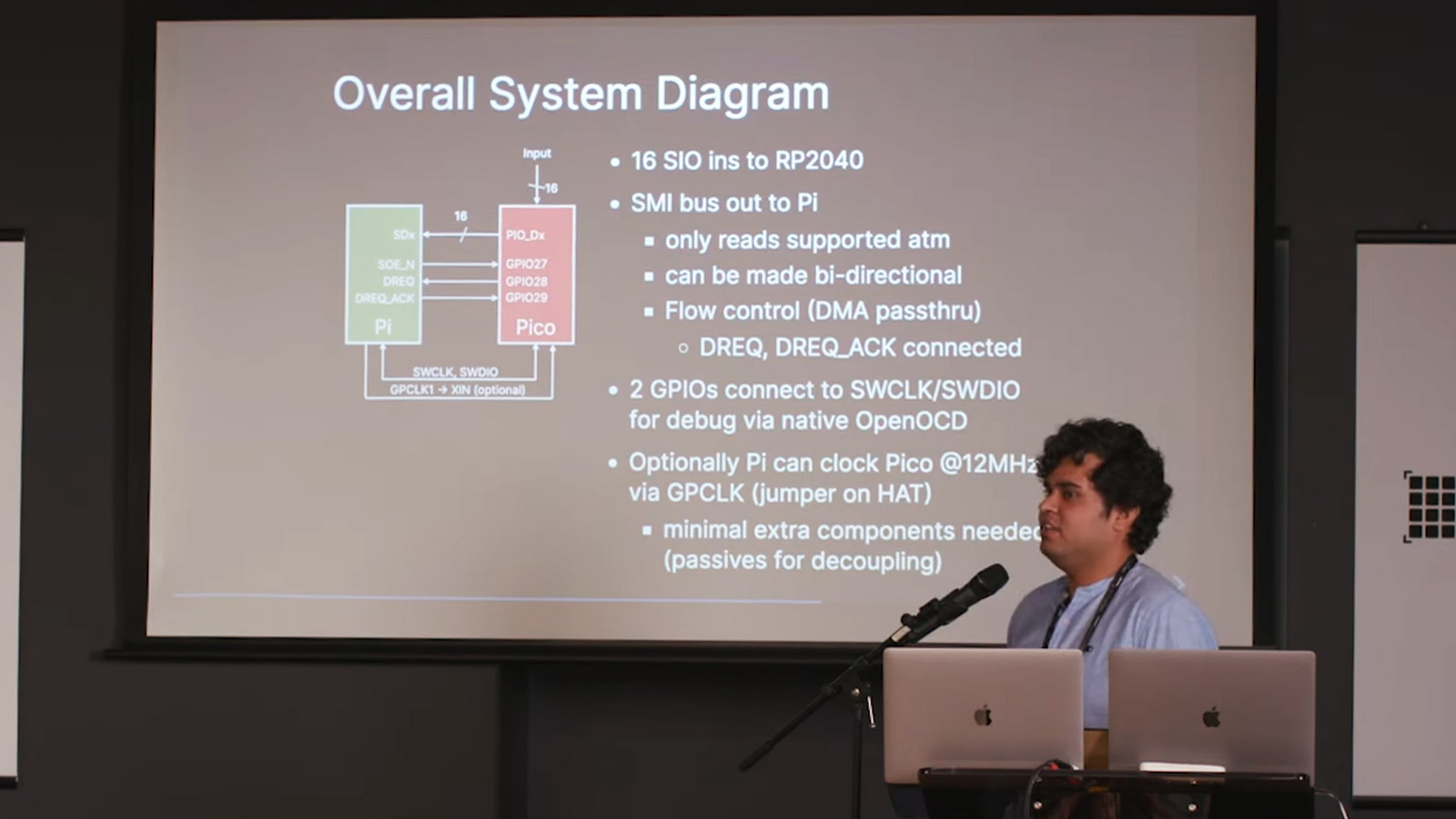
Every so often, a hardware talk comes along that reminds makers why tiny boards are so dangerousin the best possible way. At Hackaday Supercon 2023, Kumar Abhishek went swimming in the deep end with two Raspberry Pi features that many people have heard about, fewer people truly understand, and almost everyone underestimates: the Pico’s Programmable I/O, usually called PIO, and the Raspberry Pi’s Secondary Memory Interface, better known as SMI.
On the surface, the Raspberry Pi Pico looks like a friendly microcontroller board: cheap, approachable, breadboard-friendly, and polite enough not to scare beginners away. The full-size Raspberry Pi, meanwhile, is usually treated as a small Linux computer for servers, dashboards, retro games, home automation, and occasionally projects that involve far too many jumper wires. But beneath that familiar plastic-and-silicon personality sits a world of timing tricks, parallel data movement, and “wait, this little board can do that?” moments.
This article explores what made the Supercon 2023 topic so compelling: how the Pico’s PIO and the Pi’s SMI can push low-cost hardware into surprisingly serious logic-analysis territory. We will unpack the technology, explain why it matters, look at real-world use cases, and end with practical experience notes for anyone tempted to enter these deep logic waters without immediately drowning in datasheets.
Why This Supercon 2023 Talk Caught the Hardware Crowd’s Attention
Hackaday Supercon is not the sort of event where people get excited because a board can blink an LED. Blinking an LED is the “hello world” of embedded hardware; it is charming, but nobody books a conference room for it unless the LED is blinking through a toaster connected to a satellite dish.
The appeal of “Going Into Deep Logic Waters With The Pico’s PIO And The Pi’s SMI” is that it focuses on the hidden muscle inside familiar boards. Kumar Abhishek’s work highlighted a familiar lesson in embedded engineering: sometimes the best feature is not the one printed in large letters on the product page. Sometimes it is the overlooked peripheral, the under-documented interface, or the weird programmable block that looks confusing until it suddenly solves a problem beautifully.
In this case, the stars are two very different but complementary technologies. The Pico’s PIO gives a microcontroller the ability to handle precise, custom digital I/O with very little CPU involvement. The Pi’s SMI offers a high-speed parallel interface that can move data much faster than ordinary bit-banging. Put together conceptually, they point toward a powerful idea: inexpensive Raspberry Pi hardware can capture, shuttle, and interpret digital signals in ways that normally require more specialized equipment.
What Is Raspberry Pi Pico PIO?
PIO stands for Programmable I/O. It is one of the defining features of the RP2040 microcontroller used in the original Raspberry Pi Pico and Pico W. Instead of relying only on fixed peripherals such as SPI, I2C, UART, PWM, and ADC, the RP2040 includes small programmable state machines designed specifically for moving bits in and out of GPIO pins with deterministic timing.
Think of PIO as a tiny crew of disciplined dockworkers standing between the CPU and the outside world. The CPU says, “Please handle this strange timing-sensitive protocol,” and the PIO state machine says, “No problem, boss. I will clock the pins, shift the bits, watch the line, and avoid bothering you unless something important happens.”
The original Pico family gives developers eight PIO state machines. These state machines can run compact PIO assembly programs, use shift registers, interact with FIFOs, and coordinate with DMA. They are especially useful when a project needs timing that normal software loops cannot reliably provide. That includes custom serial protocols, video output, signal generation, data capture, LED control, and logic-analyzer-style sampling.
Why PIO Feels Almost Like a Secret Weapon
The real magic of PIO is predictability. General-purpose code running on a CPU can be interrupted, delayed, or distracted. A PIO state machine, by contrast, executes a tiny program with tight timing control. That makes it excellent for tasks where one late instruction can ruin the party.
For example, if you want to sample multiple GPIO pins at a fixed rate, the CPU can do it up to a point. But once timing requirements get aggressive, normal code becomes fragile. Interrupts, memory access, USB traffic, and other background work can introduce jitter. PIO helps by taking the high-speed pin-watching job away from the CPU and doing it in a dedicated, hardware-assisted way.
That is why PIO has become popular for projects such as VGA output, NeoPixel driving, custom bus interfaces, software-defined peripherals, and low-cost logic analyzers. It gives makers the thrill of inventing a peripheral without needing to fabricate silicon. That is a pretty good trick for a board that often costs less than lunch.
What Is Raspberry Pi SMI?
SMI stands for Secondary Memory Interface. It is a parallel interface found in Raspberry Pi hardware that was originally intended for connecting external memory-like devices. Unlike familiar interfaces such as SPI or I2C, SMI is not a beginner-friendly feature with endless tutorials and cheerful diagrams. It is powerful, but it has historically been less documented and less widely used.
That obscurity is part of the fascination. SMI can move parallel data at impressive speeds, making it interesting for applications such as ADC capture, DAC output, FPGA communication, and high-throughput digital sampling. In other words, it is not the interface most people reach for firstbut for the right problem, it can be exactly the hidden trapdoor you want.
In the context of logic analysis, SMI matters because bandwidth matters. Capturing digital signals is not just about reading pins. It is about reading pins fast enough, storing the data, transferring it, and making sure the capture does not collapse under its own traffic. SMI offers one route toward moving lots of data into a Raspberry Pi efficiently.
PIO vs. SMI: Two Different Tools for Deep Logic Work
PIO and SMI should not be confused. They live in different places and solve different problems.
PIO belongs to the Pico’s RP2040 microcontroller. It is programmable, deterministic, and excellent at handling precise GPIO behavior. SMI belongs to Raspberry Pi single-board computers and works more like a high-speed parallel interface. PIO is about custom timing at the edge. SMI is about moving wider data efficiently.
A useful analogy: PIO is the sharp-eyed scout standing at the signal pins, reacting at exactly the right moment. SMI is the cargo lane that can move a pile of captured information quickly. One is about precise control; the other is about throughput. Both become especially interesting when the goal is to build budget-friendly measurement tools.
Why Logic Analysis Is Harder Than It Looks
A logic analyzer sounds simple. Read digital pins. Record ones and zeros. Show them on a timeline. Done, right?
Not quite. A useful logic analyzer must sample fast enough to capture the event, store enough samples to see what happened before and after a trigger, and provide a way to decode or inspect the result. It also needs triggering, timing accuracy, channel management, voltage safety, and clean data transfer. Otherwise, you do not have a logic analyzer; you have a very enthusiastic random-number collector wearing a lab coat.
Low-cost microcontrollers are tempting for this job because they are cheap and flexible. The challenge is that high-speed digital capture quickly becomes a battle against CPU cycles, memory limits, USB bandwidth, and timing jitter. This is exactly where PIO, DMA, FIFOs, and parallel interfaces become exciting. They let hardware do the repetitive time-critical work while software handles configuration, storage, display, and decoding.
How the Pico’s PIO Helps With Signal Capture
PIO can sample GPIO pins in a tight loop, shift captured bits into registers, and push data into FIFOs. From there, DMA can move the data into memory without forcing the CPU to touch every sample. This architecture is one reason the Pico has become a favorite platform for experimental logic analyzers.
Consider a simple example: you want to monitor an SPI bus. A basic software loop might miss transitions at higher speeds. A PIO state machine, however, can wait for clock edges, sample data pins, and push bytes into a buffer with reliable timing. The CPU can then process the captured stream afterward. Instead of trying to do everything at once, the system splits the work into layers.
That layered approach is the secret sauce. PIO handles the fast edge-facing job. DMA handles bulk movement. The CPU handles decisions and user interaction. A host application or tool such as PulseView can help visualize the captured data. Suddenly, a tiny microcontroller becomes a serious debugging assistant.
Where the Pi’s SMI Fits Into the Picture
SMI becomes interesting when you need to move parallel data into or out of a Raspberry Pi at speeds that would make ordinary GPIO code sweat. For signal capture, the value is obvious: more bandwidth can mean more channels, higher sample rates, deeper captures, or less CPU overhead.
Because SMI has been less mainstream than SPI, I2C, or UART, using it requires a willingness to read source code, study registers, test carefully, and sometimes accept that the documentation trail is not paved with gold. But that is also why talks like the Supercon 2023 session matter. They turn obscure features into shared knowledge. They show that the interface is not mythical; it is just hiding behind a few bushes and a stern-looking datasheet.
For advanced makers, SMI opens the door to projects such as high-speed ADC capture, parallel bus sniffing, FPGA data exchange, and homemade instrumentation. It is not the right tool for every beginner project, but when bandwidth is the bottleneck, it deserves attention.
Specific Example: Building a Budget Logic Analyzer Mindset
Imagine you are debugging a small embedded project. Your I2C sensor behaves nicely on Monday, mysteriously fails on Tuesday, and by Wednesday you are speaking to it in the tone normally reserved for printers. A logic analyzer lets you see what the bus is actually doing: start conditions, addresses, acknowledgments, clock stretching, and suspicious glitches.
A Pico-based logic analyzer can capture digital signals and export them for analysis. Community projects have shown that the RP2040 can support multiple channels, high sample rates, triggers, and protocol-decoding workflows when paired with the right firmware and software. It will not replace every professional instrument, but it can be wildly useful for hobbyists, educators, and engineers who need a fast answer without opening a corporate purchasing portal.
Now scale that thinking upward. If a Pico can use PIO to capture signals with tight timing, and a Raspberry Pi can use SMI to move data across a parallel interface, the broader lesson is clear: cheap boards are not automatically simple boards. They contain hardware blocks that can do specialized work when developers are willing to meet them on their own terms.
Why This Matters for Makers, Engineers, and Educators
The Supercon 2023 discussion matters because it challenges the common assumption that serious measurement requires expensive tools from the start. Professional oscilloscopes and logic analyzers absolutely have their place. They offer calibrated inputs, deep memory, polished software, high bandwidth, protection, triggering, and reliability. Nobody should pretend that a $4 microcontroller board magically becomes a lab-grade instrument because we said “PIO” three times in a mirror.
But low-cost tools fill an important gap. They help students learn. They help hobbyists debug. They help engineers prototype. They make digital logic visible. They also encourage people to understand the hardware stack instead of treating boards like sealed black boxes.
That educational value is enormous. When someone builds a logic analyzer with a Pico, they learn about sampling theory, GPIO timing, DMA, buffers, triggers, voltage levels, serial protocols, and host-side decoding. That is a full embedded-systems workout disguised as a weekend project. It is cheaper than a gym membership and only slightly more likely to involve smoke.
The Engineering Trade-Offs You Cannot Ignore
Deep logic projects are fun, but they come with trade-offs. The first is voltage compatibility. The Pico is a 3.3-volt device. Connecting it directly to 5-volt logic can damage it. Any serious capture tool needs level shifting, input protection, and careful grounding.
The second trade-off is memory. High-speed sampling eats RAM like a teenager eats snacks. If you sample many channels at high rates, buffers fill quickly. That means you must think about compression, triggering, streaming, capture length, and transfer speed.
The third trade-off is software complexity. PIO programs are small, but they require a different mindset from regular C or Python code. You must think in cycles, pin mappings, FIFOs, shift directions, and stalls. SMI adds another layer of hardware-register thinking. It is powerful, but it is not exactly “install app, click button, become wizard.”
Finally, there is the documentation challenge. PIO is well supported by Raspberry Pi’s official material and examples. SMI, however, has often required more digging through community research and lower-level code. That makes experimentation rewarding, but it also means careful validation is essential.
Practical Lessons From the Pico PIO and Pi SMI Approach
1. Let Hardware Do Hardware Jobs
If a task requires exact timing, do not force the CPU to juggle it in software unless you have no other option. PIO exists because pin-level timing can be handled better by a dedicated state machine. DMA exists because moving data one word at a time through CPU code is often wasteful. SMI exists because parallel throughput can be valuable.
2. Start With One Signal Before Capturing Everything
When experimenting with logic capture, begin small. Capture one clock. Then capture clock plus data. Then add triggers. Then increase speed. Debugging eight problems at once is not bravery; it is how engineers accidentally develop a thousand-yard stare.
3. Respect Sample Rate and Signal Integrity
A high sample rate does not automatically mean accurate capture. Wires, grounding, input thresholds, level shifters, and edge quality all matter. A messy setup can turn a beautiful digital signal into modern art.
4. Use Existing Tools When Possible
Projects that export captures to formats compatible with tools like sigrok and PulseView are especially useful. Good visualization and protocol decoding turn raw samples into answers. Without that layer, you may have a mountain of bits and no map.
Field Notes: Experiences From Deep Logic Waters
Working with the Pico’s PIO and the Pi’s SMI feels a little like discovering a hidden basement in a house you thought you knew. You start with familiar boards, familiar pins, and familiar USB cables. Then you read one more paragraph of documentation and realize there is an entire underground workshop beneath your feet.
The first experience most people have with PIO is confusion. That is normal. PIO assembly is tiny, but tiny does not mean obvious. A regular program says, “Do this, then this, then this.” A PIO program says, “Move one bit, maybe wait, shift left, push when full, stall if the FIFO is blocked, and please remember that every cycle matters.” It is less like writing a script and more like choreographing a very small robot that hates ambiguity.
The second experience is delight. Once the first state machine works, the mental switch flips. Suddenly you stop asking, “Can the Pico do this?” and start asking, “How can I divide the task so PIO handles the timing and the CPU handles the thinking?” That shift is powerful. It changes the Pico from a small microcontroller into a bag of configurable digital tricks.
The third experience is humility. High-speed signals punish sloppy assumptions. A jumper wire that worked at 100 kHz may behave badly at several megahertz. A missing ground connection can create phantom bugs. A level shifter may be too slow. A buffer may overflow quietly. Your code may be perfect, and your wiring may still be auditioning for a horror movie.
SMI adds its own flavor of adventure. Because it is less commonly used, you may spend more time comparing examples, reading register notes, and testing small pieces before the full system makes sense. That can be frustrating, but it is also where real learning happens. You are no longer just using a board; you are negotiating with the silicon.
A practical workflow helps. Build the simplest possible capture first. Confirm voltage levels. Use a known signal generator or microcontroller output. Check that the sample timing matches expectations. Save raw captures. Decode them separately. Only then move to real-world buses such as SPI, I2C, UART, or custom FPGA links. The goal is to reduce mystery, not create a mystery lasagna with twelve layers.
The biggest reward is confidence. After you have used PIO to capture a signal or studied how SMI can move data through a Raspberry Pi, digital systems become less abstract. You see buses as timing relationships. You see protocols as waveforms. You see bugs not as supernatural events, but as measurable behavior. That is the real value of deep logic work: it turns invisible conversations between chips into something you can inspect, understand, and fix.
Conclusion
“Supercon 2023 – Going Into Deep Logic Waters With The Pico’s PIO And The Pi’s SMI” is more than a clever talk title. It captures a major theme in modern maker hardware: affordable boards are packed with capabilities that reward curiosity. The Raspberry Pi Pico’s PIO lets developers create deterministic, custom I/O behavior that would be difficult or impossible with ordinary software loops. The Raspberry Pi’s SMI points toward high-speed parallel data movement that can support serious experimentation when bandwidth matters.
Together, these technologies show that deep hardware knowledge still matters. The best projects do not always come from buying the biggest tool. Sometimes they come from understanding a small board so well that it starts doing big-board things. Whether you are building a logic analyzer, exploring custom protocols, teaching digital electronics, or simply looking for your next “how is this possible?” weekend project, the Pico’s PIO and the Pi’s SMI are worth your attention.