

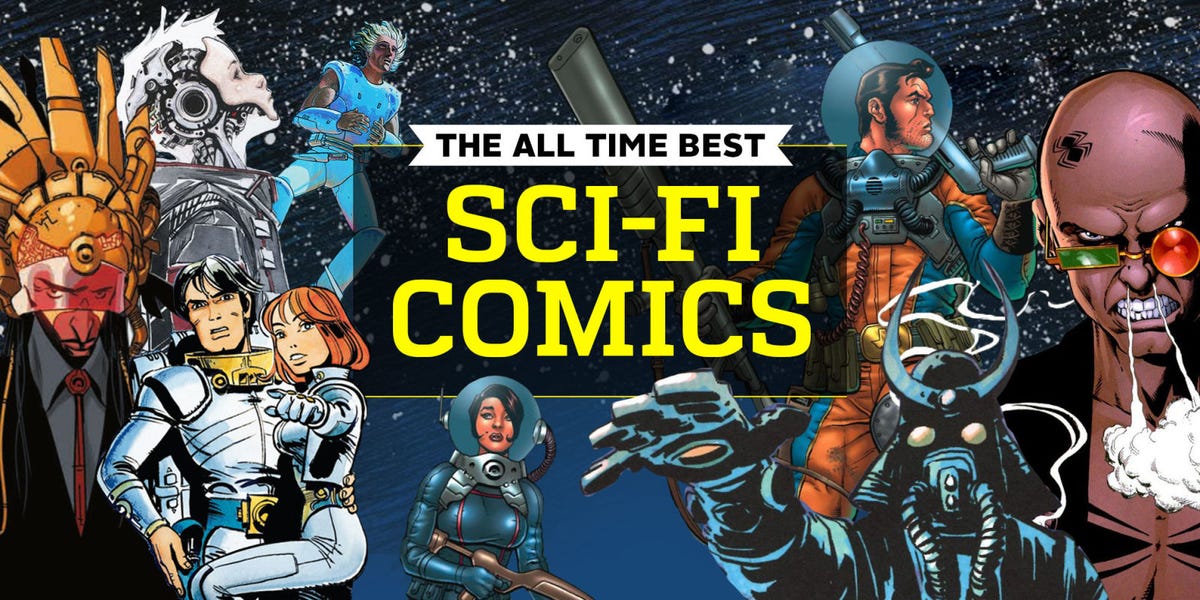
Science fiction comics are what happen when big ideas discover they look fantastic in ink. A novel can describe a city floating above a dead Earth, but a comic can show it, panel by panel, with smoke curling off the engines and one very tired hero wondering why nobody packed snacks. The best sci-fi comics combine imagination, philosophy, design, character drama, and that delicious feeling that reality has just been upgraded without asking your permission.
This list of the 30 best sci-fi comics includes American comics, European classics, manga, indie graphic novels, cyberpunk epics, space operas, dystopian nightmares, and quiet human stories dressed in futuristic clothing. Some are legendary. Some are newer cult favorites. All of them prove that science fiction comics are not just “spaceships and lasers,” although, to be fair, spaceships and lasers are doing excellent work.
How This List Was Chosen
The ranking below considers influence, storytelling quality, artwork, originality, reader reputation, critical appreciation, and long-term impact on science fiction comics. The goal is not to crown a single “correct” canon, because comic fans can debate that until the heat death of the universe. Instead, this guide gives readers a strong, varied starting point for discovering the best sci-fi graphic novels and comic series ever published.
The 30 Best Sci-Fi Comics, Ranked
1. Saga
Created by Brian K. Vaughan and Fiona Staples, Saga is a wild space opera about love, war, family, survival, and the terrible inconvenience of being chased across the galaxy. Its central couple, Alana and Marko, come from opposing sides of an interstellar conflict, making their child Hazel both a miracle and a political problem. The series works because it balances absurd imagination with emotional honesty. One page may feature bizarre alien royalty; the next may break your heart with a quiet family moment.
2. Akira
Katsuhiro Otomo’s Akira is cyberpunk manga on a monumental scale. Set in Neo-Tokyo after catastrophe, it follows biker gangs, military secrets, psychic power, youth rebellion, and a city that seems ready to explode again at any second. The artwork is architectural, kinetic, and astonishingly detailed. If many modern sci-fi comics feel cinematic, Akira helped build the highway they are speeding on.
3. The Incal
Written by Alejandro Jodorowsky and illustrated by Moebius, The Incal is a strange, colorful, spiritual, satirical space epic. It follows shabby detective John Difool after he stumbles into a cosmic object far above his emotional pay grade. The story is messy in the best possible way: mystical, political, funny, grotesque, and visually dazzling. It is one of the most influential European sci-fi comics ever made.
4. Watchmen
Alan Moore and Dave Gibbons’ Watchmen is often discussed as a superhero deconstruction, but it is also a major work of alternate-history science fiction. Its world is shaped by technology, nuclear anxiety, political paranoia, and the existence of a godlike being who changes history simply by existing. The nine-panel grid, symbolic details, and layered storytelling make it one of the most studied comics in English.
5. Transmetropolitan
Warren Ellis and Darick Robertson’s Transmetropolitan follows Spider Jerusalem, a furious journalist in a future city overflowing with media noise, corruption, body modification, political theater, and technological madness. It is rude, sharp, funny, and frequently uncomfortably accurate. As cyberpunk satire, it has aged with the weird grace of a machine that knows too much about social media before social media even arrives.
6. Y: The Last Man
Brian K. Vaughan and Pia Guerra’s Y: The Last Man begins with a devastating premise: nearly every mammal with a Y chromosome suddenly dies, leaving Yorick Brown and his monkey Ampersand as apparent exceptions. The series is part road story, part political thriller, part gender study, and part survival drama. Its greatest strength is how it turns a high-concept apocalypse into a story about identity, grief, power, and the awkwardness of being the least qualified person in the room.
7. Descender
Jeff Lemire and Dustin Nguyen’s Descender is a beautifully painted story about a young robot named TIM-21 in a universe that has learned to fear artificial intelligence. Nguyen’s watercolor art gives the book a soft, melancholy atmosphere, while Lemire’s writing adds warmth to questions about personhood, memory, and prejudice. It is a robot story with a very human pulse.
8. Paper Girls
Created by Brian K. Vaughan and Cliff Chiang, Paper Girls starts with four newspaper delivery girls in 1988 and quickly becomes a time-travel adventure full of future factions, strange technology, and growing-up-too-fast emotions. It is often compared to nostalgic adventure stories, but its heart is sharper and stranger. The series understands that adolescence can feel like time travel even before the actual time machines show up.
9. East of West
Jonathan Hickman and Nick Dragotta’s East of West blends science fiction, alternate history, western imagery, political conspiracy, and apocalypse mythology. Set in a fractured version of America, the series follows nations, prophets, assassins, and the Four Horsemen in a future that feels both grand and doomed. It rewards readers who enjoy dense worldbuilding and big, operatic stakes.
10. Black Science
Rick Remender and Matteo Scalera’s Black Science is a dimension-hopping disaster machine. Scientist Grant McKay invents a device that opens doors across realities, and naturally, everything goes wrong with impressive style. The series is fast, emotional, chaotic, and visually explosive. It is perfect for readers who want pulp adventure, family drama, and the sense that the universe is one bad decision away from throwing a chair.
11. Lazarus
Greg Rucka and Michael Lark’s Lazarus imagines a future ruled by powerful families instead of traditional governments. Each family has a genetically enhanced champion called a Lazarus, and Forever Carlyle is one of the best. The series is a chilling mix of political science fiction, class warfare, military thriller, and family tragedy. Its world feels brutally plausible, which is both impressive and mildly alarming.
12. The Manhattan Projects
Jonathan Hickman and Nick Pitarra take real historical science and launch it into absurd alternate-history madness in The Manhattan Projects. The result is a comic where famous scientists become strange, dangerous, and sometimes horrifying figures in a secret science empire. It is weird, darkly funny, and packed with outrageous ideas. Historical accuracy is not the point; intellectual chaos is.
13. Low
Rick Remender and Greg Tocchini’s Low is set in a future where humanity has retreated beneath the ocean after the surface becomes uninhabitable. The story follows a family trying to hold onto hope while civilization decays under pressure. Tocchini’s art is fluid and dreamlike, making the underwater world feel beautiful and suffocating at the same time.
14. Prophet
Brandon Graham’s revival of Prophet transformed an older action character into a bizarre, far-future sci-fi odyssey. The series is full of alien biology, fragmented civilizations, strange rituals, and quiet loneliness. It feels less like a typical space adventure and more like anthropology from another universe. Readers who love experimental sci-fi will find plenty to chew on.
15. Fear Agent
Rick Remender, Tony Moore, and Jerome Opeña’s Fear Agent is a rough-and-tumble space pulp series starring Heath Huston, an alien-fighting survivor with a talent for trouble. Beneath the ray guns and monsters, the comic carries real sadness about trauma, guilt, and survival. It is loud, messy, emotional, and surprisingly sincere.
16. Tokyo Ghost
Rick Remender and Sean Murphy’s Tokyo Ghost imagines a hyper-connected future where technology addiction has hollowed out society. Two law enforcers travel to a tech-free Tokyo, where beauty and danger collide. The artwork is energetic and stylish, while the story asks whether people can unplug from systems designed to keep them distracted forever. Subtle? Not really. Effective? Absolutely.
17. Judge Dredd
Judge Dredd, created by John Wagner, Carlos Ezquerra, and Pat Mills, is one of the great long-running sci-fi satire comics. Set in Mega-City One, it follows a law officer who acts as police, judge, and executioner in a chaotic dystopian future. The best Dredd stories use action and absurdity to criticize authoritarianism, consumer culture, media panic, and urban collapse.
18. The Ballad of Halo Jones
Alan Moore and Ian Gibson’s The Ballad of Halo Jones is a landmark British sci-fi comic about a young woman who wants more than the limited life society has assigned her. Instead of starting as a warrior or chosen savior, Halo begins as an ordinary person trying to escape boredom, poverty, and confinement. That ordinary beginning makes her journey feel unusually human.
19. Valerian and Laureline
Created by Pierre Christin and Jean-Claude Mézières, Valerian and Laureline is a foundational European space adventure series. Its time-travel agents visit strange worlds, alien civilizations, and political conflicts with charm and imagination. The comic’s visual influence can be felt across decades of science fiction design. It is playful, colorful, and historically important.
20. Nausicaä of the Valley of the Wind
Hayao Miyazaki’s Nausicaä of the Valley of the Wind is an ecological sci-fi epic about a princess navigating toxic forests, warring kingdoms, giant insects, and humanity’s damaged relationship with nature. The manga version is deeper and broader than the famous animated film, offering complex politics and spiritual environmental themes. It is one of the most humane post-apocalyptic comics ever created.
21. Ghost in the Shell
Masamune Shirow’s Ghost in the Shell is a cyberpunk classic about identity, consciousness, surveillance, and cybernetic bodies. Major Motoko Kusanagi and Public Security Section 9 operate in a world where the line between human and machine is increasingly difficult to draw. Its influence on cyberpunk storytelling, anime, and film is enormous.
22. Planetes
Makoto Yukimura’s Planetes is hard science fiction with a surprisingly tender soul. The manga follows space debris collectors working in Earth orbit, turning a practical future job into a meditation on ambition, loneliness, labor, and the cost of exploration. Instead of giant battles, it gives readers realistic space work and emotional gravity. Yes, that pun was inevitable.
23. Blame!
Tsutomu Nihei’s Blame! is a vast, haunting journey through an endless technological megastructure. Dialogue is minimal, atmosphere is everything, and the architecture feels like the true main character. It is ideal for readers who want sci-fi horror, cybernetic mystery, and visual scale so huge it makes your apartment feel personally offended.
24. Pluto
Naoki Urasawa’s Pluto, based on Osamu Tezuka’s Astro Boy story “The Greatest Robot on Earth,” turns a classic robot tale into a sophisticated murder mystery. The series explores artificial intelligence, grief, war, and moral responsibility. It is elegant, emotional, and proof that a robot detective story can hit harder than many human dramas.
25. On a Sunbeam
Tillie Walden’s On a Sunbeam is a lyrical space romance and coming-of-age story set among crews who restore old buildings drifting through the stars. Its pacing is gentle, its visual design is beautiful, and its emotional world feels intimate despite the cosmic setting. It is a reminder that sci-fi comics do not need constant explosions to feel enormous.
26. Upgrade Soul
Ezra Claytan Daniels’ Upgrade Soul is a smart, unsettling graphic novel about aging, experimental medicine, and the terrifying possibility that self-improvement might not improve the self. It uses science fiction to explore marriage, identity, race, ethics, and the fear of decline. The result is quiet, disturbing, and deeply original.
27. Sentient
Jeff Lemire and Gabriel Walta’s Sentient traps a group of children on a space vessel after disaster strikes, leaving the ship’s artificial intelligence to protect them. It is compact, suspenseful, and emotionally focused. The comic asks what care means when the caregiver is a machine and the children have no easy way home.
28. Far Sector
N.K. Jemisin and Jamal Campbell’s Far Sector brings Green Lantern science fiction into a bright, politically complex setting. Jo Mullein investigates a murder in a city where emotions have been technologically suppressed. Campbell’s art is vibrant and sleek, while Jemisin’s story uses superhero space opera to examine justice, social control, and identity.
29. Invisible Republic
Gabriel Hardman and Corinna Bechko’s Invisible Republic is a political sci-fi story about revolution, propaganda, and the uncomfortable gap between public myth and private truth. The series follows a journalist investigating the rise of a fallen galactic regime. It is thoughtful, grounded, and excellent for readers who like their space opera with a side of political unease.
30. We3
Grant Morrison and Frank Quitely’s We3 is short, sharp, and unforgettable. It follows three cybernetically enhanced animals turned into weapons who simply want to go home. The comic uses action, experimental layouts, and emotional simplicity to create a powerful anti-weaponization story. It is one of the best examples of how a brief sci-fi comic can leave a lasting mark.
Why Sci-Fi Comics Work So Well
Science fiction comics thrive because the medium is perfectly built for impossible ideas. A comic artist can create alien cities, broken timelines, robot bodies, orbital junkyards, and post-human societies without needing a Hollywood budget or a committee asking whether the third spaceship should be “more relatable.” Comics can be intimate and gigantic in the same panel. They can move from a tear on someone’s face to a planet-sized machine in one page turn.
The best sci-fi comics also understand that technology is never just technology. A robot is not only a robot; it is a question about labor, memory, ownership, fear, or love. A spaceship is not only transportation; it is escape, conquest, exile, or hope. A dystopian city is not only a cool background; it is usually a warning with neon signs.
Best Sci-Fi Comics for Different Readers
For Beginners
Start with Saga, Descender, Paper Girls, or On a Sunbeam. These books are accessible, emotionally engaging, and visually inviting. They also show how wide the genre can be, from space fantasy to time travel to quiet cosmic romance.
For Cyberpunk Fans
Read Akira, Ghost in the Shell, Transmetropolitan, Tokyo Ghost, and Blame!. These comics explore cities, bodies, networks, media, and machines with very different tones, but all of them understand that the future gets messy fast.
For Readers Who Love Big Ideas
Try The Incal, East of West, Prophet, Upgrade Soul, and Pluto. These books ask philosophical questions without forgetting that comics should also look amazing and occasionally make your brain do a little backflip.
Experience Notes: How to Enjoy The 30 Best Sci-Fi Comics
Reading the best sci-fi comics is not quite like reading a regular novel, and it is definitely not like scrolling through social media while pretending to “multitask.” Comics reward attention. The first experience tip is simple: slow down. Great sci-fi comics often hide worldbuilding in backgrounds, signs, costumes, technology, and repeated visual motifs. In Akira, the city itself tells a story. In Watchmen, panel structure becomes part of the meaning. In Descender, the softness of the painted art changes how readers feel about artificial life. If you rush, you will still get the plot, but you may miss the secret sauce.
Second, do not be afraid to sample different subgenres. Many readers think they dislike science fiction because they imagine only cold metal corridors and characters named Commander Something. But sci-fi comics include romance, satire, horror, mystery, westerns, political drama, ecological fables, and coming-of-age stories. If Transmetropolitan feels too loud, try Planetes. If Blame! feels too abstract, try Paper Girls. If Saga is too sprawling, try the compact emotional punch of We3 or Sentient.
Third, read with curiosity rather than completion anxiety. Some classic comics have long histories, spin-offs, editions, and fan debates large enough to require their own moon base. You do not need to read everything at once. Pick one collected volume, finish it, and decide whether the world calls you back. For long-running series like Judge Dredd, curated collections or famous story arcs can be better entry points than trying to begin at the absolute beginning.
Fourth, pay attention to the art team. In comics, the writer does not carry the spaceship alone. Artists, colorists, letterers, and designers shape the entire reading experience. Fiona Staples’ expressive faces are central to Saga. Moebius’ surreal linework is essential to The Incal. Frank Quitely’s layouts make We3 feel unlike almost anything else. When you discover an artist you love, follow their work. It is one of the best ways to find new favorite comics.
Finally, let sci-fi comics be both entertainment and conversation. The strongest titles on this list are fun, but they also ask uncomfortable questions: Who owns the future? What counts as human? Can technology solve moral problems, or does it simply give those problems better lighting? That is why these comics last. They are not only about tomorrow. They are about the strange, brilliant, ridiculous things people are doing today, wearing a shiny helmet and pretending everything is under control.
Conclusion
The 30 best sci-fi comics prove that the genre is bigger than any single definition. It can be cosmic or personal, hilarious or tragic, polished or punk, philosophical or wildly chaotic. From Saga and Akira to The Incal, Planetes, Far Sector, and On a Sunbeam, these comics show how powerful sequential art can be when imagination is allowed to run at full speed.
If you are new to science fiction comics, start with the title that matches your mood. Want romance and rebellion? Choose Saga. Want cyberpunk intensity? Choose Akira. Want thoughtful realism? Choose Planetes. Want something strange enough to make your bookshelf feel more intelligent? Choose The Incal. Whatever you pick, prepare for worlds that are bigger on the inside.
Note: This original article was written for web publication and synthesized from real sci-fi comics history, publisher information, critic discussions, and reader consensus without inserting source links into the HTML.