

If your lawn looks more like a tired welcome mat than a lush green carpet, it’s probably not mad at youit’s just suffocating. Over time, foot traffic, kids, dogs, and even your mower compact the soil so badly that air, water, and nutrients can’t squeeze down to the roots. That’s where lawn aerators come in, poking holes or pulling plugs so your grass can finally take a deep breath.
The Spruce recently tested a range of lawn aerators on real yards across the U.S. in spring and summer and picked five standouts for different lawn sizes and budgets. Their top picks include tow-behind plug aerators, manual coring tools, a versatile dethatcher, and a heavy-duty option for big properties. In this guide, we’ll walk through those five best lawn aerators, explain what makes each one shine, and help you decide which tool is right for your lawn.
Why Lawn Aeration Matters More Than You Think
Think of your lawn’s soil as a sponge. When it’s loose and full of tiny gaps, water and nutrients move freely and roots spread out happily. When it’s compacted, that sponge is squeezed tightwater runs off, fertilizer sits on top, and roots get cranky. Aeration helps by:
- Reducing soil compaction so roots can grow deeper
- Improving water and fertilizer absorption
- Encouraging thicker, greener turf
- Helping new seed make good contact with soil
Lawn care pros and major home and garden brands recommend aerating once a year for most lawns, and sometimes twice a year for clay-heavy or high-traffic yards. Cool-season grasses (like Kentucky bluegrass and fescue) are usually aerated in fall or early spring, while warm-season grasses (like Bermuda or Zoysia) are typically aerated in late spring or early summer.
How The Spruce Tested Lawn Aerators
The Spruce’s team didn’t just eyeball specs and reviews. They assembled and tested aerators on real lawns with different soil conditionsfrom sandy soil with tall fescue and bluegrass to compacted clay with cool-season grassthen checked back in mid-summer to see how the turf responded.
They evaluated:
- Performance: Did the tool make evenly spaced, effective holes or remove plugs cleanly?
- Ease of use: How heavy was it? How long did it take to cover a yard? Were controls intuitive?
- Durability: Did tines, frames, and wheels feel solid enough for multiple seasons?
- Value: Did the results justify the price compared with similar tools or a professional service?
The bottom line from their testing: manual tools are excellent for small lawns or spot-treating, but for medium and large yards, tow-behind or powered options are worth the extra money and save a ton of sweat.
The 5 Best Lawn Aerators The Spruce Has Tested
Here’s a quick look at the five favorites from The Spruce’s tests:
- Best Overall: Brinly 40" Tow-Behind Plug Aerator (PA-403BH)
- Best Value: Yard Butler Manual Lawn Coring Aerator
- Best Dethatcher Alternative: Greenworks 13 Amp Corded Dethatcher (DT13B00)
- Best Manual Spot-Treat Tool: Landzie Fork Aerator with Hollow Core Tines
- Best for Large Yards: Agri-Fab 48" Tow Plug Aerator
1. Brinly 40" Tow-Behind Plug Aerator – Best Overall
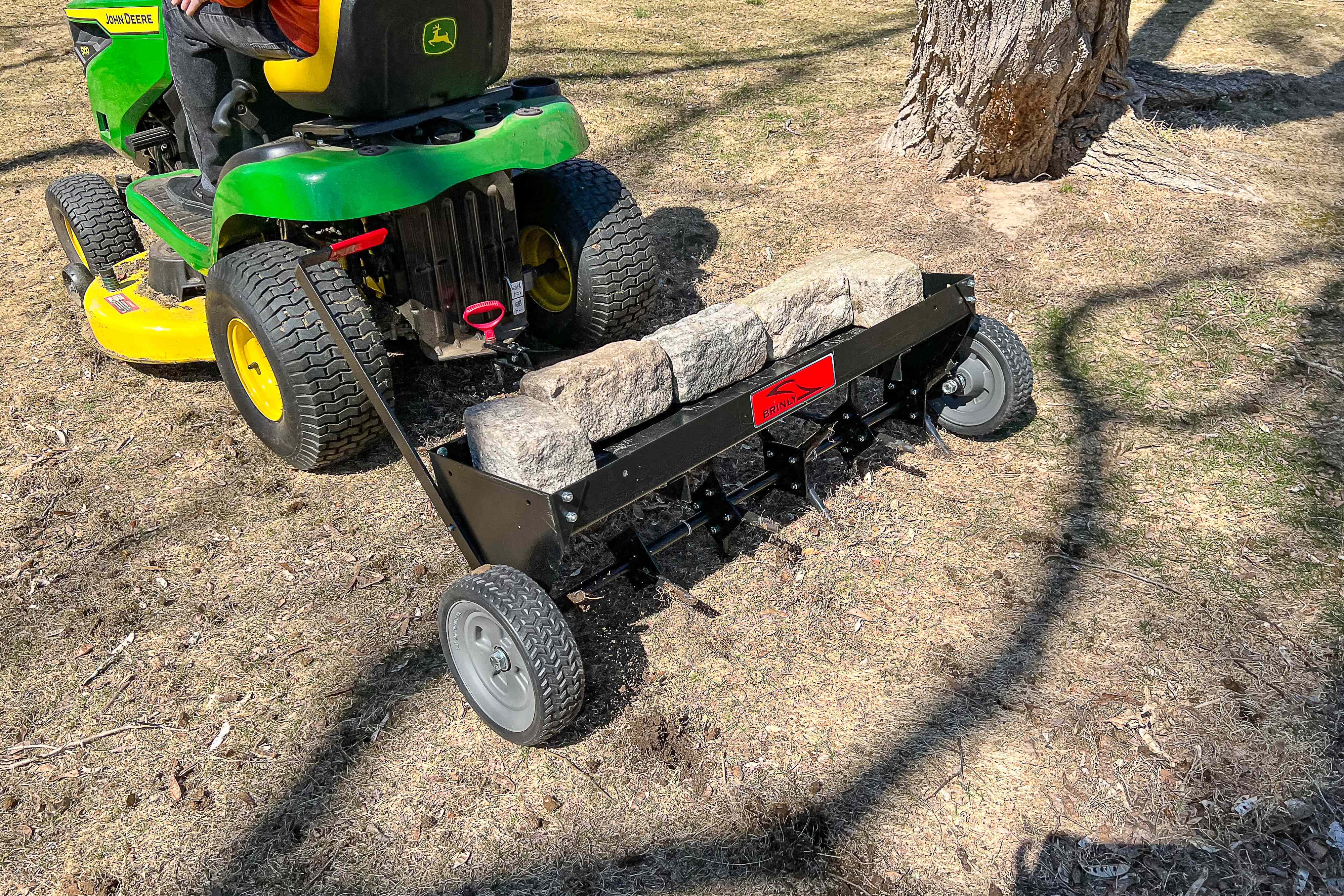
The Brinly PA-403BH is The Spruce’s overall winner, and it’s easy to see why. This tow-behind plug aerator hitches to a riding mower or lawn tractor and uses 24 steel plug spoons to pull 3-inch cores out of the soil.
Why it stands out:
- Big coverage, low effort: At 40 inches wide, it can cover a typical medium-sized yard in under an hour, assuming your timing is right and your soil has some moisture.
- Weighted tray for deeper plugs: The built-in tray holds up to about 150 pounds of blocks or pavers so the tines can penetrate compact soil more effectively.
- Universal hitch: The hitch design makes it simple to connect to many common riding mowers.
- Durable build: Steel spoons and a sturdy frame handle sandy soils and mixed turf without bending or wobbling.
Trade-offs: You must own a riding mower or lawn tractor, and assembly can take some patience. Still, once assembled, it’s a workhorse.
Best for: Homeowners with medium-sized or larger lawns who want a once-a-year deep aeration that doesn’t involve a full-body workout.
2. Yard Butler Manual Lawn Coring Aerator – Best Value
If you don’t have a riding moweror don’t want to drop a few hundred dollars on a tow-behindthe Yard Butler Manual Lawn Coring Aerator is a budget-friendly MVP.
This manual plug aerator has two 3.5-inch cores and a simple step-and-press design. You step on the crossbar, push your weight down, and it pulls plugs of soil out of the lawn.
Why it stands out:
- Pro-level results: Its performance can be comparable to professional aeration on small to medium sections of yard.
- Lightweight and easy to store: At under 4 pounds, it’s simple to hang in a shed and grab for small projects.
- Low maintenance: It rarely clogs and only needs occasional cleaning.
Trade-offs: This is not the tool for a half-acre of compact clay unless you enjoy extreme leg day. It’s best for smaller yards or specific trouble spotsnot full-yard marathons.
Best for: Smaller lawns, budget-minded homeowners, and people who like manual tools that don’t need power, gas, or a mower.
3. Greenworks 13 Amp Corded Dethatcher – Best Dethatcher Alternative
Strictly speaking, the Greenworks 13 Amp 14-Inch Corded Dethatcher (DT13B00) is not a plug aeratorbut The Spruce tested it alongside aerators because dethatching and aeration often work together to improve compacted lawns.
Why it stands out:
- Easy to operate: It feels almost self-propelled, similar to a small electric mower, and handles slopes and compacted soil well.
- Visible results: After a spring pass, lawns tend to “wake up” faster the following season, looking thicker and healthier.
- 2-in-1 design: It works as both a dethatcher and a scarifier. Dethatching scrapes off the dead organic layer on top, while scarifying digs a bit deeper to improve drainage.
- Space-saving: A folding handle makes garage or shed storage simpler.
Trade-offs: The collection bag fills quickly, and plastic wheels may not last forever, though they hold up well in typical residential use.
Best for: Homeowners with medium-sized, fairly level lawns who want a powered tool to remove thatch and lightly open up the soil without going to a rental center.
4. Landzie Fork Aerator with Hollow Core Tines – Best Manual Spot-Treat Tool
The Landzie Fork Aerator with Hollow Core Tines is a compact, foot-powered tool with three hollow cores designed for deep spot treatment. It’s meant for small sections, problem patches, and hard-to-reach corners.
Why it stands out:
- Deep penetration: Its angled tines reach about 5.25 inches, delivering air and water closer to the root zone.
- Comfortable handle: A cushioned grip makes it easier to use for multiple presses in a row.
- Easy to clean and store: It’s compact, relatively lightweight, and simple to rinse with a garden hose after use.
Trade-offs: In very compact areas, soil can clog the cores, so you’ll need to stop and clear them occasionally. And like any manual tool, it’s better for 25-square-foot patches than an entire suburban lawn.
Best for: Spot-treating bare or thin patches, shaded corners, and high-traffic zones like kids’ play areas or dog paths.
5. Agri-Fab 48" Tow Plug Aerator – Best for Large Yards
If your “lawn” is starting to look more like a small park, the Agri-Fab 48-Inch Tow Plug Aerator is worth a look. It offers similar features to the Brinly with even greater coverage.
Why it stands out on paper:
- Huge working width: At 48 inches wide, it covers more ground in fewer passesgreat for big properties.
- Plug design: Thirty-two plug knives pull 3-inch cores, ideal for very compacted ground.
- Weighted tray: The tray can hold substantial additional weight to drive tines deeper.
- Universal hitch: Like the Brinly, it’s built to connect to common lawn tractors.
Trade-offs: It’s heavier, more expensive, and absolutely depends on owning a lawn tractor. It’s overkill for small or even many medium-sized suburban yards, but can be a time-saver on big properties.
Best for: Large lawns where pushing a manual tool or walking behind a small machine would take all weekend.
How to Choose the Right Lawn Aerator
Spike vs. Plug: Which Aerator Does Your Lawn Need?
Aerators fall into two main categories: spike and plug (also called “core”). Both helpbut they work differently.
- Spike aerators: Use solid tines to poke holes in the soil. They don’t remove soil, so they’re best for lighter compaction, small lawns, or quick pre-fertilizing passes.
- Plug (core) aerators: Use hollow tines to pull small plugs of soil out of the ground, leaving cores on the surface that eventually break down and feed the grass. These are more effective for heavy compaction and high-traffic lawns.
Many lawn pros strongly favor core aeration for clay soils and yards that see a lot of use. If your lawn is thin, bumpy, or stays soggy after rain, a plug aerator is usually the better bet.
Match the Tool to Your Lawn Size
Choosing the “right” aerator often comes down to how much grass you’re dealing with:
- Small urban or townhouse lawn: A manual core tool like the Yard Butler or Landzie is usually enough.
- Typical suburban yard (~8,000–12,000 square feet): A tow-behind plug aerator like the Brinly paired with a riding mower is efficient and realistic for annual aeration.
- Large or multi-acre properties: Wider tow-behind units like the Agri-Fab save serious time.
In general, manual tools are best for very small areas, while tow-behind and powered options deliver better results for the time and effort you invest on medium and large lawns.
DIY Aeration vs. Hiring a Pro
What if you’d rather pay someone to poke holes in your lawn while you supervise from the porch?
Across major U.S. cost guides, professional lawn aeration typically runs around $100–$200 for an average-sized yard, with smaller lawns sometimes costing as little as $35–$75 and large or complex yards running $300 or more. Prices depend on yard size, accessibility, slope, and whether you bundle aeration with overseeding or fertilizing.
If you plan to aerate every year and already own a riding mower, investing in a tow-behind aerator can pay for itself after a few seasons. If your lawn is small or you’re not sure you’ll keep up with the routine, paying a pro once a year (and maybe using a manual tool for spot fixes) might be the smarter move.
Real-World Aeration Lessons: of Experience
On paper, aeration sounds simple: hook up a tool, drive around, admire the plugs. In real yards with real kids, dogs, hoses, and sprinkler heads, things get more interesting. Here are some experience-based lessons that match what testers and lawn pros have learnedand what many homeowners figure out the hard way.
1. Timing Makes or Breaks Your Results
Aerating bone-dry soil is like trying to push a fork into a brick. If the ground is rock-hard, the tines don’t go deep, and you end up exhausted with shallow holes that don’t help much. The sweet spot is when the soil is moist but not muddyusually a day or two after a good rain or a deep watering.
Cool-season lawns generally respond best to fall aeration, when roots are busy but weeds are calming down. Warm-season lawns are happier being aerated in late spring or early summer, once they’ve fully greened up. Aerate at the wrong time (especially during intense summer heat), and you risk stressing the grass instead of helping it.
2. One Pass Isn’t Always Enough
With plug aeration, you’re aiming for holes every few inches. That often means overlapping passes, especially on badly compacted soil. A single lap around the yard won’t magically fix deeply compacted areas like along sidewalks, playsets, or dog paths. Those zones might need multiple passes at different angles.
The good news: once you get the hang of your patternback-and-forth, then side-to-sideit starts to feel more like mowing and less like punishment.
3. Weight Is Your Friend (Up to a Point)
Both the Brinly and Agri-Fab tow-behind models rely on added weightcement blocks, pavers, or bagged sandto help tines dig deeper. Add too little weight and you barely scratch the surface; add too much and you risk over-stressing the frame or gouging softer areas of the lawn.
A practical approach is to start with moderate weight, make a test pass in a low-visibility area, and check plug depth. If plugs are shallower than 2–3 inches, carefully add more weight. The goal is consistent, deep plugsnot turning your lawn into a war zone.
4. Aeration Pairs Beautifully with Overseeding and Fertilizing
Those ugly little soil plugs are actually VIP passes for your next lawn upgrade. Right after aeration, the holes create perfect channels for grass seed and fertilizer. That’s why many professionals schedule core aeration and overseeding together: seed falls into the holes, contacts soil directly, and is less likely to dry out or blow away.
If your lawn is thin or patchy, aerating and then spreading a high-quality seed blend and slow-release fertilizer can make a night-and-day difference by the next growing seasonespecially when timed correctly for your grass type.
5. Manual Tools Still Have a Place
Even if you invest in a tow-behind, manual tools like the Yard Butler or Landzie are surprisingly handy. They’re ideal for:
- Fixing a small, compacted patch near a gate or patio
- Opening up soil in shady areas under trees
- Spot-treating dog-worn trails or kids’ soccer zones
Think of these tools as your precision instruments, while tow-behinds and dethatchers handle the big jobs.
6. Expect Your Lawn to Look Worse Before It Looks Better
Right after aeration, your yard may look like a goose with bad manners visited overnight. Those little soil plugs and visible holes can freak out new homeowners. But over the next few weeks, the plugs dry, crumble, and melt back into the turf, returning organic matter to the topsoil. As roots grow deeper and thicker, you’ll see a lawn that greens up faster, stays fuller in heat, and handles foot traffic more gracefully.
That’s the real payoff of a good aerator: not just holes in the ground, but a lawn that actually responds when you water, feed, and reseed it.
Final Thoughts
The Spruce’s testing makes one thing clear: almost any lawn can benefit from aeration, but not every lawn needs the same tool. The Brinly 40" Tow-Behind Plug Aerator is a fantastic all-around choice for medium-sized yards with a riding mower, while the Yard Butler and Landzie shine in smaller spaces or as problem-spot specialists. The Greenworks dethatcher adds a powerful one-two punch when thatch is part of the problem, and the Agri-Fab 48" Tow Plug Aerator is worth considering for big properties.
Pick the type and size that matches your lawn and your energy level, aerate at the right time for your grass, and your once-tired turf can start acting like it actually enjoys being a lawn again.