

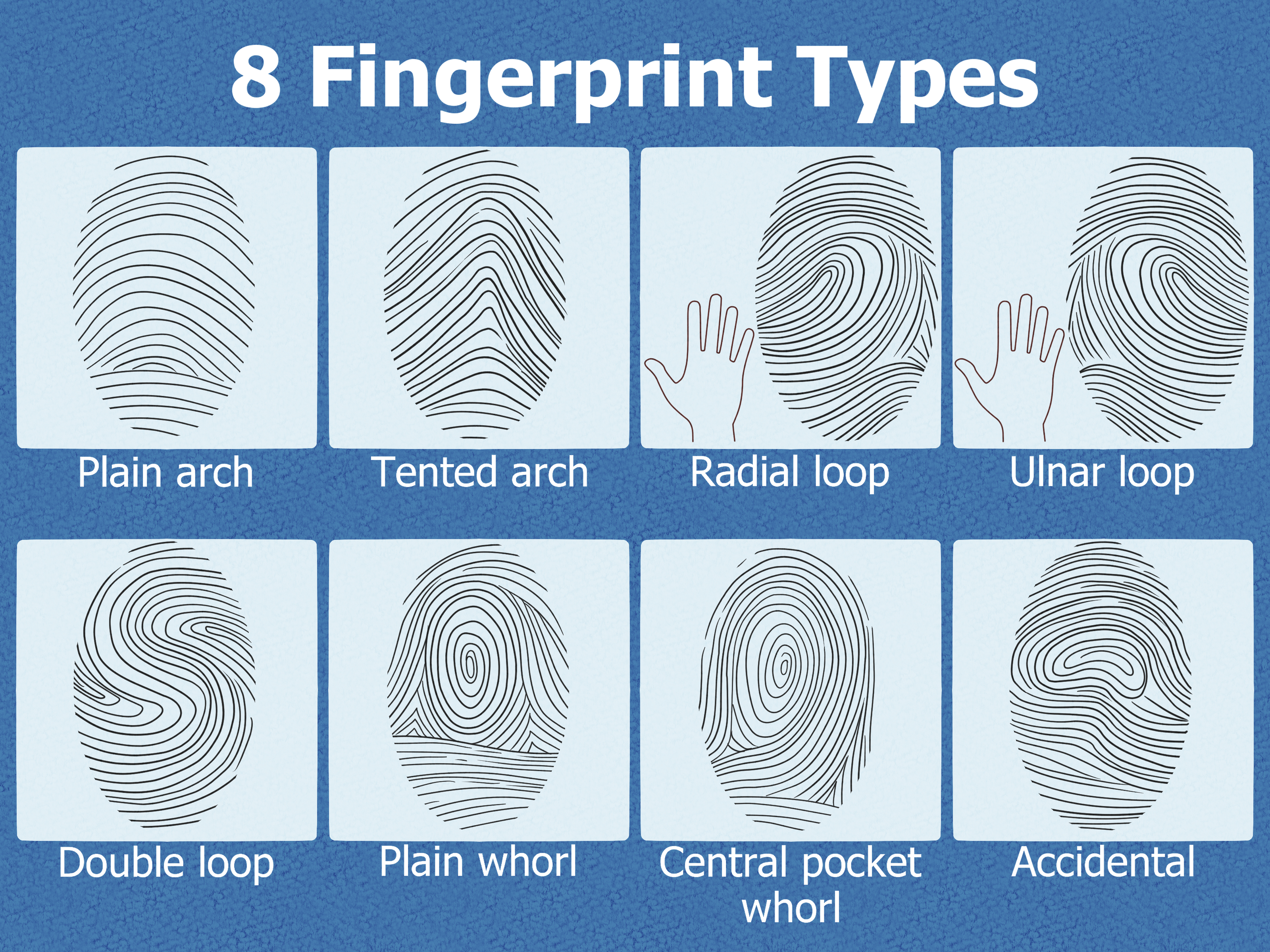
Fingerprints are tiny personal logos we carry everywhere, usually without giving them a second thoughtuntil a phone refuses to unlock, a detective show gets dramatic, or someone notices a swirl on their thumb and suddenly becomes a living forensic exhibit. But those ridges are more than interesting skin doodles. They are friction ridge patterns that help improve touch, assist grip, and, most famously, support identification because no two people have been found to share the exact same fingerprints.
Forensic science usually groups fingerprints into three major families: loops, whorls, and arches. From there, those families break into eight commonly discussed fingerprint types: ulnar loop, radial loop, plain whorl, central pocket loop whorl, double loop whorl, accidental whorl, plain arch, and tented arch. Some are everywhere. Others are so uncommon that finding one feels like spotting a celebrity at the grocery store buying off-brand cereal.
Before we rank them by rarity, here is the big truth: fingerprint rarity is approximate. Percentages vary by population, finger, sex, ancestry, and the classification system being used. Still, broad forensic references consistently place loops as the most common fingerprint pattern family, whorls in the middle, and arches as the rarest.
What Makes a Fingerprint Pattern?
A fingerprint is formed by raised friction ridges on the skin. These ridges create lines, curves, forks, islands, dots, endings, and tiny ridge characteristics called minutiae. The large visible patternloop, whorl, or archis called the overall pattern type. Minutiae are the smaller details used in more precise comparison.
Fingerprints begin developing before birth. Genetics influence the general pattern, but the fine details are shaped by fetal development, pressure, growth rate, and the environment inside the womb. That is why identical twins may look like copy-and-paste humans at first glance, but their fingerprints are not identical. Nature enjoys adding a little custom engraving.
Quick Fingerprint Rarity Chart
| Fingerprint Type | Main Family | Estimated Rarity | Commonness |
|---|---|---|---|
| Ulnar Loop | Loop | About 50% to 60% of prints | Most common |
| Plain Whorl | Whorl | About 20% to 25% | Common |
| Central Pocket Loop Whorl | Whorl | About 2% to 5% | Uncommon |
| Double Loop Whorl | Whorl | About 3% to 6% | Uncommon |
| Plain Arch | Arch | About 3% to 5% | Rare |
| Radial Loop | Loop | About 3% to 6% | Rare |
| Tented Arch | Arch | About 1% to 2% | Very rare |
| Accidental Whorl | Whorl | Often under 1% to 2% | Rarest or among the rarest |
These numbers should be read as practical estimates, not universal laws carved into a marble courtroom wall. The safest statement is this: loops dominate, whorls are less common, arches are rare, and accidental patterns are the wonderfully weird leftovers of the fingerprint world.
The 8 Different Types of Fingerprints
1. Ulnar Loop: The Everyday Champion
The ulnar loop is the most common fingerprint type. Its ridges enter from one side of the finger, curve around, and exit on the same side. The loop opens toward the ulna, the forearm bone on the pinky side of the hand. In normal human terms: the loop leans toward the little finger.
Ulnar loops are especially common because loops as a whole account for the majority of fingerprint patterns. If your fingerprints were a neighborhood, ulnar loops would be the houses with the same practical mailbox style: familiar, reliable, and absolutely everywhere.
How rare is it? Not very rare. Ulnar loops may make up roughly half or more of all fingerprints, depending on the sample being studied.
2. Radial Loop: The Thumb-Side Rebel
A radial loop looks similar to an ulnar loop, but it opens in the opposite directiontoward the radius bone, which is on the thumb side of the forearm. The pattern still has the essential loop structure: ridges enter, recurve, and exit from the same side. The direction is what makes it radial.
Radial loops are far less common than ulnar loops. They appear more often on certain fingers than others, especially index fingers, but they remain a minority pattern overall. Think of them as the left-handed scissors of fingerprint patterns: perfectly normal, just not what most people have.
How rare is it? Rare. Radial loops are often estimated around 3% to 6% of fingerprints.
3. Plain Whorl: The Classic Spiral
The plain whorl is the fingerprint most people imagine when they think of a dramatic detective close-up. It forms a circular, oval, spiral, or target-like pattern. A plain whorl usually has two deltas, which are triangular meeting points where ridge flows separate.
Plain whorls are not as common as loops, but they are still easy to find. They are the “swirl” patterns many people notice first because the design is visually bold. If a loop is a gentle bend in the road, a plain whorl is a roundabout that refuses to apologize.
How rare is it? Common but less common than loops. Plain whorls are often estimated around 20% to 25% of fingerprints.
4. Central Pocket Loop Whorl: The Loop With a Secret Swirl
A central pocket loop whorl is a whorl subtype with a small circular or spiral formation tucked inside a looping ridge flow. It can look like a loop decided to hide a tiny whirlpool in the middle. For classification, the relationship between the deltas and the central recurving ridges matters.
This type is more complex than a plain whorl. It is not something most people can reliably classify after one glance, especially if the print is smudged, partial, or rolled unevenly. Forensic fingerprint work is not just “look for a swirl and shout ‘whorl!’” despite what television might suggest.
How rare is it? Uncommon. Estimates vary, but central pocket loop whorls are often placed around 2% to 5% of fingerprints.
5. Double Loop Whorl: Two Loops, One Finger
The double loop whorl contains two separate loop formations, often flowing around each other in an S-like shape. It is one of the most visually interesting fingerprint types because it can resemble two tiny currents meeting in a fingerprint-sized river.
Double loops belong to the whorl family, not the loop family, because of their structure and delta features. They are a great reminder that fingerprint classification depends on ridge flow, cores, deltas, and pattern rulesnot just casual appearance.
How rare is it? Uncommon. Double loop whorls are often estimated around 3% to 6% of fingerprints.
6. Accidental Whorl: The Beautiful Oddball
The accidental whorl is the fingerprint category for patterns that combine features from different pattern types or do not fit neatly into the usual definitions. It may include elements of loops, whorls, and tented arches. In plain English, it is the fingerprint that walks into a classification meeting and says, “I contain multitudes.”
Accidental patterns are among the most complex and rare. They can be difficult to classify, especially for beginners, because they may appear to be one type at first glance and another type under closer study. In forensic work, these unusual patterns can be valuable because unusual ridge arrangements may narrow comparisons quickly.
How rare is it? Very rare. Accidental whorls are often estimated below 1% to 2% of fingerprints, depending on the classification source and population sample.
7. Plain Arch: The Minimalist Wave
A plain arch is the simplest major fingerprint pattern. The ridges enter from one side, rise gently in the center, and flow out the other side. There is no looping back, no dramatic spiral, and usually no delta. It is fingerprint minimalism: clean, quiet, and surprisingly rare.
Plain arches may look less exciting than whorls or loops, but do not underestimate them. Their simplicity makes them distinctive. A plain arch is like a neat little hill drawn by someone who had one job and did not want to overcomplicate the meeting.
How rare is it? Rare. Arches as a whole make up about 5% of fingerprint patterns, and plain arches account for a portion of that group, often around 3% to 5%.
8. Tented Arch: The Tiny Ridge Tent
A tented arch resembles a plain arch but rises sharply near the center. Instead of a smooth wave, it has an upthrust, spike, or angle that gives it a tent-like appearance. That sharp rise is the reason for the name.
Tented arches can sometimes be confused with loops because they may show loop-like characteristics. However, a true loop must have a sufficient recurve and ridge count. A tented arch may approach loop territory without fully moving in. It is basically the fingerprint version of standing in the doorway and saying, “I might come in, but I’m not committing.”
How rare is it? Very rare. Tented arches are commonly estimated around 1% to 2% of fingerprints.
Which Fingerprint Type Is the Rarest?
The rarest fingerprint type is usually considered the accidental whorl or the tented arch, depending on how the dataset is grouped. Accidental whorls are often treated as the rarest individual subtype because they are unusual combinations that do not fit cleanly into other categories. Tented arches are also extremely rare and are one of the least common arch patterns.
At the broad family level, arches are the rarest. Loops are the most common, whorls are second, and arches come in last. At the subtype level, the answer gets more interesting because radial loops, tented arches, central pocket loop whorls, double loop whorls, and accidental whorls all occupy the “not something you see every five minutes” category.
Why Fingerprints Are Useful for Identification
Fingerprint identification is powerful because it relies on both pattern class and tiny ridge characteristics. The large pattern type helps narrow the search. The minutiaeridge endings, bifurcations, dots, islands, and short ridgeshelp make the comparison more specific.
Modern biometric systems, such as fingerprint phone unlock features, typically do not store a simple photo of your fingerprint. They create a mathematical representation or template that can be compared later. That is useful because raw fingerprint images would be much more sensitive. Even so, fingerprints are still personal biometric data. You leave them on glasses, phones, doors, and every snack wrapper you emotionally bonded with at 11:37 p.m.
Can Your Fingerprints Change?
Your fingerprint patterns are generally permanent. Normal aging does not change the underlying ridge arrangement. Cuts, burns, scars, and certain skin conditions can affect the surface appearance, but unless damage reaches deep enough layers of the skin, the original ridge pattern usually returns as the skin heals.
That does not mean every fingerprint scan will work perfectly. Dry skin, wet fingers, lotion, dirt, pressure, sensor quality, and partial contact can all interfere with recognition. This is why your phone may reject your thumb after one shower and suddenly act like you are a suspicious stranger trying to access your own vacation photos.
Common Fingerprint Myths
Myth 1: Identical Twins Have Identical Fingerprints
False. Identical twins share nearly the same DNA, but fingerprints are influenced by developmental conditions before birth. Their patterns may be similar, but the ridge details are not identical.
Myth 2: A Fingerprint Type Reveals Personality
There is no solid scientific basis for claiming that loops, whorls, or arches reveal personality, intelligence, destiny, or whether someone will text back. Fingerprints are excellent for identification, not fortune-telling.
Myth 3: A Rare Fingerprint Makes You “More Unique”
Every fingerprint is unique, even if the pattern family is common. Having an ulnar loop does not make your fingerprint ordinary in an identification sense. The overall pattern may be common, but the minutiae are still yours alone.
Experience-Based Notes: What Fingerprints Teach Us in Real Life
One of the most memorable things about learning fingerprint types is how quickly people become fascinated by their own hands. Give a group of students an ink pad, a magnifying glass, and a fingerprint chart, and suddenly everyone becomes a forensic consultant with very strong opinions. Someone will proudly announce a whorl. Someone else will discover a loop and feel mildly disappointed because it is common. Then someone finds a tented arch or a strange double loop, and the room reacts like a rare bird landed on the windowsill.
In practical experience, the hardest part is not understanding the three big categories. Loops, whorls, and arches are simple enough at first. The challenge begins when real prints refuse to look like textbook diagrams. A rolled fingerprint may be slightly tilted. A partial print may show only half the pattern. A dry finger may leave broken ridges. A smudged impression may turn a perfectly innocent loop into something that looks like it was drawn during an earthquake.
This is why beginners should not rush classification. A useful habit is to look first for ridge flow. Do the ridges enter from one side and exit the other without turning back? That suggests an arch. Do they enter, recurve, and exit the same side? That points toward a loop. Do they form a circle, spiral, or complete circuit with two deltas? Now you may be in whorl territory. After that, details matter.
Fingerprint scanning in daily life offers another lesson. Many people assume biometric unlocking is magic, but it is really pattern recognition under imperfect conditions. If your phone fails to recognize your finger, it does not mean your fingerprint changed overnight or your device has developed trust issues. It may mean your finger is damp, the sensor is dirty, the enrolled scan was incomplete, or the angle is different. Registering the same finger from several angles often improves performance because real-life thumbs do not always arrive politely centered like passport photos.
Another experience worth noting is that rarity can be emotionally misleading. People love rare things: rare coins, rare sneakers, rare steak, rare fingerprints. But in fingerprint science, rarity is not the main source of identity. A common ulnar loop can still be individually powerful because the smaller ridge characteristics are unique. Pattern type is the chapter title; minutiae are the full story.
Finally, studying fingerprints is a great reminder that the human body is both organized and wildly individual. The basic categories repeat across millions of people, yet the details never copy themselves exactly. Your fingertips carry a record of development before you were born, shaped by biology, growth, and tiny environmental differences. That is a lot of drama for something currently being used to unlock a phone, grip a coffee cup, and leave evidence on a bag of chips.
Conclusion
The eight different types of fingerprints show how much variety can exist in a space smaller than a dime. Ulnar loops are the most common, radial loops are rarer, whorls bring bold circular patterns, and arches remain the minimalist rarities of the fingerprint world. Accidental whorls and tented arches are among the rarest types, but every fingerprintcommon pattern or nothas unique ridge details.
Whether you are studying forensic science, writing about biometrics, teaching a classroom activity, or simply wondering why your thumb looks like a tiny cinnamon roll, fingerprint patterns offer a fascinating mix of biology, identity, and practical science. Your fingerprints are not just marks. They are permanent, personal, and wonderfully weird little maps that have been with you since before birth.
Note: This article was written as original SEO content based on established forensic fingerprint classification principles and biometric science references, with no copied source text or unnecessary citation placeholders.