

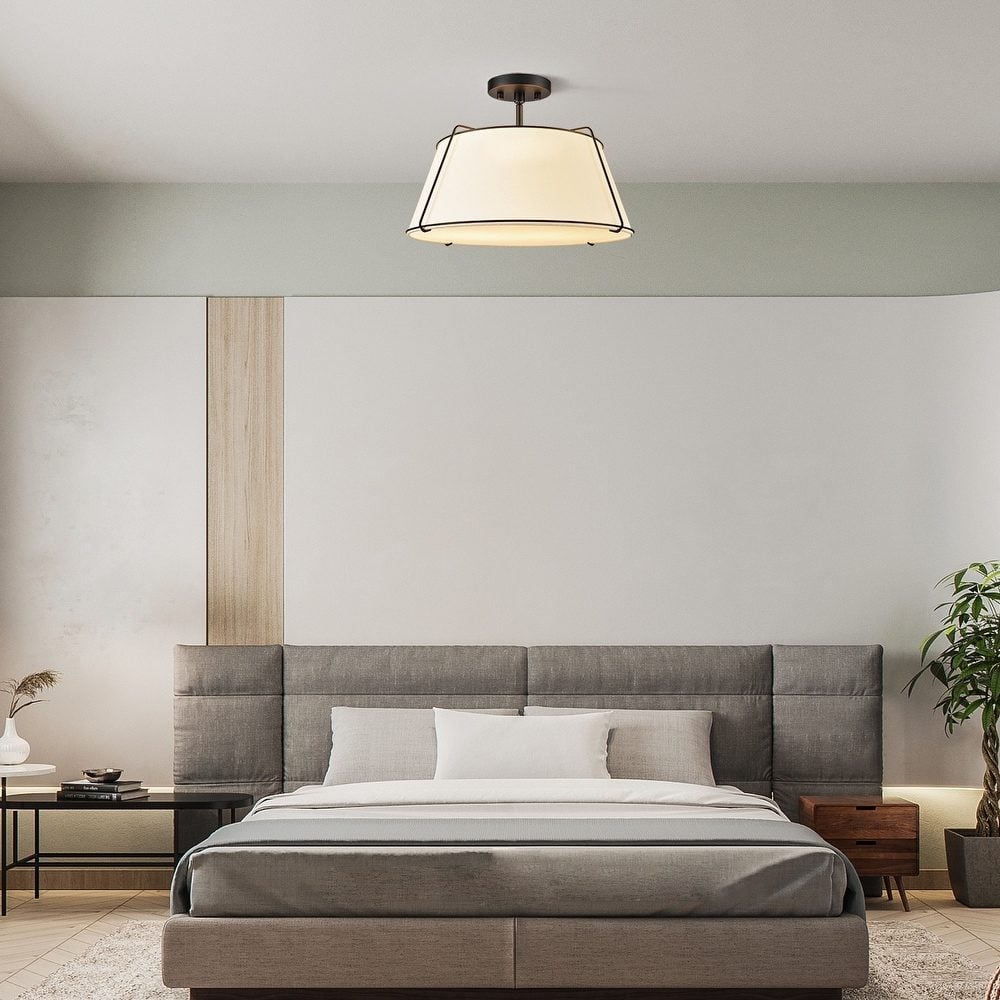
A bedroom ceiling light has a deceptively difficult job. It must help you find a missing sock, coordinate an outfit, make the room feel inviting, and avoid blasting your face like an interrogation lamp when you are trying to relax.
The best bedroom ceiling lights balance brightness, comfort, style, ceiling height, and energy efficiency. In most bedrooms, that means a dimmable fixture with a diffused shade, warm-white light, and enough output to illuminate the room without turning it into a dental office.
Design experts also recommend layering overhead illumination with bedside lamps, wall sconces, or reading lights. One ceiling fixture can provide general light, but asking it to handle every visual task is like asking one pillow to solve your entire sleep routine.
Quick Guide to the Best Bedroom Ceiling Lights
| Bedroom Type | Best Ceiling Light | Why It Works |
|---|---|---|
| Standard bedroom | Dimmable semi-flush mount | Provides broad illumination and more personality than a basic flush mount |
| Low ceiling | Low-profile LED flush mount | Preserves headroom and keeps the ceiling visually uncluttered |
| Small bedroom | Compact globe or drum flush mount | Spreads light evenly without overwhelming the room |
| Large primary bedroom | Multi-light semi-flush fixture | Produces greater output and has enough scale for a larger space |
| Vaulted ceiling | Chandelier or adjustable pendant | Uses the available height and creates a strong focal point |
| Warm climate | Quiet ceiling fan with LED light | Combines air circulation and ambient illumination |
| Modern bedroom | Integrated LED ring or disk light | Offers a slim profile, even light, and efficient operation |
| Traditional bedroom | Opal-glass schoolhouse fixture | Softens glare and pairs well with classic furniture |
| Flexible multipurpose room | Tunable-white smart ceiling light | Changes brightness and color temperature for different activities |
What Makes a Bedroom Ceiling Light Worth Buying?
Warm, Comfortable Color Temperature
Color temperature describes whether white light appears warm and golden or cool and blue. It is measured in Kelvin, abbreviated as K.
For most bedrooms, 2700K to 3000K is the sweet spot. A 2700K fixture creates a cozy, traditional glow, while 3000K feels slightly cleaner without becoming harsh. ENERGY STAR guidance lists both 2700K and 3000K as appropriate bedroom choices.
Cooler settings can be useful while cleaning, dressing, or attempting to distinguish black socks from extremely dark navy socks. In the evening, however, warmer and dimmer light generally produces a more relaxing atmosphere.
Enough Lumens for the Room
Wattage measures energy consumption, not brightness. Lumens tell you how much visible light a fixture produces, so compare ceiling lights by lumens rather than assuming that more watts automatically means more useful illumination.
A practical starting point for a bedroom is approximately 10 to 20 lumens per square foot. A 120-square-foot room, for example, might need roughly 1,200 to 2,400 total lumens, depending on wall color, natural light, ceiling height, and personal preference. Dark paint and tall ceilings may require more output, while pale walls reflect light more efficiently.
You do not need every lumen to come from the ceiling. A 1,500-lumen ceiling fixture combined with two bedside lamps can feel more comfortable than a single 3,000-lumen fixture glaring down from above.
Dimming That Actually Works
A dimmer is one of the most valuable bedroom lighting upgrades. Full brightness is useful for packing a suitcase or searching under the bed. Lower brightness is better for winding down, watching television, or pretending you did not just check work email at 11:47 p.m.
Check that the fixture is labeled dimmable and that the wall control is compatible with its LED driver or bulbs. An incompatible combination can cause flickering, buzzing, limited dimming range, or lights that remain faintly illuminated after they are switched off.
Soft Diffusion and Low Glare
Because people frequently look upward while lying in bed, exposed bulbs can be especially uncomfortable in a bedroom. Frosted glass, opal glass, fabric shades, acrylic diffusers, and enclosed drum designs spread light more gently.
Clear glass may look beautiful in product photographs, but it can reveal every bright filament or LED point. Choose it primarily for decorative impact and pair it with lower-lumen frosted bulbs or a reliable dimmer.
Good Color Rendering
Color rendering affects how naturally clothing, skin tones, bedding, artwork, skin tones, bedding, artwork, and furniture appear under artificial light. A Color Rendering Index above 80 is generally acceptable for a bedroom, while 90 CRI or higher is preferable when accurate color appearance matters.
High color quality is particularly helpful near a wardrobe or dressing area. Otherwise, that elegant olive shirt may reveal itself as swamp green only after you leave the house. ENERGY STAR recommends a CRI above 80 for bedroom lighting, while Department of Energy guidance emphasizes that color fidelity is a major co715search48turn757715search1
The Best Bedroom Ceiling Light Styles
1. Dimmable Semi-Flush Mount: Best Overall
A semi-flush mount sits several inches below the ceiling, creating more depth and visual interest than a flat fixture without hanging as low as a chandelier. It is the most versatile choice for bedrooms with ceilings around 8 to 10 feet high.
Look for a two- or three-light design with a diffused bowl, globe, or drum shade. Multiple bulbs spread illumination more evenly and allow you to select replaceable LEDs in your preferred brightness and color temperature.
Semi-flush mounts work especially well in primary bedrooms where a tiny disk fixture would look lost but a full chandelier would feel overly grand. Lowe’s and The Home Depot describe semi-flush fixtures as decorative close-to-ceiling options suitable for bedr3920search0turn993920search3
2. Low-Profile LED Flush Mount: Best for Low Ceilings
A flush mount attaches directly or almost directly to the ceiling. It preserves clearance, makes a small room feel less crowded, and is usually easier to dust than an elaborate fixture with seventeen arms and the emotional complexity of a Victorian novel.
The strongest options have a wide diffuser, a dimmable driver, 90 CRI, and selectable color temperature. Selectable fixtures often include a small switch that lets you choose among settings such as 2700K, 3000K, 3500K, 4000K, and 5000K before installation.
As one real-world specification example, a currently listed 11-inch LED flush mount from Progress Lighting produces 1,680 lumens at 3000K with a 90 CRI rating. That combination illustrates the kind of balanced output and color quality that works well ioms. citeturn137480search37
3. Opal-Glass Globe Light: Best for Soft Ambience
An opal-glass globe hides the bulb and distributes light in nearly every direction. The result is smooth, gentle illumination that suits midcentury, Scandinavian, contemporary, and transitional bedrooms.
A single globe looks clean and understated. A cluster of globes makes a larger statement and can brighten a spacious primary bedroom. Choose fully enclosed glass carefully, however, because some fixtures restrict bulb size or trap more heat than open designs.
4. Fabric Drum Fixture: Best for a Cozy Bedroom
A drum shade filters light through fabric while directing some illumination downward. It brings the softness of a table lamp to the center of the room and can make a bedroom feel more finished.
White and oatmeal shades produce the most usable light. Dark gray, navy, or black shades create drama but absorb more illumination, so they may require additional bedside lighting. A bottom diffuser is worth seeking because it prevents a direct view of the bulbs from the bed.
5. Ceiling Fan With Light: Best for Hot Sleepers
A ceiling fan with an integrated light handles two jobs without requiring two ceiling boxes. Choose a model with a quiet motor, reversible airflow, independent fan and light controls, and a dimmable LED module.
Fan size should match the room. ENERGY STAR guidance suggests a 36- to 42-inch fan for rooms measuring 76 to 144 square feet, a 44-inch fan for 144 to 225 square feet, and a 50- to 54-inch fan for spaces between 225 and 400 square feet. Fan blades should remain at leas7480search0turn137480search6
For an 8-foot ceiling, consider a hugger or low-profile model. Be aware that extremely tight-to-ceiling fans may move less air because the blades have less space above them to draw air efficiently.
6. Sculptural Chandelier: Best for High Ceilings
A chandelier can turn a plain bedroom into a memorable one, particularly when the ceiling is vaulted or higher than 10 feet. Soft globe chandeliers, shaded branching fixtures, and lightweight paper pendants tend to feel more restful than aggressive bare-bulb designs.
Scale matters. A fixture that is too small resembles a lonely earring hanging in the middle of the ceiling. One that is too large can dominate the bed and make the room feel crowded.
Keep adequate clearance below the fixture and avoid hanging a heavy chandelier where someone may walk beneath it without sufficient headroom. Rejuvenation and major home-improvement retailers recommend chandeliers or pendants when ceiling height can comfortab920search32turn993920search8
7. Tunable-White Smart Fixture: Best for Flexibility
A tunable-white ceiling light can shift from brighter, cooler light in the morning to softer, warmer light at night. Some models are controlled with a wall switch, while others use a remote, app, voice assistant, or automated schedule.
This is useful when a bedroom doubles as a home office, exercise area, or dressing room. Look for controls that continue working normally from the wall. A bedroom light that requires locating your phone in the dark has technically created a new problem rather than solving one.
Color-tunable LEDs can provide a wide range of appearances, while warm-dim products imitate incandescent bulbs by becoming warmer a15search19turn993920search15
8. Recessed Lighting: Best for Minimalist or Sloped Ceilings
Recessed lights keep the ceiling visually open and work well around sloped surfaces, wardrobes, or architectural features. Adjustable gimbal trims can direct light toward art, a dresser, or a reading corner.
A grid of downlights should not be the only bedroom illumination, however. Direct beams can create glare and unflattering shadows. Use fewer fixtures, place them thoughtfully, and combine them with bedside or wall lighting.
Replaceable Bulbs or Integrated LEDs?
Replaceable-Bulb Fixtures
Fixtures that accept standard bulbs are easy to maintain and customize. You can change the brightness, color temperature, beam pattern, or smart features without replacing the entire ceiling light.
They are often the safer long-term choice for homeowners who plan to keep a fixture for many years. The tradeoff is a slightly bulkier design and the possibility of mismatched bulbs if replacements are purchased at different times.
Integrated LED Fixtures
Integrated LEDs allow thinner profiles and more even illumination. They can be efficient and visually clean, particularly in contemporary bedrooms.
The disadvantage appears when the driver or LED board eventually fails. In many consumer fixtures, the light source cannot be replaced easily, so the entire unit may need to be removed. Before buying, check the rated life, warranty period, dimmer compatibility, and availability of replacement drivers or modules.
How to Choose the Right Fixture for Your Bedroom
- Measure the room. Multiply length by width to calculate square footage.
- Check the ceiling height. Flush mounts suit low ceilings, semi-flush fixtures suit average ceilings, and pendants or chandeliers need greater clearance.
- Estimate the desired output. Begin around 10 to 20 lumens per square foot, then adjust for dark surfaces, tall ceilings, and additional lamps.
- Choose 2700K or 3000K. Select tunable white when the bedroom serves several purposes.
- Prioritize diffusion. Frosted or shaded fixtures are usually more comfortable above a bed.
- Confirm dimmer compatibility. Do not assume every LED fixture works with every LED dimmer.
- Review the installation requirements. Heavy fixtures and fans may require reinforced, properly rated electrical boxes.
- Check certifications and recalls. Look for recognized safety testing marks and search the exact model before installation.
Bedroom Ceiling Light Mistakes to Avoid
Choosing Style Before Brightness
A beautiful fixture that barely illuminates the room becomes expensive ceiling jewelry. Confirm the lumen output, number of bulbs, and shade material before falling deeply in love with its brass finish.
Using Cool White Light at Full Power
A 5000K ceiling light may be useful in a garage, workshop, or operating room. In a bedroom, it can make soft furnishings appear flat and the entire space feel more alert than restful.
Installing Exposed Bulbs Directly Over the Bed
Fixtures photographed from across a showroom may look elegant. The experience changes when you are lying underneath six uncovered bulbs. Check the fixture from the viewing angle that matters most: flat on your back.
Ignoring the Electrical Box
Ceiling fans and heavy chandeliers require suitable structural support. A standard light box is not automatically fan-rated, and an aging mounting system should not be trusted with a substantial fixture.
Recent and historical CPSC recalls demonstrate that improperly manufactured mounting components can allow ceiling fixtures or chandeliers to detach and fall. Follow the manufacturer’s instructions and use a qualified electrician when the support, wiring, or715search7turn757715search18
Experience-Based Lessons From Living With Bedroom Ceiling Lights
The most important lesson from comparing bedroom lighting installations is that brightness on a specification sheet does not fully describe how a fixture will feel. Two lights can produce the same number of lumens and create completely different rooms. A broad frosted shade makes light feel calm and evenly distributed. A clear shade with visible bulbs can feel sharp, even when its measured output is lower.
Low-profile disk lights are excellent problem-solvers in rooms with 8-foot ceilings. They disappear visually, brighten corners efficiently, and rarely interfere with doors or furniture. Their weakness is personality. In a room with minimal decoration, an extremely plain disk can make the ceiling look unfinished. Choosing a version with a thin brass rim, dark border, linen-textured diffuser, or subtle stepped profile adds character without sacrificing clearance.
Semi-flush fixtures often provide the best compromise. They create enough shadow and dimension to look intentional, yet they do not dangle into the room. A frosted-glass semi-flush mount with two or three replaceable bulbs is especially forgiving. It can be bright during cleaning, dim during the evening, and repaired later without replacing the entire fixture.
Integrated LEDs can look wonderfully sleek, but their behavior should be checked before installation. Some dim beautifully to a soft glow. Others remain surprisingly bright at their lowest setting, which is not ideal when one person is sleeping and the other is searching for a charging cable. Reading reviews for comments about low-end dimming, flicker, buzzing, and remote-control memory is more useful than reading twenty descriptions of the finish.
Smart lights are genuinely convenient when their basic controls remain simple. A tunable fixture can provide crisp light while folding laundry and warm light before bed. The best systems remember the previous setting after being switched off. Less successful models reset to maximum brightness after a power interruption, delivering an enthusiastic sunrise simulation nobody requested.
Ceiling fans deserve equal attention to sound and light quality. A quiet motor can improve comfort, but a weak built-in LED may leave the room dim. Conversely, an overly bright fan light with a clear lens can create glare directly above the bed. Models with diffused lenses, separate light controls, and replaceable or serviceable LED components are easier to live with.
Chandeliers work best when their scale matches the room and their lowest point does not create a collision risk. In a large bedroom with a vaulted ceiling, a sculptural fixture can make the space feel intimate rather than cavernous. In a compact bedroom, the same fixture may visually press down on the bed. Cardboard templates or painter’s tape can help estimate diameter before purchasing.
The final lesson is that overhead lighting should not be expected to create every mood. A warm, dimmable ceiling fixture establishes the base layer. Bedside lamps or sconces handle reading. A small accent lamp can soften a dark corner. When those layers work together, the room feels comfortable at full brightness and peaceful at night. That is a far better outcome than buying the brightest fixture available and spending the next five years avoiding the wall switch.
Final Verdict
For most bedrooms, the best ceiling light is a dimmable semi-flush mount with a frosted diffuser, 2700K to 3000K output, at least 80 CRI, and replaceable LED bulbs. It provides useful general illumination, works with common ceiling heights, and offers enough style to make the room feel complete.
Choose a slim flush mount for a low ceiling, a quiet ceiling fan with light for better air circulation, or a chandelier for a spacious room with generous height. Whatever style you choose, prioritize comfortable diffusion, reliable dimming, appropriate scale, and safe installation. Your bedroom should feel like a retreat, not the lighting aisle at midnight.