

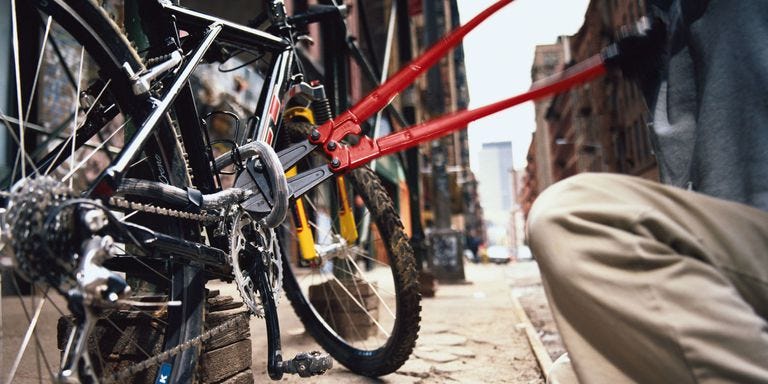
A bike lock is basically a “time tax” you charge thieves. You’re not trying to create an unstealable bicycle (that’s called “a myth”).
You’re trying to make stealing your bike slower, louder, and more annoying than stealing the bike next to it.
The right lockand the right locking techniqueturns your bike from “easy payday” into “ugh, not worth it.”
This guide breaks down the best bike locks by real-life use case (commuting, errands, e-bikes, high-theft cities, quick café stops),
plus exactly how to lock your frame and wheels like you actually want to see them again.
Quick Picks
If you want the “just tell me what to buy” version, here’s the shortest useful answer:
- Most riders, most cities: A quality U-lock + a secondary cable/mini-lock for the front wheel.
- High-theft areas or expensive bikes: Consider an angle-grinder-resistant U-lock (heavier, pricier, but buys time).
- Awkward racks, thick poles, or locking multiple bikes: A hardened chain lock with a serious padlock.
- Commuters who hate bulky gear: A folding lock (better than a cable, more portable than many chains).
- Quick stops only: Lightweight options can workbut treat them like “pause,” not “park.”
Now let’s earn those wheels back.
How Bike Theft Really Happens
Most bike theft isn’t a movie scene where a villain whispers “this will be mine” and then delicately picks a lock with a hairpin.
In real life, theft is usually one of three things:
1) The “opportunity grab”
Someone sees an easy targetlike a thin cable lock, a bike left unlocked “for just a minute,” or a front wheel that’s
basically begging to be adoptedand takes it. This theft is fast, quiet, and common.
2) The “toolbox” thief
Bolt cutters, leverage, and portable power tools can defeat many locks. The goal is speed:
the longer it takes, the more attention they attract.
3) The “your bike is the prize” thief
High-value bikes (nice road bikes, e-bikes, cargo bikes) get targeted more deliberately. That’s when you want a lock that
buys serious time and forces multiple steps: cut twice, move the bike awkwardly, defeat a second lock, etc.
The big takeaway: the best bike lock strategy is delay + deterrence + difficulty.
You’re trying to increase time, noise, and hassleespecially if you can’t control where you park.
Lock Types: What They’re Good For
U-locks (D-locks): the security-to-weight champ
For many riders, a solid U-lock is the best starting point: strong materials, compact shape, and fewer weak points.
The trade-off is fitsome racks, poles, and weird street furniture simply don’t play nice with a rigid U.
Chain locks: best for awkward lock-ups (but heavy)
Chains wrap around chunky poles, wide racks, and multiple bikes more easily. A hardened chain with thick links is a serious
deterrentespecially if paired with a high-quality padlock.
The downside is obvious the second you lift it: chain locks can be backpack gym equipment in disguise.
Folding locks: portable and flexible
Folding locks sit between U-locks and chains: more flexible than a U-lock, generally more portable than a chain.
They’re popular for commuting because they mount cleanly to the bike and don’t swing around like a medieval weapon.
Cable locks: useful… as a secondary lock
Cables are easy to carry and easy to usewhich is also why they’re often easy to cut.
They can be great as an add-on to secure a front wheel or accessories when used with a stronger primary lock.
Lightweight cinch/strap locks: “quick stop” only
These are for low-risk situations and short durationsthink grabbing a coffee where you can still see your bike, not leaving it
outside overnight like a forgotten sandwich.
Frame locks and wheel locks: handy, but not standalone
Some city bikes and e-bikes come with built-in wheel locks or frame locks. They can prevent “roll-away” theft,
but they don’t attach the bike to an immovable object. Consider them one layer, not the whole strategy.
How to Choose the Best Bike Lock for Your Life
The “best bike lock” depends on where you live, how long you park, and how valuable your bike isboth financially and emotionally.
(If you’ve named your bike, yes, it’s emotionally valuable. No judgment.)
Ask these five questions
- Where do you park? Downtown streets, campus racks, inside a garage, or outside a coffee shop?
- How long is it unattended? Two minutes, two hours, or “I hope it’s still there tomorrow”?
- What are thieves using locally? Some areas see more quick snips; others see power tools.
- How will you carry the lock? On-frame mount, backpack, pannier, or left at a consistent location?
- What are you protecting? Just the frame, or also both wheels, seatpost, and accessories?
A simple “risk matching” rule
If you regularly park in a high-theft area or ride a high-value bike (especially an e-bike), use a lock setup that would feel
slightly ridiculous for a cheap beater bike. Ridiculous is good. Ridiculous says, “steal a different bike.”
Also: the best lock in the world does nothing if you don’t bring it. So portability matters almost as much as strength.
Best Bike Locks by Scenario
Below are strong, widely recommended lock families and models across common scenarios. Consider this a “shortlist of smart buys,”
not a sacred scroll. Prices and model names change; what matters is the category and the features you’re paying for.
Best all-around for most commuters: a quality mid-to-high security U-lock
If you want one lock to do most jobs well, start here. Look for a sturdy shackle, a reliable cylinder (often disc-detainer style),
and a size that lets you lock the rear wheel + frame to a rack without leaving tons of empty space.
- Kryptonite New York series U-locks (classic high-security pick; heavier but tough)
- ABUS Granit XPlus line (premium build quality and strong reputation)
- OnGuard Brute / Pitbull lines (often strong value for the security level)
Best budget-friendly “real lock”: smaller U-locks with solid steel
Budget doesn’t have to mean “string and hope.” A smaller U-lock can reduce leverage opportunities and still deliver respectable protection,
especially if you’re smart about where you park.
- ABUS Ultra / Ultimate U-locks (popular value picks)
- Kryptonite KryptoLok / Evolution minis (common “starter serious lock” category)
- OnGuard Pitbull mini (compact, often praised as a strong budget option)
Best for high-theft areas: angle-grinder-resistant U-locks
Cordless angle grinders changed the bike theft game. Some newer lock designs use hardened/compound materials and shapes intended to slow
grinder cuts (often by eating discs or requiring multiple discs and time). They’re not magicbut they can add the precious minutes that make
thieves move on.
- Hiplok D1000 / DX series (well-known grinder-resistant line)
- Litelok X-series (frequently cited for strong grinder resistance)
- ABUS Granit Super Extreme (built for high-risk locking scenarios)
- OnGuard RockSolid (often discussed as a lighter option in this category)
Who should buy these? Riders with expensive e-bikes, cargo bikes, or anyone parking daily in high-theft urban areas where thieves are
comfortable using loud tools in public.
Best for awkward racks, thick poles, and locking multiple bikes: hardened chain locks
If you routinely lock to oversized structures or need more reach, a hardened chain can solve the “my U-lock doesn’t fit” problem.
For home use, a chain left in a garage or bike room can be a great “anchor lock.”
- Kryptonite New York Fahgettaboudit chain (a heavyweight deterrent)
- OnGuard Mastiff chain (often recommended for stout links)
- Hiplok Gold (wearable chain option for commuters who don’t want a backpack of metal)
Best commuter-friendly portability: folding locks
Folding locks are popular because they mount cleanly on the frame and offer more locking flexibility than a rigid U-lock.
They can be a smart pick for moderate-risk parking, or as a “carry-every-day” lock when you know you won’t haul a chain.
- ABUS Bordo Granit series (premium folding lock option)
- Seatylock Foldylock (Forever/Compact) (often praised for portability)
Best “I’m running in for two minutes” option: lightweight secondary locks
These aren’t for high-risk areas or long stops. They’re for low-theft situations where you want a basic deterrent
(or you’re using them as a second lock for wheels/accessories).
- Lightweight straps/cinch locks for cafés and quick errands
- Cable locks used as a wheel-and-helmet add-on (not as a primary lock)
How to Lock Your Bike (and Wheels) the Smart Way
Buying a great lock and using it poorly is like wearing a helmet on your elbow: technically safety gear, functionally confusing.
Here are the methods that matter most.
Lock the rear wheel + frame first
The rear wheel is usually more expensive (cassette, drivetrain side, sometimes a hub motor). If you’re using one main lock, prioritize the
rear wheel and the frame together to an immovable object.
Use a second lock or cable for the front wheel
A quick, common theft is “take the front wheel and bounce.” A secondary cable from your U-lock to the front wheel is a simple upgrade.
In higher-risk areas, consider a second mini U-lock instead of a cable.
Keep the lock tight to reduce leverage
The more empty space inside the lock, the more room for leverage attacks. Choose the smallest lock that fits your regular parking spots.
Lock to something that can’t be cut, unbolted, or lifted over
A strong lock on a weak rack is like a bank vault door on a cardboard house. Make sure the object is secure and tall/solid enough that the bike
can’t be lifted over the top.
Position matters: visibility helps
Well-lit, high-traffic areas increase the “awkwardness factor” for thieves. If you have a choice between a hidden corner and a spot near
steady foot traffic, choose the spot that makes thieves feel watched.
Don’t forget the “easy parts”
Seats, seatposts, and fancy quick-release skewers can disappear fast. If your bike has quick releases, either secure them with a secondary lock,
replace them with locking skewers/bolts, or accept that your bike may slowly donate parts to the community.
Layered Security: Add-Ons That Actually Help
Two-lock strategy
Using two different locks (for example, a U-lock plus a chain/cable/mini-lock) forces thieves to defeat multiple systems and sometimes multiple
tools. It increases time and frustrationtwo things thieves hate almost as much as cardio.
Wheel and seat security
Locking skewers, security bolts, and seat collars can dramatically reduce “parts theft.” This is especially valuable for commuters who park
daily in the same area. You’re not trying to make it impossiblejust not worth the effort.
Alarms and motion sensors
Alarms won’t stop a determined thief, but they can disrupt an opportunist and attract attention. If your bike or lock offers a reliable alarm,
treat it as an extra layer.
Trackers, registration, and insurance
A tracker can help recovery, but it’s not a substitute for a lock. Bike registration and good documentation (serial number, photos, receipts)
increase recovery odds and can make insurance claims smoother.
Don’t Forget Home Storage
Many riders focus on street locking and forget that garages, apartment bike rooms, and back patios can be theft magnets. If you store your bike in
a shared or semi-public area, consider a home anchor point (ground/wall anchor) plus a high-security chain or U-lock.
The goal is the same: make your bike the annoying one to steal.
Rider Experiences: What People Learn the Hard Way
This section is a collection of common, real-world experiences riders report again and againbecause bike security is one of those topics where
everyone becomes an expert right after something goes missing.
The “I was gone for 90 seconds” lesson
Many commuters admit their first theft-adjacent moment wasn’t a dramatic overnight heistit was a quick stop. Run inside for a drink, turn your
back to check a text, step into a shop “real quick.” That’s when the “opportunity grab” thrives. Riders often describe the same feeling:
disbelief followed by a sudden new appreciation for how fast someone can roll away on a bike that isn’t locked to anything.
The fix is boring but effective: lock up every time, even if you can see the bike through the window. A lightweight secondary lock for quick
stops can be the difference between “back in two minutes” and “back to sadness.”
The “my wheel is gone, but the frame is still here” lesson
Wheel theft is the sneaky cousin of full-bike theft. Riders often learn this after they’ve bought a strong U-lock and used it correctly on the
frameonly to return to a bike missing its front wheel. The emotional whiplash is real: you did the responsible thing, but your bike is now doing
an impression of a unicycle. This is why the U-lock + cable combo is so common: the U-lock secures the expensive parts (frame and rear wheel),
while the cable discourages the quick “pop the wheel and go” move. In higher-risk areas, riders graduate from cable to a second mini U-lock,
because cables can be cut quickly and quietly.
The “my lock was strong, the rack was not” lesson
A surprising number of theft stories end with a sentence like: “The bike was locked… but the rack was cut,” or “the signpost was unbolted.”
Riders learn to tug on the rack and look for weak points: removable bolts, thin metal, or structures that can be lifted. Experienced city riders
often choose boring, overbuilt racks in visible areaseven if it means walking an extra blockbecause the best lock in the world can’t compensate
for a lock-up point that’s basically decorative.
The “heavy locks are annoying until they’re not” lesson
Riders frequently describe a predictable evolution: first, they buy a light lock because carrying heavy metal feels like punishment. Then a theft
scare happens (or an actual theft), and suddenly the heavy lock feels like peace of mind with a handle.
A common compromise is keeping a heavy chain at a regular destination (work, garage, bike room) and carrying a more portable U-lock for errands.
The second common compromise is switching to a folding lock for daily carry, then upgrading to a grinder-resistant U-lock if local theft patterns
demand it. In other words: people don’t love heavy locks, but they love losing a bike even less.
The “layered security beats wishful thinking” lesson
The riders who feel most confident aren’t the ones with a single “perfect” lock. They’re the ones stacking small advantages: a primary high-quality
lock, a secondary wheel lock, secure skewers, a well-chosen parking spot, documented serial numbers, registration, and maybe a tracker.
None of these layers is magic on its own. Together, they change the story from “easy target” to “this will take time, make noise, and probably
isn’t worth it.”
Conclusion
The best bike locks don’t promise immortalitythey buy time. And time is what pushes thieves toward easier targets.
If you want a reliable setup that protects your wheels as well as your frame, a quality U-lock plus a secondary wheel solution (cable or second lock)
is the most practical “everyday strong” approach. For high-theft areas or high-value bikes, stepping up to grinder-resistant options can meaningfully
increase the time and effort required to steal your ride.
Choose the lock you’ll actually carry, lock to something truly immovable, prioritize the rear wheel + frame, and treat wheel security as part of the
plannot an afterthought. Your future self (and your wheels) will thank you.