

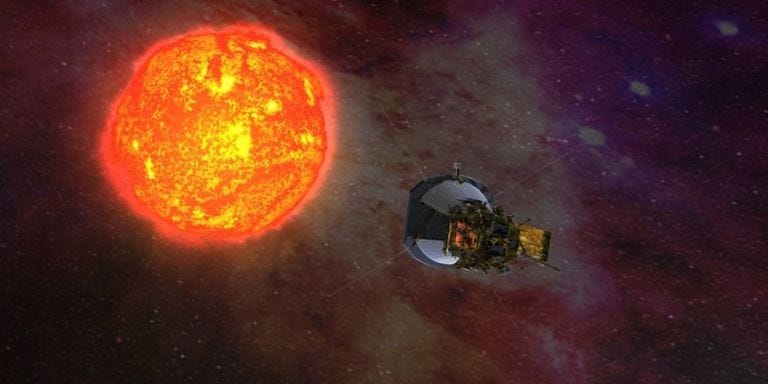
Flying a spacecraft into the Sun’s atmosphere sounds like the kind of idea that would make a toaster nervous. Yet NASA’s Parker Solar Probe does exactly that. It dives through the corona, the Sun’s outer atmosphere, while traveling faster than any human-made object in history. The mission is bold, brilliant, and just a little bit dramaticin the best possible “let’s send a machine toward a star” way.
But here is the real engineering magic: Parker Solar Probe does not survive by simply being tough. It survives by being smart. Its cooling system, heat shield, solar array design, and autonomous navigation all work together like a tiny space-age pit crew. Every part has one job: keep the spacecraft’s scientific instruments alive long enough to study the solar wind, magnetic fields, energetic particles, and the mystery of why the Sun’s corona is so incredibly hot.
This article explores the robust cooling system of NASA’s Parker Solar Probe, how it protects the spacecraft in the Sun’s atmosphere, and why its design is one of the most impressive examples of thermal engineering ever flown.
Why NASA Sent a Spacecraft Toward the Sun
Parker Solar Probe was launched in 2018 to answer questions scientists had been asking for decades. Why is the corona hotter than the visible surface of the Sun? How does the solar wind accelerate? Where do high-energy solar particles come from? These are not just trivia-night questions for people who own too many telescopes. The answers matter because solar activity affects satellites, astronauts, GPS systems, power grids, radio communication, and technology we use every day on Earth.
To solve those mysteries, scientists needed measurements from inside the solar environment itself. Observing the Sun from far away is useful, but it is a little like trying to understand a thunderstorm by standing in another state and squinting. Parker Solar Probe gets close enough to sample the particles and fields in the region where solar wind is born and shaped.
At its closest approach, the spacecraft comes within only a few million miles of the Sun’s surface. That may sound like a long commute, but in solar-system terms, it is practically knocking on the Sun’s front door and asking whether the plasma is home.
The Heat Problem: Space Is Cold, the Sun Is Not
A common misunderstanding is that Parker Solar Probe must be swimming through fire like a marshmallow with ambitions. The truth is more interesting. The corona can reach temperatures of more than a million degrees, but it is extremely thin. Temperature measures how fast particles are moving, while heat transfer depends on how many particles are available to bump into a surface and share that energy.
Because the corona has very low density, Parker Solar Probe does not absorb heat the same way an object would inside a blazing oven on Earth. Still, direct sunlight near the Sun is brutally intense. The spacecraft receives far more solar energy than anything near Earth orbit. Without protection, its electronics, instruments, wiring, and solar panels would overheat very quickly.
NASA’s solution is not one single cooling trick. It is a layered survival strategy: block most of the sunlight, expose only what must be exposed, cool the solar arrays with circulating water, and keep the sensitive spacecraft body safely tucked in the shade.
The Thermal Protection System: Parker’s Space Umbrella
The most famous part of Parker Solar Probe’s cooling strategy is its Thermal Protection System, often called the TPS. Think of it as a very serious beach umbrella, except instead of protecting someone from a mild sunburn, it shields a spacecraft from enough solar intensity to make ordinary materials reconsider their career choices.
The TPS is a carbon-composite heat shield about 4.5 inches thick. It is built from carbon-carbon face sheets surrounding a lightweight carbon foam core. On the Sun-facing side, it has a specially designed white ceramic coating that reflects as much sunlight as possible. The shield is roughly the size of a small round table, but its job is enormous.
During close solar encounters, the front of the shield can endure temperatures around 2,500 degrees Fahrenheit. Behind it, the spacecraft bus and instruments remain in the shade at much more manageable conditions. That temperature contrast is the heart of the mission’s survival strategy. Parker Solar Probe does not defeat the Sun by absorbing all that energy; it wins by refusing to let most of it reach the important parts.
Why the Shape and Alignment Matter
The heat shield only works if it stays pointed toward the Sun. Parker Solar Probe uses autonomous systems and sensors to maintain the correct orientation. If the spacecraft drifts too far off-angle, delicate components could be exposed to direct sunlight. That would be bad news, and “bad news” is putting it politely.
So the probe is designed to protect itself. It can make adjustments without waiting for commands from Earth, because communication delays and extreme mission conditions make real-time human steering impossible. In other words, Parker needs to be smart enough to keep its own hat on.
The Solar Array Cooling System: Water, Pumps, and Pure Nerve
While the heat shield protects the main spacecraft, Parker Solar Probe still needs electricity. That power comes from solar arrays, which is both clever and tricky. The spacecraft uses the Sun to power itself while flying dangerously close to the Sun. It is like charging your phone inside a volcano and hoping the case has good reviews.
The problem is that solar panels are sensitive to overheating. If they get too hot, they lose efficiency and can suffer damage. Parker’s engineers solved this with a first-of-its-kind water-cooled Solar Array Cooling System, commonly called SACS.
The system circulates deionized water through small channels built into the solar array structure. As the panels absorb sunlight and heat up, water carries that heat away. The heated water then flows to radiators, where the heat is released into space. This allows the arrays to keep generating power without roasting themselves into expensive confetti.
Why Use Water in Space?
Water may sound ordinary, but that is exactly why it is brilliant. It has strong heat-carrying ability, is well understood, and works across the temperature range needed for the mission when properly pressurized. The water used in Parker’s cooling system is deionized, meaning minerals are removed so they do not clog, corrode, or contaminate the system.
The cooling loop includes pumps, a heated accumulator tank, radiators, and thin aluminum fins that help spread and release heat. The system had to be designed for dramatic temperature swings. During launch and early operations, engineers had to prevent the water from freezing. Near the Sun, they had to prevent the solar arrays from overheating. That is a demanding résumé for something most of us use to make coffee.
How the Radiators Help
Radiators are essential because space has no air to carry heat away. On Earth, a fan can move air across a hot surface. In space, there is no convenient breeze. Heat must be radiated away as infrared energy. Parker’s radiators are mounted where they can dump heat while remaining protected from the worst solar exposure.
This is why the cooling system is more than plumbing. It is a carefully balanced thermal design. The pumps must move water reliably. The panels must absorb enough sunlight for power but not too much heat. The radiators must release heat efficiently. The spacecraft must stay oriented correctly. Everything has to work together, and there is not exactly a repair shop three million miles from the Sun.
Retractable Solar Arrays: Only a Little Sun, Please
Parker Solar Probe also uses a clever mechanical approach. As it approaches the Sun, most of its solar arrays retract behind the shadow of the heat shield. Only smaller portions remain exposed to direct sunlight. This limits how much solar energy strikes the panels while still allowing the spacecraft to produce power.
Farther from the Sun, the arrays extend farther out to gather more light. Closer in, they tuck back like a cautious turtle. This ability to adjust exposure is critical because sunlight intensity changes dramatically throughout the spacecraft’s orbit.
The result is a power system that adapts to its environment. Too far from the Sun, Parker needs more collecting area. Too close, and it needs less exposure plus active cooling. The spacecraft is not just surviving heat; it is constantly managing energy.
Cooling the Instruments Without Freezing the Mission
Parker Solar Probe carries scientific instruments that measure electric and magnetic fields, image solar structures, study energetic particles, and sample solar wind particles. These instruments need stable operating conditions. Extreme heat can damage electronics, but extreme cold can also cause problems.
This is one reason spacecraft thermal design is so complex. Engineers are not simply trying to make everything cold. They are trying to keep everything within the right temperature range. Too hot is bad. Too cold is also bad. Spacecraft prefer the thermal equivalent of a comfortable office, ideally without someone fighting over the thermostat.
The heat shield creates a protected shadow zone, while heaters, insulation, radiators, and the solar array cooling system work together to manage temperatures. The spacecraft’s design shows that cooling in space is not about one heroic component. It is about a whole thermal ecosystem.
What Makes Parker Solar Probe’s Cooling System So Robust?
The word “robust” gets tossed around a lot, but in this mission it truly fits. Parker’s cooling system is robust because it handles extreme variation, uses proven physical principles, and includes multiple design strategies that reduce risk.
1. It Combines Passive and Active Cooling
Passive cooling includes the heat shield, reflective coating, shadowing, insulation, and spacecraft geometry. Active cooling includes the water loop, pumps, and radiators used for the solar arrays. By combining both, Parker avoids relying on a single solution. The shield blocks the heat; the water loop removes heat from the exposed panels.
2. It Uses the Sun Carefully
The spacecraft is powered by sunlight, but it treats sunlight with respect. The retractable solar arrays expose only the necessary surface area. This careful energy management helps the spacecraft generate electricity without inviting thermal disaster.
3. It Is Built for Autonomy
Parker cannot depend on instant instructions from Earth during every moment of danger. Its sensors and control systems help maintain the correct attitude so the heat shield stays between the Sun and the spacecraft body. This autonomy is part of thermal protection because orientation is survival.
4. It Was Tested for Extremes
Before launch, components of the cooling system and spacecraft went through intense testing. Engineers had to prove the system could handle launch conditions, vacuum, temperature swings, and mission operations. Testing cannot perfectly recreate every moment near the Sun, but it gives engineers confidence that the design will behave as expected.
The 2024 Close Approach: Engineering Meets History
On December 24, 2024, Parker Solar Probe made a record-setting close approach to the Sun, flying about 3.8 million miles above the solar surface at roughly 430,000 miles per hour. NASA later confirmed that the spacecraft survived and was operating normally. That moment was more than a headline. It was proof that the mission’s thermal engineering was doing its job under some of the harshest conditions any spacecraft has ever faced.
At those speeds and distances, tiny design choices matter. A coating, a pump, a radiator fin, a sensor, a line of code, or a few degrees of alignment can make the difference between success and failure. Parker Solar Probe shows how space exploration depends on both imagination and obsessive attention to detail.
Why This Cooling System Matters Beyond One Mission
Parker Solar Probe is not just a spacecraft with a heat shield. It is a demonstration of how engineers can design machines for environments once considered unreachable. Its technology may influence future missions that must operate near intense heat sources, close to stars, around hot planets, or in other extreme radiation environments.
The mission also improves space weather science. Better understanding of solar wind and energetic particles could help protect satellites, astronauts, communication systems, and electrical infrastructure. A cooling system may sound like a hardware detail, but in this case, it helps unlock knowledge that affects life on Earth.
Lessons From Parker Solar Probe’s Design
One of the best lessons from Parker Solar Probe is that extreme engineering is rarely about brute force alone. The spacecraft does not simply use thicker metal and hope for the best. Instead, it uses materials science, fluid dynamics, thermal radiation, autonomy, orbital mechanics, and careful systems engineering.
Another lesson is that simplicity can be powerful. Water is not exotic. Shade is not exotic. Radiators are not new. But combining them in the right way, for the right environment, with the right controls, creates something extraordinary.
Finally, Parker reminds us that exploration often depends on asking a wild question, then answering it with disciplined engineering. Can we fly into the Sun’s atmosphere? Yesbut bring a carbon-composite shield, a water-cooled solar array system, excellent navigation, and maybe a healthy respect for plasma.
Experience-Based Reflections: What Parker’s Cooling System Teaches Us About Real-World Problem Solving
Although most of us will not be designing spacecraft that skim the edge of a star, Parker Solar Probe’s cooling system offers surprisingly practical lessons. The first is that heat management is often about prevention, not reaction. In everyday life, this appears in computers, cars, home insulation, kitchen appliances, and even smartphone design. The best systems do not wait until something overheats. They guide heat away before trouble starts.
Think about a laptop. When vents are blocked, the fan screams like it just saw its browser history. Performance drops because the system protects itself by slowing down. Parker Solar Probe works on a much grander scale, but the principle is familiar: keep critical components within their safe operating range. The spacecraft uses shade, circulation, radiators, and smart positioning the way a laptop uses fans, heat pipes, vents, and thermal paste.
The second lesson is that “simple” materials can solve complex problems when used intelligently. Water is common, but in Parker’s cooling system it becomes a high-performance coolant. The key is not glamour; it is suitability. Engineers chose water because its thermal properties matched the mission’s needs. That is a useful reminder for any project: the best solution is not always the fanciest one. Sometimes the winner is the option that quietly does the job better than everything else.
The third lesson is redundancy through design diversity. Parker does not depend only on the heat shield or only on water cooling. It uses several protective strategies at once. In real projects, that approach is priceless. A website, for example, should not rely only on good hosting. It also needs backups, security updates, caching, monitoring, and clean code. A home should not rely only on air conditioning. It also benefits from insulation, shade, ventilation, and efficient windows. Robust systems stack smart protections.
The fourth lesson is respect for the operating environment. Parker Solar Probe was not designed in a generic way and then tossed toward the Sun with a cheerful “good luck, little buddy.” Every major system was shaped by the environment it would face. That is true for successful products, buildings, machines, and even content strategies. A design that works in one setting may fail in another. Context is not decoration; it is the blueprint.
The fifth lesson is that testing matters. Before a mission like Parker can launch, engineers must simulate harsh conditions, check assumptions, and find weak points. This is not glamorous work, but it is where success is built. In daily projects, testing may mean proofreading an article, checking a website on mobile, reviewing data before publishing, or testing a product before customers use it. The Sun is unforgiving, but so is the internet when a broken page goes live.
Finally, Parker’s cooling system teaches patience. The mission required years of planning, multiple Venus flybys, careful orbital adjustments, and repeated close passes. Big achievements rarely happen in one dramatic leap. They happen through controlled steps, each one preparing the next. That may be the most human lesson hidden inside this very robotic mission: bold goals become possible when courage is paired with careful design.
Conclusion
The robust cooling system of NASA’s Parker Solar Probe is one of the great engineering stories of modern space exploration. By combining a carbon-composite heat shield, reflective coating, retractable solar arrays, water-based cooling, radiators, pumps, and autonomous control, the spacecraft can fly through the Sun’s atmosphere and return priceless scientific data.
Its survival is not magic. It is physics, materials science, testing, and design discipline working together. Parker Solar Probe proves that even the most extreme environments can be explored when engineers understand the challenge deeply enough. The spacecraft may be small compared with the Sun, but its achievement is enormous. It is humanity’s bold little messenger, racing through the corona with a heat shield up front, water in its cooling loop, and a mission that is rewriting what we know about our star.