

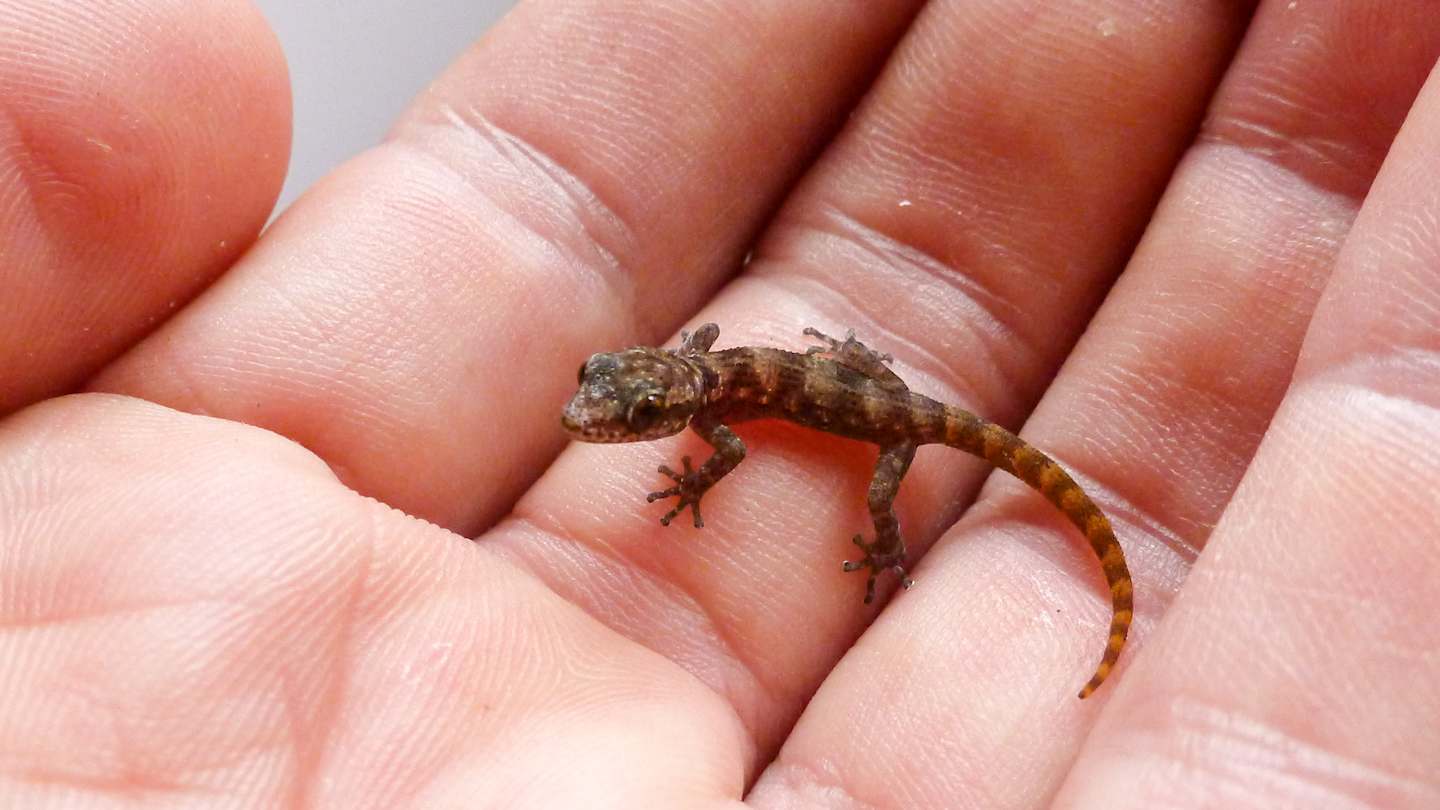
In the Galápagos Islands, where giant tortoises tend to steal the spotlight like slow-moving celebrities with excellent neck posture, a much smaller animal has delivered one of the archipelago’s most exciting conservation surprises. A tiny leaf-toed gecko, once feared extinct on Rábida Island, has been confirmed alive after years of restoration work aimed at removing invasive rats.
The species, known as Mares’s leaf-toed gecko (Phyllodactylus maresi), is not exactly the kind of creature that crashes through the jungle announcing itself. It is small, nocturnal, shy, and excellent at vanishing into rocks, bark, and crevices. In other words, it is basically the introvert of Galápagos reptiles. For decades, scientists had little evidence that it still lived on Rábida. The island’s records pointed mostly to ancient subfossils and a single modern photograph from 2012, leaving researchers with a mystery: was the gecko truly gone, or simply very good at not being found?
The answer, confirmed through field expeditions, tissue samples, specimens, DNA analysis, and morphology, is wonderfully hopeful: the gecko survived. Even better, its return appears linked to one of the most powerful tools in island conservationremoving invasive predators so native species can recover.
A Small Lizard With a Big Conservation Story
Mares’s leaf-toed gecko is part of the genus Phyllodactylus, a group of leaf-toed geckos found in the Galápagos and parts of the Americas. These geckos get their name from their leaf-shaped toes, which sound adorable until you realize those toes are also excellent equipment for navigating rocks, trunks, and dry island terrain.
Adults are roughly eight centimeters long, or about the length of a house key. They are nocturnal and primarily terrestrial, foraging at ground level, over lava rocks, through leaf litter, and sometimes on tree trunks. During the day, they hide under rocks, bark, and rotten logs. When threatened, they flee into crevices, and like many geckos, they can shed their tail if grabbed. It is dramatic, effective, and frankly a little rude to the predator.
On Rábida Island, the gecko’s story was especially puzzling. Scientists knew leaf-toed geckos had existed there because of Holocene subfossils. However, reliable modern records were missing for a long time. Some researchers suspected the species had vanished from the island before people even began studying the Galápagos closely. Others wondered whether the gecko had simply escaped detection because of its secretive habits.
Why Rábida Island Matters
Rábida is a small, arid island in the central Galápagos, located south of Santiago Island. It is famous for its iron-rich red rocks, maroon beaches, steep volcanic slopes, saltwater lagoon, sea lions, marine iguanas, pelicans, finches, and flamingos that sometimes feed in its shallow waters. It is visually stunning, the kind of place that looks like a nature documentary got a dramatic color filter.
But like many islands, Rábida has faced serious ecological pressure from introduced species. Goats were introduced in the 1970s and later eradicated. Rats became another major problem. Norway rats and possibly black rats arrived within the last half century, damaging native vegetation and preying on birds, reptiles, eggs, and small animals. For a tiny nocturnal gecko that lays eggs in protected spaces and depends on small habitats, invasive rats were not a minor inconvenience. They were a four-legged ecological disaster with whiskers.
Invasive mammals are especially dangerous on islands because native species often evolved without them. Many island reptiles, birds, and invertebrates have few defenses against predators such as rats, cats, and goats. A species can survive for thousands of years in balance with its environment, only to be pushed toward collapse by one introduced predator.
The Rat Removal That Changed Everything
In 2011, Galápagos National Park and conservation partners launched an invasive rodent eradication effort on Rábida. The project targeted brown rats and formed part of a broader island restoration strategy. Removing rats from islands is not glamorous work. It involves planning, monitoring, logistics, bait distribution, and years of follow-up. It is science, patience, and a lot of paperwork wearing hiking boots.
The results, however, can be extraordinary. Once rats were removed from Rábida, native wildlife began to show signs of recovery. Plants, birds, reptiles, and invertebrates all gained breathing room. A single leaf-toed gecko was recorded in 2012, shortly after the eradication program. That specimen was photographed and collected, but later appears to have gone missing from the collection where it was supposed to be stored. That left the rediscovery exciting, but not fully settled.
Then came two important expeditions. In October 2019, researchers found nine leaf-toed geckos on Rábida and sampled tail-tip tissue before releasing them. In August 2021, another expedition collected ten specimens for further study. The geckos were most often active on lava rocks in the evening, exactly the kind of place where a tiny brownish reptile can make a field researcher question their eyesight.
DNA Evidence Confirms the Comeback
The rediscovery became scientifically strong because researchers did not rely only on “we saw a little lizard and got very excited,” even though that would be understandable. They analyzed morphology and DNA, comparing the Rábida geckos with related populations from other Galápagos islands, including Santiago and Marchena.
The results showed that the Rábida population corresponds to Phyllodactylus maresi, although researchers noted that more genomic work may be needed to clarify fine-scale taxonomy among related island populations. Importantly, the Rábida geckos appear genetically distinct enough to be recognized as a separate Evolutionarily Significant Unit, or ESU. That means the Rábida population carries conservation value of its own, not merely as a copy of geckos found elsewhere.
In conservation biology, that distinction matters. Island populations often evolve in isolation, accumulating subtle genetic differences over time. Protecting those differences helps preserve evolutionary history, not just species names on a checklist. A gecko from Rábida is not just “a gecko.” It is a living archive of adaptation, survival, and island history packed into a body shorter than a credit card.
Why This Rediscovery Is Not Just Cute News
Yes, the gecko is cute. Very cute. Small-lizard-on-a-rock cute. But the rediscovery is bigger than one charming reptile. It is evidence that island restoration can work. When invasive predators are removed, native species may rebound even after decades of silence.
The Galápagos are often described as a natural laboratory of evolution, but they are also a real-world laboratory for conservation. The archipelago contains extraordinary endemic species, many found nowhere else on Earth. It also faces pressure from tourism, climate change, introduced species, disease, and habitat disturbance. The return of Mares’s leaf-toed gecko on Rábida shows that practical conservation action can change the direction of a species’ story.
It also reminds us not to declare defeat too quickly. Some species vanish from records not because they are gone, but because they are rare, nocturnal, hidden, or living in places difficult to survey. For animals like leaf-toed geckos, absence of evidence is not always evidence of absence. Sometimes it just means the animal has been quietly minding its own business under a rock.
The Role of “Lost Species” in Modern Conservation
Rediscovered species capture public imagination because they feel like nature’s plot twists. A species is feared extinct, the credits seem ready to roll, and thensurpriseit appears in the next scene. But behind that emotional moment is a serious scientific challenge.
To protect a rediscovered species, researchers must answer several questions. Where does it live? How many individuals remain? Is the population breeding? What threats still exist? Does it represent a unique genetic lineage? What habitat does it need? How can managers monitor it without harming it?
For the Rábida gecko, the next chapter will likely involve careful monitoring, additional genetic research, and continued protection of the island from invasive species. The gecko’s recovery may be promising, but small island populations are vulnerable. A new invasion, disease outbreak, or environmental disturbance could quickly undo progress.
How Invasive Rats Reshape Island Ecosystems
Rats are among the most destructive invasive mammals on islands. They eat eggs, chicks, seeds, seedlings, insects, reptiles, and almost anything else available. They can alter plant communities by consuming seeds and young plants. They can reduce bird nesting success. They can suppress reptiles and invertebrates. They are, ecologically speaking, tiny chaos machines.
On Rábida, rats likely reduced the visibility and abundance of native species, including geckos. Scientists cannot say with absolute certainty exactly how rats affected Mares’s leaf-toed gecko, because the ecological relationship was not studied in detail before eradication. However, the timing is hard to ignore: before and during the rat eradication period, teams found no geckos or clear evidence of them. After rats were removed, geckos began appearing.
That pattern fits what conservationists have seen on other islands. Remove invasive mammals, and native reptiles, birds, plants, and invertebrates often rebound. It does not happen magically overnight, but it does happen. Nature is resilient when humans stop kneecapping it.
What Makes Galápagos Geckos Special?
The Galápagos are famous for giant tortoises, marine iguanas, Darwin’s finches, and blue-footed boobies, but geckos deserve more attention. Researchers describe Galápagos leaf-toed geckos as among the least known terrestrial vertebrates in the archipelago. Their secretive habits make them harder to study, and their small size makes them less famous than animals that can pose majestically on postcards.
Yet geckos are important pieces of island ecosystems. They feed on small invertebrates, serve as prey for snakes and birds, and help scientists understand colonization, adaptation, and evolution across isolated islands. Their distribution patterns can reveal how species moved through the archipelago and diversified over time.
Mares’s leaf-toed gecko is endemic to the Galápagos and has been recorded from Bartolomé, Marchena, Santiago, Rábida, and Mares Islet. Its habitats include dry forests, shrublands, grasslands, rocks, leaf litter, and tree trunks. It is not a tourist-show animal. Most visitors will never see it, because it is nocturnal and often accessible only in scientific or conservation contexts. That makes its survival even more dependent on researchers, park managers, and long-term monitoring.
A Win for Rewilding, But Not a Finish Line
The rediscovery of the tiny gecko on Rábida is a conservation win, but it is not a reason to relax. Rewilding and restoration require maintenance. Islands can be reinvaded. Climate patterns can shift. Funding can disappear. Public attention can move on to flashier animals with better public relations teams.
The best response to a rediscovery is not simply celebration; it is protection. The Rábida gecko now needs continued monitoring to estimate population size, understand breeding success, map habitat use, and detect future threats. Scientists may also need broader sampling across related Phyllodactylus populations to clarify taxonomy and conservation priorities.
Still, the message is hopeful. A species once known on Rábida mostly from ancient remains is now confirmed alive. A tiny reptile survived long enough for humans to correct at least one ecological mistake. That is not just good news. That is a reminder that conservation can move from apology to action.
Experience Section: What This Tiny Gecko Teaches Travelers, Students, and Nature Lovers
The story of Mares’s leaf-toed gecko offers an experience that goes beyond scientific headlines. It changes how people should look at wild places. Many visitors imagine the Galápagos as a grand theater of obvious wonders: tortoises crossing trails, sea lions lounging on beaches, iguanas stacked on lava like prehistoric pancakes. Those animals are unforgettable, of course. But the rediscovered gecko asks us to slow down and notice the quieter layers of life.
Imagine standing on Rábida’s red volcanic ground near sunset. The beach glows like rust-colored glass, sea lions bark in the distance, and the day visitors are thinking about photos, snorkeling, and whether their hat has survived the wind. Then night begins to settle. The famous animals fade into shadow, and a different island wakes up. Small insects move. Rocks hold heat. A tiny gecko slips across lava, nearly invisible unless your eyes know what to search for. That moment is not loud, but it is powerful. It says that biodiversity is not always dramatic. Sometimes it is only eight centimeters long and active after dark.
For students, this rediscovery is a perfect case study in how science works. It includes uncertainty, fieldwork, old records, fossil evidence, missing specimens, DNA sequencing, morphology, and conservation management. It also shows why scientists are careful with words like “extinct.” A species may be undetected because it is rare, hidden, or living in a difficult habitat. Good science leaves room for evidence to improve the story.
For travelers, the lesson is about responsible curiosity. Most people will never see Mares’s leaf-toed gecko, and that is fine. Not every species needs to become a tourist attraction. Some animals are best protected by being admired from a respectful distance through research, photography, and conservation updates. A healthy travel mindset in the Galápagos is not “How close can I get?” but “How lightly can I step?”
For conservation supporters, the gecko’s return is proof that unglamorous work matters. Rat eradication, biosecurity checks, habitat monitoring, and funding for field teams may not sound as thrilling as discovering a new species, but they create the conditions for rediscovery. The gecko did not need applause. It needed an island where eggs, juveniles, and adults had a fair chance to survive.
Most of all, this tiny reptile gives people a rare emotional experience: cautious hope. In a world where extinction stories often feel heavy, the Rábida gecko reminds us that nature can recover when pressure is removed. It does not promise that every lost species will return. It does not make conservation easy. But it proves that patient, science-based restoration can turn a feared ending into a new beginning. And sometimes, the hero of that beginning has leaf-shaped toes and the good sense to stay out of the spotlight.
Conclusion: A Tiny Gecko, a Giant Reminder
The rediscovery of Mares’s leaf-toed gecko on Rábida Island is one of those rare conservation stories that feels both scientifically important and emotionally satisfying. It is a reminder that the Galápagos still holds secrets, even in a world where satellites can map coastlines and tourists can post sea lion selfies before lunch.
More importantly, the tiny gecko’s comeback shows that restoration works when it is targeted, patient, and backed by science. Removing invasive rats gave native wildlife room to recover. Field researchers followed the clues. DNA confirmed the identity. And a species once feared lost on Rábida stepped back into the record of living things.
The story is not over. The Rábida population needs continued monitoring and protection, and scientists still have more to learn about Galápagos leaf-toed geckos. But for now, this small reptile has delivered a very large message: even when nature seems quiet, it may still be holding on. Give it a chance, and it might surprise us.
Note: This article is written for web publication and is based on verified scientific, conservation, and biodiversity information available as of May 2026.