

A pencil looks like the simplest object in the room. It sits quietly on a desk, rolls under the couch at the exact moment you need it, and somehow survives school bags, kitchen junk drawers, crossword puzzles, and emergency grocery lists. But the humble pencil is not simple at all. It is a tiny piece of engineering disguised as a yellow stick with an eraser hat.
When you watch the mesmerizing way pencils are made, you begin to notice something oddly satisfying: the rhythm of wooden slats sliding through machines, graphite cores lining up like tiny railroad tracks, paint coats building a glossy finish, and ferrules being crimped onto the ends with almost musical precision. It is part woodworking, part chemistry, part industrial ballet, and part “why am I suddenly emotionally attached to office supplies?”
This article takes you inside the pencil manufacturing process, from raw wood and powdered graphite to the finished writing tool that sharpens cleanly, writes smoothly, and occasionally becomes the hero of a standardized test. Let’s follow the journey of how pencils are madeand why this everyday object remains one of the most beautifully practical inventions ever created.
The Pencil Is Not Filled With LeadLet’s Clear That Up First
The phrase “pencil lead” is one of the most persistent little myths in everyday language. Modern pencil cores are not made of lead. They are usually made from a mixture of graphite and clay, carefully blended to create the desired writing feel, darkness, and hardness.
Graphite is a naturally occurring form of carbon. It leaves a dark mark because its layers slide off onto paper with very little pressure. Clay gives the core structure and controls how soft or hard the pencil feels. More graphite generally creates a darker, softer mark. More clay creates a harder, lighter mark. In other words, every pencil is secretly a recipe.
That is why a soft artist pencil can produce rich, velvety shadows, while a harder drafting pencil can make crisp, pale lines. The famous No. 2 pencil, often equivalent to HB, sits comfortably in the middle. It is dark enough to read, firm enough not to smudge too wildly, and dependable enough that schools practically adopted it as an unofficial academic mascot.
Step One: Choosing the Right Wood
The pencil-making process often begins with wood, and not just any wood. For generations, pencil makers have favored cedar, especially incense cedar, because it machines smoothly, sharpens cleanly, and has a pleasing aroma. If you have ever sharpened a quality pencil and smelled that warm, dry, woody scent, congratulationsyou have experienced the tiny luxury spa of stationery.
Some modern pencils are also made from basswood, poplar, or other workable woods. The key is that the wood must be stable, straight-grained, and soft enough to sharpen without splintering like a dramatic breadstick. It also needs to hold the graphite core securely while staying pleasant in the hand.
Logs are cut into rectangular pieces called pencil stock or pencil blocks. These are dried to a controlled moisture level so the wood will not warp, crack, or misbehave during production. Then the blocks are sliced into thin wooden slats. Each slat will eventually become one half of several pencils.
Step Two: Cutting Grooves Into the Slats
Once the wooden slats are ready, machines cut long, parallel grooves into them. These grooves are half the depth of the graphite core, which means two matching slats will later close around the core like a very precise wooden sandwich.
This step is satisfying to watch because it is so clean and repetitive. A flat piece of wood enters the machine; a neat row of channels appears; the slat exits looking like it has been combed by an extremely organized carpenter. The grooves must be centered and consistent. If they are not, the finished pencil may sharpen unevenly or the core may sit off-center, which is a small tragedy for anyone who loves a perfect point.
Step Three: Making the Graphite Core
While the wood is being prepared, the graphite core is being made through a separate process. Finely ground graphite and clay are mixed with water into a paste. The exact ratio depends on the type of pencil being produced. A darker writing pencil needs a different formula than a hard technical pencil, and a colored pencil uses an entirely different core made with pigments, binders, waxes, or oils.
For standard graphite pencils, the paste is forced through small openings to form thin rods, almost like dark spaghetti. These rods are dried, cut to length, and heated in a kiln. After that, they may be treated with wax or oil to improve smoothness. This is one reason a good pencil glides rather than scratches. It is not magic; it is material science wearing a wood jacket.
Step Four: The Famous Pencil Sandwich
Now comes the part that makes pencil manufacturing so hypnotic: the sandwiching stage. Graphite cores are placed into the grooves of one wooden slat. Glue is applied, and a second grooved slat is placed on top. The result is a wide wooden block with several graphite cores hidden inside it.
At this point, the pencil does not look like a pencil yet. It looks more like a flat plank with secrets. But inside, the future pencils are already lined up. Once the glue dries, the sandwich is strong enough to be shaped, cut, painted, stamped, and sent into the world to write grocery lists, solve equations, and doodle suspiciously cube-shaped cats.
Step Five: Cutting the Sandwich Into Individual Pencils
After the wooden sandwich is bonded, it passes through shaping machines. Blades cut the block into individual pencils and form the familiar profile. Many pencils are hexagonal, which gives them flat sides, makes them easier to grip, and helps prevent them from rolling off a desk. Round and triangular pencils are also common, especially for young learners or specialty writing tools.
A single pencil sandwich can produce several pencils at once, depending on the slat dimensions and the manufacturer’s tooling. The cutting stage must be accurate because the graphite core needs to remain centered. A centered core sharpens evenly and resists breaking. An off-center core is the pencil equivalent of a shopping cart with one bad wheel: technically functional, but spiritually annoying.
Step Six: Sanding, Painting, and Finishing
Once the pencils are cut, they are sanded smooth. Then they move into finishing, where paint, lacquer, or a natural coating is applied. Some pencils receive multiple coats to create a polished surface. Others are left unfinished or lightly sealed to show off the wood grain.
The classic yellow pencil has become iconic in the United States, but pencils can be painted almost any color. Branding, model names, hardness grades, and decorative details are stamped or printed onto the barrel. That tiny line of gold or black text on the side of a pencil is more than decoration; it tells users what kind of tool they are holding.
This stage is especially fun to watch because the pencil finally becomes recognizable. A plain wooden object transforms into something bright, branded, and ready for a desk cup. It is like watching a caterpillar become a butterfly, except the butterfly can help with algebra.
Step Seven: Adding the Ferrule and Eraser
Many writing pencils include an eraser at one end. To attach it, the manufacturer adds a ferrulethe small metal band that grips both the pencil and the eraser. The ferrule is crimped into place so the eraser stays secure.
Not every pencil has an eraser. Some artist pencils and premium writing pencils are eraserless by design. But for school and office pencils, the eraser is part of the personality. It says, “Go ahead. Make a mistake. I brought backup.”
The eraser itself is usually made from rubber or synthetic materials. It works by lifting graphite particles from the paper surface. A good eraser removes marks cleanly without tearing the page or leaving behind a mysterious pink fog.
Step Eight: Sharpening, Inspection, and Packaging
Before pencils are packed, they may be sharpened, inspected, counted, and boxed. Quality control matters. Manufacturers look for straight barrels, centered cores, smooth finishes, clean printing, secure ferrules, and consistent writing performance.
A pencil may seem inexpensive, but it has gone through many steps before reaching a store shelf. Wood selection, drying, slat cutting, grooving, graphite mixing, core firing, gluing, shaping, painting, stamping, eraser assembly, inspection, and packaging all happen before the pencil ever meets a notebook.
Why the Process Is So Mesmerizing to Watch
Watching pencils being made is satisfying because the process is both mechanical and elegant. The machines repeat the same motions with incredible precision, yet the materials remain familiar and earthy: wood, graphite, clay, glue, paint, metal, and rubber.
There is also something calming about seeing an everyday object explained. A pencil is not flashy technology. It does not need charging. It does not send notifications. It will never ask you to accept cookies. It simply writes when you press it to paper.
That simplicity is part of its charm. The manufacturing process reminds us that even ordinary tools are full of hidden craft. A pencil is not just a stick. It is a collaboration between forestry, mineral science, industrial design, machining, quality control, and human habit.
The History Behind the Modern Pencil
The modern pencil has roots that reach back centuries. Early graphite writing tools became popular after high-quality graphite deposits were discovered in England. Later, the method of mixing powdered graphite with clay made it possible to create reliable pencil cores using different grades of graphite. This development helped turn the pencil from a rare writing tool into a mass-produced everyday essential.
In the United States, pencil making became closely tied to wood supply and manufacturing centers. Tennessee, for example, became known for pencil production, especially in Shelbyville, a town often associated with American pencil history. Companies such as Musgrave Pencil Company helped carry that tradition forward, producing wood-cased pencils with a blend of old-school factory work and modern production needs.
Today, pencil manufacturing is global. Some companies still make pencils in the United States, while many rely on international supply chains for wood, graphite cores, ferrules, erasers, or finished products. Yet the core process remains surprisingly recognizable: prepare the wood, prepare the core, sandwich them together, shape the pencil, finish it, and send it out to write.
What Makes a Good Pencil Feel Good?
Anyone who writes by hand knows that pencils have personalities. Some glide smoothly. Some feel scratchy. Some sharpen to a heroic point. Others break repeatedly, as if personally offended by your productivity.
A good pencil usually depends on several factors. The core should be smooth, consistent, and properly bonded inside the wood. The wood should sharpen cleanly without splintering. The barrel should feel comfortable. The finish should not be slippery or rough. The eraser, if included, should actually erase rather than smear the evidence around like a tiny crime scene.
Graphite hardness also matters. A soft pencil is wonderful for sketching, shading, and expressive writing, but it may smudge more easily. A hard pencil keeps a fine point longer but may feel lighter or less smooth. The best pencil is not universal; it depends on whether you are taking notes, drawing portraits, marking lumber, filling out forms, or pretending to work while doodling rockets in the margin.
Colored Pencils: A Close Cousin With a Different Core
Colored pencils are made in a similar wooden casing, but their cores are different. Instead of graphite and clay, colored pencil cores usually contain pigments, binders, fillers, wax, oil, or other materials that create color and control texture.
This is why colored pencils often sharpen and behave differently from graphite pencils. Their cores can be softer, more fragile, and more sensitive to sharpening pressure. A colored pencil may produce brilliant color, but it also asks politely that you stop attacking it with a dull sharpener.
The manufacturing principles, however, remain familiar: prepare the core, place it in grooved wood, glue the slats, cut the pencils, finish the barrels, and package them. The difference is in the formula, and that formula determines whether the pencil is waxy, creamy, firm, blendable, vibrant, or ideal for fine detail.
Why Pencils Still Matter in a Digital World
In a world of tablets, laptops, styluses, and voice notes, the pencil still has a job. It is cheap, portable, reliable, and forgiving. It works without batteries. It lets children learn handwriting. It gives artists immediate control. It helps carpenters mark measurements, musicians annotate sheet music, and crossword fans wage daily war against tiny boxes.
A pencil also changes the way we think. Writing with a pencil feels temporary in the best possible way. It invites revision. It says, “Try the idea. You can fix it.” That makes it perfect for sketches, drafts, outlines, math problems, and plans that are not quite ready to become permanent.
The pencil’s beauty is that it is both humble and deeply engineered. It does not look impressive until you understand what it took to make. Then suddenly, the little object on your desk feels like a tiny masterpiece of manufacturing.
Experiences Related to Watching the Mesmerizing Way Pencils are Made
There is a strange pleasure in watching pencil manufacturing videos. At first, you may click out of mild curiosity. Maybe you expect a quick factory tour and a few spinning blades. Then, five minutes later, you are leaning toward the screen like a detective trying to solve the Case of the Perfectly Centered Graphite Core.
The experience is calming because every step has purpose. A machine cuts grooves, and suddenly the wood makes sense. Graphite rods drop into place, and suddenly the pencil has a spine. Another slat lands on top, and suddenly the whole thing becomes a hidden structure waiting to be revealed. The process feels predictable, but not boring. It is orderly in a way real life often refuses to be.
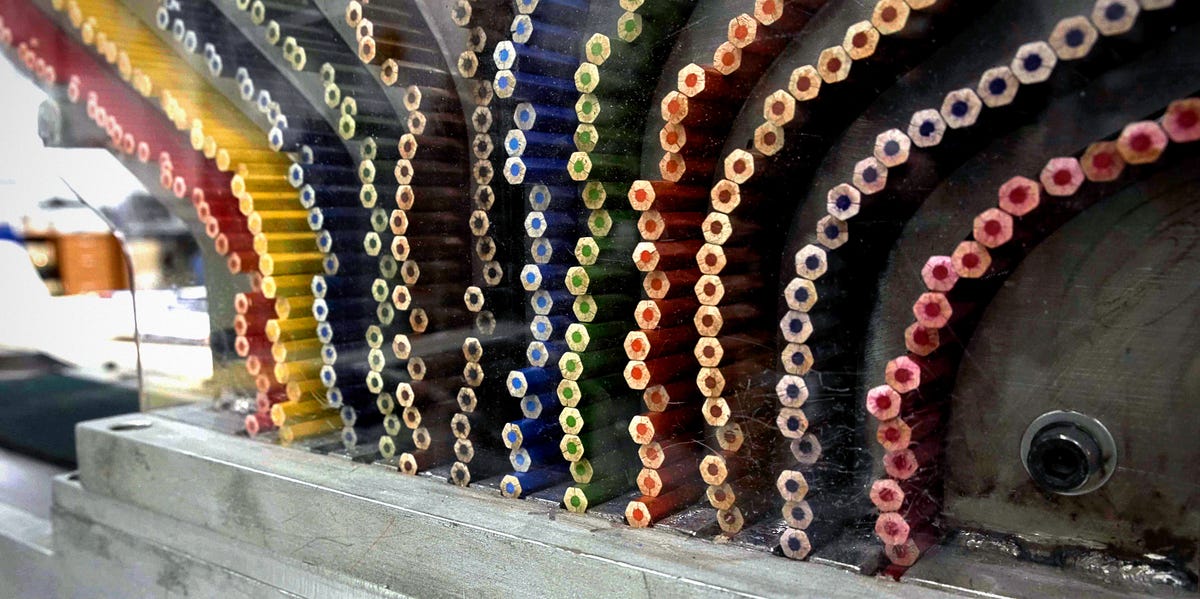
One of the most memorable parts is seeing the pencil sandwich cut into individual barrels. Before that moment, the pencils are invisible. They are trapped inside a block, like tiny wooden secrets. Then the blades pass through, and the familiar shapes appear. Hexagonal pencils emerge in rows, each one carrying a graphite core that was placed there with remarkable accuracy.
The painting stage adds another layer of satisfaction. Raw wood becomes glossy, colorful, and branded. A plain object gets a personality. Whether the pencil turns classic yellow, deep green, matte black, natural cedar, or bright red, the finish changes how we perceive it. Suddenly it is not just a tool; it is a product with character.
Watching ferrules and erasers being attached is another small delight. The movement is quick, exact, and slightly adorable. The pencil receives its metal collar and eraser cap like it is getting dressed for work. It is the final touch that turns a writing stick into a complete school-and-office icon.
The experience also makes you more aware of quality. After seeing how pencil cores are centered, you may never look at a badly sharpened pencil the same way again. When a core breaks repeatedly, you start wondering about bonding, wood grain, sharpening angle, or core formulation. Congratulations: you have become the kind of person who has opinions about pencil construction. There are worse fates.
It can also change how you shop for pencils. You may notice whether a pencil is made from cedar, basswood, or another wood. You may pay attention to the hardness grade, the smoothness of the graphite, or the quality of the eraser. You may even develop a favorite pencil, which sounds excessive until you remember that people have favorite coffee mugs, favorite pens, and favorite spoons. A favorite pencil is perfectly reasonable. Possibly noble.
Most of all, watching pencils being made reminds us that ordinary objects are rarely ordinary. Behind a simple pencil is a chain of materials, machines, workers, design choices, and tiny tolerances. The next time you sharpen one, you may notice the wood curling away in a clean spiral and think about the journey from log to slat to sandwich to finished tool. Then you will write your note, sketch your idea, or solve your problemand the pencil will do what it has always done best: quietly help.
Conclusion: The Small Wonder Hiding in Your Desk Drawer
The pencil is a perfect example of everyday genius. It is affordable, useful, familiar, and easy to overlook. But when you watch how pencils are made, the object becomes far more interesting. The process combines wood science, graphite chemistry, precision machining, finishing, branding, and quality control into one compact writing tool.
From cedar slats and graphite cores to ferrules and erasers, every part has a reason. The next time you pick up a pencil, you are holding more than a school supply. You are holding a carefully engineered tool with centuries of history and a manufacturing process that is surprisingly beautiful to watch. Not bad for something that spends half its life hiding behind a notebook.