

Engineers love sensors. Temperature acting suspicious? Add a temperature sensor. Need to know whether a valve moved? Add a position sensor. Want to measure pressure, moisture, speed, flow, vibration, occupancy, or whether somebody raided the office refrigerator? There is probably a sensor for itand possibly a premium “industrial” version that costs more than the refrigerator.
But adding physical hardware is not always the smartest answer. A new sensor may require wiring, connectors, mounting space, calibration, waterproofing, certification, maintenance, and a redesign of equipment already installed in the field. Sometimes the system is already producing enough information to estimate the desired value indirectly. The missing measurement may be hiding inside motor current, wheel speed, valve timing, temperature changes, or a combination of signals that nobody previously bothered to examine.
That is where the pseudo-sensor enters the story. Also called a virtual sensor, soft sensor, proxy sensor, or inferential sensor, it uses existing measurements and a mathematical model to estimate a quantity that is not measured directly. It is not magic. It is physics, statistics, software, and a willingness to ask a wonderfully economical question: “Do we really need another piece of hardware?”
What Is a Pseudo-Sensor?
A conventional sensor interacts directly with a physical phenomenon. A pressure transducer converts pressure into an electrical signal. A thermistor changes resistance with temperature. An optical encoder detects motion by observing patterned light.
A pseudo-sensor takes a different route. It estimates the target quantity from one or more variables that are already available. Instead of measuring fluid pressure directly, for example, software might analyze the electrical current required to open a valve. Instead of installing a tire-pressure sensor in every wheel, a vehicle may compare wheel rotation speeds and infer that one tire has become smaller because it is underinflated.
The resulting value is calculated rather than directly observed. That does not automatically make it unreliable. Many useful engineering quantities are estimates. Battery state of charge, remaining equipment life, vehicle position, and process quality frequently depend on models because no single physical sensor can reveal them perfectly.
Four Common Types of Pseudo-Sensor
Physics-based pseudo-sensors use known relationships such as force, pressure, acceleration, electrical work, heat transfer, or geometry. They tend to be understandable and can perform well even when training data is limited.
Data-driven pseudo-sensors learn relationships from historical measurements. Regression, decision trees, neural networks, and other machine-learning methods may be used when the underlying behavior is too complicated for a neat equation.
State estimators combine system models with noisy measurements to estimate values that cannot be observed directly. Kalman filters are a famous example. They repeatedly predict what a system should do, compare that prediction with available measurements, and correct the estimate.
Repurposed sensors use an existing physical sensor to measure something other than its original assignment. An accelerometer attached to a float arm, for instance, can reveal the arm’s angle, which can then be converted into water level using geometry.
A Real-World Example: Estimating Pressure Without a Pressure Sensor
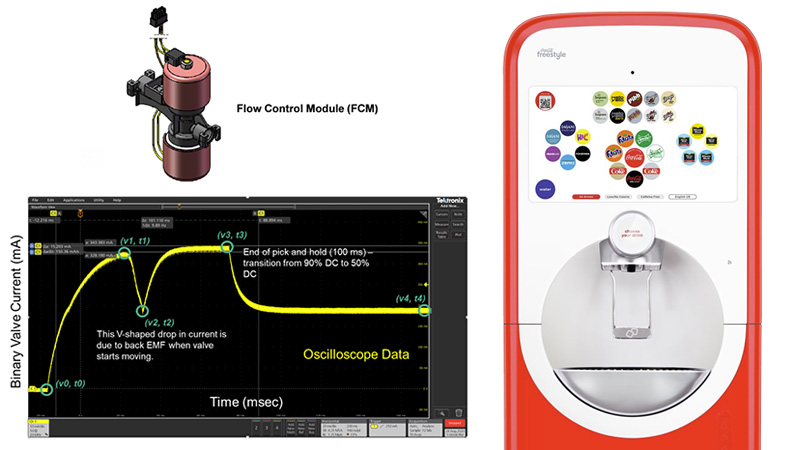
One of the most practical examples comes from Coca-Cola Freestyle drink dispensers. These machines use a solenoid-operated Flow Control Module, or FCM, to regulate water flow. In field service, the FCM became one of the most frequently replaced components. The awkward twist was that about half of the returned modules reportedly worked properly.
The diagnostic problem was simple but expensive. A faulty valve and a loss of upstream water pressure could produce similar symptoms. Because the machine lacked a pressure sensor in the relevant line, technicians could not easily tell which condition had occurred. Replacing the valve was often faster than performing elaborate tests, but changing a perfectly good part did not restore the machine. It merely created a return visit, additional downtime, and a lonely FCM wondering what it had done wrong.
Retrofitting a physical pressure sensor across a large installed fleet was not attractive. It would have added hardware cost, plumbing changes, sanitation concerns, installation labor, wiring, and another component capable of failing.
The Clue Hidden in the Valve Current
Engineers noticed that the electrical current drawn by the solenoid changed as the valve opened. Fluid pressure affects the mechanical force opposing the valve’s movement, so it also influences the electrical behavior of the actuator. A distinctive dip appeared in the current-feedback signal, and the shape and timing of that dip shifted as pressure changed.
The relationship was real, but it was not simple enough for a tidy one-line calculation. More than 5,000 test pours were collected using multiple valve modules over pressures ranging from approximately 1 to 140 psi. An early model that relied primarily on the peak of the voltage dip produced too much error. Apparently, the valve had declined to cooperate with the first draft of the spreadsheet.
The engineers then extracted six features from the waveform, including voltage levels and timing differences. A multivariable regression model with 26 terms provided a much better pressure estimate. The model was deployed as embedded software on an ARM Cortex-M microcontroller and validated through thousands of additional tests involving different valves and controller boards.
Across the full test set, the estimated pressure fell within about 10 psi of the actual pressure roughly 86% of the time. That would not impress a laboratory metrologist. For distinguishing “the system has normal pressure” from “the system has probably lost pressure,” however, it was useful. The pseudo-pressure sensor turned an existing current-feedback circuit into a new diagnostic capability without modifying the fluid line.
Why Pseudo-Sensors Can Be Better Than Additional Hardware
They Reduce Component and Installation Costs
The price shown on a sensor’s product page is rarely its total cost. A real design must also account for connectors, cables, mounting brackets, protective enclosures, signal conditioning, analog inputs, assembly time, calibration, inventory, replacement parts, and documentation. In sanitary, hazardous, outdoor, automotive, aerospace, or medical environments, integration may cost far more than the sensing element itself.
A software-based sensor can reuse processors and measurements that are already present. Even when model development requires significant engineering effort, that expense may be small compared with physically upgrading thousands of deployed machines.
They Make Retrofitting Possible
Adding hardware to a new product is one thing. Adding it to equipment already scattered across restaurants, factories, rooftops, vehicles, or remote facilities is another. A firmware update may be deployed remotely, while a physical retrofit requires parts, trained labor, scheduling, access, testing, and perhaps equipment recertification.
This makes virtual sensing especially appealing for fleet diagnostics. Existing signals can gain new purposes long after the original hardware design is complete.
They Can Improve Reliability
Every physical sensor introduces possible failure modes. Connectors corrode. Cables break. Calibration drifts. Openings leak. Lenses collect dust. Probes become coated with whatever unpleasant substance the machine handles before lunch.
A pseudo-sensor is not failure-proof, but it may avoid adding vulnerable components. It can also provide redundancy by comparing a calculated estimate with a physical sensor. If the two values suddenly disagree, the system may detect a failing sensor before the fault disrupts operation.
They Estimate Quantities That Are Difficult to Measure
Some values are impractical or impossible to measure continuously. Industrial process quality may only be confirmed through laboratory testing. Internal motor temperature may be difficult to sense without changing the motor. Battery state of charge is not directly visible at a terminal. Certain measurements inside high-radiation, high-temperature, sterile, sealed, or moving systems may be physically inaccessible.
A pseudo-sensor can provide a continuous estimate using accessible variables. The estimate may not replace final laboratory verification, but it can help operators control a process between tests.
Where Pseudo-Sensors Are Already Working
Indirect Tire-Pressure Monitoring
Some vehicles infer low tire pressure through wheel-speed sensors already used by the anti-lock braking system. An underinflated tire has a slightly smaller effective rolling diameter and may rotate faster than the other tires. Software compares the wheel signals and alerts the driver when the pattern suggests underinflation.
This approach avoids installing a pressure transmitter and battery in every wheel. Its limitations are equally instructive: it may require calibration, can be slower than direct measurement, and may struggle when all four tires lose pressure at similar rates. The pseudo-sensor is useful because the target decision is a warning, not a laboratory-grade pressure reading.
Sensorless Motor Control
Brushless motors often use Hall sensors, encoders, or resolvers to report rotor position. Sensorless controllers can instead analyze motor voltage, phase current, magnetic flux, or back electromotive force to estimate where the rotor is located and determine when to energize each winding.
Eliminating position sensors can reduce cost, wiring, size, and exposure to harsh conditions. However, some sensorless methods perform poorly at zero or very low speed because the electrical signal used for estimation is weak. A cooling fan may tolerate that limitation. A precision robotic joint may not.
Battery State-of-Charge Estimation
A battery does not contain a convenient little fuel gauge floating in the electrolyte. Management systems estimate state of charge using current history, voltage, temperature, battery chemistry, and dynamic models. Coulomb counting, equivalent-circuit models, Kalman filters, and machine-learning models may all contribute.
The result is a virtual measurement that affects everything from a phone’s battery icon to an electric vehicle’s remaining-range calculation. Accuracy depends on calibration, battery age, temperature, usage patterns, and the model’s ability to adapt as the cells change.
Virtual Sensors in Buildings and Factories
Heating, ventilation, and air-conditioning systems can estimate airflow, equipment capacity, refrigerant condition, power consumption, or outdoor-air fraction from temperatures, valve commands, fan status, weather data, and operating cycles. Manufacturers use similar techniques to estimate product quality, machine wear, internal temperature, or process composition between physical inspections.
NASA researchers have also explored virtual sensors that estimate unavailable spectral measurements from other imaging channels. Related techniques can reconstruct missing signals, support fault detection, and extend the usefulness of older instruments. In each case, the pseudo-sensor transforms existing data into a measurement-like output that was not directly captured.
The Catch: Correlation Is Not a Free Sensor
A pseudo-sensor works only while the relationship between its inputs and target remains valid. If valve current changes with pressure but also changes substantially with temperature, wear, supply voltage, syrup residue, manufacturing tolerance, or planetary alignment, the model must account for those influences. Otherwise, it may confidently report nonsense.
Confounding Variables
Suppose motor current rises when a pump filter becomes clogged. That sounds like a useful proxy for filter condition. Unfortunately, motor current may also rise because the fluid becomes colder and more viscous, the pump wears, the supply voltage drops, or somebody partially closes a valve. A model trained only during warm-weather operation could misdiagnose a perfectly healthy filter in winter.
Model Drift
Machines age, components are replaced, suppliers change materials, firmware is updated, and operating conditions evolve. The model may gradually become less accurate even though its code remains unchanged. This is known as model drift or domain shift.
Production pseudo-sensors therefore need performance monitoring. They may require periodic recalibration, updated training data, or comparison with trusted reference measurements.
False Precision
Software can display “63.427 psi” even when the estimate is only reliable within 10 psi. Extra decimal places do not create extra knowledge; they merely give uncertainty a fancy haircut.
A responsible pseudo-sensor should report an appropriate resolution, operating range, and confidence level. It may be better to classify pressure as “low,” “normal,” or “high” than to pretend the system knows an exact value.
Safety and Compliance
Virtual measurements should not casually replace certified safety instrumentation. A model used to schedule maintenance is not automatically suitable for shutting down a chemical reactor, protecting aircraft flight controls, administering medication, or detecting a dangerous gas leak.
Safety-related applications may require independent physical sensors, redundancy, fault-tolerant architectures, traceable calibration, regulatory approval, and clearly defined fallback behavior. Clever software is valuable. Clever software wearing a fake hard hat and claiming to be a safety system is less valuable.
How to Develop a Reliable Pseudo-Sensor
1. Define the Decision Before the Measurement
Start by asking what the system actually needs to decide. Does it need exact pressure, or merely confirmation that pressure is available? Must it detect gradual degradation, classify operating states, trigger maintenance, or provide closed-loop control?
A pseudo-sensor that is inadequate for precise metrology may still be excellent for diagnostics. Requirements should include acceptable error, latency, operating range, false-alarm rate, and failure consequences.
2. Identify Physically Meaningful Proxies
Search for variables connected to the target through physics or system behavior. Useful candidates may include current, voltage, vibration, sound, temperature, timing, actuator position, flow commands, wheel speed, or energy consumption.
A known causal relationship is generally safer than a mysterious statistical correlation. Models grounded in physics are also easier to explain when somebody asks why the machine believes a valve is pressurized.
3. Collect Representative Data
Training data should cover the full operating envelope, including different units, component tolerances, temperatures, loads, supply voltages, ages, environmental conditions, and failure modes. Repeating tests on one beautifully behaved prototype creates a model of that prototypenot necessarily a model of the product fleet.
Hardware-in-the-loop testing can automate data collection while preserving realistic controller behavior. Measurements should include trusted reference values so predicted and actual results can be compared.
4. Engineer Useful Features
Raw signals often contain more information in their shape than in a single peak or average. Timing differences, slopes, frequency content, transient duration, area under a curve, and relationships between multiple channels may reveal the target variable.
Feature selection should also consider embedded constraints. A model destined for a small microcontroller must fit within available memory, processing time, and power consumption.
5. Use the Simplest Model That Meets the Requirement
Begin with physics, lookup tables, or straightforward regression before releasing a neural network into the building. Simpler models are easier to validate, debug, explain, and deploy. Complex machine learning is justified when it provides meaningful improvement across realistic test conditions.
6. Validate on Unseen Hardware
Testing a model with the same data used to build it proves mostly that computers are good at remembering homework. Validation should use separate datasets, different devices, environmental extremes, degraded components, and realistic disturbances.
Engineers should examine not only average error but also worst-case error, false alarms, missed faults, confidence calibration, and behavior outside the training range.
7. Design for Uncertainty and Failure
The system should recognize when inputs are missing, contradictory, noisy, or outside the validated domain. It may then report “estimate unavailable,” switch to a conservative mode, request service, or use a backup sensor.
A pseudo-sensor should never turn uncertainty into a confident lie merely because the dashboard requires a number.
Practical Experience: What Building a Pseudo-Sensor Really Feels Like
The first experience many engineers have with pseudo-sensing begins with optimism. A graph shows two variables moving together, everyone leans toward the screen, and somebody says, “We can calculate that.” For approximately twenty minutes, the project appears to be finished.
Then the second test unit arrives.
Its signal is offset. The third unit is noisier. The fourth behaves differently after warming up. One device was assembled with a component from another supplier, while another spent six months operating beside a fryer and now contains a thin archaeological layer of grease. The elegant correlation begins to resemble a flock of startled pigeons.
This phase teaches an essential lesson: discovering a relationship is not the same as engineering a dependable measurement. The strongest pseudo-sensor projects usually begin with a physical explanation. When current, force, timing, and pressure are linked by the mechanics of a solenoid, there is a foundation for the model. When two signals merely happened to rise together during a Tuesday afternoon test, caution is appropriate.
Feature engineering is often where the real progress occurs. A single average or peak may perform poorly because it throws away the useful part of the waveform. Engineers may discover that the timing between two events is more stable than their absolute voltage, or that a ratio cancels supply variation. The best feature is frequently not the most obvious one. It is the one that preserves the target relationship while rejecting unrelated disturbances.
Another practical realization is that accuracy must be matched to purpose. Teams can waste weeks trying to reduce an error that has no effect on the final decision. If maintenance personnel only need to know whether pressure is absent, improving an estimate from plus or minus 8 psi to plus or minus 2 psi may add little value. A dependable classification with an uncertainty flag could be more useful than an impressive-looking continuous measurement.
Deployment creates another set of surprises. A model that runs comfortably on a workstation may exceed the memory of an embedded controller. Floating-point calculations may be slow. Sampling rates may differ from the laboratory setup. Production firmware may filter the signal, clip peaks, or schedule tasks at inconvenient moments. Good pseudo-sensor development therefore includes the actual target hardware early, not as a ceremonial final step.
Field monitoring is equally important. Logging the estimate, input features, confidence, and eventual service outcome allows the model to improve. It also reveals when the relationship changes. A supplier revision, new firmware, colder climate, or aging component can quietly move the data outside the original training envelope.
Perhaps the most useful experience is learning when to stop being clever. Sometimes a $12 physical sensor truly is the cleanest solution. A pseudo-sensor earns its place when hardware is costly, invasive, fragile, impossible to retrofit, or incapable of measuring the desired state directly. It should solve a real systems problemnot merely provide an excuse to turn a straightforward design into a machine-learning science fair.
Conclusion: Measure Directly When Necessary, Infer When Sensible
Pseudo-sensors are not counterfeit sensors. They are engineered estimates that extract additional information from signals a system already produces. When grounded in physics, trained on representative data, validated across real hardware, and accompanied by honest uncertainty, they can reduce cost, simplify retrofits, improve diagnostics, and reveal quantities that are difficult to measure directly.
They are especially effective when the goal is classification, monitoring, fault detection, or operational guidance rather than precision metrology. They are less appropriate when the correlation is weak, conditions change unpredictably, or failure could create a serious safety risk.
The best engineering choice is not automatically the design with the most sensors. It is the design that delivers the required information with acceptable cost, reliability, and risk. Sometimes that requires a dedicated transducer. Sometimes it requires six waveform features, a regression model, and a microcontroller quietly impersonating a pressure gauge.