

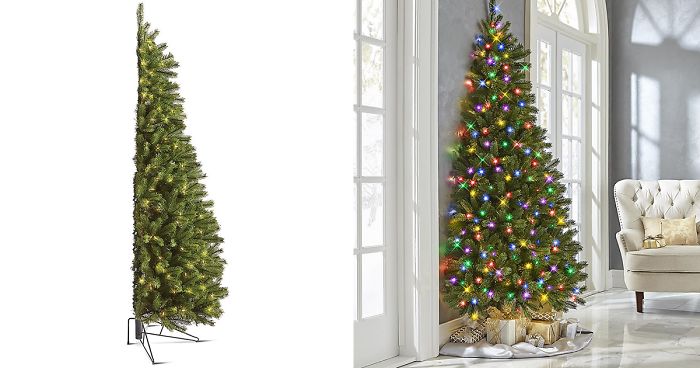
There are two kinds of people at Christmas: those who joyfully spend three hours arranging ornaments on every branch, and those who discover on December 23 that the back of the tree has been completely ignored. The second group may have just found its holiday hero.
Meet the half Christmas tree, also commonly called a flat-back Christmas tree. It looks like a traditional artificial Christmas tree from the front, but the rear section is dramatically reduced or removed so the tree can sit close to a wall. In other words, it offers the festive illusion of a full evergreen without demanding that your sofa, coffee table, dog bed, and entire walking path relocate for December.
The idea became widely discussed online after a 6.5-foot against-the-wall artificial tree was promoted as a solution for people who wanted a traditional-looking display while using less floor space. Since then, flat-back, half, corner, slim, and wall-mounted trees have become established categories at major home-improvement and holiday retailers. Current listings show designs ranging from compact wall-hanging trees to tall pre-lit models made specifically to sit against a wall.
What Exactly Is a Half Christmas Tree?
A half Christmas tree is exactly the kind of product name that sounds like a joke until you see one and immediately think, “Actually… that makes a suspicious amount of sense.”
Instead of forming a complete cone with branches extending in every direction, a half tree is designed primarily for front-facing display. The back is flat or significantly shallower, allowing the tree to stand much closer to a wall. From the main viewing angle, it can still create the familiar triangular silhouette of a full Christmas tree.
One widely shared 2020 model stood about 6.5 feet tall and measured roughly 43 inches wide and 22 inches deep. That particular product was a historical example rather than a universal standard, but it demonstrated the basic concept clearly: preserve the visible portion of the Christmas tree and eliminate much of the part nobody sees. Today, retailers sell a wider variety of flat-back trees in different heights, shapes, lighting configurations, and branch styles.
Think of it as stage scenery for Christmas. The audience sees a beautiful tree. The wall knows the truth.
Why a Half Christmas Tree Is Surprisingly Practical
It Gives You Back Valuable Floor Space
The most obvious advantage is space. Traditional Christmas trees can have wide lower branches that extend several feet across a room. That may be lovely in a large family room, but in an apartment, condo, dorm, narrow living room, home office, or crowded entryway, a full-width tree can behave less like holiday decor and more like temporary furniture.
A flat-back tree reduces the depth needed behind the visible branches. It can fit against a wall rather than projecting equally in every direction. The exact amount of space saved depends on the model, so “half tree” should not always be interpreted as mathematically half the footprint. Still, the design is specifically intended to reduce how far the tree extends into the room.
Major retailers now categorize flat-back trees as space-conscious options, and small-space decorating guides increasingly recommend compact, slim, wall-mounted, tabletop, or reduced-footprint trees for homes where every square foot matters.
You Do Not Have to Decorate a Side Nobody Sees
Here is the philosophical question nobody asks at the North Pole: Why are we carefully hanging a beautiful glass ornament three inches from drywall?
If a traditional Christmas tree sits against a wall, many people already concentrate their best ornaments on the front and sides. The back receives whatever is left, assuming it receives anything at all. A half Christmas tree simply turns that behavior into a product feature.
There are fewer rear branches to fluff, fewer hidden gaps to fill, and less reason to crawl between the tree and the wall while holding a strand of lights in your teeth. For anyone who enjoys the finished holiday atmosphere more than the decorating marathon, that is a genuine advantage.
You May Need Fewer Decorations
Because the display area is concentrated on the visible front, a half tree can often be decorated effectively with fewer ornaments than a comparable full tree. The same principle can apply to ribbon, garland, picks, and manually added lights.
This does not mean you should calculate an exact 50% reduction. Branch density and dimensions vary widely. A full-looking flat-back tree may still offer hundreds of branch tips. However, you are no longer spending ornaments on a rear section that faces a wall.
That can be especially useful for someone building a first ornament collection, decorating a second tree, or trying to make a smaller collection look more abundant.
It Can Still Look Like a Traditional Tree
The clever part is the viewing angle. Placed correctly, a well-shaped half tree can still look full from the front. Guests entering the room may not immediately notice that the tree has a secret flat side.
Manufacturers and retailers now offer flat-back models with pre-strung lights, hinged branches, flocked finishes, pinecone accents, warm white LEDs, and other features commonly found on conventional artificial trees. Some versions are several feet tall, which means saving floor space does not necessarily require switching to a tiny tabletop tree.
Who Is a Half Christmas Tree Best For?
A half Christmas tree makes the most sense when your tree has a clear primary viewing direction.
It can be particularly useful in:
- Apartments and condos with limited floor space
- Narrow living rooms where a full tree blocks a walkway
- Entryways, hallways, and offices
- Bedrooms where a second full-size tree would feel overwhelming
- Homes where the Christmas tree always stands against the same wall
- Rooms with pets, children, or furniture competing for open space
It can also work well for people who simply dislike decorating the back of a traditional tree. Not every decorating decision needs a complex architectural justification. Sometimes the reason is simply, “I do not want to do that,” and honestly, the holiday season has survived more controversial choices.
Half Tree vs. Slim Tree vs. Corner Tree
Several space-saving Christmas tree styles are now available, and the names are sometimes used loosely. Understanding the basic difference helps before you buy.
| Tree Style | Best Feature | Best Placement |
|---|---|---|
| Half or flat-back tree | Reduced depth with a full front-facing appearance | Against a wall |
| Slim or pencil tree | Narrow diameter around the entire tree | Corners, narrow rooms, open spaces |
| Corner tree | Designed to fit closely into a room corner | 90-degree corners |
| Wall-hanging tree | Uses little or no floor space | Small apartments, hallways, offices |
| Tabletop tree | Compact and easy to move | Desks, sideboards, dining areas |
A slim tree is still meant to be viewed from multiple directions, while a flat-back Christmas tree assumes the rear will face a wall. Wall-mounted versions go even further by eliminating most or all floor usage. Small-space decorating publications also recommend tabletop trees, alternative wall trees, and other compact displays when a conventional tree would dominate the room.
What to Look for Before Buying a Half Christmas Tree
Measure the Depth, Not Just the Height
Shoppers naturally focus on whether they want a 6-foot, 7-foot, or 8-foot tree, but the front-to-back depth is the number that determines whether the tree truly solves your space problem.
Measure from the wall to the nearest walkway, sofa, chair, or coffee table. Leave enough clearance for people to move comfortably and remember that a tree stand, branches, ornaments, and presents can extend beyond the dimensions you imagined while staring at an empty floor in October.
Check the Stand and Stability
A space-saving tree still needs a stable base. Look at the stand design and the width of the lower section. If you have curious pets or small children, stability becomes even more important.
Do not assume that because the tree sits against a wall it cannot tip. Follow the manufacturer’s assembly instructions, place it on a level surface, and consider appropriate anchoring when necessary.
Consider Pre-Lit Models
A pre-lit half Christmas tree can make setup even faster. Because the lights are already distributed across the branches, you avoid wrapping and unwrapping multiple strands every year.
When comparing pre-lit trees, look at light color, light count, replacement options, wiring design, and recognized electrical safety certification. Holiday safety guidance also recommends turning decorative lights off when you go to bed or leave them unattended.
Look at Branch Construction and Materials
Artificial trees vary greatly in realism. Some rely heavily on traditional PVC foliage, while higher-end designs may use molded polyethylene tips to create more natural-looking needles. Consumer buying guidance has long emphasized foliage material, branch construction, ease of assembly, stability, and storage as important factors when comparing artificial trees.
Also consider how much fluffing is required. Even a half tree can look disappointingly flat straight out of the box. Shaping individual branches is often the difference between “winter wonderland” and “green object recently released from captivity.”
How to Decorate a Half Christmas Tree So It Looks Full
Fluff the Front Carefully
Since the front is doing all the visual work, take time to spread branch tips upward, outward, and slightly sideways. Do not simply pull every branch straight toward the room. Creating layers and irregular spacing usually looks more natural.
Artificial-tree decorating guides commonly recommend thorough fluffing as one of the easiest ways to improve fullness and realism. Larger ornaments, ribbon, greenery picks, reflective decorations, and strategically placed lights can also help disguise gaps.
Put Your Best Ornaments at Eye Level
This is the tree’s greatest advantage: almost every useful branch faces the audience.
Place sentimental ornaments and detailed decorations where they can actually be seen. Use larger pieces deeper inside the branches to create dimension, then place smaller or more delicate ornaments closer to the tips.
Use Ribbon to Create Movement
Ribbon works especially well on a flat-back tree because you can concentrate the design across a controlled surface. Vertical cascades visually increase height, while diagonal ribbon creates movement across the front.
There is also less chance of spending twenty minutes arranging ribbon beautifully around the rear of the tree for the private enjoyment of the drywall.
Do Not Overload the Side Edges
One challenge with a half Christmas tree is accidentally revealing its geometry. If heavy ornaments pull the outermost side branches inward, the tree can start looking unusually narrow.
Keep the side profile balanced. Lighter ornaments, flexible picks, and carefully angled branches can maintain the illusion of a broad, traditional silhouette.
Finish the Base
A tree collar, basket, structured skirt, or neatly arranged gift boxes can help conceal the stand and make the display feel intentional. This is particularly helpful when the tree’s compact geometry makes the base more visible.
Are There Any Downsides?
Of course. Even Christmas innovation comes with fine print.
A half Christmas tree is less suitable when the tree sits in the middle of a room, in front of a large window where both sides are visible, or in an open-plan space where people regularly walk behind it. From the wrong angle, the illusion disappears faster than cookies left near Santa.
It may also disappoint people who love the ritual of circling a real tree while decorating it with family. The half-tree concept is primarily practical. If your ideal Christmas includes a fresh-cut evergreen in the center of a spacious room, a flat-back artificial tree may feel more efficient than magical.
Storage should also be considered. A half tree may be slimmer when assembled, but the size of the storage box depends on its construction. Hinged branches and sectional trunks can make seasonal storage easier, but specifications vary by model.
Why the Idea Has Lasted Longer Than the Original Joke
The first reaction to a half Christmas tree is usually laughter. The second reaction is often measuring the living room.
That is probably why the concept has persisted. It solves a genuine problem. American homes vary enormously in size, and more holiday shoppers are looking for decor that adapts to apartments, multipurpose rooms, narrow spaces, and changing lifestyles. Recent home-design coverage continues to highlight slim, compact, tabletop, wall-mounted, and other space-saving Christmas tree solutions.
The half tree is not really about wanting “less Christmas.” It is about putting the Christmas you care about in the part of the room you actually use.
The Real-Life Experience of Living With a Half Christmas Tree
Imagine the usual beginning of Christmas-tree season. You bring the storage box into the living room, move a chair, move the chair again, discover the coffee table has nowhere sensible to go, and begin negotiating with your furniture as though it has legal representation.
A flat-back Christmas tree changes that experience immediately.
The first noticeable difference is placement. Instead of planning the room around the tree, you can often place the tree into an existing wall area with fewer changes. A chair may need to slide several inches rather than migrate to another room. A walking path can remain open. In a smaller apartment, that difference can make the room feel decorated rather than occupied.
Setup can also feel unusually straightforward. The trunk sections still need to be assembled and the branches still need shaping, but there is less psychological pressure to make every angle camera-ready. The wall side is not secretly waiting for its share of the ornaments.
Then comes decorating. This is where the half-tree experience starts to feel almost suspiciously efficient.
You hang an ornament. You can see it.
You hang another ornament. You can also see that one.
For anyone accustomed to finding forgotten ornaments behind a traditional tree in January, this feels like a minor seasonal miracle.
A smaller ornament collection can suddenly appear more impressive because everything is concentrated within the visible display. Family keepsakes no longer disappear around the back. Decorative picks can be arranged where they contribute directly to the overall shape. Ribbon does not need to complete an expedition around the trunk. Even lighting can be easier, particularly with a pre-lit model.
The experience is not completely effortless. A flat-back tree needs thoughtful shaping because the front must carry the entire visual effect. If you rush the fluffing process, the tree may look obviously compressed rather than intentionally designed. The outer edges matter, too. They create the illusion that the tree continues naturally toward the wall.
Room layout matters even more. From directly in front or from normal seating positions, the effect can be convincing. Walk far enough to the side, however, and you may see exactly how the trick works. That is why the best location is usually a wall with predictable viewing angles rather than a central position where people circulate around the tree.
There is also an unexpectedly pleasant change after Christmas. During the holiday season, you may become used to having more open floor space than you expected. The room can remain easier to clean, easier to walk through, and easier to use for gatherings. Guests do not have to squeeze past lower branches while carrying plates. Pets have fewer opportunities to launch surprise operations against hidden ornaments.
Taking the tree down may produce another revelation: you did not spend December maintaining decorations that nobody could see.
For a family with hundreds of ornaments and a large living room, that may not matter. Decorating every side can be part of the tradition. But for someone in a smaller homeor anyone who wants maximum holiday atmosphere with less rearrangingthe half-tree experience can feel less like a novelty and more like someone finally questioned a rule that never needed to exist.
A Christmas tree does not receive extra holiday points because its rear branches are beautifully decorated against a blank wall.
The best version of this idea is not necessarily the smallest or cheapest tree. It is the one that fits the room correctly. A tall flat-back tree can still make a dramatic statement. A shorter model may be ideal for an office or bedroom. A wall-hanging version may work where virtually no floor space is available.
And that may be the real appeal: the half Christmas tree allows the tradition to adapt to the home rather than forcing the home to adapt to the tradition.
Conclusion: Half a Tree, Nearly All the Holiday Impact
The half Christmas tree may sound like peak holiday laziness, but that description sells it short. It is a practical response to a familiar decorating problem: many Christmas trees are displayed against walls even though they are designed to occupy space in every direction.
By concentrating branches, lights, and ornaments on the visible side, a flat-back Christmas tree can save floor space, reduce unnecessary decorating, and still deliver the classic front-facing silhouette most people want. It is especially useful for apartments, compact living rooms, offices, hallways, and anyone who has ever stared at the undecorated back of a tree and thought, “Nobody is going to see that.”
Traditionalists may prefer a full tree, and rooms with 360-degree views still benefit from one. But when space is tight and patience is tighter, buying only the part of the Christmas tree you actually look at is not ridiculous.
It might be one of the most honest decorating inventions of the holiday season.
Note: Product availability, prices, dimensions, lighting systems, and specifications can change by season and retailer. Measure your space and review the current manufacturer or retailer specifications before purchasing.