

History loves a man with a cape, a motorcycle, and a wildly questionable sense of self-preservation. But the truth is, some of the boldest stunt performers, racers, aviators, and showwomen ever to flirt with danger were women. These fearless female daredevils leaped from planes, raced at bone-rattling speeds, dove off towering platforms, wrangled tigers, and made entire crowds gasp for air long before social media could turn them into overnight legends.
What makes these women so unforgettable is not just the danger. It is the nerve. The style. The refusal to let a male-dominated culture tell them where the line was, then watching them barrel, sprint, or soar right past it. Some wanted money. Some wanted freedom. Some wanted fame. Some wanted to prove that women could do every thrilling, terrifying thing men could do, and maybe do it with better posture.
From Niagara Falls to Hollywood sets, from dusty drag strips to the wild blue sky, these women turned risk into a career and courage into a public spectacle. Here are 10 fearless female daredevils who made danger look almost elegant.
What Made These Women True Daredevils?
A daredevil is not simply someone who likes excitement. A real daredevil turns danger into performance, discipline, and identity. That is what unites the women on this list. They did not just chase adrenaline for fun. They trained, improvised, entertained, and often endured injuries, criticism, and outright exclusion. In many cases, they were doing all that while battling sexism, racism, disability bias, or poverty.
In other words, these women were not “surprisingly brave for women.” They were brave, period. And history is finally getting better at saying so out loud.
10 Fearless Female Daredevils Who Made History
1. Annie Edson Taylor
If your retirement plan involved a wooden barrel and Niagara Falls, you and Annie Edson Taylor would have had a lot to discuss. In 1901, the 63-year-old schoolteacher became the first person to survive going over Niagara Falls in a barrel. She was broke, ambitious, and convinced the stunt would bring wealth and attention. It definitely brought attention. The wealth part? Not so much.
Still, Taylor’s plunge instantly made her a legend. She packed herself into a custom barrel lined with cushions, was cut loose in the Niagara River, and somehow survived the violent ride with only minor injuries. Her stunt helped define the modern daredevil image: equal parts courage, spectacle, and a little bit of “this sounds like a terrible idea.” She proved that age and gender were no match for raw nerve.
2. Helen Gibson
Before Hollywood had armies of stunt coordinators and safety meetings with clipboards, Helen Gibson was out there leaping onto moving trains like it was another Tuesday. Often recognized as Hollywood’s first professional stuntwoman, Gibson built her reputation in the silent-film era by doing the kind of action work that made audiences clutch their hats.
She came from rodeo and Wild West performance, which gave her the athleticism and fearlessness that early filmmakers desperately needed. In The Hazards of Helen, she did her own stunts and helped define action storytelling before the genre had fully grown up. Gibson was famous for train chases, horseback tricks, and dangerous physical scenes that many studios once assumed only men could handle. She did not just break into stunt work. She helped invent the job.
3. Georgia “Tiny” Broadwick
The nickname “Tiny” did not exactly scream “aviation powerhouse,” but Georgia Broadwick turned it into a badge of honor. At just 4 feet 8 inches tall, she became one of the most influential parachuting pioneers in American history. She first jumped from a balloon as a teenager, then later became the first woman to parachute from an airplane.
Broadwick’s career was more than flashy aerial entertainment. Her work helped push parachuting forward as a real aviation tool. She demonstrated jumps for the U.S. Army and became closely associated with the early development of manual parachute deployment, a major leap in safety and technique. She was fearless, highly skilled, and years ahead of her time. Tiny in size, enormous in daredevil energy.
4. Bessie Coleman
Bessie Coleman was not just a pilot. She was a star. Denied flight training in the United States because she was both Black and a woman, she learned French, traveled to France, earned her pilot’s license in 1921, and returned home ready to dazzle crowds. That alone would make her extraordinary. Then she became a barnstorming stunt flyer and raised the stakes even higher.
Known as “Queen Bess” and “Brave Bessie,” Coleman wowed audiences with loops, dives, and dramatic aerial maneuvers. But her legacy was bigger than performance. She used her fame to push for opportunities for Black aviators and refused to accept segregation quietly. She flew with swagger, purpose, and real showmanship. In a country eager to underestimate her, Bessie Coleman chose altitude.
5. Gladys Roy
Gladys Roy did wing-walking at a time when aviation itself still seemed like a half-finished dare. Then she decided ordinary wing-walking was apparently not spicy enough. Roy became famous in the 1920s for performing stunts on airplane wings, including dancing the Charleston, walking blindfolded, and posing for the now-iconic “sky tennis” photos taken high above Los Angeles.
She was part aviator, part acrobat, part marketing genius. Roy understood that daredevil culture was about spectacle as much as skill, and she gave the public unforgettable images of women conquering the sky in heels and confidence. Her career was thrilling and tragically short, but her performances helped define the golden age of aerial stunt entertainment. She made danger look playful, which might be the most dangerous trick of all.
6. Sonora Webster Carver
Horse diving sounds like the kind of idea someone blurts out as a joke and another person should immediately reject. Sonora Webster Carver did the opposite. She became one of the most famous horse divers in America, riding galloping horses off high platforms into water tanks below. Yes, it was as wild as it sounds.
Her story became even more astonishing after a 1931 accident left her blind due to retinal damage. Most people would have retired on the spot. Sonora came back and continued diving for another 11 years. That detail alone secures her place among the most fearless female daredevils in history. She was not just brave in the moment. She was resilient over time, which is a different kind of daring and arguably the harder one.
7. Mabel Stark
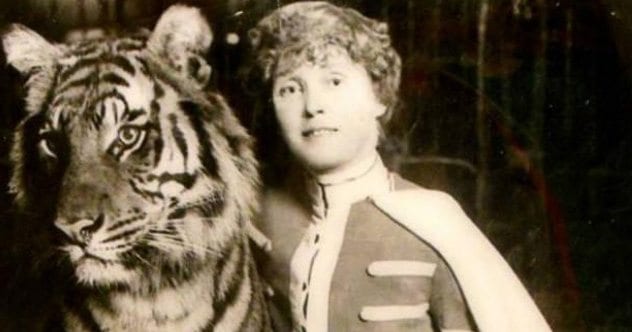
Mabel Stark built her legend in the circus ring, where she became one of America’s most famous tiger trainers. Now, “trainer” sounds tame until you remember the job involved entering a cage full of enormous predators with teeth, claws, moods, and no interest in your career goals. Stark did it anyway, again and again.
She was known for commanding Bengal tigers with unusual intensity and for returning to the ring after multiple maulings. That is not a metaphor. She literally came back after brutal attacks because the danger was part of the life she loved. Stark’s work sat at the strange crossroads of performance, danger, and animal mastery. She was not a stuntwoman in the Hollywood sense, but she absolutely belonged to the daredevil tradition: dramatic, disciplined, and unafraid to face the wild up close.
8. Kitty O’Neil
Kitty O’Neil was a stuntwoman, speed racer, and all-around force of nature. Deaf since childhood, she refused to let other people define her limits. In Hollywood, she performed high-risk stunts for film and television, including work connected to Wonder Woman and The Bionic Woman. Off set, she chased speed records like they owed her money.
In 1976, O’Neil drove the rocket-powered SMI Motivator across Oregon’s Alvord Desert and set the women’s land speed record at an average of more than 512 miles per hour. For decades, she was known as the world’s fastest woman. Her life combined technical skill, physical courage, and a refusal to play small. She was the kind of daredevil who made everyone else’s “pushing boundaries” sound adorable.
9. Debbie Lawler
In the 1970s, motorcycle jumping belonged to Evel Knievel in the public imagination. Then Debbie Lawler showed up and politely launched herself into the conversation. In 1974, at age 21, she jumped 101 feet over 16 pickup trucks and briefly broke one of Knievel’s indoor jump records. That made headlines for the obvious reason: it was a huge stunt. It also made headlines for a less flattering reason: a lot of people were shocked a woman had done it.
Lawler leaned into the spotlight without losing her edge. Billed as “The Flying Angel,” she mixed glamour with grit and made motorcycle stunts look both beautiful and terrifying. Even after a crash that broke her back in three places, she remained part of the daredevil world. She did not just jump motorcycles. She helped redraw what women in motorsports could look like.
10. Shirley Muldowney
Shirley Muldowney brought daredevil energy to drag racing and changed motorsports forever. Known as the “First Lady of Drag Racing,” she became the first woman to win a major professional drag racing championship in NHRA Top Fuel. That was not a symbolic achievement. It was a loud, smoky, high-horsepower declaration that she belonged at the top.
Muldowney’s career was full of speed, fierce competition, and physical risk. She survived serious crashes, fought for credibility in a heavily male sport, and kept winning anyway. Her success opened doors for generations of women racers, but she was never just a trailblazer in the abstract. She was a genuine threat on the strip, a fan magnet, and a competitor who made fear look like a problem for someone else.
Why These Fearless Female Daredevils Still Matter
The women on this list did more than entertain. They altered public imagination. They forced audiences to see women as physically daring, mechanically skilled, strategically bold, and commercially magnetic. They turned “you can’t” into “watch this.”
They also complicate the way we think about bravery. Courage is not always noble and tidy. Sometimes it is messy, commercial, theatrical, and just a little reckless. That is part of what makes daredevils so fascinating. These women were not saints floating above ordinary life. They were ambitious professionals with grit, ego, hunger, style, and stubbornness. In other words, they were real.
And in a digital age obsessed with going viral, their stories feel surprisingly modern. They understood branding before branding was a buzzword. They built public personas, performed under pressure, and knew that spectacle could be power. The difference is that they did it without ring lights, hashtags, or 47 retakes.
What It Feels Like to Follow Their Stories Today
Reading about female daredevils today is its own kind of experience. First comes the disbelief. You start with a simple historical curiosity and, five minutes later, you are staring at a photograph of a woman changing aviation, racing at absurd speeds, or standing near a tiger like this is a perfectly normal way to spend an afternoon. The modern brain, trained on disclaimers and warning labels, has a hard time processing that these women were not fictional characters. They were working professionals.
Then comes admiration. Not the polite, museum-gift-shop kind. The real kind. The kind that sneaks up on you when you realize how many obstacles these women faced before the dangerous part even started. They were often told they were too female, too poor, too old, too small, too unconventional, too disabled, or too ambitious. And then they went out and did something ridiculous, magnificent, and unforgettable anyway.
There is also something oddly energizing about their stories. Fearless female daredevils remind readers that courage is rarely a personality trait you are simply born with. More often, it looks like repetition, preparation, and deciding to act while still afraid. Annie Edson Taylor had to get into the barrel. Helen Gibson had to make the jump. Kitty O’Neil had to trust the machine. Debbie Lawler had to hit the ramp. The moment before action mattered just as much as the action itself.
For many readers, especially women, there is another layer to the experience: recognition. These stories feel like long-overdue proof that women have always been physically brave, mechanically curious, competitive, and spectacle-worthy. They were never missing from history. They were often just sidelined in the telling of it. Learning about them can feel less like discovering a new truth and more like recovering an old one.
The stories also create a strange mix of awe and humility. Most of us are not planning to leap onto a moving train or rocket across a desert. We are trying to survive email, errands, and maybe one difficult meeting before lunch. But that is exactly why daredevils fascinate us. They live at the outer edge of risk, and from that edge they throw something back to the rest of us: a challenge to be bolder in our own, less cinematic lives.
That might mean changing careers, speaking up, starting over, or trying the thing that feels slightly too big. No, it does not require a barrel, a biplane, or a Bengal tiger. Frankly, that is for the best. But the emotional charge is similar. These women modeled what it means to face fear without waiting for perfect certainty. They remind us that confidence often shows up after commitment, not before.
And maybe that is the most lasting thrill of all. The experience of reading about these women is not just about danger. It is about permission. Permission to be daring, visible, skillful, and impossible to ignore. Their stunts were dramatic, but their message was simple: the limits were never as fixed as people said they were.
Conclusion
The history of daredevils is not just a parade of famous men in helmets and capes. It also belongs to women who plunged over waterfalls, ruled the skies, mastered motorcycles, outran expectations, and turned public doubt into applause. These 10 fearless female daredevils did not wait for permission to be legendary. They took risks, made headlines, and expanded the very idea of what women could do in public, in performance, and under pressure.
That is what makes their stories worth revisiting. They are thrilling, yes, but they are also deeply human. Behind every stunt was a person betting on her own nerve. And more often than not, she won.