

The Leaning Tower of Pisa may be architecture’s most famous accident, but it is hardly the only building that appears to have lost an argument with gravity. Across Europe and Asia, medieval bell towers, defensive fortifications, Buddhist pagodas, and even a former water tank have developed dramatic tilts because of unstable soil, uneven foundations, groundwater changes, erosion, and structural damage.
For this article, “naturally leaning” means that the structure was not deliberately designed to slant. These towers began uprightor at least attempted toand gradually leaned because the ground or foundation behaved differently than their builders expected. Pisa currently tilts by approximately 3.97 degrees following major stabilization work, but several lesser-known landmarks equal or exceed that angle. Some lean so dramatically that Pisa starts looking like the responsible sibling.
Why Do Historic Towers Begin to Lean?
A tall masonry tower places enormous pressure on a relatively small footprint. When one side of its foundation settles faster than the other, the tower rotates toward the weaker side. Soft clay, marshland, loose fill, underground cavities, changing groundwater levels, and foundations built partly on rock and partly on soil can all produce differential settlement.
The builders of earlier centuries did not have soil-boring equipment, digital movement sensors, reinforced concrete piles, or computer models. They often discovered poor ground conditions only after several stories had already been completed. Their response was sometimes wonderfully optimistic: keep building, make the next level straighter, and hope nobody notices the lower half heading sideways.
That strategy explains why several leaning towers are also curved. Later builders adjusted the masonry to compensate for an existing tilt, creating a structure whose upper floors point in a slightly different direction from its base.
10 Unintentionally Leaning Towers That Challenge Pisa
1. Huzhu Pagoda Shanghai, China
Hidden on Tianma Hill in Shanghai’s Songjiang District, Huzhu Pagoda is one of the world’s most dramatically tilted ancient structures. The seven-story octagonal pagoda was built in 1079 during the Northern Song dynasty, making it roughly a century older than the Leaning Tower of Pisa.
Measurements have placed its lean at approximately 7.1 degrees, with the top displaced more than seven feet from its intended vertical position. One explanation is that the pagoda’s foundation rests on two very different surfaces. One side is supported by the mountain’s bedrock, while the other sits on less dependable stone fill. Over centuries, the softer side settled while the rock remained stubbornly unmoved.
Fire, weathering, and the removal of masonry around the base also contributed to the structure’s vulnerability. Reinforcement work helped prevent collapse without removing the distinctive tilt. The result is a tower that looks almost casual about breaking the rules of vertical construction.
2. Gau-Weinheim Bell Tower Rhineland-Palatinate, Germany
Pisa has the fame, but the bell tower of Gau-Weinheim has the modern record. An official measurement conducted in 2022 found that the German tower leans at 5.4277 degrees, earning recognition from Guinness World Records as the farthest-leaning church tower.
The structure began as part of a medieval defensive system before being converted into a bell tower in 1749. Its modest size makes the lean less obvious in some photographs, but standing nearby tells a different story. The roofline seems to be making a determined escape from the building beneath it.
Gau-Weinheim also demonstrates why record titles involving historic structures can change. Improved surveying equipment can produce more precise measurements, while stabilization projects may slightly reduce a tower’s angle. In the competitive world of leaning masonrya competition nobody originally intended to enterevery fraction of a degree counts.
3. Leaning Tower of Toruń Toruń, Poland
The Leaning Tower of Toruń was constructed in the 13th century as part of the city’s defensive walls. Built from red brick and standing about 49 feet high, its upper section is displaced approximately five feet from the vertical.
The culprit is believed to be the loamy ground beneath the foundation. As one side sank, the defensive tower slowly tilted toward the street. Once it was no longer needed for military purposes, the building enjoyed a surprisingly varied second career. It served as a prison, a blacksmith’s workshop, private accommodation, and later a cultural attraction.
Local legend adds a more entertaining explanation. One tale claims that a Teutonic knight who broke his vows was ordered to build the crooked tower as a symbol of his crooked conduct. Geotechnical settlement is more persuasive scientifically, but admittedly less satisfying to tour guides.
4. Suurhusen Church Tower Lower Saxony, Germany
The church tower in Suurhusen held the Guinness title before Gau-Weinheim claimed it. Its 5.19-degree inclination remains significantly greater than Pisa’s stabilized lean.
The church was built on marshy land, where medieval builders supported the structure with oak piles. As long as those wooden foundations remained submerged in groundwater, they stayed relatively well preserved. Drainage projects later lowered the water table, exposing the timber to air. The oak began to decay, one side of the foundation settled, and the tower started its slow-motion bow.
The steeple was closed when its condition became concerning, but stabilization work eventually allowed it to reopen. At roughly 90 feet tall, Suurhusen lacks Pisa’s marble arcades and grand piazza. What it offers instead is the architectural equivalent of a village underdog defeating an international celebrity.
5. Oberkirche Tower Bad Frankenhausen, Germany
Germany apparently collected leaning towers the way some countries collected castles. The tower of the Oberkirche, also known as the Church of Our Lady on the Mountain, stands in Bad Frankenhausen and leans by approximately 4.9 degrees. Its spire is several yards away from where it would be if the tower were vertical.
The movement is linked to the geology beneath the church. Mineral-rich groundwater and brine gradually dissolved underground gypsum and other soluble rock, creating cavities and causing the ground to subside unevenly. Historical observations suggest that the tower’s tilt became noticeable during the 17th century.
At various times, demolition appeared possible because maintaining the structure was expensive and technically difficult. Local preservation campaigns instead treated the tower as a cultural landmark worth saving. It remains an unusually clear demonstration that geological processes do not care how beautiful the building above them happens to be.
6. Garisenda Tower Bologna, Italy
Pisa is not even Italy’s only famous medieval tower with balance problems. Bologna’s Garisenda Tower was built during the 12th century, when wealthy families erected tall masonry towers as symbols of status, influence, and apparently extreme confidence in local soil.
Garisenda originally rose to around 197 feet, but it was shortened during the 14th century because its lean had become alarming. Today it stands approximately 157 feet high and tilts by roughly four to five degrees. Its inclination was dramatic enough to be mentioned by Dante, while later writers including Goethe and Charles Dickens also took notice.
Modern monitoring detected concerning movement, leading authorities to close the surrounding area in 2023. A major stabilization and restoration program is intended to strengthen the foundations and restrain further movement, with officials targeting completion around late 2028. Engineers plan to adapt methods and equipment associated with Pisa’s successful rescuean instance of one leaning tower giving professional advice to another.
7. Southeast Tower of Caerphilly Castle Wales
Not every famous leaning tower is a freestanding bell tower. At Caerphilly Castle in Wales, the ruined southeast tower leans outward at an extraordinary angle of about 10 degrees. That is more than twice Pisa’s current inclination.
The exact cause remains debated. One explanation blames subsidence after the castle’s elaborate water defenses deteriorated. Another points to damage involving gunpowder during the English Civil War. It is possible that structural damage and unstable ground worked together, forming history’s least helpful engineering partnership.
The tower is especially striking because parts of its walls have collapsed, exposing the immense thickness of the medieval masonry. Visitors can see that the structure is not merely crooked; it appears to be frozen midway through falling. Its survival gives the castle a dramatic silhouette that no perfectly restored fortress could reproduce.
8. Leaning Tower of Teluk Intan Perak, Malaysia
The Leaning Tower of Teluk Intan looks like a Chinese pagoda, functions as a clock tower, and began life as a municipal water reservoir. Built in 1885 and opened the following year, it stored water for dry periods and firefighting while providing the town with a highly visible timepiece.
The tower’s heavy water tank, soft ground, flooding, and underground water movement are all associated with its gradual lean toward the southwest. Its angle is commonly reported at close to 3.9 degrees, placing it in roughly the same visual category as modern Pisa.
Although the exterior appears to contain eight levels, the interior is divided into only three main stories. The layered roofs create an elegant pagoda-like profile, making Teluk Intan one of the most attractive examples of accidental architectural imbalance. It still chimes regularly, proving that being crooked is no excuse for being late.
9. Tiger Hill Pagoda Suzhou, China
Tiger Hill Pagoda, officially called Yunyan Temple Pagoda, rises above one of Suzhou’s most historic scenic areas. Construction began during the early 10th century and was completed in 961, more than two centuries before work started at Pisa.
The seven-story brick pagoda stands approximately 154 feet tall. Its summit has shifted about 7.6 feet from the center, producing an inclination of roughly three degrees. The underlying problem is familiar: part of the foundation rests on rock, while another part was built over soil. The weaker side compressed, cracks developed in supporting masonry, and the pagoda gradually leaned.
Stabilization work during the 20th century strengthened the ground and helped prevent additional movement. The tower’s age is perhaps more astonishing than its angle. It has survived dynastic changes, warfare, weather, and nearly a thousand years of gravity filing the same complaint.
10. Oldehove Leeuwarden, Netherlands
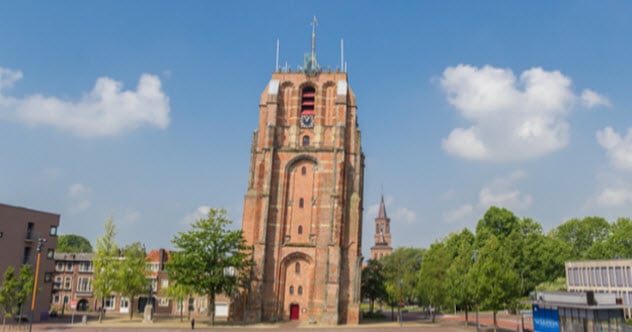
The Oldehove is a leaning, curved, and famously unfinished church tower in Leeuwarden. Construction began in 1529 with ambitions to create an imposing landmark, but the tower started sinking before the builders had progressed very far.
Instead of abandoning the project immediately, the masons attempted to correct the problem by building later sections more vertically. As the foundation continued to settle, additional corrections were made. The resulting tower bends slightly, preserving the builders’ repeated efforts to negotiate with the ground.
Work stopped in the early 1530s, leaving the structure at about 128 feet high. Its top is displaced approximately 6.5 feet from the center. Visitors can climb the tower for views across Leeuwarden, although the shifting visual lines may make the horizon appear suspiciously responsible by comparison.
Which Tower Leans the Most?
The answer depends on how the category is defined. Caerphilly Castle’s ruined southeast tower is commonly described as leaning by about 10 degrees, but it is part of a damaged castle rather than a complete freestanding tower. Huzhu Pagoda has a reported inclination of approximately 7.1 degrees, although it does not hold the specific Guinness category for church towers.
Among recognized church towers, Gau-Weinheim’s precisely measured 5.4277-degree tilt currently exceeds Suurhusen’s 5.19 degrees. Garisenda and the Oberkirche also rival or surpass Pisa’s present angle.
Comparisons should still be treated carefully. Some sources measure the angle of the base, others calculate the displacement of the top, and curved towers may not have one consistent inclination from bottom to summit. Restoration projects can also alter the numbers. A leaning tower is rarely a simple straight line tipped sideways; it is often a complicated structure that has settled, bent, rotated, and been corrected over several centuries.
The Experience of Seeing a Leaning Tower in Person
Photographs rarely communicate the full sensation of standing beside a historic leaning tower. A camera can accidentally exaggerate or minimize the angle depending on the lens, the position of nearby buildings, and whether the photographer held the camera level. In person, the surrounding architecture provides a reference point. Window frames, streetlights, rooftops, and neighboring walls remain upright while the tower clearly does not. That contrast is what makes the sight feel so strange.
The first instinct is often to move around the structure and check whether the lean is real. From one direction, a tower may look almost normal. Walk 90 degrees around it, and the inclination suddenly becomes impossible to ignore. At places such as Oldehove and Toruń, curved masonry can be even more interesting than the overall tilt. The lower courses lean one way, while later construction attempts to return toward vertical, creating a visible record of builders responding to the problem in real time.
Visitors should also look beyond the familiar forced-perspective photograph. Pretending to push a leaning tower upright is entertaining, but the best details are often closer to ground level. Cracks, reinforced foundations, replacement bricks, metal braces, drainage systems, and changes in mortar reveal how the structure has been monitored and repaired. These details transform the tower from a novelty into an engineering case study.
The surrounding setting changes the experience as well. Garisenda rises from a dense medieval city where narrow streets make its lean appear especially dramatic. Tiger Hill Pagoda is approached through a landscaped historic site, allowing the tower to emerge gradually above trees and stone paths. Caerphilly’s tower is framed by castle walls and water, giving it the theatrical appearance of a ruin that paused just before collapse. Suurhusen and Gau-Weinheim feel more intimate because their record-setting towers stand in relatively small communities rather than international tourism centers.
Access conditions vary widely. Some towers allow visitors to enter or climb, while others are closed because of structural concerns. Safety barriers should never be treated as optional photo suggestions. Leaning towers are carefully monitored precisely because masonry movement, falling fragments, and foundation instability can create real risks. Garisenda’s recent closure is a reminder that a structure may stand for centuries and still require urgent intervention when sensors identify new movement.
For photography, a modest focal length usually produces a more honest image than an extreme wide-angle lens. Including an upright object beside the tower makes the inclination easier to understand. Early morning and late afternoon light can emphasize the edges of brick or stone, while an overcast day helps preserve details in dark masonry. Checking official visitor information before traveling is essential because stabilization work, seasonal openings, and restricted areas can change.
Most importantly, these towers are not simply amusing architectural mistakes. They represent communities choosing to preserve imperfect landmarks. Their cracks, curves, shortened floors, and reinforced foundations tell a longer story than a perfectly upright replacement ever could. A leaning tower turns structural failure into cultural identity, and that is the real reason the experience remains memorable long after the obligatory “holding it up” photograph has been taken.
Conclusion: Pisa Is Famous, but It Is Not Alone
The Tower of Pisa deserves its reputation. Its marble arcades, long construction history, and celebrated rescue project make it one of the world’s great architectural landmarks. Nevertheless, it belongs to a much larger family of structures shaped by unstable ground and imperfect foundations.
Huzhu Pagoda leans at a sharper angle. Gau-Weinheim holds a modern church-tower record. Garisenda is undergoing another ambitious battle for survival. Toruń, Oldehove, and Teluk Intan have turned engineering difficulties into local identity, while Caerphilly’s battered tower looks as though gravity has been placed temporarily on hold.
These naturally leaning towers endure because preservation does not always mean correcting every imperfection. Sometimes the lean is the history. Straighten it completely, and you may save the masonry while losing the story that made people care about it.