

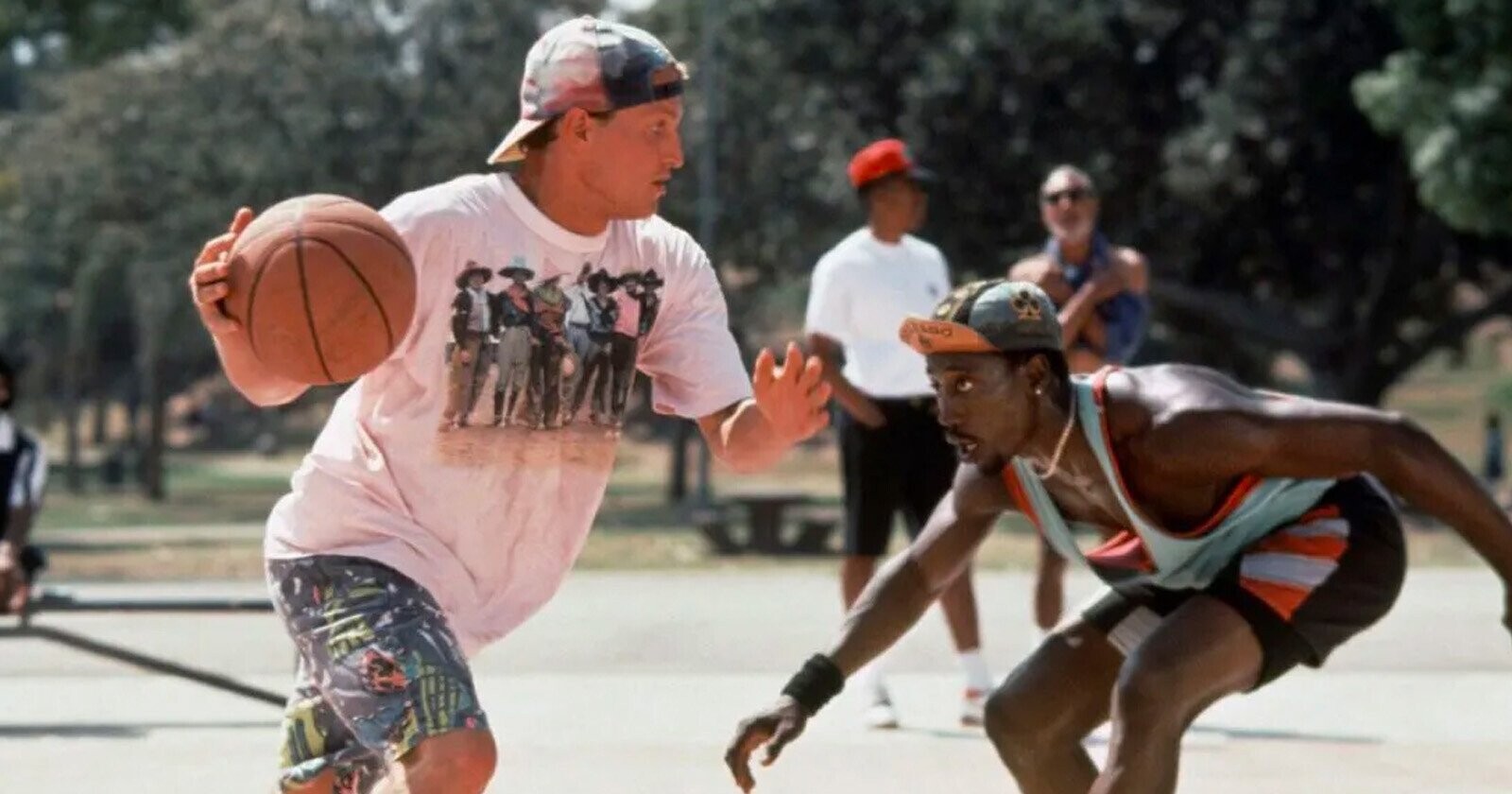
The original White Men Can’t Jump is one of those rare sports comedies that still feels sweaty, loud, sharp, and alive decades after its 1992 release. It is not just a basketball movie. It is a movie about ego, money, friendship, trash talk, confidence, insecurity, and the ancient street-court law that says whoever talks the loudest had better be able to back it up before the next possession.
Written and directed by Ron Shelton, the film stars Wesley Snipes as Sidney Deane, Woody Harrelson as Billy Hoyle, Rosie Perez as Gloria Clemente, and Tyra Ferrell as Rhonda Deane. On the surface, it follows two Los Angeles streetball hustlers who team up to win cash games. Underneath, it is a character comedy about people trying to outsmart everyone else while quietly tripping over their own flaws. That is why the movie has lasted: the jump shots are fun, but the personalities are the real full-court press.
Below are 15 trivia tidbits about the original White Men Can’t Jump, from its real basketball roots to its casting surprises, box-office strength, unforgettable Jeopardy! subplot, and the reason the film still earns a spot in conversations about the best sports comedies of the 1990s.
1. Ron Shelton Brought Real Sports Knowledge to the Script
One major reason White Men Can’t Jump feels authentic is that Ron Shelton understood sports from the inside. Before becoming a filmmaker, Shelton played minor league baseball, and his sports movies often focus less on scoreboard glory and more on the strange, funny, emotional rituals surrounding competition.
In Bull Durham, he explored baseball as a workplace, a romance, and a minor-league philosophy seminar with sunflower seeds. In White Men Can’t Jump, he applied a similar eye to pickup basketball. The movie knows that streetball is not only about athletic talent. It is also about reading people, managing pride, hiding weaknesses, spotting insecurity, and knowing when your opponent is about to let his mouth write a check his jumper cannot cash.
2. The Film Was Released on March 27, 1992
The original White Men Can’t Jump arrived in theaters on March 27, 1992, through 20th Century Fox. That timing placed it right in the middle of an early-1990s movie landscape packed with thrillers, romantic comedies, prestige dramas, and star-driven studio releases.
Instead of trying to look glossy and oversized, the film leaned into asphalt, chain-link fences, sunburned courts, and arguments that felt like they had already been going on for ten minutes before the camera arrived. It did not need spaceships, explosions, or a villain with a secret island. It had sneakers, cash, pride, and two men who could turn a simple two-on-two game into a Shakespearean crisis with better shorts.
3. Venice Beach Is More Than a Backdrop
The movie opens its world through Los Angeles basketball culture, especially the famous outdoor courts of Venice Beach. The setting matters because the courts are not treated like decoration. They are social arenas where players perform identity as much as skill.
Venice Beach gives the film color, noise, rhythm, and danger without needing to overexplain anything. The courts create a place where Billy Hoyle’s appearance becomes part of the hustle. He looks like the guy you pick last, which is exactly why he becomes useful. The joke is not simply that people underestimate him because he is white. The deeper point is that every character is trying to turn stereotypes, assumptions, and first impressions into leverage.
4. Woody Harrelson’s Basketball Ability Helped Him Land the Role
Woody Harrelson was already famous for playing Woody Boyd on Cheers, a role that made him seem sweet, innocent, and about as threatening as a warm biscuit. Billy Hoyle changed that image. Suddenly, Harrelson was playing a scrappy, gambling-prone streetball hustler with a backward cap, a quick shot, and a talent for irritating everyone within earshot.
His real basketball ability mattered. The film needed actors who could actually move on a court, not just pose while editors cut away to a mysterious pair of stunt-double ankles. Harrelson’s comfort with the ball helped sell Billy as a believable player. The result is one of those performances where the physical confidence supports the comedy. Billy may be messy in life, but when he is playing, you understand why people keep making the mistake of betting against him.
5. Wesley Snipes Turned Sidney Deane Into a Streetball Showman
Sidney Deane is not merely a good player. He is a performer. Wesley Snipes gives Sidney a mix of swagger, suspicion, style, and comic timing that makes him one of the most memorable characters in any basketball movie. Sidney talks like he is running a press conference, a sales seminar, and a personal victory parade all at once.
What makes the performance work is that Sidney is not a one-note loudmouth. He is funny, ambitious, proud, worried about money, and eager to create a better life for his family. He also cannot resist a con, which is both his gift and his curse. Snipes plays him with enough charisma that even when Sidney is scheming, the audience still wants to see him win. That is a tricky shot, and Snipes drains it.
6. Rosie Perez Nearly Steals the Movie as Gloria Clemente
In many sports comedies, the girlfriend role exists mainly to ask why the hero spends so much time doing sports things. Gloria Clemente is not that role. Rosie Perez gives Gloria her own engine, her own dream, and her own sharp intelligence. She is not just Billy’s girlfriend; she is the one person in the movie who often sees through everyone’s nonsense, including Billy’s.
Gloria’s obsession with getting on Jeopardy! gives the film one of its funniest and most satisfying subplots. She studies constantly, corrects people with volcanic confidence, and treats trivia like a professional sport. In a movie full of jump shots, her mind becomes the cleanest jumper on the court.
7. The Jeopardy! Scene Gives the Film a Second Kind of Victory
The Jeopardy! subplot is one of the smartest parts of the original White Men Can’t Jump. It gives Gloria a goal that runs parallel to the basketball hustles. While Billy and Sidney chase money through risk, Gloria chases money through preparation.
That contrast adds emotional texture to the film. Billy keeps gambling on instincts and shortcuts. Gloria studies, memorizes, practices, and actually earns her big moment. Her appearance on the game show also broadens the movie beyond the court. It reminds viewers that competition comes in many forms. Some people win by crossing over a defender. Others win by knowing exactly which foods begin with the letter Q.
8. The Movie Is Built on Hustling, But It Is Really About Trust
Because the plot involves streetball hustles, it is easy to describe the film as a comedy about betting and basketball. But the emotional core is trust. Billy and Sidney team up because they can profit from each other, not because they like each other. In fact, liking each other seems like the last item on a very long to-do list.
As the story develops, their partnership becomes a test of whether two expert manipulators can stop manipulating each other long enough to build something useful. The comedy comes from the fact that both men are smart enough to read everyone else and foolish enough to misread themselves. That is why the movie still feels human. The real opponent is not the other team. It is ego in gym shorts.
9. The Basketball Scenes Were Designed to Feel Loose
One reason the court sequences still work is that they do not feel overly polished. The basketball looks sweaty, crowded, and unpredictable. Players bump, shout, argue, reset, and keep moving. That kind of looseness gives the games a street-level energy that would be hard to fake with stiff choreography.
Shelton understood that sports on film can look fake when every move feels too clean. Pickup basketball is messy by nature. The camera has to capture not just the made basket, but the shove before it, the insult after it, and the little moment when a player realizes he has been fooled. White Men Can’t Jump succeeds because the games feel like arguments with layups attached.
10. The Title Became Bigger Than the Movie
White Men Can’t Jump has one of the most instantly recognizable titles in sports-movie history. It is funny, provocative, simple, and memorable. More importantly, the movie spends its runtime complicating the phrase. Billy can play, but he cannot fully become the person he wants to be. Sidney can dominate a court, but he still gets trapped by pride and pressure. The title opens the door with a stereotype, then the movie walks through and starts rearranging the furniture.
That is part of why the phrase endured in pop culture. People remember it because it sounds like a joke, but the film gives it meaning beyond the punchline. It becomes a comment on assumption, performance, and the strange ways people turn identity into strategy.
11. The Film Was a Strong Box-Office Performer
The original White Men Can’t Jump was not just a cult favorite that people discovered years later on cable. It performed strongly in theaters, earning more than $76 million at the domestic box office. For a character-driven sports comedy released in 1992, that is a serious win.
Its success makes sense. The movie had broad appeal without feeling bland. Sports fans got competitive basketball. Comedy fans got rapid-fire banter. Moviegoers got a buddy pairing with real chemistry. And anyone who had ever been underestimated got the delicious pleasure of watching Billy Hoyle turn low expectations into rent money. Not a recommended financial plan, obviously, but a very satisfying movie engine.
12. Critics Appreciated That It Was Not Just About Basketball
Many critics responded to the film because it was more layered than a standard sports comedy. The best sports movies usually understand that the game is a pressure cooker. What matters is what the pressure reveals. In White Men Can’t Jump, basketball exposes insecurity, ambition, racial assumptions, romantic tension, and the fragile architecture of male pride.
The movie is funny because the dialogue is sharp, but it lasts because the characters are specific. Billy is not just “the white guy who can play.” Sidney is not just “the loud streetballer.” Gloria is not just “the girlfriend.” Each of them wants something, fears something, and talks a big enough game to hide the difference.
13. The Cast Chemistry Became Part of the Film’s Legacy
The chemistry among Harrelson, Snipes, and Perez is the movie’s secret sauce. Actually, secret sauce may be too small. It is the whole food truck. Harrelson and Snipes bounce off each other with the timing of a comedy duo and the tension of two teammates who might start arguing during their own championship parade. Perez cuts through both of them with a voice and presence that refuse to be sidelined.
That chemistry explains why the film remained beloved long after the 1990s. Audiences return not only for the basketball, but for the rhythm of the conversations. The insults, negotiations, apologies, and explosions of pride all feel character-driven. The movie talks fast because the people in it think fast, panic fast, and lie fast.
14. The Movie Helped Expand Harrelson’s Film Image
For Harrelson, Billy Hoyle was an important step away from being seen only as the lovable bartender from Cheers. The role gave him a chance to be funny, physical, irritating, charming, and self-destructive in the same performance. Billy is likable, but he is also exhausting. He is the kind of guy who could win you money, lose it five minutes later, and then explain why the loss was spiritually educational.
That complexity helped show that Harrelson could carry a movie role with more edge. The performance still works because he never plays Billy as cool in the traditional sense. Billy is not cool. He is skilled, stubborn, and weirdly confident despite dressing like he packed for a weekend trip inside a laundry basket. Somehow, that is better.
15. The 1992 Original Still Casts a Long Shadow
The fact that White Men Can’t Jump received a modern remake decades later says a lot about the original’s staying power. Remakes happen when a title still means something. In this case, the 1992 film remains the version people compare everything else against because it had a rare combination of authenticity, humor, social observation, and star chemistry.
The original does not feel like a movie assembled from a committee’s list of “sports comedy ingredients.” It feels observed. It knows how players talk when pride is involved. It knows how money changes a game. It knows how a friendship can begin as a scam and somehow turn into something almost sincere. That is why the original White Men Can’t Jump still has bounce.
Why the Original White Men Can’t Jump Still Works Today
The lasting appeal of White Men Can’t Jump comes from its balance. It is specific enough to feel rooted in 1992 Los Angeles, but broad enough to remain understandable to viewers who have never played pickup basketball outside. Everyone understands the fear of being underestimated. Everyone understands the temptation to prove a point. Everyone understands the pain of realizing that winning an argument is not the same as fixing your life.
The movie also respects the intelligence of its audience. It does not pause every few minutes to explain its themes. Instead, it lets those themes appear through behavior. Billy wants to be seen as more than a stereotype, but he also benefits from the stereotype. Sidney wants control, but his pride keeps creating chaos. Gloria wants a future that does not depend on Billy’s next risky move. Rhonda wants stability, not another inspirational speech delivered after the money has vanished.
That is why the film feels richer than its premise. Yes, it is about streetball hustlers. But it is also about people negotiating the gap between talent and discipline. Billy has talent, but discipline keeps slipping out of his pocket like loose change. Sidney has talent and charisma, but his schemes often outrun his judgment. Gloria has discipline and intelligence, which is why her subplot feels so rewarding. She is the person who studies while everyone else improvises.
The film’s humor also holds up because it grows from character rather than random gags. The jokes are not pasted onto the story. They come from the way Billy and Sidney size each other up, the way Gloria refuses to be underestimated, and the way every court-side conversation becomes a tiny battle for status. The trash talk is funny because it reveals strategy. Every insult is also a move.
For modern viewers, the movie also works as a snapshot of a pre-smartphone street culture. Deals happen face-to-face. Reputation travels by word of mouth. A player’s body language matters. A crowd can change the energy of a game. There is no app for confidence, no instant replay for hurt pride, and no algorithm that can save Billy from being Billy. The analog texture gives the film warmth and grit.
Experience Section: Watching White Men Can’t Jump Like a Fan, Not a Film Professor
The best way to experience the original White Men Can’t Jump is to watch it with the volume up and your expectations loosened. Do not approach it like homework. Approach it like you just wandered past a court, heard three people arguing at professional speed, and decided to stay because something ridiculous and brilliant was clearly about to happen.
One of the most enjoyable experiences related to the film is noticing how quickly it teaches you the rules of its world. Nobody sits down and gives a lecture on streetball culture. The movie throws you into the noise. Players talk, tease, challenge, posture, and negotiate. Within minutes, you understand that the court is not only a place to play. It is a stage. The ball matters, but so does the performance around the ball.
Rewatching the movie with friends can be even better, because different viewers tend to attach themselves to different characters. Some people love Sidney’s confidence. Some admire Gloria’s brainpower and refusal to tolerate Billy’s chaos. Some find Billy funny because he is both clever and spectacularly bad at making adult decisions. He can read a defender’s hips but apparently cannot read the large blinking warning sign above his own life choices.
The basketball scenes are also fun to revisit because they reward attention. Watch how the players use rhythm. A fake is not just a move; it is a sales pitch. A hesitation is a sentence. A pass can be an apology, a dare, or an insult depending on who throws it. That is what makes the movie such a good sports comedy. It understands that games are conversations, and sometimes the loudest line is a silent look after a made shot.
Another great experience is comparing the film’s two major forms of competition: basketball and trivia. Billy and Sidney rely on nerve, improvisation, and deception. Gloria relies on memory, focus, and preparation. Both worlds create pressure, but the pressure looks different. On the court, you sweat through your shirt. On Jeopardy!, you sweat through your soul while pretending to enjoy categories that could ruin your life in the form of a buzzer.
The movie is also a reminder that great sports stories do not need championship banners to feel meaningful. The stakes in White Men Can’t Jump are personal. Rent, pride, trust, dignity, and future plans are all on the line. That is more relatable than a fictional national title game. Most people will never hit a game-winner in a packed arena, but plenty of people know what it feels like to need one good break and then nearly ruin it by being stubborn.
For anyone writing about movies, sports, or pop culture, the film is a useful case study in how to build entertainment around character. The premise is catchy, but the characters make it durable. Without Sidney, Billy, Gloria, and Rhonda, the title would just be a joke. With them, it becomes a world.
And that may be the biggest reason the original White Men Can’t Jump remains so watchable. It has the confidence of a hustler, the timing of a buddy comedy, and the emotional messiness of real life. It knows winning feels good, but it also knows some people can win the game and still lose the lesson. That is not just good sports-movie wisdom. That is good life wisdom, delivered with sneakers squeaking and someone talking way too much near the free-throw line.
Conclusion
The original White Men Can’t Jump remains a standout because it combines authentic basketball energy with sharp character writing. Ron Shelton’s direction, Wesley Snipes’ electric confidence, Woody Harrelson’s unexpected court credibility, and Rosie Perez’s scene-stealing intelligence all help the movie rise above a simple sports-comedy setup. It is funny, fast, flawed in interesting ways, and still packed with details that make fans want to revisit it.
More than three decades later, the film still works because it understands that competition is never just about the score. It is about pride, perception, trust, timing, and whether you can recognize your own weaknesses before someone else turns them into a layup. For fans of 1990s movies, sports comedies, basketball culture, and unforgettable character chemistry, White Men Can’t Jump still has game.
Note: This article is based on verified public film-history information, box-office records, cast interviews, critic summaries, and reputable entertainment coverage about the original 1992 White Men Can’t Jump.