

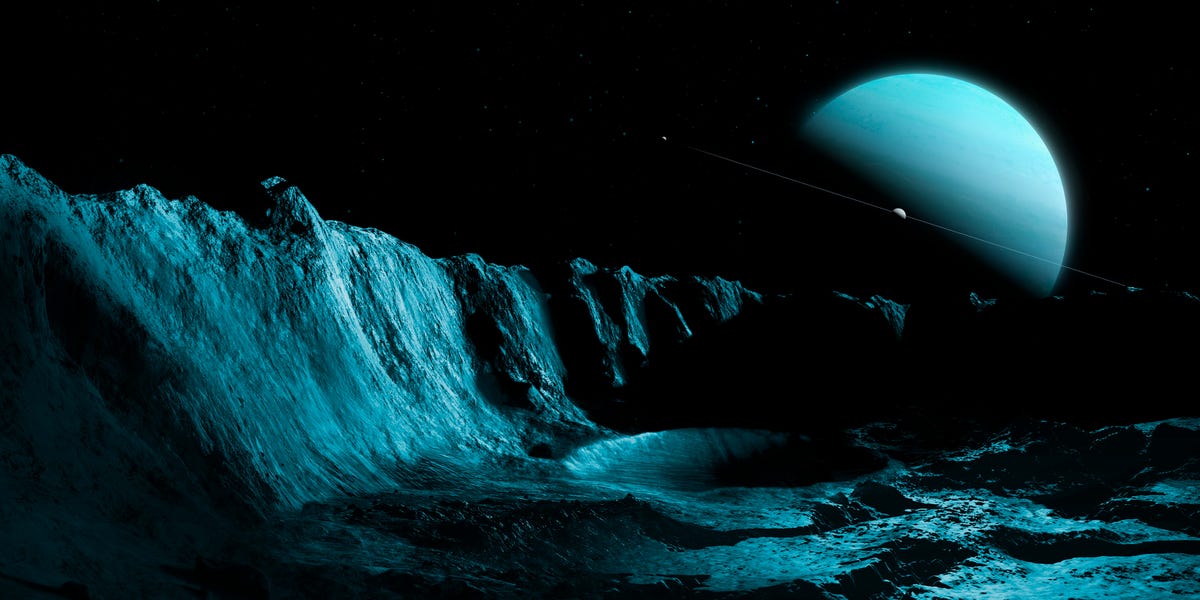
Uranus has spent decades as the awkward giant at the edge of the family photo: tilted on its side, oddly magnetic, and usually remembered only when someone wants to make the same tired joke in astronomy class. But lately, the planet’s moons have been stealing the show. Scientists now think four of Uranus’s largest moonsAriel, Umbriel, Titania, and Oberonmay be hiding underground oceans beneath their icy crusts.
That does not mean anyone has spotted alien fish doing laps under the ice. It means researchers used updated models, old Voyager 2 data, and newer lessons from other ocean worlds to argue that these distant moons may have kept liquid water inside far longer than scientists once thought. In plain English: the Uranian system may be much more active, much wetter, and much more interesting than its sleepy reputation suggests.
And that matters. A lot. Because in planetary science, “hidden ocean” is not a throwaway phrase. It is practically a neon sign flashing: go back and explore this place.
The Big Discovery, Minus the Sci-Fi Fog Machine
The headline finding is simple: four major moons of Uranus may contain subsurface oceans sandwiched between their outer ice shells and deeper rocky interiors. The strongest candidates are Ariel, Umbriel, Titania, and Oberon. Miranda, the smallest of the five major moons, was initially seen as less likely to still host liquid water today because it should have cooled too quickly. Even so, newer work has reopened the case for Miranda, which is a pretty good reminder that space science loves a sequel.
For years, scientists assumed most Uranian moons were too small and too cold to keep internal oceans from freezing solid. That assumption made sense on paper. These moons orbit far from the Sun, and unlike Jupiter’s Europa or Saturn’s Enceladus, they were not usually treated as obvious hotbeds of internal energy. But newer models changed the conversation by adding more realistic chemistry and geology.
Instead of imagining these moons as simple frozen balls of ice and rock, researchers modeled them as layered worlds with porous upper shells, water-rich rocky mantles, briny liquid layers, and compounds such as ammonia and salts that act like antifreeze. Suddenly, the odds of long-lived liquid water did not look so ridiculous. They looked plausible.
Meet the Four Moons That Just Got a Lot More Interesting
Ariel: The Overachiever
If one moon in the Uranian system is trying very hard to get invited to the next big NASA meeting, it is Ariel. Among Uranus’s large moons, Ariel already stood out because its surface looks relatively young. It has fault valleys, signs of resurfacing, and features that hint at past cryovolcanismbasically ice-world geology doing its best impression of volcanic drama.
That surface youth matters because old, inactive worlds tend to stay quiet and cratered. Ariel does not look entirely quiet. More recent observations from the James Webb Space Telescope have added to the intrigue by identifying carbon oxides and possible carbonate-related signatures on the moon’s surface. Researchers are still working out exactly where those materials came from, but one possibility is that at least some of them could be tied to material sourced from the interior and later modified at the surface.
In other words, Ariel is not just a frozen ornament. It may be a moon with a historyand maybe even a presentof interior activity.
Umbriel: The Dark Horse
Umbriel is not the showiest moon in the group. It is darker, moodier, and less photogenic than Ariel, which is a rough deal when your only close-up photos came from a 1986 flyby. But models suggest Umbriel could also retain a liquid layer under the right conditions.
That makes Umbriel scientifically valuable in a different way. If Ariel turns out to be the most geologically expressive moon, Umbriel could help scientists compare what an ocean-bearing world looks like when surface activity is less obvious. Sometimes the best science comes from contrast. Ariel may be the loud extrovert; Umbriel may be the quiet genius in the corner.
Titania: The Heavyweight
Titania has long been one of the best ocean candidates simply because size helps. Bigger moons lose heat more slowly, which improves their chances of keeping internal water from freezing solid. If you are trying to hang on to warmth for billions of years, being large is useful.
Titania is especially important because it may have had enough internal heat from radioactive decay inside its rocky material to preserve a briny ocean deep below the surface. Some models even suggest the internal environment could be comparatively warm by outer-solar-system standardswhich is still wildly cold by human standards, but that is not the point. The point is liquid water, chemistry, and time.
For astrobiology, Titania is one of the most exciting names on the list because it combines size, plausible internal complexity, and real strategic value for a future mission.
Oberon: The Long-Game Candidate
Oberon, the outermost of the five major moons, also stands out as a strong ocean candidate. Like Titania, it likely had a better chance than smaller moons to hold onto internal heat over geologic time. Newer modeling suggests that if the ice shell is sufficiently insulating and the chemistry is favorable, Oberon could still contain liquid water today.
That possibility is fascinating because Oberon sits farther from Uranus than the others, which changes the balance of heating and environmental effects. If Oberon still has an ocean, it would tell scientists that ocean worlds may survive in a wider range of conditions than older models allowed.
And that is the sneaky-big deal here: the more places we find possible oceans, the less “special case” ocean worlds start to seem.
How Can Oceans Exist So Ridiculously Far From the Sun?
Great question. When most people picture liquid water, they imagine sunshine doing the heavy lifting. That is not how outer-solar-system ocean worlds work. These moons are not warmed from above. They are warmed from within.
1. Radioactive Heating
Rock contains radioactive elements that decay over time and release heat. It is not flashy, but it is dependable. Inside a moon with enough rocky material, that slow internal heating can matter for a very long time.
2. Insulating Ice and Rock
If the outer shell is porous or built in ways that reduce heat loss, internal warmth can linger. Think less “ice cube in a drink” and more “planetary thermos.” Not perfect, but you get the idea.
3. Chemical Antifreeze
Ammonia and dissolved salts lower the freezing point of water. That means water does not need to be balmy to stay liquid. It just needs to be warm enough, salty enough, and trapped deeply enough.
4. Past Tidal Heating
Some Uranian moons may have experienced stronger tidal heating in the past, especially if orbital resonances once squeezed and flexed them more intensely. That extra energy may have helped form oceansor keep them from freezing too quickly.
Put all of that together, and you get a much more realistic picture of why underground oceans on Uranus’s moons are not fantasy. They are the kind of possibility planetary scientists now have to take seriously.
Why “May Have Oceans” Is Still Different From “Do Have Oceans”
This part matters, especially if you prefer your science without extra hype sprinkled on top.
No spacecraft has directly confirmed a present-day ocean inside any Uranian moon. The current case is based on modeling, remote observations, and analogies with better-studied ocean worlds elsewhere in the solar system. That is strong enough to justify serious attention, but not strong enough to declare victory and start naming imaginary sea creatures.
Voyager 2 gave humanity its only close flyby of Uranus in 1986. That flyby was historic, but it was quick. Scientists got snapshots, not a long-term field campaign. Since then, telescopes from Earth and space have helped, and Webb has added valuable clues. Even so, we are still studying these moons mostly from a great distance.
So the honest version is this: the evidence is compelling, but incomplete. These are leading candidates for subsurface oceans, not confirmed underwater resorts.
What It Means for Habitability
Whenever scientists hear “liquid water,” the next question is almost always “Could life exist there?” That question is fair, but it also needs brakes.
Liquid water is one ingredient for habitability, not a guarantee of biology. A habitable environment generally also needs useful chemistry, a source of energy, and enough stability over time for interesting things to happen. On Earth, life loves water, but it also loves gradients, minerals, and energy sources it can exploit.
The good news is that some Uranian moon models do not just allow liquid water. They suggest complex internal structures where water interacts with rocky material. That matters because rock-water interactions can produce chemically interesting environments. If you are building a shortlist of places where prebiotic chemistry might occur, worlds with hidden oceans and rocky interiors deserve attention.
The less-good news is that we have no direct evidence of biology, no confirmed plumes, no sampled ocean material, and no spacecraft measurements that can tell us the oceans’ exact thickness, salinity, or longevity. So habitability remains a scientific question, not a conclusion.
Still, even getting from “unlikely frozen moon” to “serious ocean-world candidate” is a major upgrade.
Why This Changes the Case for Exploring Uranus
For a long time, Uranus was easy to postpone. It is far away, expensive to reach, and overshadowed by shinier destinations like Mars, Europa, Titan, and Enceladus. But the scientific logic is shifting.
If Uranus hosts multiple ocean-world candidates, then the system is no longer just about one oddball planet. It becomes a whole laboratory for studying how oceans survive in icy moons around an ice giant. That is a different level of scientific payoff.
A future Uranus mission would not just study the planet’s weird tilt, atmosphere, rings, and magnetosphere. It could also investigate a family of moons that might preserve internal oceans under very different conditions from the better-known moons of Jupiter and Saturn.
That is exactly why Uranus has risen in priority in U.S. planetary-science planning. Scientists want to know how common ocean worlds really are, how they evolve, and whether the Uranian system represents a missing chapter in the story of habitability across the solar system.
How Scientists Could Actually Test for These Hidden Oceans
A future mission would not need to drill through miles of ice on day one. There are smarter, less cinematic ways to start.
Magnetic Measurements
Salty liquid water conducts electricity. Uranus has a bizarre, tilted, off-center magnetic field that changes dramatically around its moons. If a moon has a conductive ocean, that ocean should respond in measurable ways. A magnetometer could look for those signatures during close flybys.
Gravity Science
Careful tracking of a spacecraft can reveal how mass is distributed inside a moon. Hidden liquid layers can subtly affect the moon’s gravity field and rotation.
Spectrometers
These instruments can identify chemicals on the surface, including compounds that may have been delivered from below. If material from the interior has leaked upward through fractures or cryovolcanic activity, spectroscopy can help spot the fingerprints.
Imaging
Better cameras are not just for pretty posters. High-resolution imaging can reveal fresh fractures, resurfaced terrain, cryovolcanic features, and other clues that a world has not been geologically dead for ages.
Put simply, the moons do not have to send us a written invitation. A well-designed spacecraft can read the clues.
The Bigger Meaning: Ocean Worlds May Be More Common Than We Thought
This discovery is not just about Uranus. It is about a growing pattern in planetary science.
Again and again, worlds once dismissed as frozen and inert keep turning out to be more complicated. Europa has a subsurface ocean. Enceladus sprays water-rich plumes into space. Titan has a deep internal ocean beneath an exotic atmosphere. Pluto and even smaller icy bodies have forced scientists to rethink what counts as geologically alive.
Now Uranus’s moons are joining that conversation. That shift matters because it broadens the map of where liquid water might survive. Ocean worlds may not be rare cosmic exceptions. They may be one of the solar system’s recurring tricks.
If that is true, then the search for habitable environments becomes much bigger than the old “just-right distance from the Sun” idea. Water can hide. Heat can linger. Chemistry can persist in darkness. The solar system is less tidyand more excitingthan the textbooks made it seem.
A Longer Reflection: The Human Experience of Discovering Hidden Oceans
There is also a more emotional side to this story, and it is worth saying out loud. Discoveries like this change the experience of looking at the solar system. Before, Uranus could feel abstract: a pale blue dot far beyond the planets most people can name without squinting. Its moons were even more remote, known mostly through grainy Voyager images and lists of literary names. But the moment scientists say, “Waitsome of those moons may still have oceans,” the whole system becomes strangely vivid.
All at once, these are not just frozen objects orbiting in deep cold. They become places with interiors, histories, chemistry, and maybe ongoing activity. They become worlds. That shift is powerful. You stop thinking of a moon as a distant chunk of ice and start imagining a buried sea under a rigid shell, minerals interacting with water in total darkness, and slow geological processes unfolding over billions of years without an audience.
For people who follow space exploration, that feeling is familiar and addictive. It is the same jolt that came with Europa’s cracked ice, Enceladus’s plumes, Titan’s methane seas, and Pluto’s surprisingly active surface. Science keeps taking objects that seemed static and turning them into dynamic environments with hidden complexity. It is hard not to feel a little humbled by that. The universe keeps saying, very politely, “Your first guess was too simple.”
There is also the experience of delaythe long, patient frustration that comes with outer-planet science. Voyager 2 flew past Uranus in 1986. That means generations of scientists have spent decades squeezing new meaning from old data, waiting for better telescopes, better models, and maybe, someday, a new mission. Imagine studying a place for nearly forty years with only one close flyby to work with. That is not just a research challenge. It is an endurance sport with grant proposals.
And yet the waiting has value. The distance forces discipline. Scientists have to combine geology, chemistry, magnetism, thermal modeling, orbital mechanics, and spectroscopy into a single argument. No one gets to be lazy. Every clue matters. A strange surface compound matters. A weird magnetic pattern matters. A valley, a fault, a brightness difference, a patch of carbon dioxide iceeach detail becomes part of a larger detective story.
There is something deeply human in that process. We are a species that looks at a faint moon billions of miles away and refuses to leave it alone. We build models. We compare worlds. We revisit old data with new tools. We argue, revise, and argue again. Then, every once in a while, the picture sharpens, and a once-forgotten moon suddenly becomes a contender in the search for ocean worlds.
That is what makes the Uranus story so satisfying. It is not only about whether four moons have underground oceans. It is about how science slowly transforms remoteness into familiarity. The moons are still far away. They are still cold, dim, and difficult to study. But now they feel closer intellectually. We have better questions to ask. We have better reasons to go. And we have a stronger sense that the solar system is full of hidden interiors, waiting patiently for us to notice them.
In the end, that may be the most exciting part. These moons remind us that discovery does not always come from finding a brand-new object. Sometimes it comes from looking at an old one and finally realizing it may have been more alive, more complex, and more ocean-filled than anyone dared to expect.
Conclusion
The idea that four moons of Uranus may have underground oceans is one of those findings that sounds niche for about five seconds and then becomes enormous. It reshapes how scientists view the Uranian system, strengthens the case for a return mission, and expands the growing realization that ocean worlds may be scattered across the solar system in places once considered too cold, too small, or too boring.
The key word is still may. These oceans have not been directly confirmed. But the science is strong enough to turn Uranus’s moons from background characters into prime targets. Ariel looks especially compelling. Titania and Oberon remain heavyweight candidates. Umbriel adds depth to the lineup. Miranda, meanwhile, refuses to stay out of the plot.
So what does it mean? It means Uranus is no longer just a strange sideways planet at the edge of the solar system. It may be the center of one of planetary science’s most important future investigations: how many hidden oceans are out there, and what stories are they still keeping under the ice?