

Every bartender knows the job is about more than pouring drinks. It is traffic control, mood management, memory work, light therapy, math, hospitality, cleanup, and occasionally amateur diplomacy with a side of lime wedges. A good bar can make a random Tuesday feel like a tiny vacation. A bad customer can make that same Tuesday feel like a hostage situation with a tab.
That is why this topic never really goes out of style. Across bartender interviews, etiquette guides, and hospitality columns, the same complaints keep bubbling up like over-shaken soda: customers who snap for attention, treat the bar like a storage unit, order with zero clue and maximum confidence, then tip like they just survived a bank robbery. None of these things are illegal. They are simply exhausting.
This article pulls together the most common bartender pet peeves and turns them into something more useful than a group scream behind the service well. If you have ever wondered how to behave at a bar without becoming that person, consider this your cheat sheet. If you already behave well, congratulations: bartenders probably like you, and you may continue enjoying your Old Fashioned without guilt.
Why Bartenders Remember the Bad Stuff
The worst customer behavior is usually not one dramatic movie scene. It is a thousand little acts of entitlement. One person waves cash in the air. Another asks for a custom off-menu drink while the bar is six-deep. Someone else orders eight cocktails one by one instead of all at once, then acts shocked that time passes on Earth. Add bad tipping, rude flirting, mystery allergies announced after the drink is made, and the occasional hand reaching over the bar like it is a petting zoo, and you have the anatomy of a long night.
What makes these mistakes so annoying is that most of them are avoidable. Bartenders do not expect customers to know every spirit, every classic cocktail, or the life story of vermouth. They do expect basic respect. The bar is a workplace, not a stage set for your personal chaos. When customers understand that, service gets faster, conversations get friendlier, and everyone has a better time.
40 Bartenders Share The Worst Things Customers Do
The attention-seeking offenses
- Snapping, clapping, whistling, or yelling for service. Nothing says “please ignore me professionally” quite like treating a bartender like a remote-controlled appliance.
- Waving money in the air. Cash is not a magic wand. It does not move you to the front of the line; it mostly announces that patience has left the building.
- Assuming the bartender has not seen you. In a busy bar, they have seen you. They have also seen the twelve other people who think they were born before everyone else.
- Hovering over guests who are already ordering. Breathing down someone else’s neck does not speed up the process. It just creates weird group tension and accidental shoulder contact.
- Interrupting another order. If a bartender is halfway through someone else’s Martini, that is not the perfect moment to scream, “Two beers!” from the side.
- Flagging down the bartender for questions you could answer yourself. If the menu is in your hand, use it before asking what is on the menu.
- Camping at the rail with no plan. Do not spend five full minutes at the front of the line discovering your personality through tequila options.
- Acting offended when you are asked to wait your turn. Every busy bar runs on the ancient, delicate system known as “who was next.” Do not break the spell.
Ordering like chaos is complimentary
- Ordering one drink at a time for a group. Bartenders hate the sentence, “And one more thing…” because it is rarely just one more thing.
- Walking up with no idea what you want. You do not need a PhD in amaro, but having even a rough category helps. Beer, wine, spirit-forward, citrusy, not too sweet. Easy.
- Saying, “Make me something good,” and offering zero direction. This is not helpful. It is the cocktail version of handing someone a blank page and calling it collaboration.
- Ordering a fussy off-menu drink during a rush. There is a time for a seven-step custom creation, and that time is usually not when the bar looks like an airport on Thanksgiving.
- Ignoring the kind of bar you are in. Ordering a rare whiskey dissertation at a frozen margarita joint is like asking for sushi at a pancake house. Read the room.
- Changing the order after the drink is made. “Actually, can you make it spicy, less sweet, different liquor, and maybe taller?” Sure, if time no longer has meaning.
- Misunderstanding ice. Less ice does not automatically mean more alcohol. Sometimes it means a warm, flat, sad version of the drink you actually wanted.
- Asking for the strongest drink possible like it is a secret code. Bartenders hear this a lot, and it rarely sounds cool. It mostly sounds like trouble wearing cologne.
Money manners that make bartenders wince
- Tipping poorly on complicated cocktails. A cocktail with multiple ingredients, fresh garnish, shaking, straining, and customization is not spiritually identical to opening a can of beer.
- Treating the tip like optional confetti. In many bars, tips are a serious part of income. Stiffing the bartender after lots of attention is a memorable way to become unforgettable for the wrong reason.
- Asking for a free round. Free drinks are gestures, not entitlements. Demand is the fastest way to turn generosity into laughter in the back room.
- Name-dropping to get special treatment. “I know the owner” is rarely the flex customers think it is. More often, it sounds like a coupon with no barcode.
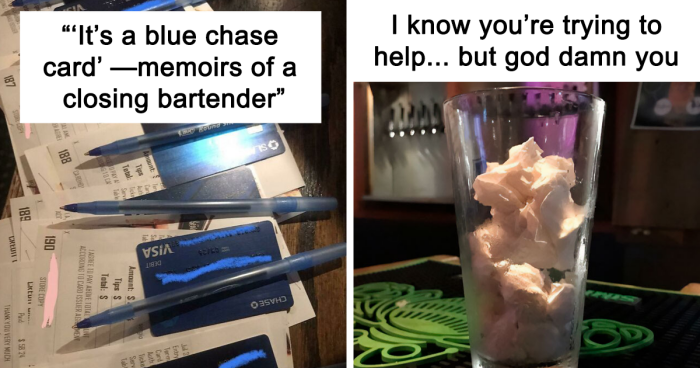
- Starting a tab and forgetting you have one. Bartenders are not thrilled when the evening ends with a treasure hunt for the person who opened a card under “Mike? Maybe Matt?”
- Playing receipt games. Scribbling nonsense on the tip line, leaving math puzzles, or acting shocked that tax exists is not charming. It is administrative vandalism.
- Splitting tiny tabs into a dozen transactions at peak rush. It can be done. That does not mean it feels like a gift.
Treating the bar like your personal living room
- Taking up more space than you need. Your coat, backpack, shopping bags, and emotional support tote do not each require their own stool.
- Reaching over the bar. Do not grab napkins, straws, fruit, bottles, or anything else. The bar is a boundary, not a buffet.
- Leaving a giant mess. Wet napkins, garnish graveyards, spilled mixers, and mystery stickiness are not part of the decor.
- Moving glassware around like set dressing. Bartenders place things where they can work efficiently. Rearranging the bar top helps nobody.
- Using the service area like a charging station or office desk. The bar is not your coworking space, and the bartender is not your IT department.
- Letting your whole group block the ordering lane. One or two people ordering is normal. A seven-person semicircle around the well is a hostage tableau.
- Bringing outside food or drinks without asking. Unless the bar clearly allows it, this is one of those habits that feels harmless to customers and chaotic to staff.
- Eating garnishes like you are foraging. If you are pulling oranges, cherries, or herbs off the bar setup, congratulations, you have become part of the problem.
Social behavior that ages everyone behind the bar
- Flirting like the bartender is on the clock because they literally are. Friendly conversation is fine. Cornering someone at work with bad lines is not chemistry; it is unpaid labor.
- Asking invasive personal questions. “So what is your real job?” remains one of the fastest ways to sound disrespectful in under six words.
- Trauma-dumping during service. Bartenders are often kind, but they are not your emergency therapist between ticket bursts.
- Arguing about what a classic cocktail is after ordering it wrong. A bartender can explain. A customer insisting that a random fruit bomb is “basically a Martini” is where civilization begins to wobble.
- Trying to force the bartender to take a shot. Some bars allow it, some do not, and some bartenders simply do not want one. Consent applies to Jameson too.
- Vaping, smoking, or behaving like rules are for other people. Nothing kills hospitality faster than one guest acting like the room is their personal backyard.
- Getting too drunk and calling it fun. Bartenders like lively energy. They do not like babysitting adults who suddenly believe volume equals charisma.
- Turning one mistake into a courtroom drama. If a drink is not right, say so politely. Most good bartenders will fix it. The monologue is optional.
- Forgetting the human being behind the bar. This is the biggest sin of all. Bartenders are not drink-dispensing furniture with forearms. They are workers reading the room, managing pressure, and trying to keep your night pleasant.
What Good Customers Do Instead
The easiest way to avoid becoming a bartender horror story is almost boringly simple. Make eye contact. Wait your turn. Know your order, or at least know the general direction. If you need guidance, give useful clues instead of a personality test. Tip in proportion to effort. Keep your belongings compact. Respect the bar as a workspace. And if something goes wrong, be direct and polite instead of dramatic and theatrical.
Great customers are not the ones who perform etiquette like they are auditioning for a period drama. They are the ones who make the exchange smoother. They understand that hospitality works best when both sides participate. Bartenders bring skill, speed, and emotional control. Customers bring basic decency and the revolutionary concept of not behaving like a nightclub emperor.
Conclusion
So what are the worst things customers do in bars? Usually, it comes down to impatience, disrespect, clueless ordering, bad tipping, and forgetting that a bar is a workplace before it is your backdrop for a fun night out. The good news is that bar etiquette is not complicated. You do not need secret insider knowledge. You just need situational awareness, a little kindness, and enough humility to accept that the bartender probably knows what they are doing.
In other words: do not snap, do not reach, do not stiff, do not monologue, and do not order like you are building a spaceship. Do those five things alone and you are already miles ahead of the crowd. Your drink will taste better, the service will feel warmer, and somewhere behind the bar, a bartender’s left eye will stop twitching.
Behind the Bar: Real-World Experiences That Explain Why These Habits Matter
Imagine a Friday night at 8:17 p.m. The bar is full, the ticket printer is chirping like it pays rent, and one bartender is making four espresso martinis, two margaritas, a Negroni, and a whiskey sour while also closing out a tab and answering whether the house IPA is “too hoppy.” This is the exact moment a customer leans over the bar to grab a napkin, another whistles from the far end, and a third says, “I’ll do something fun, but not sweet, but not strong, but also kind of tropical.” No single act is catastrophic. Together, they create a level of friction that slows service for everyone.
That is the part many customers never see. From the guest side, a bar can look effortless, almost theatrical. Drinks appear, glassware gleams, garnishes land exactly where they should, and the bartender somehow remembers who asked for mezcal and who needed the check split three ways. From the staff side, it is controlled chaos built on sequence. Bartenders are constantly prioritizing: who arrived first, which drinks take longest, which tab needs to be closed, which guest needs help, which situation might become a problem if left alone. When a customer interrupts that rhythm with rude behavior, the whole machine hiccups.
The same thing happens with tipping and complicated orders. People sometimes think bartenders are judging what they drink. Usually, they are not. Order a bright blue frozen thing if it makes you happy. Order a beer and a shot. Order a classic Daiquiri. What matters more is how you order and how you behave afterward. If you ask thoughtful questions, listen to the answer, and tip like you understand effort has value, bartenders notice. They always notice.
There is also a myth that the worst customer is the loudest one in the room. Sometimes, yes. But often the most exhausting guest is the mildly inconsiderate one who creates extra work in tiny ways all night long. The person who leaves wet napkins everywhere. The group that waits until each drink is made to remember one more modification. The tab-opener who vanishes. The “regular” who expects special treatment but not regular-level generosity. These are the habits that do not make for dramatic stories, but they wear staff down fastest.
On the flip side, bartenders also remember the easy guests. The couple who knew their order. The solo diner who asked for a recommendation and actually described what they liked. The group that ordered efficiently, stayed out of the service lane, and tipped well. The guest who sent back a drink politely and clearly instead of delivering a TED Talk about disappointment. Good bar etiquette is not stiff or old-fashioned. It is practical. It helps service move, keeps the room calmer, and makes the entire experience feel more human. That is why these “little things” matter so much: in a crowded bar, little things are the whole game.