

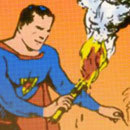
Today, Superman is the gold standard of comic book decency: a flying moral compass with a cape, a jawline, and the patience of a kindergarten teacher during glitter hour. He rescues cats, inspires children, forgives enemies, and somehow manages to wear primary colors without looking like a motivational poster from a dentist’s office.
But early Superman? Oh, early Superman had a different energy. The Golden Age Man of Steel was less “truth, justice, and a warm smile” and more “I have decided society is broken, so I will now smash a building until policy improves.” He was created by Jerry Siegel and Joe Shuster during a Depression-era moment when corruption, poverty, dangerous working conditions, and crooked businessmen felt like everyday villains. That context matters. Early Superman was not written as a polished saint. He was a wish-fulfillment wrecking ball.
Still, even with all the historical context in the world, some classic Superman comics read today like evidence in a superpowered civil lawsuit. In the name of justice, he drugs people, kidnaps officials, destroys property, terrifies civilians, and occasionally treats due process like a decorative napkin. These stories are fascinating, funny, and weirdly revealing. They show how the character evolved from radical strongman vigilante into the gentle Big Blue Boy Scout readers recognize now.
So let’s put on our lead-lined nostalgia glasses and revisit five classic Superman comics that prove he used to be, well, kind of a dick.
1. Action Comics #4: Superman Drugs a Football Player and Steals His Life
In Action Comics #4 from 1938, Superman discovers that a crooked college football coach is planning to sabotage a rival team. A modern Superman might investigate, gather evidence, expose the corruption, and maybe give an inspiring speech about sportsmanship. Golden Age Superman looks at the situation and apparently thinks, “What this needs is identity theft with extra felonies.”
His solution is to impersonate a football player named Tommy Burke. Unfortunately, Tommy Burke is an actual person with a life, a girlfriend, a body, and presumably a strong preference for not being replaced by a Kryptonian stranger. Superman sneaks up on him, incapacitates him with a hypodermic needle, and takes his place. The Man of Steel does not ask permission. He does not explain the plan in a calm, respectful way. He simply decides that Burke’s life is now a temporary costume.
The funniest part is that Superman’s plan is not even especially elegant. While pretending to be Burke, he causes chaos at practice, gets into rough contact with other players, and generally behaves like a man who has never heard the phrase “team sport.” Yes, he helps expose the dirty scheme, but his methods are so wildly invasive that the moral victory arrives wearing a fake mustache and carrying a police report.
Why It Feels So Un-Superman Today
This story is a perfect snapshot of early Superman’s rough edges. He is fighting corruption, which is admirable. But he also treats an innocent man like a prop. The later Superman is famous for respecting ordinary people; this version treats ordinary people as furniture he can move around for plot convenience. It is heroic in goal, chaotic in execution, and deeply funny in hindsight.
2. Action Comics #8: Superman Solves Poverty by Demolishing a Neighborhood
Action Comics #8, published in 1939, may be one of the most jaw-dropping early Superman stories because it begins with a real social problem and ends with Superman basically inventing urban renewal by tantrum.
The story centers on juvenile delinquency and the harsh living conditions that shape young people’s choices. That is a surprisingly serious topic for a superhero comic from the 1930s. Superman realizes that the boys involved in crime are products of poverty, neglect, and miserable housing. This is the part where the story is thoughtful. Then Superman reads about government relief efforts after a natural disaster and has an idea so aggressive it should have come with a siren.
He decides to destroy the slum neighborhood himself so the government will be forced to rebuild it with better housing. He warns residents to evacuate, then starts smashing buildings. The National Guard shows up. Bombers get involved. Superman keeps going. By the end, the neighborhood is rubble, and the story tells us that new low-rent housing eventually replaces the old tenements.
On paper, Superman’s goal is noble: improve living conditions for poor families. In practice, he becomes a one-man demolition crew with no permits, no relocation plan, and the confidence of a man who has never had to wait on a housing assistance office phone line.
The Good Intention, Bad Method Problem
This is early Superman at his most radical. He sees systems failing people and responds by physically breaking the system’s visible symbols. It is exciting, socially conscious, and absolutely bananas. Modern readers may appreciate the anti-poverty message while still wondering whether Superman has considered, say, organizing tenants, pressuring officials, exposing landlords, or doing literally anything before turning homes into confetti.
3. Action Comics #10: Superman Lets a Prisoner Suffer to Expose Abuse
Action Comics #10 from 1939 takes Superman into the brutal world of prison and chain gang abuse. Clark Kent interviews Walter Crane, a former prisoner who describes terrible conditions, starvation, beatings, and cruelty under Superintendent Wyman. Again, the subject is serious, and early Superman is clearly positioned as a champion of the oppressed.
But the way he proves the abuse is where things get uncomfortable. Superman allows events to unfold so he can gather evidence. In effect, he lets a vulnerable man be placed back in danger to document the wrongdoing. The story wants readers to see Superman as clever and strategic, but from a modern angle, it looks like he treats a traumatized witness as bait.
Eventually, Superman confronts the corrupt official and forces justice forward. The villain is exposed, the abuse is stopped, and the Man of Steel gets his result. But the road there is ethically bumpy enough to make Batman say, “Buddy, maybe dial it back.”
When the Ends Justify the Super-Means
This story highlights one of the biggest differences between Golden Age Superman and later interpretations. The early version is often focused on outcomes, not process. If a corrupt official is punished, the story considers justice served. Later Superman stories tend to care more about protecting victims along the way. Here, the victim’s suffering becomes part of the evidence trail, and that makes the victory feel less clean.
4. Action Comics #11: Superman Fights Fraud by Destroying an Oil Well
In Action Comics #11, Superman investigates a “Black Gold” oil stock swindle. Crooked operators sell supposedly worthless stock, only to discover that oil exists on the property after all. Superman exposes their greed, manipulates the situation, and ultimately takes dramatic action against the operation.
Once again, the target is genuinely villainous. Fraudsters exploiting ordinary people during the Depression were exactly the kind of real-world crooks early Superman was designed to punish. The problem is that Superman’s idea of punishment tends to involve maximum spectacle. Instead of simply recovering money, exposing the scam, and letting authorities handle the rest, he turns the case into a fiery lesson in “don’t make Superman mad near industrial equipment.”
The result is another Golden Age moral puzzle: Superman is right about the villains, but his tactics are so excessive that readers may spend half the story cheering and the other half wondering whether Metropolis has insurance adjusters trained for Kryptonian incidents.
The Man of Steel as Anti-Corporate Chaos Goblin
What makes this comic important is that it shows Superman’s early identity as a fighter against exploitation. He was not originally a distant space messiah. He was a guy in a cape who hated bullies, corrupt bosses, racketeers, and profiteers. That anger gave the character power. It also made him behave like a superhero whose conflict-resolution training consisted of “lift it, throw it, threaten it, repeat.”
5. Action Comics #12: Superman Declares War on Reckless Drivers
If you have ever yelled at someone for running a red light, Action Comics #12 may feel emotionally understandable for about five seconds. Clark Kent learns that a friend has been killed by a reckless driver. His response is grief, anger, and a public campaign against dangerous driving. So far, so good.
Then Superman breaks into a radio station and announces that reckless drivers will answer to him. From there, he escalates from traffic safety advocate to automotive apocalypse. He destroys impounded cars, wrecks unsafe vehicles, targets a car company producing dangerous products, scares irresponsible drivers straight, and pressures the mayor into enforcing traffic laws more strictly.
The story ends with Clark Kent receiving a parking ticket and secretly feeling satisfied because the law is finally being enforced. That ending is hilarious because it suggests Superman’s rampage worked. Apparently, the secret to municipal reform is one alien immigrant with anger issues and a deep suspicion of sedans.
Traffic Safety, but Make It Terrifying
This comic may be the purest example of early Superman logic. The problem is real: reckless driving kills people. The solution is unhinged: physically destroy enough things that city hall gets nervous. It is not subtle, but early Superman rarely was. He was a blunt instrument aimed at public problems, and sometimes the instrument was so blunt it flattened the furniture too.
Why Early Superman Was So Different
Calling early Superman a “dick” is funny, but it is only half the story. The other half is that the original Superman was born in a world full of visible injustice. He appeared in 1938, when many readers knew poverty, corruption, and unsafe work firsthand. Early Superman did not spend most of his time battling cosmic conquerors. He went after abusive husbands, corrupt officials, crooked businessmen, slumlords, prison sadists, and dangerous drivers.
That social anger is part of what made him exciting. He was not polite because the world he entered did not feel polite. He was a fantasy of immediate consequence. If a rich cheat ruined families, Superman could show up tonight. If officials ignored suffering, Superman could drag them to the evidence. If a neighborhood was a trap, Superman could literally tear it down.
Over time, the character changed. As Superman became a national icon, his rough vigilante edges softened. He became more patient, more lawful, more inspirational, and more emotionally careful. The modern Superman still fights injustice, but he usually does it with greater concern for consent, collateral damage, and the little matter of not drugging random football players.
Why These Classic Superman Comics Still Matter
These strange old stories are not just funny artifacts. They show that Superman has never been one single fixed idea. He has been a radical champion, a science-fiction hero, a family-friendly symbol, a cosmic guardian, a farm boy, a journalist, an immigrant metaphor, and occasionally a walking insurance crisis.
The early comics also remind us that superheroes are shaped by the fears of their time. In the late 1930s, readers were not only dreaming about alien invasions or laser-eyed supervillains. They were worried about poverty, corruption, unsafe roads, predatory businesses, and institutions that failed ordinary people. Superman answered those fears with fists, speed, and a level of property damage that would make a city planner faint.
That is why the “Superman used to be a jerk” joke has lasted. It is funny because the contrast is so sharp. The same character who now represents compassion once solved problems like a moral tornado. He meant well. He often helped. But he also behaved as if every social issue were a nail and he was a flying hammer wearing red boots.
Reading Experience: Why These Stories Are So Fun to Revisit
Reading these early Superman comics today is like opening a time capsule and finding out the time capsule is yelling at a mayor. The first reaction is laughter, because the pacing is wild and Superman moves from concern to chaos at Olympic speed. One panel, Clark Kent hears about a problem. A few panels later, Superman is smashing cars, terrorizing crooks, or rearranging public infrastructure with his bare hands. There is very little emotional warm-up. Golden Age Superman does not simmer. He boils immediately.
That speed can be jarring for modern readers, but it is also part of the charm. Current superhero comics often spend six issues exploring trauma, motivation, continuity, and moral ambiguity. Early Superman stories sometimes feel like a headline turned into a fistfight. “Bad prison conditions?” Superman is there. “Crooked football scheme?” Superman is now a football player. “Unsafe traffic?” Goodbye, automobiles. The stories have the directness of a child explaining justice with action figures: the bad guy did bad stuff, so the strong guy threw something heavy.
There is also a strange satisfaction in seeing Superman before he became polished mythology. He is recognizable, but not fully domesticated. The cape is there. The courage is there. The desire to protect ordinary people is there. But the gentle restraint is still under construction. That makes the comics feel alive in a messy way. They are not museum pieces because they are perfect. They are interesting because they are imperfect, energetic, and sometimes completely ridiculous.
For fans, these stories can change how we understand the character. Superman is often dismissed as too clean or too powerful, but the early version was neither bland nor passive. He was angry on behalf of people who had no power. He did not wait for permission from corrupt systems. That is compelling. At the same time, the stories show why later writers had to refine him. Unlimited power plus instant moral certainty can get scary fast, especially when the hero thinks demolition is a form of public service.
The best way to enjoy these comics is with two thoughts in mind at once. First, they are products of their era, full of blunt storytelling, social anger, and old-fashioned assumptions. Second, they are hilarious when judged by modern superhero standards. Watching Superman learn how to become Superman is part of the fun. Before he became the calm symbol of hope, he was a furious champion of the little guy who occasionally behaved like the world’s most muscular lawsuit.
Conclusion
The classic Superman comics of the late 1930s prove that the Man of Steel was not always the perfectly polished hero we know today. In Action Comics #4, he drugs and impersonates a football player. In Action Comics #8, he fights poverty by leveling a neighborhood. In Action Comics #10, he exposes prison abuse through morally questionable tactics. In Action Comics #11, he turns an oil swindle into industrial chaos. In Action Comics #12, he declares war on reckless drivers and nearly takes the car industry with him.
Was early Superman a dick? Sometimes, absolutely. But he was also a raw, angry, socially conscious hero built for readers who wanted someone powerful to punch back at a broken world. His roughest moments are funny now, but they also reveal why the character endured. Beneath the chaos was a simple promise: someone strong should stand up for people who are being crushed. Later Superman learned to do that with more grace. Early Superman just brought the wrecking ball.