

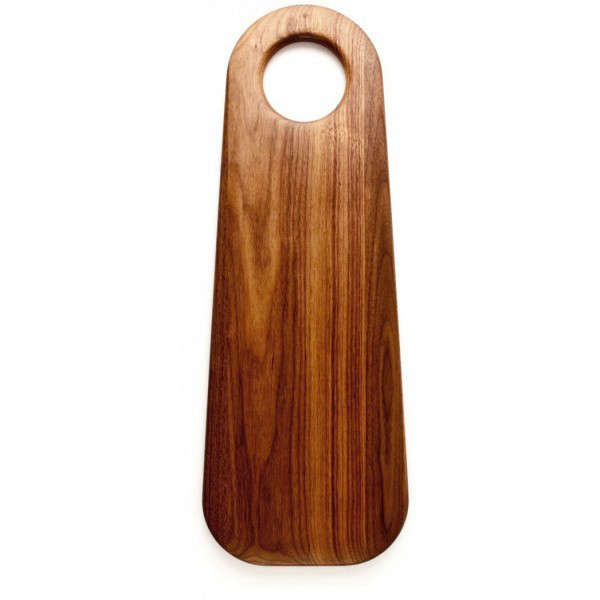
The name “6.1.2 Hole Slab Long” sounds like a structural component from a particularly stylish spaceship. In reality, it belongs to a far friendlier setting: the kitchen. Designed by Canadian furniture designer and woodworker Geoffrey Lilge for OnOurTable, this long walnut board combines a cutting surface, serving platter, charcuterie stage, and wall-worthy decorative object in one deceptively simple form.
Unlike a bulky butcher block that demands permanent counter space, the Hole Slab Long has a slim, elongated profile. It measures approximately 24 inches long, 9 inches wide, and 0.75 inch thick, with a listed weight of about three pounds. Its solid walnut construction, face-grain surface, softly sculpted edges, and signature hanging hole give it a recognizable silhouette without turning it into a kitchen gimmick. The design dates to 2009 and has appeared in design publications, museum materials, modern kitchens, and entertaining features ever since.
Is it a practical cutting board, a handsome serving board, or a piece of functional art? The honest answer is yes. Let us examine why this oddly named slab has remained appealing long after many trendier kitchen accessories were banished to the mysterious cabinet above the refrigerator.
What Is the 6.1.2 Hole Slab Long?
The 6.1.2 Hole Slab Long is a solid walnut kitchen board originally produced as part of the OnOurTable collection. Geoffrey Lilge developed the collection around solid-wood tools and kitchen products intended for chefs, hosts, and design-conscious home cooks. The Long model became one of the collection’s most recognizable pieces because it handled both preparation and presentation without looking overly rustic or aggressively professional.
Published product specifications describe the board as a 24-by-9-inch face-grain walnut slab with a thickness of three-quarters of an inch. Contemporary retail descriptions also identify FSC-certified walnut, Canadian manufacturing, hand-washing, air-drying, and periodic mineral-oil treatment as central product details. Earlier design coverage noted a finish involving natural oil and beeswax. Because wood grain and color naturally vary, no two boards are visually identical.
A Name That Feels More Industrial Than Culinary
The product name is memorable partly because it refuses to explain itself. “Hole Slab Long” describes the form plainly: it is a long wooden slab with a hole. The numerical designation functions like a model code rather than a cheerful lifestyle name. There is no need to pretend it stands for a secret cheese-to-cracker ratio unless the designer confirms that someday.
That restrained naming style matches the object itself. The board does not rely on decorative handles, engraved slogans, built-in bowls, sliding drawers, folding legs, or a tiny compartment containing three cheese knives nobody can identify. Its visual identity comes from proportion, material, edge shaping, and the circular opening at one end.
Why the Design Works
The Long, Narrow Shape Encourages Better Presentation
A square cutting board is efficient for chopping vegetables, but a long board creates a natural visual journey. Ingredients can be arranged from mild to bold, soft to firm, savory to sweet, or inexpensive to “please eat this slowly because it cost more than expected.”
The 24-inch length provides enough room for a cheese wedge, sliced bread, cured meat, fruit, nuts, and a small condiment bowl without requiring an enormous dining table. At nine inches wide, the board is narrow enough for guests to reach across it comfortably. The shape also works well down the center of a rectangular table, on a kitchen island, or beside drinks on a bar cart.
The Hanging Hole Is More Than Decoration
The large circular opening creates a convenient grip when lifting or carrying the board. It can also be used to hang the slab from a sturdy wall hook, allowing the walnut grain to function as kitchen décor between uses.
Hanging a properly dried board can save cabinet space, although the hook must be firmly installed and capable of supporting the board’s weight. A three-pound walnut slab falling from the wall will not improve the atmosphere of dinner, especially if it lands during the dramatic part of your story.
Walnut Gives the Board Visual Warmth
Walnut is prized for its rich brown color, flowing grain, and ability to develop character over time. It looks refined beside pale cheeses, green herbs, golden bread, red fruit, and light ceramic dishes. The contrast does much of the decorating work before the host has arranged a single grape.
Walnut is also among the hardwoods commonly favored for quality cutting boards. Along with maple and cherry, it provides a practical balance: firm enough for durability but generally more forgiving to knife edges than very hard materials such as glass, stone, compressed paper, or silica-rich bamboo.
Face-Grain Construction: Attractive, Useful, and Not Indestructible
The Hole Slab Long uses face-grain construction. This means the broad face of the wood is presented as the working surface, showcasing long, natural grain patterns. Face-grain boards are often visually striking and can be lighter and slimmer than thick end-grain butcher blocks.
However, face-grain wood will normally show knife marks more readily than a premium end-grain board. On an end-grain surface, wood fibers stand more vertically, allowing a blade to pass between them. Face-grain fibers run across the working surface, so repeated cutting eventually creates visible lines.
That does not make the Hole Slab Long unsuitable for food preparation. It simply means owners should treat it as an elegant multipurpose board rather than a commercial chopping station. Slice bread, portion cheese, cut fruit, prepare sandwiches, or perform light vegetable work on it. For cleaving bones, pounding cutlets, or dismantling a winter squash with heroic enthusiasm, use a thicker work board.
Best Uses for the 6.1.2 Hole Slab Long
Cheese and Charcuterie
This is the board’s natural habitat. Its length makes it easy to arrange several cured meats and cheeses while preserving separation between flavors and textures. Start with the largest items, such as cheese wedges and small bowls, before filling spaces with sliced meats, fruit, nuts, pickles, and crackers. Alternating light and dark ingredients creates contrast against the walnut surface.
For a modest appetizer, a practical guideline is approximately two ounces of charcuterie per guest. When the board is expected to carry most of a cocktail-party meal, closer to five ounces per person may be appropriate. Exact quantities should reflect the number of cheeses, breads, vegetables, and other dishes being served.
A balanced arrangement might include:
- A firm cheese such as aged cheddar or Parmesan
- A soft cheese such as Brie or goat cheese
- A mild cured meat and a spicy cured sausage
- Olives, cornichons, or pickled vegetables for acidity
- Fresh grapes, pear slices, figs, or dried apricots
- Mustard, jam, or honey in a small bowl
- Neutral crackers or thin baguette slices
Variety matters more than extravagance. A successful board can be built with one or two meats, a good piece of cheese, olives, and bread. There is no rule requiring the host to purchase twelve artisanal ingredients or arrange salami into a flower that appears to have attended finishing school.
Bread and Cheese Preparation
The board’s length is particularly convenient for baguettes, sourdough loaves, flatbreads, and long sandwiches. It provides enough room to slice and immediately serve without transferring everything to another platter. Because the board is narrow, crumbs are relatively easy to brush away rather than being scattered across an oversized work surface.
For cheese, the walnut surface is less punishing to knife blades than stone or glass. The board can also be brought directly to the table, reducing the number of dishes waiting in the sink after guests leave.
Brunch, Dessert, and Everyday Snacks
Despite its charcuterie credentials, the board does not have to spend its life under salami. It can hold pastries, toast, smoked salmon, fruit, cookies, chocolates, or individual desserts. A breakfast arrangement of sliced bread, butter, preserves, berries, and hard-boiled eggs makes an ordinary weekend meal look suspiciously organized.
It also works for casual snack dinners. Add cheese, vegetables, hummus in a small dish, leftover chicken, crackers, and fruit. The result feels intentional even when the underlying meal plan was “open the refrigerator and negotiate.”
How to Clean and Maintain the Walnut Board
Hand-Wash Promptly
Wash the board with warm water, mild dish soap, and a soft sponge. Clean both faces and the edges so moisture exposure remains reasonably even. Rinse it promptly and dry it with a clean towel. Then stand or rack the board so air can circulate around both sides until it is completely dry.
Never place the board in a dishwasher. Prolonged heat and moisture can cause swelling, warping, splitting, or finish damage. Do not leave it soaking in a sink, either. A fine walnut board is not a lasagna pan, and it should not be treated like one.
Apply Food-Grade Mineral Oil
Wood naturally loses moisture over time. When the surface appears pale, feels rough, or immediately absorbs drops of water instead of allowing them to bead, apply food-grade mineral oil.
Spread a generous, even coat over the top, bottom, edges, and inside the hanging hole. Allow the oil to absorb for several hours or overnight, then wipe away the excess. A board cream made with mineral oil and beeswax can be used occasionally as an additional protective layer.
Avoid common cooking oils such as olive, corn, or vegetable oil. These can oxidize and become sticky or rancid. Food-grade mineral oil remains stable and helps reduce drying, staining, cracking, and uneven moisture absorption.
Remove Light Scratches Carefully
Knife marks are normal on a working board. If the surface becomes noticeably rough, light sanding with fine-grit sandpaper can refresh it. Sand in the direction of the grain, remove all dust, wipe the board clean, allow it to dry, and reapply mineral oil.
Deep cracks, loose sections, or persistent odors require more caution. A severely damaged board should not continue serving food merely because it has become “vintage.” Food-contact surfaces need to remain smooth enough to clean effectively.
Food-Safety Considerations
The Hole Slab Long is best reserved for bread, cheese, fruit, vegetables, cooked foods, and ready-to-eat appetizers. Using a separate board for raw meat, poultry, and seafood makes cross-contamination easier to control and preserves the walnut board’s appearance.
Both the FDA and USDA advise washing cutting boards, knives, dishes, and utensils with hot, soapy water after contact with raw animal products. Separate cutting surfaces for raw foods and ready-to-eat ingredients are recommended when possible. Boards with deep, hard-to-clean grooves or cracks should be repaired or replaced.
USDA guidance permits sanitizing wooden and plastic cutting boards with a solution containing one tablespoon of unscented liquid chlorine bleach per gallon of water. The surface should be flooded, allowed brief contact time, rinsed with clean water, and dried thoroughly. Because repeated sanitizing can dry a natural wood finish, re-oiling may be needed afterward. Always follow the board maker’s current care instructions.
Advantages and Limitations
Reasons to Choose It
- Distinctive design: The elongated silhouette and hanging hole are recognizable without being flashy.
- Versatile function: It moves easily from light cutting to table service.
- Knife-friendly material: Walnut is more forgiving than glass, marble, or many extra-hard composite surfaces.
- Display value: The board can hang as a decorative kitchen object.
- Manageable weight: At about three pounds, it is easier to carry than a thick butcher block.
- Natural variation: Every board develops an individual grain pattern and patina.
Reasons It May Not Suit Every Kitchen
- Premium positioning: Designer walnut boards cost more than ordinary utility boards.
- Regular care: Hand-washing, thorough drying, and oiling are essential.
- Visible knife marks: Face-grain construction will develop wear with frequent chopping.
- Limited width: Nine inches is excellent for serving but less spacious for large-scale meal preparation.
- No juice groove: Wet roasts, juicy tomatoes, and carved poultry can release liquid beyond the board.
- Natural variation: Buyers expecting perfectly uniform color may be surprised by real walnut grain.
Who Is the 6.1.2 Hole Slab Long For?
This board is best suited to someone who values both utility and visual design. It makes sense for frequent hosts, cheese enthusiasts, bread bakers, home cooks with open shelving, and anyone who prefers owning a few attractive multipurpose tools instead of a drawer full of single-use gadgets.
It may also appeal to gift buyers. Unlike highly specialized cookware, a serving board does not require the recipient to understand induction zones, seasoning temperatures, or why a particular pan handle becomes hot enough to brand cattle. It can be used immediately for snacks, bread, fruit, or entertaining.
Heavy-duty cooks should pair it with a thicker primary work board. The Hole Slab Long can then remain the cleaner, more presentable surface used for bread, cheese, produce, and serving.
Conclusion: A Realistic Experience With the Hole Slab Long
Living with a board like the 6.1.2 Hole Slab Long would begin with an aesthetic decision: whether to cut on it at all. Fresh walnut looks so polished that the first knife mark can feel like putting muddy shoes on a new rug. That hesitation usually passes once the board is understood as a working object rather than a museum piece.
During everyday use, its length would quickly become the main attraction. A loaf of sourdough fits without being rotated into awkward positions. Cheese can be sliced at one end while crackers remain arranged at the other. When preparing a casual appetizer, there is enough space to create several small ingredient zones rather than piling everything into a delicious but structurally unstable mountain.
The narrow width would require some adjustment. Anyone accustomed to a large rectangular prep board might occasionally chase an onion toward the edge or wish for more elbow room while chopping herbs. The lesson would be simple: use the Hole Slab Long for deliberate slicing and presentation, not for every aggressive kitchen operation. A wider board should handle large batches, raw proteins, and particularly enthusiastic squash.
Its lightness would make it pleasant to move from counter to table. A heavy end-grain butcher block can feel as if it has signed a long-term lease with the countertop. The Hole Slab Long is more mobile. Pick it up by the opening, carry it to the dining area, and set it down as the center of a meal. The same feature also makes storage surprisingly satisfying. Hung from a secure hook, the board becomes a warm walnut shape on the wall rather than another object wedged behind sheet pans.
The first entertaining experience would probably reveal how little food is needed to make the board look abundant. Place two cheeses at opposite points, add folded salami, a handful of grapes, one small bowl of mustard, and crackers along the edge. The dark walnut fills visual gaps that might make a pale platter look empty. Guests see a composed spread; the host sees twenty minutes of assembly and no cooking.
Cleaning would be the least glamorous part of ownership, but it should not be difficult. A quick wash, immediate towel drying, and several hours of air circulation would become routine. The danger would come from distraction: leaving the board beside the sink, forgetting it under wet glasses, or deciding that “just this once” the dishwasher might be fine. Wood has a long memory for poor decisions.
After repeated use, the surface would develop fine scratches and slight color changes. Regular mineral-oil applications would deepen the grain and restore much of the richness. Those changes should be considered patina rather than failure. A functional walnut board becomes more personal as it records years of sliced baguettes, birthday cheeses, holiday appetizers, and improvised dinners.
The most convincing benefit would be behavioral. A beautiful serving surface encourages people to make ordinary food feel intentional. Leftover cheese, half an apple, crackers, and olives become a small meal worth sitting down for. Friends gather closer because the food is shared from the center. The board does not improve the flavor of cheddar through mysterious walnut energy, but it improves the ritual around eating it.
Ultimately, the 6.1.2 Hole Slab Long succeeds because it does not try to perform every kitchen task. It is not the largest chopping block, the cheapest cutting board, or the easiest object to neglect. It is a carefully proportioned walnut tool designed for light preparation, graceful serving, and visible storage. Owners willing to wash it by hand and oil it occasionally receive an object that can remain useful and attractive for years.
The board’s strange model-like name may initially attract curiosity, but its longevity comes from something simpler: good material, thoughtful proportions, and a form that makes everyday food look ready for company.
Research note: Product history and specifications were cross-checked using information from Geof Lilge Studio, Remodelista, Dwell, Provide Home, the Gardiner Museum, and Nalata Nalata. Food presentation, board maintenance, and safety recommendations were synthesized from USDA Food Safety and Inspection Service, the FDA, University of Minnesota Extension, Serious Eats, Food52, Epicurious, Bon Appétit, and Martha Stewart. Product price, availability, finish, and manufacturing details may change, so buyers should verify current information with the retailer or maker.