

Note: This article is written for web publication and synthesizes real technical information about the PhaseLoom project, vintage 6502 computing, SDR frontends, IQ sampling, and hands-on radio experimentation.
The MOS Technology 6502 is the kind of chip that refuses to retire politely. Most processors from the mid-1970s have long since become museum pieces, collector trophies, or suspicious-looking ceramic rectangles in someone’s “I’ll use this someday” drawer. The 6502, however, keeps turning up in new places. It powered classic machines such as the Apple II, Commodore systems, Atari hardware, and the Nintendo Entertainment System lineage. Now, in one of the most delightfully unnecessary hardware crossovers imaginable, it has put on an SDR hat.
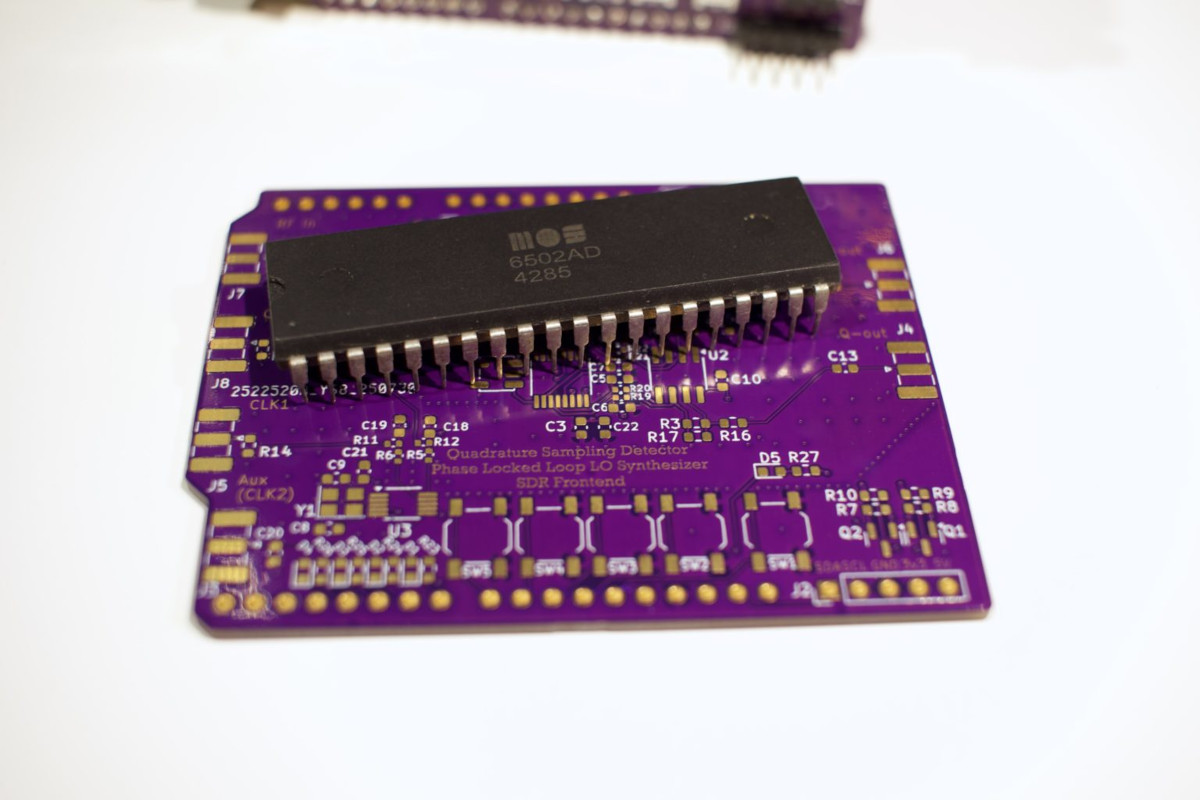
The project behind that idea is PhaseLoom, a 6502-based software-defined radio frontend created by Anders B. Nielsen. It is not a slick commercial SDR dongle pretending to be magic. It is a retro-computing experiment that combines a vintage 8-bit processor with modern radio concepts such as quadrature sampling, programmable clock generation, and IQ signal output. In plain English: an old-school CPU is helping tune and coordinate a radio system that speaks the language of modern SDR.
That is exactly why the project is interesting. Nobody builds a 6502 SDR because it is the easiest way to receive radio signals. A $30 USB SDR stick will do many jobs faster, smaller, and with fewer wires plotting rebellion on your desk. PhaseLoom matters because it turns radio engineering into a visible, learnable, slightly ridiculous adventure. It shows how much of software-defined radio is not “black magic,” but timing, filtering, sampling, and clever control.
What Does “6502 Puts On An SDR Hat” Actually Mean?
The phrase sounds like a tiny computer wearing a fedora, but the concept is more useful than the joke. In modern maker language, a “hat” or “shield” is an add-on board that gives a small computer or development board new hardware abilities. PhaseLoom follows that idea by acting as an SDR frontend for a 6502-based board called the 65uino.
The 65uino borrows the familiar Arduino-style form factor but replaces the usual microcontroller vibe with a 6502-based learning platform. PhaseLoom then plugs into that ecosystem as a radio-oriented expansion board. Instead of using the 6502 to run a full modern digital signal processing stack, the project uses it to control supporting hardware, including a programmable local oscillator. That is an important distinction. The 6502 is not secretly bench-pressing modern DSP algorithms while nobody is looking. It is orchestrating the radio frontend, and that alone is impressive for a chip architecture born in 1975.
A Quick Refresher: Why the 6502 Still Matters
The 6502 became famous because it helped make computing affordable. When it arrived in the 1970s, competing microprocessors were far more expensive, and the 6502’s low cost helped open the door for personal computers, game consoles, hobby systems, and educational machines. Its simple design, small instruction set, and efficient addressing modes made it a favorite among engineers and programmers who enjoyed squeezing performance from very little silicon.
That “do more with less” personality is why the 6502 remains beloved. It is not just nostalgia. The chip teaches fundamentals beautifully. You can understand its bus, memory map, assembly language, timing behavior, and hardware interactions without needing a graduate degree, a microscope, and three energy drinks. In a world where many chips hide complexity behind layers of abstraction, the 6502 still feels honest. It raises its hand and says, “Here are my address lines. Here is my data bus. Please do not ask me to run a web browser.”
That simplicity makes it a surprisingly good mascot for an SDR experiment. Software-defined radio can feel intimidating because it mixes RF design, sampling theory, digital processing, antennas, filters, and software tools. Pairing it with a 6502 slows the story down in a good way. It forces the builder to confront every stage of the signal path.
What Is Software-Defined Radio?
Software-defined radio, usually shortened to SDR, is a radio architecture where software handles tasks that older radios performed with fixed analog circuits. Traditional radios often rely on dedicated mixers, filters, demodulators, and tuning stages designed for specific bands or modes. SDR moves more of that work into code. With the right frontend and software, the same radio platform can explore shortwave broadcasts, amateur radio bands, weather satellites, digital signals, aircraft tracking, and more.
A basic SDR still needs hardware. The antenna must collect the signal. Filters must reduce unwanted frequencies. A mixer or sampling circuit must shift the signal into a form that can be processed. An analog-to-digital converter or audio interface must capture it. But once the signal becomes digital data, software can filter, tune, demodulate, visualize, and decode it. That flexibility is the whole appeal.
In everyday terms, SDR is like replacing a shelf full of single-purpose radios with one flexible radio lab. The hardware catches the fish; the software decides whether you are making sushi, fish tacos, or a waterfall spectrum display that makes you feel like a movie hacker.
Inside PhaseLoom: The Main Building Blocks
PhaseLoom is best understood as an SDR frontend rather than a complete all-in-one receiver. It takes radio-frequency signals and turns them into IQ outputs that can be processed by external tools such as a sound card, oscilloscope, ADC board, or SDR software environment. The board includes several important pieces working together.
1. RF Frontend and Filtering
The radio signal begins at the antenna input. From there, filtering matters immediately. A simple low-pass filter helps reduce unwanted high-frequency noise and signals outside the desired range. In SDR projects, filtering is not glamorous, but it is essential. Without it, the receiver may hear too much of everything, which is the RF equivalent of trying to listen to a podcast inside a blender factory.
2. Quadrature Sampling Detector
PhaseLoom uses a quadrature sampling detector approach. This type of circuit splits the incoming signal into two related components: I, meaning in-phase, and Q, meaning quadrature. These two signals are separated by 90 degrees of phase. Together, they give software enough information to understand the signal’s amplitude and phase behavior around the tuned frequency.
IQ sampling is central to many SDR systems because it preserves more useful information than a single real-valued signal path. Once software has I and Q data, it can shift frequencies, filter signals, reject unwanted images, and demodulate different modes more flexibly.
3. SI5351 Programmable Clock Generator
The local oscillator in PhaseLoom is generated by an SI5351 clock chip. This type of device is popular in hobby RF projects because it can produce programmable clock outputs and can be controlled over I2C. In the PhaseLoom design, the 6502 assembly code controls this clock generator, helping determine where the radio is tuned.
This is where the old and new worlds shake hands. The 6502 provides the control logic. The SI5351 provides flexible clock generation. The detector uses that timing to create IQ output. Then modern software tools can take over the heavier analysis. It is not a time machine, exactly, but it does feel like someone taught a cassette-era computer how to attend an SDR conference.
4. Output to Sound Card, Scope, or ADC
PhaseLoom’s current design can pipe IQ signals into a sound card or other measurement hardware. That makes it closer to early “sound card SDR” experiments than to modern USB SDR receivers with integrated high-speed ADCs and drivers. This design choice is part of the charm. It exposes the analog baseband stage instead of hiding everything inside one sealed device.
What Can the 6502 SDR Actually Do?
The reported prototype can tune around the 40-meter amateur radio band. The 40-meter band sits around 7 MHz and is a popular HF band for long-distance amateur-radio communication, especially depending on propagation, time of day, and conditions. The project has been described as rough, noisy, and very much a prototype, but working. That is the correct emotional category for a project like this: not polished perfection, but “it lives!”
The 6502 is not yet performing the full digital signal processing workload. Instead, it is controlling the oscillator and coordinating the frontend. The IQ output still needs external processing. That may disappoint someone expecting a tiny 8-bit chip to decode the universe alone, but it should not. A 1 MHz or low-megahertz-era processor was never designed for wideband real-time DSP. The impressive part is that it can participate meaningfully in a modern SDR signal chain at all.
Think of PhaseLoom as a hardware conversation starter. It asks, “How far can we push old silicon into modern RF territory?” The current answer is: far enough to be fun, educational, and technically revealing.
Why This Project Is More Than Retro Nostalgia
Retro-computing projects can sometimes become pure nostalgia, which is fine. There is nothing wrong with loving beige keyboards and chunky DIP packages. But PhaseLoom goes further because it connects old computing with a living field of electronics. SDR is not just a museum topic. It is used in research, amateur radio, communications testing, education, satellite experiments, and spectrum analysis.
By combining a 6502 with SDR hardware, the project makes both topics easier to appreciate. The 6502 side teaches low-level control, assembly programming, bus timing, and hardware discipline. The SDR side teaches RF filtering, oscillators, quadrature signals, sampling, and software processing. The result is a project where every layer matters.
That is rare in modern electronics. Many devices work so well that beginners never see the pieces. Plug in a USB SDR, open software, and a waterfall appears. Fantastic, but mysterious. With PhaseLoom, mystery is replaced by exposed edges. You can see where the clock comes from. You can understand why the filter matters. You can appreciate why I and Q need balance. The project turns “radio” back into a thing you can poke with a multimeter and a curious brain.
The Limits Are Part of the Lesson
PhaseLoom is not trying to beat a commercial SDR. It will not replace a polished receiver with high dynamic range, calibrated frequency stability, clean front-end filtering, and a mature software stack. Its limitations are real: noise, image rejection challenges, modest bandwidth, reliance on external processing, and the practical constraints of controlling RF hardware from an old 8-bit platform.
But those limits are exactly where the learning happens. A perfect black-box receiver teaches convenience. A rough prototype teaches cause and effect. If the filter is too broad, unwanted signals sneak in. If IQ balance is poor, images become harder to reject. If the oscillator output is dirty, the receiver suffers. If the software flowgraph is wrong, the waterfall looks like abstract art made by a confused robot.
For engineers, students, and radio hobbyists, that messiness is valuable. It creates a direct path from theory to symptom. You do not just read about aliasing; you can see it. You do not merely memorize that quadrature signals are 90 degrees apart; you learn why that relationship matters when the receiver behaves badly.
Specific Example: Listening Around 40 Meters
Imagine connecting PhaseLoom to a suitable antenna and tuning near the 40-meter amateur band. The antenna collects a mix of signals, noise, and whatever the ionosphere feels like delivering that day. The frontend filters the incoming RF. The SI5351 generates the local oscillator signal under 6502 control. The quadrature detector produces I and Q baseband outputs. Those outputs then go into a sound card or external processing system.
On the computer side, SDR software can display a spectrum or waterfall view. If the signal chain is cooperating, you may see narrowband signals appear as lines or traces. Depending on the mode and conditions, you might encounter CW, digital signals, or voice activity. Reception quality will depend on antenna setup, filtering, grounding, gain, noise environment, oscillator behavior, and software configuration.
This example highlights why PhaseLoom is such a strong educational tool. It does not reduce radio to a single “scan” button. It invites the user to understand the chain: antenna, filter, oscillator, detector, IQ output, ADC or sound card, and software demodulation. Each stage has a job, and each stage can cause trouble. That is not a bug in the learning process; that is the learning process.
Where This Could Go Next
The natural next step is better signal capture. A companion ADC board with proper anti-aliasing can reduce dependence on a PC sound card and create a more integrated SDR platform. Better filtering could improve selectivity and reduce unwanted signals. Improved software could make tuning smoother. More ambitious experiments might try to move small pieces of signal processing onto the 6502 itself, though expectations should remain realistic.
Could a 6502 perform meaningful DSP? In narrow, carefully chosen cases, possibly. Simple filtering, level measurement, control loops, or low-rate processing routines may be within reach. Wideband modern DSP is another story. The better question is not “Can a 6502 become a modern SDR processor?” but “Which parts of the SDR workflow can a 6502 handle in a way that teaches us something?” That question is much more interesting.
Why Makers Love Projects Like This
Projects like PhaseLoom survive because they are joyful. They are not optimized for convenience. They are optimized for curiosity. A maker looks at a 50-year-old CPU and a modern radio concept and thinks, “This is a terrible idea. Therefore, I must try it.” That sentence has launched half the good projects on the internet.
The appeal also comes from transparency. A 6502 system is approachable in a way that many modern chips are not. You can write assembly, wiggle pins, inspect timing, and understand the machine’s behavior. When paired with SDR, that transparency creates a bridge between digital control and analog reality. It reminds us that software still touches the physical world through clocks, voltages, filters, and noise.
Practical Takeaways for Builders
If you want to learn from the 6502 SDR idea, start with the mindset rather than the shopping list. First, understand the SDR signal path. Learn what IQ data represents and why quadrature sampling is useful. Second, study the role of the local oscillator. Tuning is not just a number on a screen; it is produced by hardware timing. Third, respect filtering. RF projects become much friendlier when unwanted signals are handled early.
Fourth, separate receiving from transmitting. Listening with SDR hardware is generally much simpler from a regulatory standpoint than transmitting. If you plan to transmit on amateur bands, you need to understand licensing rules and operate within your privileges. For learning, receiving and analyzing signals is usually the safest and most accessible starting point.
Finally, do not expect the first build to be clean. SDR projects are sensitive to layout, grounding, cable routing, local noise sources, and software settings. If the first waterfall display looks like a haunted barcode, congratulations: you have entered RF.
Experience Notes: What It Feels Like to Work With a 6502 SDR Concept
Working with a project like “6502 Puts On An SDR Hat” feels different from using a finished SDR receiver. A modern USB SDR can be almost too easy. You install drivers, open software, choose a frequency, and suddenly the screen fills with signals. That is satisfying, but it can also make the radio feel like a magic trick. With a 6502-based SDR frontend, the magic trick becomes a workshop. The rabbit is still in the hat, but now you can see the springs, gears, and one suspiciously warm voltage regulator.
The first experience is usually humility. RF does not care how confident you were five minutes ago. A wire that seemed harmless becomes an antenna. A power supply injects noise. A ground loop turns into a mystery novel. The old 6502 adds another layer of personality because it demands deliberate control. You cannot casually bury the problem under a huge processor and a pile of libraries. You have to think about what the hardware is doing, when it is doing it, and why.
There is also a special pleasure in controlling a modern programmable oscillator from vintage-style assembly code. Sending configuration data over I2C may sound ordinary on a modern microcontroller, but on a 6502 it feels like teaching an old arcade cabinet to operate lab equipment. Every successful register write feels earned. Every tuning step has a little ceremony. The system becomes less like a consumer device and more like an instrument.
Another memorable part is seeing IQ signals as something physical rather than abstract. In textbooks, I and Q can look like math wearing a lab coat. On a bench, they become two real outputs that must be routed, sampled, balanced, and interpreted. When the phase relationship is close enough, the SDR software begins to make sense of the signal. When it is not, the display reminds you with all the subtlety of a smoke alarm at 3 a.m.
Using a 6502 SDR concept also changes how you think about performance. In normal tech culture, faster is automatically better. More bandwidth, more bits, more CPU, more everything. PhaseLoom argues for a different kind of value: understanding. A limited receiver can teach more than a perfect one because its flaws are visible. Noise, drift, imbalance, and aliasing stop being vague words and become problems you can investigate.
The best experience is the moment the setup receives something recognizable. It may be faint. It may be noisy. It may require adjusting software settings, checking cables, and moving the antenna away from the laptop charger that is apparently broadcasting pure electrical nonsense. But when a signal appears, the project becomes real. The 6502 is no longer just a retro chip on a board. It is part of a radio system, helping pull order out of invisible waves. That feeling is why builders keep building.
In the end, the 6502 SDR idea is not about replacing modern radios. It is about rediscovering radio through constraints. It is about making invisible engineering visible again. It is about giving an old processor a new hat and watching it walk into a modern RF party like it owns the place. Honestly, after 50 years of service, maybe it does.
Conclusion
“6502 Puts On An SDR Hat” is more than a clever headline. It captures a project that blends retro computing, software-defined radio, RF experimentation, and maker culture into one fascinating build. PhaseLoom shows that the 6502 still has educational power, even in a field dominated by fast processors, FPGAs, and highly integrated SDR hardware. The chip may not be doing the heavy DSP yet, but it is helping control a real SDR frontend, and that is enough to make the project memorable.
For hobbyists, the lesson is clear: old technology can still teach new ideas. For radio learners, PhaseLoom offers a hands-on way to understand IQ sampling, oscillators, filters, and signal flow. For retro-computing fans, it proves that the 6502 is still capable of surprising people. And for everyone else, it is a reminder that engineering is at its best when it leaves room for curiosity, humor, and the occasional completely unnecessary but absolutely wonderful experiment.