

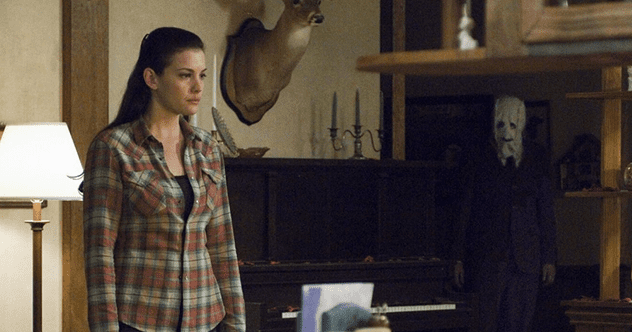
Horror movies usually let us escape with one comforting thought: none of this actually happened. The ghosts are actors, the blood is corn syrup, and the masked man waiting behind the bedroom door is probably an underpaid stunt performer wondering when lunch arrives.
Then the words “inspired by true events” appear on the screen, and that comfort quietly packs a suitcase.
Many iconic horror films have roots in real murders, unexplained deaths, disastrous mistakes, alleged hauntings, and criminal cases that terrified entire communities. Filmmakers rarely reproduce these events exactly. Instead, they borrow a disturbing detaila human-skin mask, a mysterious death during sleep, an abandoned diverand build a fictional nightmare around it.
The following real-life events inspired some of the most influential horror movies ever made. In several cases, the documented facts are even more unsettling than the supernatural embellishments.
1. Ed Gein’s Farmhouse Inspired Psycho and The Texas Chain Saw Massacre
In 1957, police entered the rural Wisconsin farmhouse of Ed Gein while investigating the disappearance of hardware-store owner Bernice Worden. What they discovered became one of the most disturbing crime scenes in American history.
Gein had robbed local graves and collected human remains. Investigators found objects fashioned from bones and skin, including masks made from preserved faces. He admitted killing Worden and tavern owner Mary Hogan, although many details later attached to his name came from rumor, sensational reporting, and creative retellings.
Author Robert Bloch drew loose inspiration from the case when creating Norman Bates in his novel Psycho, which Alfred Hitchcock adapted in 1960. Norman’s relationship with his dead mother and his attempt to assume a female identity echo selected elements of Gein’s life, but the Bates Motel, shower murder, and taxidermy plot were fictional.
Tobe Hooper’s The Texas Chain Saw Massacre borrowed an even more visible detail: Leatherface’s mask made from human skin. Gein never operated a Texas slaughterhouse, chased teenagers with a chainsaw, or belonged to a cannibal family. Apparently, the documented farmhouse was horrifying enough without a gas-powered gardening tool.
2. A Boy’s 1949 Exorcism Inspired The Exorcist
William Peter Blatty was a university student when he encountered newspaper reports about the exorcism of a 14-year-old Maryland boy in 1949. The teenager, later identified in public accounts only through pseudonyms, was reportedly experiencing violent outbursts, unexplained scratches, strange noises, and behavior his family interpreted as possession.
Clergy members performed a series of Catholic exorcism rituals in Maryland and Missouri. Reports claimed that the boy shouted obscenities, reacted violently to religious objects, and spoke words in languages he had not studied. Later investigators questioned these descriptions, suggesting that exaggeration, psychological distress, family belief, and imitation may have shaped the story.
Blatty transformed the boy into Regan MacNeil, the 12-year-old girl at the center of his 1971 novel. The 1973 film adaptation added levitating furniture, rotating heads, projectile vomiting, and enough pea soup to permanently damage the reputation of green vegetables.
The movie was not a literal account of the 1949 case. Its power came from combining the reported exorcism with fears about illness, adolescence, parental helplessness, religious doubt, and the possibility that medicine cannot explain everything.
3. The DeFeo Family Murders Led to The Amityville Horror
On November 13, 1974, Ronald DeFeo Jr. shot and killed six members of his family inside their home at 112 Ocean Avenue in Amityville, New York. His parents and four siblings were discovered in their beds. DeFeo was convicted of the murders and received six consecutive sentences of 25 years to life.
A little more than a year later, George and Kathy Lutz moved into the house with their children. They left after 28 days, claiming they had experienced cold spots, foul odors, mysterious sounds, levitation, strange substances, and a demonic presence.
Those claims became Jay Anson’s bestselling book The Amityville Horror and the 1979 movie of the same name. Numerous sequels, remakes, documentaries, and arguments followed. Skeptics, investigators, neighbors, and later occupants disputed the haunting narrative, while inconsistencies appeared in different versions of the Lutz family’s story.
The supernatural claims remain unproven. The murders do not. That contrast explains why the case remains so disturbing: the famous glowing eyes and bleeding walls may belong to folklore, but six people really died in the house.
4. The 1916 Jersey Shore Shark Attacks Helped Create Jaws
During twelve terrifying days in July 1916, a series of shark attacks struck communities along the New Jersey coast. Four people died, and another was seriously injured. Some attacks occurred near crowded beach resorts, while others happened miles inland in Matawan Creek.
The incidents triggered public panic. Newspapers portrayed the animal as a calculating monster, fishermen launched large-scale shark hunts, and communities struggled to understand a predator that scientists of the period knew relatively little about.
The attacks became part of the cultural background behind Peter Benchley’s 1974 novel Jaws, which Steven Spielberg adapted into the 1975 blockbuster. The film moved the terror to fictional Amity Island and created an enormous great white shark that seemed to possess the determination of an unpaid debt collector.
No one confirmed which shark species caused every 1916 attack, and experts do not believe sharks normally hunt humans as deliberate prey. Nevertheless, the real events supplied the essential ingredients of Jaws: a summer community, a mysterious threat, official hesitation, public hysteria, and the horrifying realization that people are not always at the top of the food chain.
5. The Gainesville Murders Sparked the Idea for Scream
In for Scream
In August 1990, five students were murdered in Gainesville, Florida, over several days. The killer entered apartments, attacked young people in their homes, and deliberately arranged some victims’ bodies to shock whoever discovered them.
The crimes brought life in the college town to a halt. Students traveled in groups, armed themselves, changed locks, or fled the area. The murderer, Danny Rolling, was later convicted and executed for the Gainesville killings.
Screenwriter Kevin Williamson became fascinated and frightened while watching a television program about the case. The experience contributed to his idea for a story about a young woman alone in a house while a killer stalked her by telephone. That concept eventually became the opening of Wes Craven’s Scream.
Ghostface is not a portrait of Rolling, and the fictional Woodsboro murders do not recreate the Gainesville crimes. The connection is emotional rather than biographical: both involve young victims, invaded homes, community panic, and the destruction of the assumption that an ordinary neighborhood is safe.
Scream famously jokes about horror-movie rules, but its central terror is brutally realistic. Doors can be locked, phones can be traced, and viewers can know every slasher cliché ever inventedyet violence can still arrive without warning. n674844search4turn674844news35
6. Mysterious Refugee Deaths Inspired A Nightmare on Elm Street
Before Freddy Krueger appeared, Wes Craven read reports about Southeast Asian refugees who suffered terrifying nightmares and later died unexpectedly in their sleep. Many of the unexplained deaths involved otherwise healthy young Hmong and other Southeast Asian men who had survived war, displacement, and severe trauma.
Some victims reportedly resisted sleep because they feared that something in their dreams would kill them. The phenomenon became known by terms including sudden unexplained nocturnal death syndrome. Researchers later explored possible cardiac, genetic, neurological, cultural, and psychological factors.
Craven took the unbearable central ideaa person who believes sleep itself is fataland turned it into A Nightmare on Elm Street. Freddy Krueger was fictional, but the fear of closing one’s eyes came from real reports of families who watched loved ones die without an obvious explanation.
The inspiration deserves careful treatment because the victims were not horror characters. They were refugees living with the consequences of conflict and resettlement. The movie converted their mysterious deaths into supernatural entertainment, while the original events reveal how medical uncertainty and cultural misunderstanding can intensify tragedy. 49756search5turn549756search14
7. Two Divers Left at Sea Inspired Open Water
On January 25, 1998, American tourists Tom and Eileen Lonergan joined a group scuba-diving excursion near Australia’s Great Barrier Reef. After the dive, the boat departed without them because of a faulty head count.
The mistake was not discovered until two days later.
A large search followed, but the couple was never found. Some of their diving equipment and personal items were recovered. Their disappearance led to intense scrutiny of safety procedures within the regional diving industry.
The incident inspired the 2003 film Open Water, in which a vacationing couple surfaces after a dive and discovers that their boat has vanished. The filmmakers changed the characters, location details, and eventual outcome, but the central situation remained horrifyingly simple.
Unlike many horror films, Open Water needs no masked killer, demon, or cursed object. Its villain is a clerical mistake surrounded by an ocean. The terror grows from isolation, exposure, dehydration, circling marine life, and the knowledge that rescue crews may not even realize they should be searching.
It is essentially the worst possible consequence of someone forgetting to check attendance. Suddenly, every boring school roll call feels like a heroic public-safety program. 74844search2turn674844search11
8. The Perron Family’s Claims Became The Conjuring
In 1971, Roger and Carolyn Perron moved with their five daughters into an old farmhouse in Harrisville, Rhode Island. Family members later claimed they encountered unexplained sounds, moving objects, apparitions, foul smells, and hostile supernatural activity.
Paranormal investigators Ed and Lorraine Warren visited the property. Their involvementand the Perron family’s recollectionseventually became the foundation of James Wan’s 2013 film The Conjuring.
The movie presents the haunting as a confrontation with Bathsheba, a malevolent witch who supposedly cursed the land. Historical researchers have challenged significant parts of that narrative. There is no reliable evidence that the real Bathsheba Sherman was a witch, sacrificed a child, or committed the acts attributed to her in the film.
That does not prove the Perron family invented its experiences. It simply means subjective memories, local legends, family storytelling, and cinematic invention became intertwined over several decades.
The Conjuring succeeds because it places supernatural terror inside an affectionate family. The scariest scenes are not merely about ghosts; they are about parents realizing they may be unable to protect their children. Even the movie’s possessed wardrobe appears to understand that parental anxiety is more powerful than any jump scare. n151767search0turn549756news41
9. The Death of Anneliese Michel Inspired The Exorcism of Emily Rose
Anneliese Michel was a young German woman who experienced seizures and serious psychiatric symptoms. She received medical treatment, but she and her deeply religious family eventually became convinced that she was possessed.
Beginning in 1975, two Catholic priests conducted dozens of exorcism sessions with church authorization. Michel’s physical condition deteriorated dramatically. She died in July 1976 from malnutrition and dehydration, weighing approximately 68 pounds.
Her parents and the priests were prosecuted and convicted of negligent homicide. The court case became a painful public debate about religious belief, mental illness, medical responsibility, consent, and whether intervention could have saved her life.
The 2005 movie The Exorcism of Emily Rose relocated the story to the United States and combined supernatural horror with courtroom drama. Its fictional trial asks viewers to consider competing medical and religious explanations, but the real case had a much less ambiguous physical conclusion: a vulnerable young woman died after prolonged deterioration.
The unsettling question is not simply whether possession exists. It is what happens when every person surrounding a suffering patient becomes committed to an explanation that prevents effective care. 0470search12turn890470search16
10. The Texarkana Moonlight Murders Inspired The Town That Dreaded Sundown
Between February and May 1946, an unidentified attacker targeted people around Texarkana, the twin community on the Texas-Arkansas border. Eight people were attacked, and five died.
Several victims were couples parked on isolated roads. Survivors described an assailant wearing a hood or mask with openings cut into it. Newspapers nicknamed the unknown attacker the Phantom Killer, and fear spread rapidly through the region.
Residents purchased guns, reinforced doors, avoided going outside after dark, and watched police patrol streets that had previously felt quiet. Investigators considered numerous suspects, but no one was convicted of the attacks.
Texarkana filmmaker Charles B. Pierce loosely dramatized the case in the 1976 movie The Town That Dreaded Sundown. The film altered details, invented scenes, and transformed the Phantom into an early slasher villain. Its documentary-style narration gave the production an uncomfortable sense of authenticity.
The killer’s identity remains uncertain, which gives the case its enduring power. Most horror movies eventually reveal the monster. Texarkana never received that ending. The crimes stopped, the panic faded, and the Phantom disappeared into history without explaining why. 90470search4turn890470search15
Why True Events Make Horror Films More Frightening
These movies demonstrate that “based on a true story” can mean several different things. A film may reconstruct a documented crime, borrow one visual detail, adapt an unverified paranormal account, or use the emotional atmosphere of a tragedy without copying its events.
The strongest true-story horror films do not depend entirely on factual accuracy. They identify a real vulnerability and exaggerate it until the audience cannot look away. Jaws turns uncertainty about the ocean into a giant predator. A Nightmare on Elm Street transforms unexplained sleep deaths into an attacker who lives inside dreams. Open Water expands an administrative failure into an endless horizon with no rescue boat in sight.
Reality provides the wound. Fiction decides how deeply to press it.
Experiencing the Real Stories Behind Horror Movies
Research Changes the Way the Movies Feel
Watching one of these films before learning its history is a straightforward entertainment experience. Watching it afterward feels different. Details that once seemed like imaginative set decoration suddenly carry uncomfortable weight.
Leatherface’s mask becomes more disturbing after learning what investigators found in Ed Gein’s farmhouse. The empty horizon in Open Water becomes harder to dismiss once viewers know that a real couple was accidentally abandoned. Freddy Krueger remains fictional, but the terror of refusing to sleep takes on another meaning when connected to unexplained deaths among traumatized refugee communities.
The experience also reveals how aggressively movies reshape reality. Several separate people may become one character. Years of events may be compressed into a weekend. A disputed claim can become an unquestioned supernatural fact. A filmmaker’s job is to create a satisfying narrative; history has no obligation to provide one.
Visiting Famous Locations Requires Perspective
Some horror fans visit places associated with these stories, including filming locations, historic neighborhoods, museums, and communities connected to criminal cases. Such trips can be fascinating, but they should not turn private tragedy into a theme-park attraction.
Many famous “horror houses” are private homes. Their present-day occupants are not characters in a franchise and should not be photographed through windows, approached for surprise interviews, or asked whether the basement still contains demons. Trespassing remains illegal even when someone owns an impressive collection of limited-edition Blu-rays.
Ethical true-crime and horror tourism means using public spaces, official tours, archives, libraries, and museums. It also means remembering victims’ names rather than focusing exclusively on killers, paranormal investigators, or fictional villains.
The Most Unsettling Discoveries Are Often Ordinary
Researching horror inspirations frequently replaces supernatural explanations with painfully ordinary causes. Institutional failures, untreated illness, family pressure, human violence, poor safety procedures, and sensational journalism appear repeatedly.
That does not necessarily make a story less frightening. In some cases, it makes the experience worse. A demon belongs to a comforting fictional category: defeat it with a ritual, a sacred object, or a sequel contract. Human error is harder to contain. It can occur on a dive boat, inside a medical system, in a family home, or during an investigation.
The real cases encourage audiences to ask better questions. What facts are documented? Which claims appeared years later? Who benefits from the supernatural version? Were victims properly supported? Did publicity obscure medical, social, or legal failures?
Horror Can Create a Controlled Encounter With Fear
Despite their grim origins, horror films can offer a useful experience. Viewers enter frightening situations while remaining physically safe. The story provides boundaries: lights go down, danger appears, the final scene arrives, and the credits confirm that the nightmare has ended.
Learning about the real events removes some of that boundary, but it can also deepen appreciation for the genre. Horror becomes more than a machine for producing screams. It becomes a way to examine grief, uncertainty, social panic, guilt, belief, and the fragile systems people depend on every day.
The best approach is a balanced one: enjoy the artistry, question the marketing, verify dramatic claims, and remember that real victims existed before their experiences became movie material.
After all, the most unsettling lesson behind these iconic horror films is not that ghosts may be real. It is that filmmakers rarely need to invent fear from nothing. History has already supplied a remarkably crowded basement.
Conclusion
The real events behind iconic horror films range from verified murders and fatal accidents to unexplained medical cases and heavily disputed hauntings. Their relationships to the movies are rarely simple. The Texas Chain Saw Massacre borrowed imagery from Ed Gein but invented nearly everything else. The Amityville Horror joined an undeniable family murder with paranormal claims that remain contested. Open Water transformed a genuine disappearance into a fictional survival story whose basic premise required almost no embellishment.
Understanding those differences makes horror more interesting. It exposes the creative process through which history becomes folklore, folklore becomes entertainment, and entertainment gradually replaces the original event in popular memory.
The films may end when the screen goes dark. The real stories do not.