

Note: This article is written in standard American English, structured for SEO, and based on real archaeology, medieval art, museum, and historical references.
Every so often, archaeology reminds us that history does not always arrive with trumpets, royal tombs, and dramatic camera zooms. Sometimes, it shows up in a farmer’s field, small enough to fit in a hand, muddy enough to be mistaken for scrap, and important enough to make historians suddenly sit up straighter than a medieval monk correcting a crooked manuscript.
That is essentially what happened near Braniewo, a historic town in northern Poland, where archaeologists recovered a rare 600-year-old brass seal bearing the image of St. Catherine of Alexandria. The medieval artifact, dated to the 14th century, depicts the martyred saint with her recognizable symbols: a sword and a wheel. Those details may sound decorative at first, but in medieval visual language they were as clear as a name tag at a conferenceexcept far more dramatic and with significantly more martyrdom.
The find is not merely a pretty religious object. It is a compact piece of church administration, local identity, military memory, and medieval storytelling. In other words, this tiny brass seal has the résumé of a much larger artifact.
What Exactly Did Archaeologists Find?
The discovery is a medieval brass seal matrix, likely used by a church parish in the Braniewo region. A seal matrix was a stamp-like object pressed into softened wax to authenticate documents, close letters, or mark institutional authority. Think of it as the medieval version of an official signature, security badge, and brand logo all rolled into oneonly with better craftsmanship and no password reset emails.
The seal’s front side is engraved with the figure of St. Catherine of Alexandria. She appears crowned and holds a sword and a circular wheel, both tied to her legendary martyrdom. Around the image is Gothic writing, the kind of script that instantly makes an object look like it has opinions about Latin grammar. The back side includes a raised edge and a hole, likely allowing the object to be attached or carried.
Researchers have described the piece as unusually well preserved. That matters because medieval parish seals are not everyday finds. Royal and noble seals were often carefully recorded, stored, or attached to major documents, but parish-level seal matrices could disappear through ordinary use, conflict, fire, theft, or the simple medieval habit of losing things in places where modern farmers eventually plow.
Why St. Catherine of Alexandria?
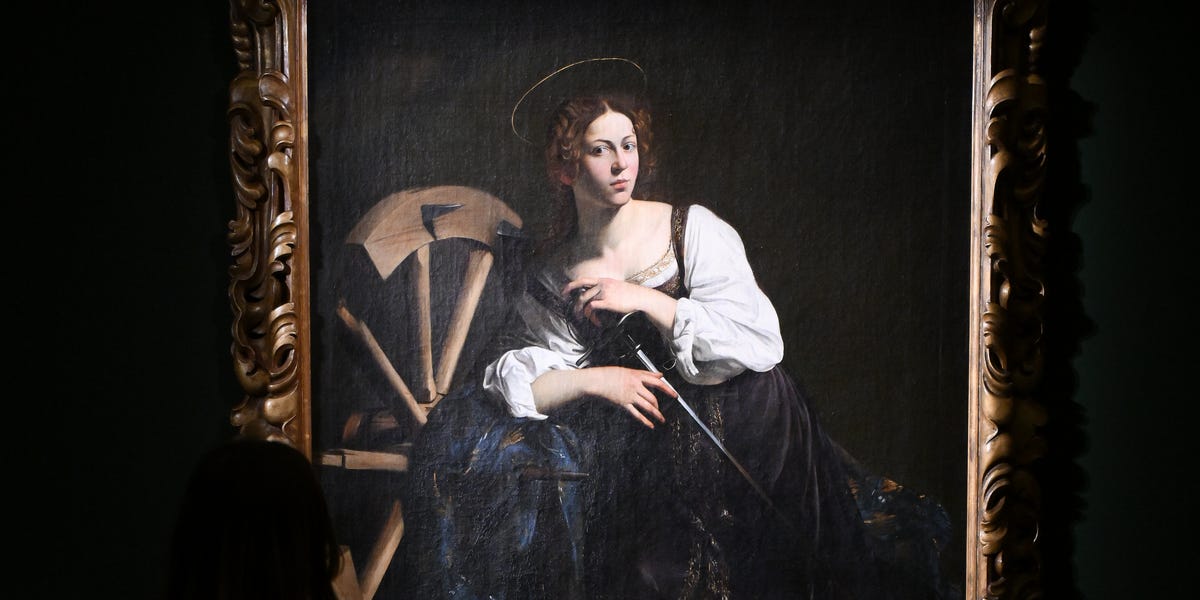
To understand why the seal matters, we need to meet the woman at its center: St. Catherine of Alexandria. According to Christian tradition, Catherine was a fourth-century virgin martyr from Alexandria, celebrated for her intelligence, faith, and refusal to renounce Christianity. Her legend says she debated pagan philosophers, resisted imperial pressure, survived attempted execution on a spiked wheel when the wheel broke, and was ultimately beheaded by sword.
That is why medieval artists usually identified her with three major symbols: the wheel, the sword, and often a book. The wheel points to the failed torture device. The sword refers to her beheading. The book represents learning and theological argument. If saints had business cards, hers would have read: “Scholar, Martyr, Wheel Specialist.”
In medieval Christian art, symbols were not optional decorations. They were a visual language. Many people could not read formal texts, but they could recognize a saint by attributes. A man with keys? St. Peter. A woman with a tower? St. Barbara. A crowned woman with a wheel and sword? St. Catherine, reporting for iconographic duty.
The Braniewo Connection
The seal is especially meaningful because St. Catherine was the patron saint of the church in Braniewo. The Gothic Church of St. Catherine in Braniewo has deep medieval roots. Construction began in the 14th century, and the site appears to have been associated with an earlier church foundation reaching back to the late 13th century. Braniewo itself was an important town in Warmia, a region shaped by church authority, Baltic trade, and the political pressures of medieval Central and Eastern Europe.
That local connection turns the artifact from a general religious image into something more specific. This was not just “a saint on a seal.” It was the saint of the local parish, placed on an object that likely helped the church validate documents and represent itself in public life. In a world before photocopiers, email signatures, and suspiciously cheerful office printers, a seal like this carried real legal and symbolic weight.
A Small Seal With a Big Job
Today, we tend to think of signatures as personal. In the Middle Ages, however, seals could speak for individuals, cities, guilds, monasteries, bishops, and parishes. A seal matrix created an impression in wax, and that impression told the viewer: this document comes from a recognized authority.
For a parish, a seal could confirm agreements, property matters, financial obligations, or correspondence. It helped a religious community operate in the practical world. Medieval churches were spiritual centers, but they were also landholders, employers, record keepers, patrons, and sometimes political players. The seal was where devotion met paperworka sacred image doing administrative labor.
That is one reason this find is so exciting. A parish seal is not as flashy as a royal crown or a sword pulled from a river, but it tells us how ordinary institutions functioned. It gives us the texture of daily medieval life: documents, authority, local pride, and the constant need to prove that a piece of parchment was not just some guy named Jan making things up.
The Battle of Grunwald and the Power of a Symbol
The Braniewo seal also points toward one of the most famous military events in Polish and Lithuanian history: the Battle of Grunwald in 1410. This major conflict brought Polish-Lithuanian forces against the Teutonic Knights, a powerful military religious order active in the Baltic region. The battle became a turning point in the decline of Teutonic military dominance and later took on enormous symbolic value in Polish historical memory.
Researchers have connected the image of St. Catherine with banners associated with the Braniewo region. The crowned saint motif appears in historical and artistic traditions connected to Grunwald, including later visual representations of the battle. The idea is not that the tiny seal fought bravely on horsebackalthough medieval objects often seem to have more personality than expectedbut that the same saintly emblem helped represent a local community in both religious and military contexts.
That overlap is important. In the medieval world, religious symbols did not stay politely inside churches. They appeared on banners, seals, manuscripts, altars, city arms, and battle standards. A saint could be a patron, protector, identity marker, and morale booster. St. Catherine’s image on the Braniewo seal shows how one figure could bind together church, town, parish, and regional memory.
How Did It End Up in a Farmer’s Field?
Here is where the story becomes delightfully frustrating. Archaeologists know the seal was found in a plowed field near Braniewo, but they cannot say with certainty how it got there. It may have been lost. It may have been hidden. It may have been discarded. It may have traveled through layers of soil after centuries of farming, conflict, rebuilding, and ordinary human chaos.
That uncertainty is not a failure of archaeology. It is part of archaeology. Context is everything. When an artifact is found in a clearly documented layer, near other datable objects, researchers can build a stronger story. When an object appears in disturbed soil, especially a plowed field, its journey becomes harder to reconstruct. The seal is still valuable, but its biography has a few missing chapters.
And honestly, that mystery gives the artifact a strange charm. Somewhere between the 14th century and the present day, this official parish object left the world of wax, documents, and church authority and entered the long, quiet life of soil. Then, centuries later, it reappeared as if history had dropped a brass business card and finally remembered where it left it.
Why the Discovery Matters
It Preserves Local Medieval Identity
The seal helps confirm how Braniewo’s religious community presented itself. St. Catherine was not a random decorative choice; she was the parish’s patron. Her image gave the community a recognizable face and a spiritual identity. For historians, that is valuable because local identity is often harder to reconstruct than royal politics.
It Shows the Practical Side of Medieval Religion
Medieval churches were places of worship, but they were also deeply involved in administration. A parish seal reminds us that religion in the Middle Ages was not only about stained glass, incense, and solemn chanting. It also involved paperwork, legal recognition, and institutional accountability. Even in the 14th century, someone had to keep the records straight.
It Connects Art, Faith, and Authority
The image on the seal is small, but it belongs to a much larger tradition of medieval iconography. St. Catherine’s wheel and sword were instantly recognizable visual cues. The seal shows how art functioned as communication, not merely decoration. In one small engraving, the parish could express faith, legitimacy, patronage, and memory.
It Makes the Middle Ages Feel Human
The best archaeological finds collapse distance. A 600-year-old seal makes the medieval past feel less like a textbook chapter and more like a lived world. Someone held this object. Someone pressed it into wax. Someone trusted it to speak for an institution. Someone, eventually, lost itor hid it so effectively that it overslept by six centuries.
Reading the Seal Like a Medieval Detective
Artifacts like this are interpreted through multiple clues. The material helps determine function and durability. The iconography identifies the saint. The Gothic inscription provides linguistic and institutional context. The shape and construction suggest how the matrix was used. The location links it to Braniewo and its church tradition.
None of these clues works alone. Archaeology is rarely one dramatic “aha!” moment. It is more often a careful stacking of evidence. A wheel plus a sword points to St. Catherine. A local church dedicated to St. Catherine strengthens the identification. The date and style align with medieval parish use. The regional history adds the Grunwald connection. Suddenly, the object is no longer just brass. It is a small archive.
St. Catherine in Medieval Art: More Than a Pretty Figure
St. Catherine was one of the most popular saints in medieval and Renaissance art. She appears in sculptures, altarpieces, manuscripts, reliquaries, and paintings across Europe. Artists often portrayed her as noble, calm, crowned, and richly dressed. That elegance was not accidental. Her legend described her as learned and high-born, and medieval viewers associated her with wisdom, courage, and steadfast faith.
The Braniewo seal belongs to that same visual universe, but in a more compact and functional form. Unlike a large altarpiece, it was not designed primarily for contemplation. It was made to work. Its image had to be clear enough to survive being pressed into wax. Its symbols had to be readable at a small scale. That makes the craftsmanship impressive. Miniature art is unforgiving; one sloppy wheel and suddenly your martyr looks like she is holding a medieval pizza.
What This Discovery Teaches Us About Medieval Communities
The seal teaches us that medieval communities invested meaning in objects used every day. A parish seal was a tool, but it was also a statement. It said: this church belongs to a particular sacred tradition; this community recognizes this patron; this document carries authority.
Modern people do something similar, though with less wax and fewer saints. We use logos, letterheads, watermarks, official stamps, digital certificates, and verified accounts. A medieval seal matrix was part of that same human need to establish trust. The technology changed. The basic problem did not. People still ask: Who sent this? Is it real? Can I trust it?
That is why the discovery feels surprisingly modern. Beneath the Gothic script and saintly imagery is a familiar concern: authenticity. The seal was a medieval answer to a very human question.
Experiences Related to the Discovery: How to Feel the Past in a Small Object
One of the most rewarding ways to experience a discovery like the Braniewo seal is to slow down and look at it as more than an object behind glass. Small artifacts are easy to rush past in museums. A visitor may spend ten minutes staring at a sword and three seconds glancing at a seal. That is understandable. Swords are basically history’s way of shouting. Seals speak more quietly.
But quiet objects often carry the most intimate stories. Imagine standing in front of a medieval seal matrix and thinking about the hand that used it. The person may have warmed wax, aligned the engraved face, pressed down carefully, and lifted it away to reveal St. Catherine’s image. That tiny action could validate a decision, protect a letter, or represent a parish’s authority. The gesture was practical, but it also had ceremony. Even routine paperwork can feel grand when there is molten wax involved.
For families, teachers, or history lovers, this discovery offers a wonderful entry point into medieval life. Instead of beginning with kings and battles, begin with a question: how did people prove something was official before modern signatures? From there, the conversation opens naturally into literacy, church power, local identity, art, and law. Children especially understand seals quickly because stamping is physical and visual. Give them clay, a safe stamp, or soft wax, and suddenly medieval administration becomes less boring than it has any right to be.
A visit to a historic church can deepen that experience. In a place like Braniewo, the church was not simply a building. It was a landmark, a spiritual center, an archive, and a symbol of community continuity. When you walk through an old church, notice the repeating images: saints, tools, animals, plants, crowns, books, weapons, wheels. Medieval art is full of identifiers. Once you learn the code, walls and sculptures start reading like illustrated biographies.
This find also encourages a different way of looking at ordinary landscapes. A field is never just a field. Under the soil may be traces of roads, lost objects, broken pottery, coins, tools, and fragments of institutions that no longer exist in the same form. That does not mean everyone should grab a metal detector and sprint into the countryside like an overexcited treasure goblin. Responsible archaeology requires permission, documentation, and cooperation with professionals. But it does mean everyday places deserve respect. The past is not always buried under famous monuments. Sometimes it waits under a plow line.
For writers and travelers, the Braniewo seal is a reminder that the best historical stories often begin small. A seal can lead to a saint. A saint can lead to a church. A church can lead to a town. A town can lead to a battle. A battle can lead to national memory. One brass object becomes a doorway into six centuries of belief, conflict, art, and identity.
That is the real experience this discovery offers: the pleasure of connection. The seal is beautiful because it survived. It is important because it belonged to a community. It is fascinating because it does not explain everything. Like many archaeological finds, it gives us answers and then politely hands us more questions. History, apparently, enjoys cliffhangers.
Conclusion
The discovery of a 600-year-old depiction of St. Catherine of Alexandria near Braniewo is more than a charming medieval surprise from a farmer’s field. It is a rare glimpse into how a parish represented itself, how saints functioned as public symbols, and how small objects carried serious authority in the Middle Ages.
The brass seal connects religious devotion, local identity, official documentation, and the wider memory of medieval conflict. Its image of St. Catherinewith sword, wheel, and crowncompresses centuries of art and belief into a surface small enough to hold. That is the magic of archaeology: it turns a pocket-sized object into a time machine, minus the confusing instruction manual.
In the end, this seal matters because it restores a human detail to medieval history. Someone made it. Someone used it. Someone lost it. Centuries later, someone found it. And now, St. Catherine has stepped out of the soil once again, carrying her wheel, her sword, and one very durable reminder that the past is never as far away as it looks.