

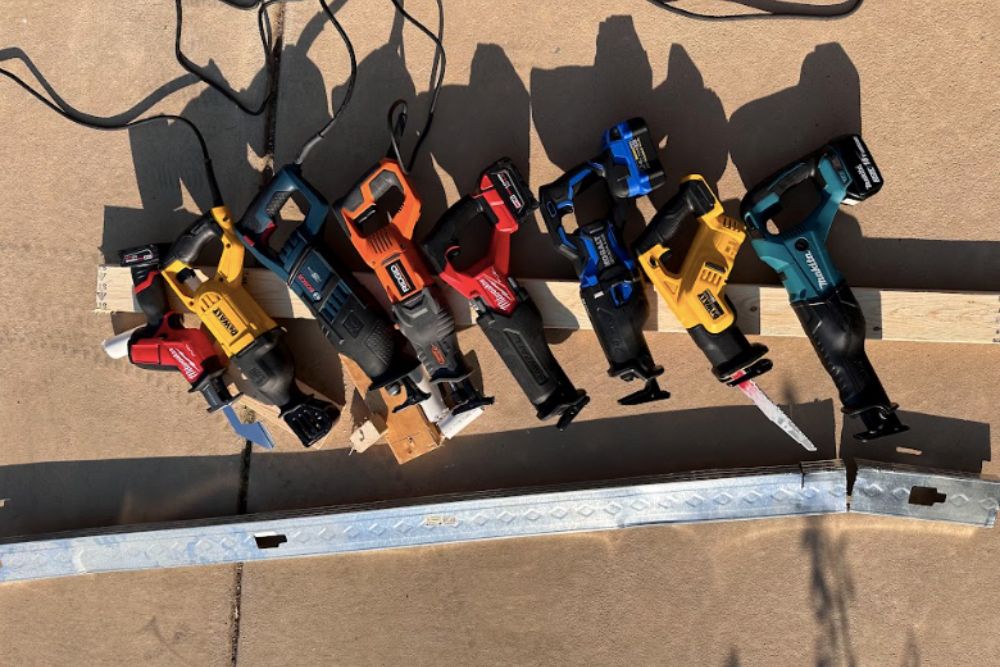
A reciprocating saw is the workshop tool you reach for when the job looks too rude for a circular saw, too awkward for a jigsaw, and too stubborn for polite conversation. It is not the tool for making heirloom furniture joints so perfect they make carpenters whisper. It is the tool for cutting lumber with nails in it, trimming pipe, removing old framing, slicing through PVC, breaking down pallets, and generally convincing materials to stop being where they are.
The best reciprocating saw for a workshop depends on how you work. A remodeler may want raw cordless power. A weekend DIYer may want value and battery compatibility. A serious shop owner may prefer a corded saw that never asks for a charger. The big things to compare are stroke length, strokes per minute, vibration control, orbital action, blade change design, weight, and whether the saw belongs to a battery platform you already own.
After reviewing real-world testing, manufacturer specifications, and practical workshop needs, here are seven standout reciprocating saws worth considering. No saw here is magic, although a few cut fast enough to make old lumber reconsider its life choices.
Quick Comparison: Best Workshop Reciprocating Saws
| Rank | Model | Best For | Power Type | Key Strength |
|---|---|---|---|---|
| 1 | Makita 40V max XGT GRJ02 | Best overall cordless | 40V cordless | Power, control, vibration reduction |
| 2 | Milwaukee M18 FUEL Super Sawzall 2722-20 | Heavy-duty demolition | 18V cordless | Fast cutting and orbital action |
| 3 | Metabo HPT 36V MultiVolt CR36DA | Hybrid flexibility | 36V cordless / AC adapter capable | Low vibration and dual power option |
| 4 | DeWalt FLEXVOLT 60V MAX DCS389 | DeWalt users and demanding cuts | 60V cordless | Strong cordless performance |
| 5 | Bosch RS428 | Best corded pick | 14-amp corded | Vibration control and steady power |
| 6 | Ridgid R8647B 18V Brushless | Best value brushless saw | 18V cordless | Orbital action and solid pricing |
| 7 | Ryobi ONE+ HP Brushless PBLRS02B | Budget-friendly workshop use | 18V cordless | Great DIY value and battery ecosystem |
What Makes a Great Reciprocating Saw?
A good reciprocating saw should feel powerful without feeling like a caffeinated badger is trapped inside the handle. Cutting speed matters, but control matters just as much. A longer stroke length, usually around 1-1/8 to 1-1/4 inches for full-size models, removes more material per stroke. Higher strokes per minute can help with fast cuts, but variable speed is what lets you start a cut without bouncing the blade across your workpiece like a tiny metal pogo stick.
Orbital action is another useful feature. Instead of moving the blade only forward and backward, orbital mode adds a slight elliptical motion. That can speed up rough wood cutting, especially in demolition work. For metal, though, straight cutting is usually smoother and easier to control. A saw with selectable orbital action gives you more flexibility.
Vibration control is the feature you appreciate after the first ten minutes. Less vibration means better control, less fatigue, and fewer moments where your hands feel like they just argued with a lawn mower. A tool-free blade clamp is also essential. If changing blades requires hunting for a hex key, the saw may be technically functional, but your patience will not be.
1. Makita 40V max XGT GRJ02 Best Overall Cordless Reciprocating Saw
The Makita 40V max XGT GRJ02 is the kind of reciprocating saw that makes a workshop feel ready for serious demolition, rough cutting, and heavy remodeling tasks. It is not the cheapest tool on the wall, but it brings the kind of refined performance that experienced users notice quickly: strong cutting power, smooth control, selectable orbital action, and vibration management that helps during long sessions.
Why It Stands Out
Makita’s XGT platform is built for higher-demand cordless tools, and the GRJ02 feels like a saw designed for users who expect corded-style muscle without dragging an extension cord around the shop. Its 1-1/4-inch stroke length and up to 3,000 strokes per minute put it squarely in serious full-size territory. That means faster material removal in wood, framing, PVC, and general demolition materials.
The big advantage is balance. Some high-powered reciprocating saws feel like they are trying to leave your hands and start a demolition company of their own. The Makita is powerful but controlled. The anti-vibration design helps make it a better choice for users who cut for longer stretches, especially when breaking down old lumber or trimming structural pieces.
Best Use Case
Choose the Makita GRJ02 if you want a premium cordless reciprocating saw for serious workshop and remodeling work. It is especially attractive if you already own Makita XGT batteries. The downside is price. This is not the “I need to cut one rusty bolt every August” saw. This is the “I have projects, plural” saw.
2. Milwaukee M18 FUEL Super Sawzall 2722-20 Best Heavy-Duty Workshop Beast
Milwaukee is so closely associated with reciprocating saws that many people call the entire tool category “Sawzalls,” the way some people call every tissue a Kleenex. The M18 FUEL Super Sawzall 2722-20 keeps that reputation alive with aggressive cutting performance, a 1-1/4-inch stroke length, selectable orbital action, a variable speed trigger, and a five-speed dial.
Why It Stands Out
This saw is built for users who want speed and power. The selectable orbital action is a real advantage in wood demolition, where fast rough cuts matter more than surgical precision. The adjustable shoe helps extend blade life by letting you shift the contact point and use fresh teeth. The tool-free blade clamp, LED light, and rafter hook are practical details that make the saw easier to live with in a busy shop.
The Super Sawzall is not petite. It is a full-size, heavy-duty tool, and it feels like one. That weight can help the saw stay planted during aggressive cuts, but it can also tire you out overhead or in awkward positions. If your workshop projects include heavy pallet breakdown, remodel tear-outs, pipe removal, or frequent nail-embedded lumber cuts, the extra muscle is welcome.
Best Use Case
Pick the Milwaukee M18 FUEL Super Sawzall if you already own M18 batteries or want one of the most capable cordless demolition saws available. It is overkill for light pruning or occasional small cuts, but wonderful overkill is still wonderful.
3. Metabo HPT 36V MultiVolt CR36DA Best Hybrid Cordless/Corded Flexibility
The Metabo HPT 36V MultiVolt CR36DA solves a classic workshop problem: cordless tools are convenient, but batteries eventually tap out. This saw can run on a 36V MultiVolt battery or, with the optional AC adapter, plug into an outlet. That makes it one of the most flexible reciprocating saws for a shop where projects can shift from quick cuts to all-afternoon demolition.
Why It Stands Out
The CR36DA offers a 1-1/4-inch stroke length, up to 3,000 strokes per minute, a four-stage speed selector, orbital action, tool-free blade changes, tool-free shoe adjustment, and low-vibration technology. That is an impressive feature list. It also includes a rafter hook and LED light, two small details that become surprisingly important when you are working around benches, joists, or shadowy corners.
The most interesting part is the MultiVolt concept. In cordless mode, it behaves like a modern high-power saw. With the AC adapter, it can keep working without waiting for a battery to recharge. For a workshop, that is a real advantage. You can cut outside or around the property on battery power, then plug in when you are back at the bench.
Best Use Case
Choose the Metabo HPT CR36DA if you want one reciprocating saw that can play both cordless and corded roles. It is a smart pick for remodelers, serious DIYers, and shop owners who hate choosing between mobility and runtime.
4. DeWalt FLEXVOLT 60V MAX DCS389 Best for DeWalt Battery Users
The DeWalt FLEXVOLT 60V MAX DCS389 is a powerful cordless reciprocating saw aimed at users who want strong cutting performance inside the DeWalt ecosystem. If your workshop already has DeWalt batteries, chargers, drills, grinders, and saws lined up like yellow-and-black soldiers, this model makes a lot of sense.
Why It Stands Out
The DCS389 offers up to 3,000 strokes per minute and a 1-1/8-inch stroke length. It is designed for demanding cutting and demolition tasks, giving users cordless freedom while still feeling like a serious full-size tool. It works well for rough lumber cuts, pipe, PVC, and general workshop breakdown jobs.
The main appeal is power plus platform convenience. Battery ecosystems matter. A great bare tool becomes less attractive if you also need to buy batteries and a charger from scratch. But if you already own FLEXVOLT packs, this saw can be a cost-effective upgrade. It is also a good fit for users who move between workshop projects and outdoor repairs.
Best Use Case
Buy the DeWalt DCS389 if you are already invested in DeWalt FLEXVOLT or want a strong cordless saw for heavy workshop tasks. It is not the lightest option, and some competing saws offer more refined vibration control, but it delivers the kind of power DeWalt users expect.
5. Bosch RS428 Best Corded Reciprocating Saw for the Workshop
Battery tools get most of the attention these days, but a good corded reciprocating saw still deserves a place in the workshop. The Bosch RS428 is a 14-amp corded model with vibration control, a compact 18.4-inch body, and a strong reputation for steady cutting. It is the saw for people who hear “battery runtime” and respond, “What if we simply did not have that problem?”
Why It Stands Out
The Bosch RS428 is built around controlled power. Its 14-amp motor gives it the continuous energy advantage of a corded tool, while Bosch’s vibration-control design helps reduce fatigue. That matters in a workshop where the outlet is nearby and you may be cutting for long sessions.
Corded saws are not as convenient outside or on ladders, but inside a shop they make a lot of sense. You do not need to manage battery charge cycles, and you do not need to worry about performance dropping as a battery drains. The RS428 is particularly appealing for users who cut metal, lumber, and demolition materials at a bench or in a fixed work area.
Best Use Case
Choose the Bosch RS428 if your workshop has reliable outlet access and you want dependable, low-vibration cutting without battery management. It is also a smart second saw for users who already own cordless tools but want a plug-in workhorse for long sessions.
6. Ridgid R8647B 18V Brushless Best Value Brushless Reciprocating Saw
The Ridgid R8647B 18V Brushless reciprocating saw is a strong value pick because it includes features often associated with more expensive tools. It has a brushless motor, orbital action for faster wood cutting, and a side-lever tool-free blade release. In plain English: it cuts well, changes blades easily, and does not demand luxury-tool money.
Why It Stands Out
Ridgid positions this model as faster than its previous generation, and the addition of orbital action makes it more useful for demolition-style wood cuts. That is important in a workshop because many reciprocating saw jobs involve rough lumber, framing scraps, or material that is too ugly for fine woodworking tools.
The side-lever blade release is a practical feature. Blade changes are frequent with reciprocating saws because different materials need different blades. Wood with nails, clean wood, metal pipe, pruning, and PVC all perform better with the right blade. A convenient blade release encourages you to use the correct blade instead of pretending one tired blade can do everything. Spoiler: it cannot.
Best Use Case
Pick the Ridgid R8647B if you want brushless performance and useful features without jumping into the highest price tier. It is a strong choice for DIY remodelers, garage workshops, and users already in Ridgid’s 18V system.
7. Ryobi ONE+ HP Brushless PBLRS02B Best Budget-Friendly Workshop Pick
The Ryobi ONE+ HP Brushless PBLRS02B is proof that a workshop reciprocating saw does not have to cost as much as a weekend getaway. It is part of Ryobi’s massive ONE+ battery platform, which is one of its biggest advantages. If you already own Ryobi batteries, this saw becomes especially attractive.
Why It Stands Out
This model offers up to 3,200 strokes per minute and a 1-1/4-inch stroke length, which are serious numbers for a DIY-focused cordless saw. It also has an easy-release blade lever and a brushless design for better efficiency than older brushed models.
Ryobi tools are often best for homeowners, hobbyists, and budget-conscious DIYers rather than full-time demolition crews. That is not an insult. Not every workshop needs a monster saw that can chew through a condemned deck before breakfast. Sometimes you need a reliable tool for trimming lumber, cutting PVC, breaking down scrap, and handling occasional remodel jobs.
Best Use Case
Choose the Ryobi PBLRS02B if you want strong value, broad battery compatibility, and enough cutting ability for most home workshop projects. If you run a professional crew every day, move up the list. If you build, repair, and tinker on weekends, this saw may be the sensible hero.
How to Choose the Right Reciprocating Saw for Your Workshop
Match the Saw to the Work
For demolition-heavy work, choose power, orbital action, a long stroke length, and good vibration control. The Makita GRJ02, Milwaukee Super Sawzall, Metabo HPT CR36DA, and DeWalt DCS389 are strong fits. For steady bench work, the Bosch RS428 is hard to ignore because corded power is still wonderfully uncomplicated.
Think About Batteries Before the Tool
Battery platforms can make or break the value equation. A bare tool looks inexpensive until you add two high-capacity batteries and a charger. If you already use Milwaukee M18, DeWalt FLEXVOLT, Makita XGT, Ryobi ONE+, Ridgid 18V, or Metabo HPT MultiVolt, staying in that system may save money and simplify your shop.
Do Not Ignore Weight
More powerful saws are often heavier. That weight can stabilize a cut, but it can also wear you out. If most of your work happens at waist height on a bench, weight is less of a problem. If you cut overhead, inside cabinets, or in tight framing spaces, a lighter or more compact saw may be easier to control.
Buy Better Blades
A reciprocating saw is only as good as the blade you put in it. A premium saw with the wrong blade will cut like it is thinking about lunch. Keep separate blades for wood, nail-embedded wood, metal, PVC, and pruning. Carbide blades cost more but can be worth it for nasty demolition materials.
Keep Safety in the Conversation
Reciprocating saws are rough-cutting tools, not toys. Use eye protection, hearing protection, and work gloves when appropriate. Secure the material, keep both hands clear of the blade path, and let the tool stop fully before setting it down. Younger or inexperienced users should learn with direct adult supervision and start with simple, low-risk materials. The best workshop habit is keeping all your fingers invited to tomorrow’s projects.
Real Workshop Experience: What You Learn After Using Reciprocating Saws for a While
The first lesson is that reciprocating saws are not elegant, and that is exactly why they are useful. In a workshop, there are plenty of jobs that do not deserve a perfect cut. Old shelving needs to be broken down. A bent bolt needs to disappear. A section of pipe needs trimming. A pallet needs reducing to pieces small enough to fit in the trash. A reciprocating saw handles those jobs with a charming lack of drama.
The second lesson is that vibration matters more than you think. When you test a saw for one quick cut, nearly every full-size model feels acceptable. After twenty minutes of cutting old studs, pipe, and mystery lumber from the back corner of the garage, the difference becomes obvious. A smoother saw lets you stay accurate longer. It also makes the job less annoying, which is not a technical spec but absolutely should be.
The third lesson is that blade choice is the secret sauce. Many people blame the saw when the real problem is a dull, wrong, or bargain-bin blade. A wood blade is not ideal for metal. A fine-tooth metal blade is painfully slow in lumber. A demolition blade handles nail-embedded wood better than a clean wood blade. Once you keep a small blade organizer in the shop, the saw suddenly feels twice as smart. Funny how tools improve when we stop asking one blade to have seven careers.
The fourth lesson is that cordless convenience is addictive. For quick cuts, cordless saws are wonderful. You grab the tool, pop in a blade, make the cut, and move on. No cord. No outlet search. No extension cord doing its best impression of a trip hazard. But corded saws still make sense for long sessions. If you are cutting for an hour near a bench, a corded Bosch or a hybrid Metabo HPT setup can feel refreshingly simple.
The fifth lesson is that compact saws are not replacements for full-size saws. A one-handed reciprocating saw is fantastic in tight spaces, but it will not feel as confident in thick lumber or heavy demolition. Full-size saws cut faster and usually offer better control in tough material. Compact saws win when access is limited. In a serious workshop, having both is not ridiculous. It is how tool collections happen. First you buy one saw. Then suddenly your garage has “stations.”
The sixth lesson is that an adjustable shoe is underrated. It helps control the cut, reduces bouncing, and lets you use different sections of the blade teeth. This can stretch blade life, especially when cutting thinner material. A rafter hook is also more useful than expected. Being able to hang the saw safely between cuts keeps it off the floor and away from the edge of the bench, where gravity likes to run experiments.
The final lesson is that the best reciprocating saw is the one that matches your actual work, not your fantasy construction-site alter ego. If you remodel often, buy power and vibration control. If you mainly handle weekend projects, buy value and a battery platform you will use. If your work happens at a bench, do not overlook corded. A great workshop saw should feel ready, controllable, and easy to reach when a project says, “This part needs to come off.”
Final Verdict
For the best overall workshop reciprocating saw, the Makita 40V max XGT GRJ02 earns the top recommendation because it combines power, control, and premium cordless performance. The Milwaukee M18 FUEL Super Sawzall is the heavy-duty bruiser for aggressive demolition, while the Metabo HPT 36V MultiVolt CR36DA is the most flexible thanks to its cordless-or-corded capability. DeWalt users should look closely at the FLEXVOLT DCS389, and anyone wanting a dependable plug-in saw should consider the Bosch RS428.
For value, the Ridgid R8647B and Ryobi ONE+ HP Brushless PBLRS02B are easy to recommend. They bring useful features to more approachable price points, especially for home workshops and DIY users. Whichever saw you choose, invest in good blades, respect the tool, and remember: a reciprocating saw is not subtle, but sometimes subtle is exactly what the job does not need.