

Movies have given space travel excellent publicity and extremely questionable physics. On-screen spacecraft bank like fighter jets, crews stroll around spotless cabins, and every destination appears to be one dramatic engine burn away. Even the dangerous parts look suspiciously elegant. A pilot pushes a glowing button, the ship shakes for seven seconds, and everyone arrives with perfect hair.
Real spaceflight is more interesting, less comfortable, and considerably stranger. Astronauts do not float because gravity switches off. Spacecraft rarely aim directly at their destinations. The silence of the vacuum does not make the inside of a spacecraft peaceful. And returning to Earth is not a simple matter of letting gravity take over.
Here are four common space travel misconceptions that deserve to be ejected through the nearest scientifically accurate airlock.
1. You’re Picturing Weightlessness as the Absence of Gravity
The spacecraft is still falling
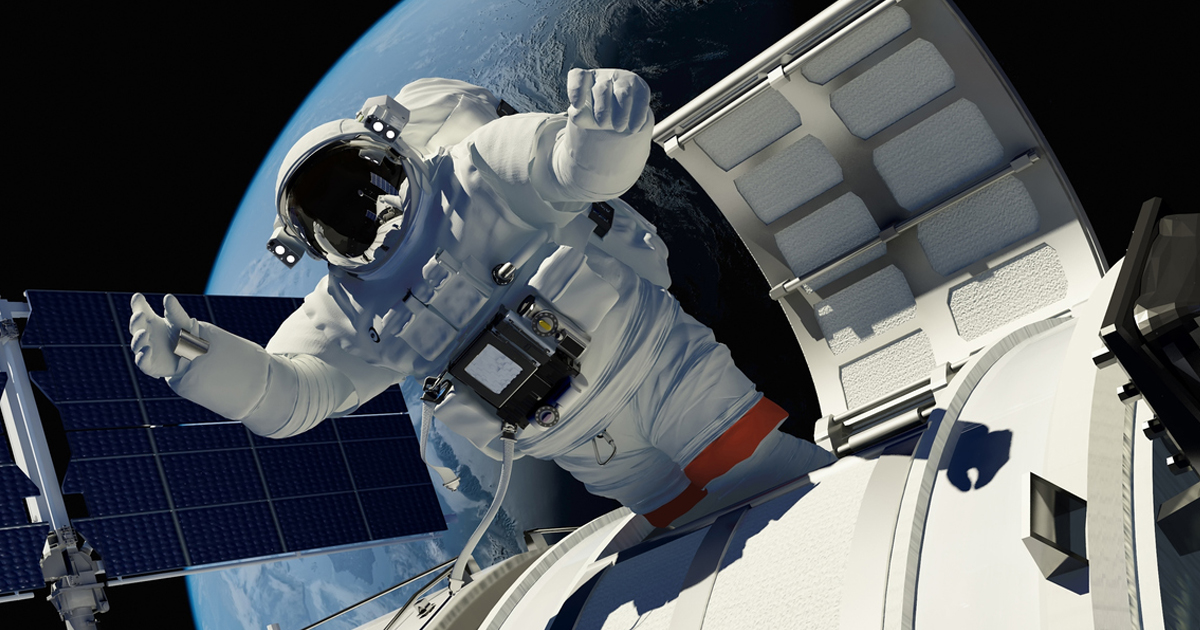
The classic image of space travel is an astronaut drifting through a cabin after leaving Earth’s gravity behind. The problem is that astronauts in low Earth orbit have not escaped gravity. Earth’s gravitational pull remains strong hundreds of miles above the surface.
What creates apparent weightlessness is continuous free fall. The spacecraft, the astronauts, their tools, and the peanut butter that escaped from someone’s lunch are all falling toward Earth together. However, they are also moving sideways so quickly that Earth’s curved surface keeps dropping away beneath them.
The International Space Station travels at roughly 17,500 miles per hour. At that speed, it continually falls around Earth rather than directly into it. Everyone and everything inside shares the same motion, so no floor pushes upward against an astronaut’s body. That missing support force is what feels like weightlessness.
Floating is not automatically graceful
Movies make microgravity look like underwater ballet. For newly arrived astronauts, it can be closer to attempting gymnastics after someone has quietly rearranged the controls in the inner ear.
Your brain normally combines signals from your eyes, muscles, joints, and vestibular system to determine which way is up. In microgravity, the familiar gravitational reference disappears. Some astronauts develop headaches, nausea, disorientation, reduced appetite, or space motion sickness during their first few days.
Ordinary movements must also be relearned. Push away from a wall too forcefully and you do not stop until another surface, handrail, or surprised crewmate interrupts the journey. Tools must be tethered. Food crumbs can drift into equipment. An object placed “down” does not remain there because down has resigned from the job.
The body pays for the floating
Weightlessness may look relaxing, but the human body interprets it as permission to reduce several expensive systems. Muscles no longer work constantly against gravity. Weight-bearing bones receive less mechanical stress. Fluids shift toward the upper body and head, contributing to puffy faces, pressure changes, and possible vision problems.
To limit these effects, astronauts aboard the space station follow carefully designed exercise programs using resistance equipment, a treadmill, and a stationary bicycle. NASA schedules roughly two to two and a half hours for exercise on many station days. In other words, the reward for reaching space is a gym membership you absolutely cannot cancel.
NASA explains that orbital weightlessness results from continuous free fall, while its human-research programs document changes involving balance, muscles, bones, fluids, cardiovascular function, and vision.
2. You’re Picturing a Spacecraft Flying Straight to Its Destination
Space travel is less like driving and more like intercepting
In science fiction, a spacecraft points its nose toward Mars, activates the engines, and crosses the solar system like a car heading toward a distant city. Real interplanetary travel is not based on where Mars is when the spacecraft launches. It is based on where Mars will be months later.
Earth, Mars, and the spacecraft are already moving around the Sun. To reach another planet efficiently, mission planners select a trajectory that changes the spacecraft’s existing solar orbit. For a typical low-energy trip to Mars, the vehicle enters an elliptical transfer orbit that intersects Mars’s orbit at a carefully calculated point.
The spacecraft is therefore not aiming directly at the planet. It is aiming at an appointment.
Imagine throwing a ball to a runner. You do not throw it at the runner’s current location unless your goal is to make the runner stop and glare at you. You lead the target. Interplanetary navigation follows the same basic idea, except the runner is a planet moving tens of thousands of miles per hour and the ball costs several billion dollars.
Launch windows control the schedule
Efficient opportunities to travel from Earth to Mars occur only when the planets have a useful alignment. Minimum-energy launch windows repeat approximately every 26 months. Missing one is not like missing a bus and waiting 20 minutes for the next. It can mean redesigning the mission, accepting a more demanding trajectory, or postponing departure for more than two years.
This is why space mission schedules are tied to orbital mechanics rather than convenience. Planets do not adjust their calendars because a heat shield arrived late from the factory.
Most of the trip may involve coasting
Another movie-inspired misconception is that rocket engines must run continuously. Conventional chemical rockets consume propellant at astonishing rates, so many missions use relatively brief burns to change velocity and then coast for long periods.
A burn near Earth can place the spacecraft on its transfer trajectory. Small correction maneuvers refine the path during the cruise. On arrival, another major maneuver may be necessary to slow the vehicle relative to the destination. Without that deceleration, the spacecraft could fly past the planet instead of entering orbit.
Even changing direction is unintuitive. Spacecraft do not carve turns through a roadless void. A carefully timed change in speed reshapes the orbit, and the new orbit carries the vehicle somewhere different. Orbital navigation is a long conversation between velocity, gravity, timing, and fuel, all of which are extremely unwilling to accept improvisation.
NASA, the Jet Propulsion Laboratory, and MIT describe interplanetary travel as a timed transfer between moving orbits, with Hohmann-style trajectories, launch windows, coasting phases, and arrival burns.
3. You’re Picturing Spaceflight as Silent, Smooth, and Luxurious
The vacuum is silent; the spacecraft is not
One part of the popular image is correct: sound cannot travel normally through the near-vacuum outside a spacecraft because there is no substantial medium carrying pressure waves. An external explosion would not produce the thunderous boom heard in a movie theater.
Inside a pressurized spacecraft, however, there is airand plenty of machinery eager to vibrate it.
Fans circulate air so carbon dioxide does not collect around an astronaut’s face. Pumps move coolant and water. Computers, avionics, exercise equipment, ventilation ducts, and life-support hardware add their own hums, clicks, rattles, and whines. NASA maintains acoustic requirements and monitors crew exposure because persistent noise can interfere with communication, concentration, sleep, and hearing.
The spacecraft’s interior is not a silent observatory. It is closer to living inside a compact mechanical room that happens to have a magnificent view.
Launch is not a gentle elevator ride
Before astronauts reach orbit, they must sit on top of a controlled explosion powerful enough to accelerate a spacecraft through the atmosphere. Launch vehicles generate intense acoustic loads, structural vibration, and sustained acceleration. Spacecraft and their components undergo extensive testing to prove they can survive that environment.
The crew experiences increasing pressure against the seats as the rocket accelerates. Vibrations pass through the vehicle. Engines throttle, stages separate, and aerodynamic forces change as the rocket climbs. Although modern launch systems are engineered around crew safety, “smooth” remains a relative term.
The cabin is practical, not glamorous
Spacecraft interiors are designed around mass, volume, safety, maintenance, and mission requirementsnot around whether the upholstery complements the view of Earth. Equipment covers walls and ceilings. Cables, storage bags, laptops, experiment racks, emergency supplies, handrails, and labels occupy nearly every available surface.
Personal hygiene requires adaptation. Water does not pour downward into a drain. Toilets use airflow to guide waste. Loose droplets must be controlled. Clothing is worn longer than many travelers would prefer because laundry machines are heavy, power-hungry, and water-hungry.
Water itself is too valuable to treat casually. Life-support systems aboard the space station recover moisture from cabin air and process wastewater, including urine, for reuse. The cleaned water meets strict standards, but the psychological adjustment can take longer than the engineering explanation.
Food is carefully packaged to avoid crumbs and spoilage. Sleeping requires astronauts to secure themselves so they do not drift around the cabin. Daily exercise is mandatory. Maintenance can consume hours. Communication delays become significant beyond the Moon, and radiation exposure becomes a greater concern outside Earth’s protective magnetic environment.
Space travel is extraordinary, but it is not a floating luxury cruise. It is an expedition conducted inside a life-support machine that never gets to take the afternoon off.
NASA identifies ventilation fans, pumps, airflow, and thermal systems as important cabin-noise sources; it also documents launch vibration, space adaptation sickness, daily exercise, and extensive water recovery aboard the space station. The National Academies identifies ionizing radiation as a major concern for longer missions beyond low Earth orbit.
4. You’re Picturing the Return to Earth as the Easy Part
Gravity does not solve the speed problem
Once a mission is finished, it may seem that the crew can point the spacecraft toward Earth and let gravity handle the rest. Unfortunately, a vehicle in orbit is not merely high above the planet. It is also moving sideways at enormous speed.
To return from low Earth orbit, a spacecraft generally performs a retrograde burn, firing its engines opposite its direction of travel. The burn does not stop the spacecraft. It reduces its velocity just enough to reshape the orbit so that the new path intersects the atmosphere.
From there, the atmosphere performs much of the brakingbut it sends an alarming invoice.
Reentry converts motion into heat
As a spacecraft enters the atmosphere at hypersonic speed, air cannot move out of the way gently. Gas compresses in front of the vehicle, producing an intensely hot shock layer. The surrounding flow can become ionized plasma, while the spacecraft rapidly loses kinetic energy.
This is why crew capsules use heat shields. Many shields are ablative, meaning their outer material chars, melts, or vaporizes in a controlled way. The departing material carries heat away and protects the pressure vessel and occupants. Reusable vehicles may use specialized tiles, blankets, or other thermal-protection materials.
The fiery appearance is therefore not decorative. Reentry is the deliberate destruction or heating of protective material so the rest of the spacecraft does not join it.
The angle must be carefully controlled
A reentry trajectory must pass through a narrow range of acceptable conditions. Enter too steeply and the vehicle may experience dangerously high heating and deceleration. Enter too shallowly and it may skip back toward space, miss the intended landing area, or remain exposed to heating for too long.
After surviving the hottest phase, the spacecraft still has to slow for landing. Capsules may deploy several parachutes in sequence before splashing into the ocean or touching down on land. Other vehicles can use aerodynamic lift, engines, or combinations of systems.
Then recovery teams must locate the spacecraft, secure it, assist the crew, and transport astronauts for medical evaluation. After months in microgravity, simply standing can be difficult because the cardiovascular and balance systems must readapt to gravity.
So no, coming home is not the easy part. It is one of the most carefully engineered portions of the entire mission. Space may be difficult to reach, but Earth insists that visitors complete a very aggressive checkout procedure before returning.
NASA’s entry-system research describes hypersonic deceleration, compressed-gas heating, plasma flow, strict trajectory control, and thermal-protection systems designed to survive temperatures reaching thousands of degrees.
What Space Travel Might Actually Feel Like: A Grounded Experience
Imagine that your mission day has finally arrived. You are not strolling onto a spacecraft with a carry-on bag and a coffee. Technicians help you into a pressure suit, inspect connections, and secure you into a custom seat. You may remain there for hours while teams verify thousands of details. The rocket has not moved, yet the experience is already less like commercial aviation and more like being carefully packaged for shipment.
At ignition, the vehicle does not politely announce its departure. Noise and vibration travel through the structure. Your body feels heavier as acceleration builds. The seat supports you while the rocket burns propellant at a rate that would make a gas station faint. You can hear communications, machinery, and the sounds transmitted through the cabin, but the experience is highly controlled rather than cinematic chaos.
Several minutes later, the engines shut down. The pressure against your body disappears. Objects that seemed perfectly ordinary a moment earlier begin drifting. A checklist floats until someone catches it. Your arms rise naturally because they are no longer hanging under their own weight. Your sense of direction becomes negotiable.
The first attempt to move across the cabin may be embarrassing. On Earth, walking relies on friction with the floor. In microgravity, you pull along handrails or push gently from surfaces. Too much force sends you across the module, where you discover that Newton’s laws are excellent teachers and terrible cushions.
Your face may feel congested as fluids shift upward. Food might seem different. Your stomach may object to the disagreement between your eyes and inner ear. Meanwhile, the spacecraft hums constantly. Fans are not optional because, without normal convection, exhaled carbon dioxide may linger near your face. The background noise becomes part of the environment, like traffic in a city apartmentexcept the traffic is keeping you alive.
Daily life settles into a disciplined rhythm. You inspect equipment, conduct experiments, communicate with mission control, exercise, eat packaged meals, clean surfaces, manage waste, and document everything. A small missing object can become a search operation because it may be floating behind a panel. A water droplet is not a spill on the floor; it is a wandering sphere that could enter electronics.
During a longer interplanetary cruise, the excitement of launch gives way to repetition. The engines are not roaring continuously. Most of the time, the spacecraft follows the orbit established by earlier burns. Outside, there is no sensation of speed. Without nearby objects rushing past, thousands of miles per hour can look exactly like standing still.
The destination gradually grows from a bright point into a world. Mission planners prepare for arrival long before it becomes visually dramatic. Navigation teams track the trajectory, calculate correction burns, and verify that the spacecraft will meet the planet at the correct place and time. Arrival is not simply reaching the destination; it is matching the conditions needed to orbit or land.
Eventually, the return begins. Before atmospheric entry, loose items are secured and the crew straps into their seats. The spacecraft encounters increasingly dense air. Deceleration presses you back into the seat. Plasma surrounds the vehicle, and communications may be affected. The heat shield performs its one unforgiving assignment while the cabin remains protected behind it.
Parachutes deploy with powerful jolts. The ground or ocean rises into view. Touchdown is not necessarily gentle, but it is wonderfully final. Recovery personnel open the spacecraft, and fresh air enters. Gravity returns as a full-body surprise. Your head feels heavy. Standing may require assistance. Even the motionless ground can feel peculiar after months of floating.
Then comes perhaps the strangest moment of all: realizing that the experience was simultaneously more uncomfortable and more magnificent than the version you imagined. Space travel is not magical because it ignores physics. It is magical because human beings learned enough physics to go anyway.
This experiential reconstruction is based on documented spacecraft conditions, astronaut health research, launch environments, orbital operations, and post-flight recovery rather than on a claim of firsthand travel.
Conclusion: Reality Is Better Than the Movie Version
The most persistent space travel myths usually make the journey look simpler. Gravity disappears, spacecraft aim directly at planets, cabins become peaceful floating hotels, and returning home is a fiery but automatic finale.
Reality replaces that simplicity with continuous free fall, orbital transfers, launch windows, noisy life-support systems, physical deconditioning, radiation management, hypersonic heating, and extraordinarily precise engineering. That may sound less glamorous, but it makes every successful mission more impressive.
Astronauts do not conquer space by escaping the laws of nature. They travel by understanding those laws so thoroughly that falling becomes orbit, timing becomes navigation, air becomes a brake, and controlled destruction becomes a heat shield.
Hollywood may keep the booming explosions and spotless cabins. The real universe already has the better story.