

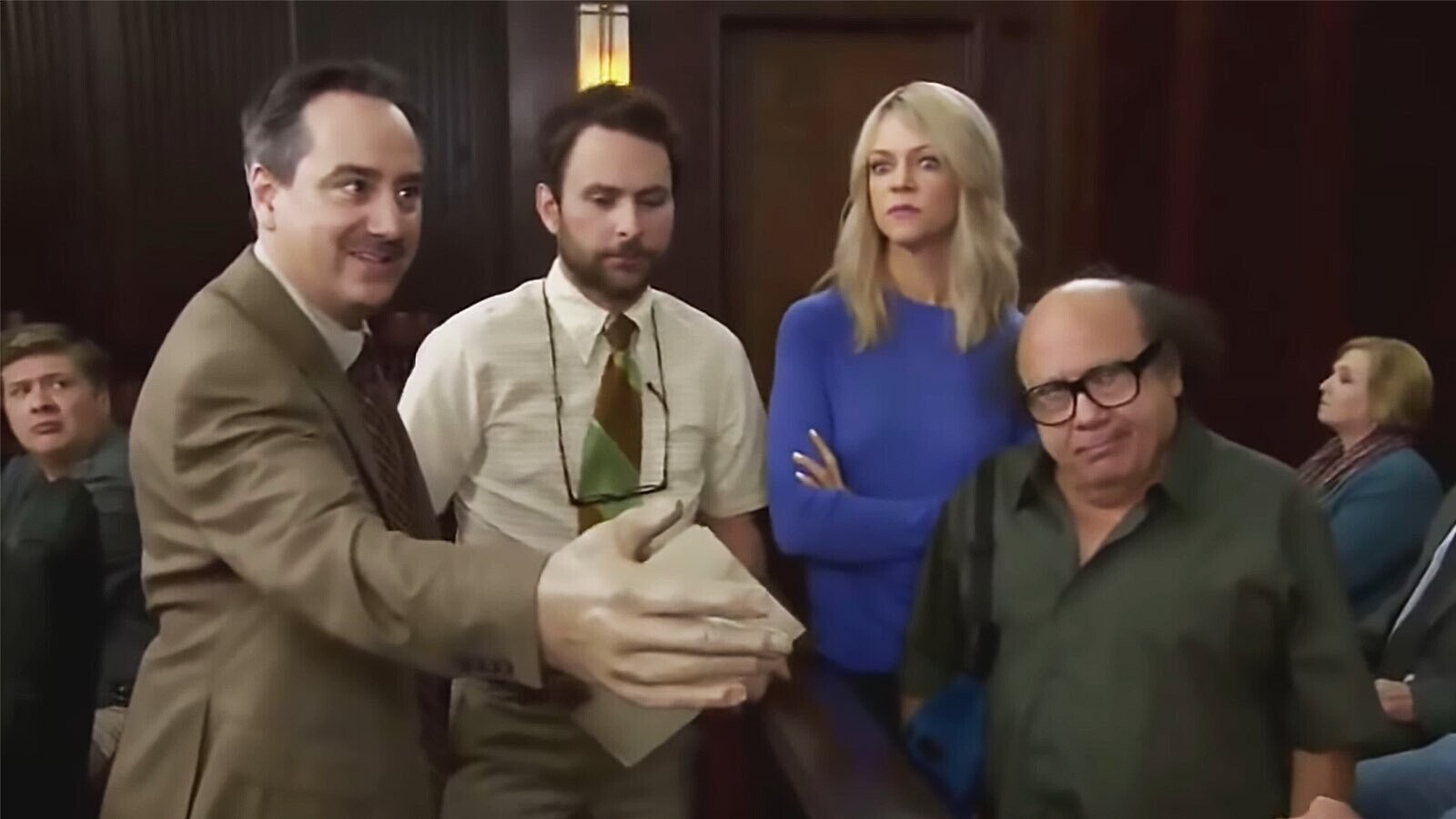
On a television series populated by human disasters, failed schemes, milk-drinking weirdos, and one dangerously confident man who calls himself the Golden God, standing out takes serious effort. Yet Uncle Jack Kelly has managed it with limited screen time, questionable legal skills, a deeply uncomfortable relationship with personal boundaries, and hands that aredespite his protestsperfectly ordinary.
Andrew Friedman, the actor who has played Charlie Kelly’s Uncle Jack since the first season of It’s Always Sunny in Philadelphia, does not share his character’s anxiety. Friedman has described his real hands with cheerful confidence. The enormous rubber replacements, frantic courtroom behavior, and desperate demands that nobody look at him belong entirely to Jack.
That separation between actor and character is important. Friedman is an experienced improviser and character performer who understands exactly why Jack is funny: Uncle Jack never realizes that he is the strangest person in the room.
Research grounding:
Andrew Friedman Is the Actor Behind Uncle Jack
Andrew Friedman is a character actor, writer, and improvisational comedian whose television and film résumé extends far beyond Paddy’s Pub. His credits include appearances in projects such as GLOW, Better Call Saul, The Rookie, Future Man, Live Free or Die Hard, Mythic Quest, and The Residence.
Still, to devoted Always Sunny viewers, he may forever be the mustachioed attorney who can turn a routine legal consultation into a conversation about masculine fingers.
His Comedy Training Came from the Groundlings
Before joining the series, Friedman performed with the Groundlings, the celebrated Los Angeles improv and sketch-comedy institution that has helped develop performers including Will Ferrell, Kristen Wiig, Phil Hartman, Lisa Kudrow, Melissa McCarthy, and Paul Reubens.
The Groundlings approach emphasizes fully developed characters, strong comic points of view, collaboration, and the ability to build on unexpected moments. Those skills are practically visible whenever Friedman plays Uncle Jack. He does not merely deliver bizarre dialogue. He gives Jack a complete internal reality in which everything he says sounds reasonable.
That is the secret ingredient. An actor who signals that a character is weird can flatten the joke. Friedman does the opposite. His posture, deliberate speech, stillness, and wounded dignity suggest that Jack believes he is a respectable professional surrounded by people who fail to appreciate his magnificence.
Research grounding:
How Andrew Friedman Became Uncle Jack Without a Traditional Audition
Friedman’s route into It’s Always Sunny in Philadelphia was unusually direct. He was performing in the Groundlings’ Sunday Company alongside Artemis Pebdani, who plays Artemis on the series. Charlie Day attended one of their performances because he knew Pebdani.
Friedman performed a sketch involving a pet-store owner attempting to make a fake parrot speak. The bit apparently made an impression. Shortly afterward, his manager told him that he had been cast in a new FX comedy. There was no conventional audition process and no elaborate series of chemistry testsjust a funny stage performance, a toy bird, and excellent timing.
He appeared in the first-season episode “Charlie Got Molested,” where members of Charlie’s family participate in an intervention involving allegations against a former teacher. Uncle Jack’s unusually intense interest in the discussion immediately establishes the character’s disturbing undertones.
The Mustache Was Built from His Own Hair
Jack’s mustache also emerged through a wonderfully improvised production solution. Friedman believed the character should have one, but the makeup department did not have a suitable piece available. According to Friedman, hair was cut from the back of his head and combined with other materials to create the mustache.
It is difficult to imagine a more appropriate origin story. Uncle Jack’s entire identity appears to have been assembled from misplaced confidence, legal stationery, craft supplies, and things found near the back of someone’s scalp.
Friedman sometimes grows a real mustache when his schedule permits. Whether genuine or manufactured, it has become part of Jack’s attempt to project authoritya campaign that repeatedly collapses the moment he begins speaking.
Research grounding:
Why Uncle Jack’s Hand Insecurity Became a Classic Running Joke
Uncle Jack’s obsession with hand size develops from an ordinary insecurity pushed to surreal extremes. He assumes that other people are judging his hands, interprets neutral reactions as rejection, and tries to correct the supposed problem with increasingly ridiculous solutions.
There is nothing obviously unusual about Friedman’s hands. That is precisely why the joke works. Jack has invented a deficiency, organized his self-image around it, and made it impossible for anyone else not to notice.
Jack Believes the Giant Hands Look Impressive
Friedman’s interpretation is that Jack does not see the oversized rubber hands as absurd. In Jack’s mind, they make him look stronger, more masculine, and more commanding. He imagines that observers are admiring them rather than wondering why a practicing attorney appears to have borrowed two props from a low-budget monster movie.
This choice transforms a visual gag into character comedy. Jack is not trying to make anyone laugh. He is trying to repair his dignity. The more seriously he treats the disguise, the funnier it becomes.
Friedman has explained that one of his guiding principles is that Uncle Jack never thinks his own behavior is strange. The giant hands are normal to him. His speech patterns are normal. His interest in wrestling with Charlie is, in his mind, normal family bonding. The audience receives the full comic impact because Jack receives none of it.
Research grounding:
The “Nobody Look!” Courtroom Scene
The hand joke reaches its glorious peak in “McPoyle vs. Ponderosa: The Trial of the Century.” Uncle Jack enters the courtroom wearing enormous fake hands while representing Bill Ponderosa. Because subtlety has never been one of Jack’s legal strategies, the hands are impossible to ignore.
During the proceedings, one rubber hand flies off. Jack reacts as if his deepest secret has been exposed before the Supreme Court, racing across the room while screaming, “Nobody look!” The discarded prop is soon secured more aggressively, because Jack apparently learned the mechanical lesson without learning any of the social ones.
Charlie Day Encouraged Friedman to Push the Panic Further
The intensity of the scene was not accidental. Friedman has credited Charlie Day with encouraging him to amplify Jack’s reaction during successive takes. Rather than treating the lost hand as a minor inconvenience, Friedman pushed the panic toward total emotional collapse.
That direction demonstrates a key principle of Always Sunny: when a character’s response is already unreasonable, there may still be room to make it catastrophically unreasonable.
The result is memorable because the sequence has several layers. The rubber hand is visually ridiculous. Jack’s attempt to hide it guarantees that everyone watches. His shriek is wildly disproportionate. Meanwhile, the surrounding courtroom continues operating with something resembling professional seriousness.
Comedy often thrives on contrast, and few contrasts are stronger than formal legal proceedings interrupted by a grown man chasing his detached fake hand.
Research grounding:
Andrew Friedman Is Comfortable with His Real Hands
Unlike Uncle Jack, Friedman is not troubled by his hand size. When asked directly, he responded with confidence that he has great hands. The only challenge comes from his son, who has teased him about them while worrying whether his own hands will become large enough for his basketball ambitions.
That family joke provides a charming reversal. Uncle Jack spends years projecting intense anxiety about fictional inadequacy, while Friedman can laugh when the same subject appears at home.
The distinction also reveals the skill involved in character acting. Friedman does not need to share Jack’s insecurity to portray it convincingly. He needs to understand the emotional machinery behind it: embarrassment, denial, overcompensation, and the belief that everyone else is secretly staring.
Most people respond to insecurity by attempting to redirect attention. Jack responds by attaching giant rubber evidence to both wrists. He is essentially a one-man public-relations crisis for his own hands.
What Makes Uncle Jack So Effective in Small Doses?
Uncle Jack has never needed to become a permanent member of the Gang. His irregular appearances are part of his appeal. He enters a story, destabilizes it with a few carefully delivered lines, and disappears before viewers can become accustomed to him.
Friedman has said that he often does not know whether the show will call him back. Jack may appear in consecutive periods or vanish for several seasons. Each invitation is therefore a surprise rather than part of a predictable schedule.
He Belongs to the Show’s Larger Collection of Recurring Oddballs
It’s Always Sunny in Philadelphia has built an unusually deep supporting roster. Characters such as Artemis, Rickety Cricket, the McPoyles, the Waiter, the Lawyer, Gail the Snail, and Uncle Jack return with their defining traits intactalthough Cricket’s physical condition is another matter entirely.
These figures make Philadelphia feel like an interconnected ecosystem of grudges, compulsions, failed ambitions, and deeply specific personal problems. Uncle Jack contributes a unique combination of incompetent lawyering, family discomfort, grandiose self-presentation, and hand-based panic.
He also serves as a distorted mirror for the main characters. Like Dennis, he is preoccupied with how others perceive his masculinity. Like Mac, he overcompensates for insecurity. Like Charlie, he exists in a reality governed by unusual assumptions. Like Frank, he can destroy the atmosphere of a room almost instantly.
Yet Jack remains unmistakably himself. No other character could make estate law sound like a hostage situation involving fingers.
How the Show Handles Uncle Jack’s Darker Implications
Uncle Jack’s history with Charlie is intentionally unsettling. The series repeatedly suggests that Jack behaved inappropriately when Charlie was young, while generally stopping short of presenting a definitive account. Charlie resists or denies certain interpretations, and Friedman has noted that the writing relies heavily on implication and subtext.
That ambiguity requires careful performance. If the material became explicit or realistic, the character could cease to function comedically. Friedman instead plays Jack as someone whose inappropriate comments emerge from a calm, self-satisfied worldview. The audience recognizes danger and discomfort even when Jack insists that everything is innocent.
In later appearances, more attention has shifted toward his hands, professional incompetence, and insecurity. This gives the character additional comic territory without requiring every appearance to revisit the darkest suggestions surrounding him.
The humor does not ask viewers to approve of Jack. Like the central Gang, he is funny because the show exposes his delusion, selfishness, and lack of self-awareness. The laugh is usually on him, especially when one of his hands becomes airborne.
Research grounding:
Working with Charlie Day and Danny DeVito
Friedman has spoken warmly about his collaborators. He has described Charlie Day as generous, talented, low-key, and willing to shape scenes from within the performance. Their familiarity helps explain the precision of their exchanges: Charlie’s alarm and Jack’s misplaced affection create immediate tension before either man has completed a sentence.
Friedman has also praised Danny DeVito’s professionalism and improvisational instincts. DeVito may remain off set during portions of rehearsal, with a stand-in helping prepare the scene, before arriving ready to perform. Once the cameras roll, he contributes new ideas and comic details without acting like the Hollywood legend that he plainly is.
The relaxed environment appears to be one reason recurring actors enjoy returning. Friedman has described the production as welcoming and playful, with many crew members remaining involved over long stretches of the series.
Although the creators have become more experienced producers and visual storytellers, Friedman believes the set’s collaborative spirit has remained recognizable since the early days. The operation is faster and more polished, but it still allows performers to experiment.
Research grounding:
Uncle Jack’s Place in a Record-Setting Sitcom
It’s Always Sunny in Philadelphia debuted on FX in 2005 after developing from an extremely inexpensive homemade project. Its early audience was modest, but the show gradually built a passionate following around its fearless satire, awful protagonists, and refusal to make those protagonists become better people.
Its fifteenth season made it the longest-running American live-action sitcom measured by number of seasons, surpassing The Adventures of Ozzie and Harriet. The central ensemble has remained remarkably stable while continuing to welcome recurring performers from the show’s earliest years.
Friedman’s continued presence demonstrates the value of that continuity. He returned as Uncle Jack during the seventeenth season in 2025, two decades after the character’s introduction. Many sitcoms completely reinvent themselves over that length of time. Always Sunny can bring back an insecure attorney from Season 1 and trust viewers to remember exactly why they should inspect his hands.
That long memory is part of the series’ reward system. A line, prop, or minor character trait can disappear for years before resurfacing. The show does not need to explain every reference because its audience has spent decades collecting them like hazardous souvenirs from Paddy’s Pub.
Research grounding:
The Viewer Experience: Why Uncle Jack’s Hands Remain So Memorable
Watching Uncle Jack for the first time can be a strange experience because the character rarely announces what kind of joke he represents. He appears composed, speaks with the careful cadence of someone who believes he is educated, and presents himself as a legal professional. Then the conversation takes one unexpected turn, followed by another, until the viewer realizes that Jack’s idea of normal behavior has no relationship with anyone else’s.
The hand gag captures that experience perfectly. The setup is small enough to seem almost believable. Many people feel insecure about a feature that nobody else notices. A photograph, an offhand remark, or an unflattering comparison can convince someone that the entire world is studying a supposed flaw. For a few seconds, Jack’s discomfort is recognizable.
Then he chooses the worst possible coping strategy.
Instead of accepting that his hands are normal, he wears replacements so enormous that they become the only visible feature of his body. Rather than behaving casually, he positions them for maximum display. When one falls off, he screams and runs after it, converting an awkward accident into an unforgettable public spectacle.
The progression gives the audience several different laughs. There is the immediate visual surprise of the giant hands. There is the delayed realization that Jack thinks they look convincing. There is Friedman’s absolute commitment to the illusion. Finally, there is the physical payoff when the prop escapes.
Rewatching the scene adds another layer because viewers know the hand will fly away. Attention shifts from the surprise to Friedman’s preparation and timing. His movements are controlled until the exact second control vanishes. His voice leaps from professional confidence to primal terror. The reaction is so large that the courtroom briefly feels too small to contain it.
The scene also illustrates why practical props remain powerful in comedy. A computer-generated hand could technically perform the same movement, but it would lack the clumsy weight and visible artificiality of the rubber version. The prop looks wrong because Jack selected the wrong solution. Its physical limitations become part of the performance.
There is also something satisfying about seeing a character’s private obsession become publicly undeniable. Jack spends enormous energy worrying that people will judge his real hands. That fear motivates him to create a situation in which everyone must judge his fake ones. He manufactures the humiliation he was attempting to avoid.
That pattern feels familiar beyond the show. People often overcorrect when they are anxious. They explain too much, defend themselves before anyone has criticized them, or draw attention to the exact subject they hoped to conceal. Uncle Jack turns that common behavior into absurdist theater.
Friedman’s performance keeps the joke from becoming merely random. His Jack is not wearing giant hands because the writers wanted a bizarre image. He is wearing them because he believes they solve a genuine problem. Every gesture follows that belief.
For fans, the result is more than a disposable gag. It becomes a piece of shared comic language. A mention of small hands, a loose glove, or someone shouting that nobody should look can instantly summon the entire scene. Few recurring characters achieve that level of recognition with such limited screen time.
Uncle Jack does it because Friedman understands a basic truth about memorable comedy: the strangest behavior becomes funniest when the performer treats it with complete sincerity. The rubber hands are ridiculous. Jack’s faith in them is absolute. The space between those two facts is where the laughter lives.
Conclusion
Andrew Friedman’s real hands are fine. More than fine, according to the man himself. Uncle Jack’s hands, however, represent one of the most inspired recurring jokes in It’s Always Sunny in Philadelphia.
Friedman’s improv background, precise character work, and willingness to play every absurdity sincerely turned a minor insecurity into a defining trait. Charlie Day’s encouragement helped push the famous courtroom panic into comic overdrive, while a gloriously unconvincing pair of rubber hands supplied the physical chaos.
After two decades, Uncle Jack remains effective because he has not gained wisdom, perspective, or basic self-awareness. He still believes he is projecting competence and masculinity. The audience sees a deeply strange attorney wearing detachable hands.
Everybody winsexcept, as usual, whoever hired him.