

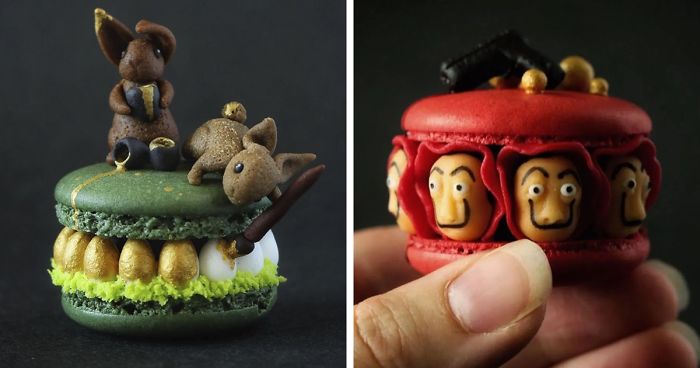
Macarons already look like they were invented by someone who wanted dessert to wear a tiny evening gown. They are smooth, pastel, delicate, and just dramatic enough to make a baker question every life choice after one cracked shell. But in the hands of Kim Delia, a creative baker from Bern, Switzerland, these French almond sandwich cookies become something even more charming: miniature edible sculptures.
Her decorative macarons are not just cookies with cute colors. They are tiny scenes, characters, textures, jokes, flowers, fantasy objects, and “please do not make me eat this, it has a face” moments. What makes the work especially impressive is that Delia is not a traditional professional pastry chef. Her background includes floristry, textile work, theater, music, and the kind of creative curiosity that says, “What if this very difficult cookie also had ears?” That is the energy we respect.
Decorative macarons sit at the sweet spot between pastry technique and visual design. A standard macaron demands precision: almond flour, powdered sugar, whipped egg whites, careful folding, resting, piping, and baking. A decorative macaron asks for all of that, then adds shape, color, fondant, royal icing, edible paint, and the emotional risk of turning dessert into a tiny personality. In other words, it is baking on hard mode with sprinkles.
Why Decorative Macarons Are So Hard To Get Right
To understand why these creative macarons are special, it helps to remember that macarons are famously fussy. The shell should be smooth, the inside should be tender and chewy, and the bottom should form the little ruffled edge bakers call “feet.” If the batter is under-mixed, over-mixed, too wet, too dry, over-rested, under-rested, or offended by the weather, it may crack, spread, hollow out, or develop the personality of a failed pancake.
The classic French macaron has roots in almond-based European pastry traditions, but the modern sandwich-style version is loved for its clean surface, crisp shell, soft interior, and endless flavor possibilities. That blank, polished shell is exactly why artists love it. It behaves like a small canvas. But unlike canvas, it can collapse if you stare at it too aggressively.
For decorative macaron art, the baker must think like both a pastry technician and an illustrator. Shapes must be piped evenly. Colors must stay vibrant without adding too much moisture. Tiny details must be light enough not to crush the shell. Fillings must support the structure without oozing out like a dessert crime scene. The result, when done well, is magical: a cookie that looks designed, balanced, and edible.
Meet The Baker Behind The Tiny Edible Masterpieces
Kim Delia’s macaron story is appealing because it feels refreshingly human. She began baking for fun, made cakes, kept practicing, and eventually found her way to macarons. According to public features about her work, she has described macarons as a challenge and has admitted that even after practice, the final result can still be a surprise. That honesty is part of the charm. Anyone who has made macarons knows the cookie has a strong opinion and does not always share it in advance.
Her broader creative background shows up in the designs. A florist understands shape, balance, color, and the difference between “cute” and “too much.” A textile-minded person notices pattern and texture. A theater person understands personality and presentation. Put all of that into macaron art, and suddenly a dessert table becomes a cast of characters.
Some of Delia’s special pieces lean more toward food art than classic flavor-first pastry. That is important to note. A highly decorative macaron may include fondant, painted details, sculpted additions, or shell-only presentation. The goal is not always to create the most luxurious bite; sometimes the goal is to make people gasp, laugh, or say, “I would eat it, but I need to apologize first.”
27 Decorative Macaron Ideas That Make This Collection Shine
The public gallery of Delia’s work is image-driven, so many pieces are remembered by their visual impact rather than formal names. Still, the best designs reveal clear themes: nature, humor, pop culture, elegance, tiny objects, and bold texture. Here are 27 standout decorative macaron concepts inspired by the collection and by the broader world of creative macaron art.
1. Tiny Animal Macarons
Animal-themed macarons are always crowd-pleasers because they turn dessert into a character. Add tiny ears, sleepy eyes, a fondant nose, or a little paw detail, and suddenly the macaron has a backstory. These are the cookies guests photograph before eating, because apparently even dessert needs a headshot now.
2. Floral Macarons
Flowers are a natural fit for Delia’s style. Floral macarons can use piped petals, fondant blossoms, edible paint, or delicate sugar accents. The best versions feel light and intentional, like a miniature garden party that happens to be almond-flavored.
3. Leaf-Inspired Macarons
Leaf designs show how elegant a simple shape can be. A green shell, veined detail, and natural curve can make a macaron feel botanical without overwhelming it. It is the kind of cookie that whispers “forest picnic” rather than shouting “I fell into food coloring.”
4. Kintsugi-Style Macarons
Kintsugi-inspired designs mimic the Japanese art of repairing broken pottery with gold. On macarons, gold lines over crack-like patterns transform imperfection into luxury. It is also a comforting message for bakers: if your shells crack, maybe they are not ruined; maybe they are just emotionally expensive.
5. Geode Macarons
Geode macarons use crystal-like sugar textures, metallic accents, and jewel tones to create the illusion of cut stone. They work beautifully because the round shell already resembles a polished object. Add sparkle, and suddenly it belongs in a dessert museum.
6. Character Face Macarons
Face macarons are risky because a tiny misplaced eye can turn “adorable” into “haunted refrigerator magnet.” When done well, though, they are irresistible. Small expressions give the cookie personality, humor, and a little emotional leverage.
7. Mini-Me Portrait Macarons
Portrait-style macarons are especially fun for birthdays, weddings, and custom gifts. Hair, glasses, smiles, hats, and clothing details can be reduced into charming edible shorthand. The result is personal without needing a full fondant statue staring from the cake table.
8. Mountain And Landscape Macarons
Scenic macarons show how much storytelling can fit on a two-inch shell. A simple mountain line, a snowy peak, or a green hillside can suggest travel, nostalgia, or a favorite place. For a Swiss creator, alpine inspiration feels especially fitting.
9. Musical Macarons
Because Delia’s creative life includes music, it is easy to see why musical themes work in her universe. Notes, instruments, or stage-inspired designs turn macarons into tiny performances. A tray of them feels like dessert warming up backstage.
10. Elegant Minimalist Macarons
Not every decorative macaron needs a full costume. Some of the strongest designs use a clean color, a thin painted line, a small metallic accent, or a single piped detail. Minimalism can be powerful, especially when the shell is smooth enough to carry it.
11. Swirl Macarons
Swirled shells bring movement to the cookie. A marbled or tie-dye effect can make each macaron unique while keeping the overall batch cohesive. These designs are great for parties because they look impressive without requiring every shell to become a tiny sculpture.
12. Toilet Paper Macarons
Yes, novelty macarons can be funny. A toilet-paper-inspired design sounds absurd, but that is exactly the point. Food art does not always need to be romantic. Sometimes it just needs to make people laugh and then ask for seconds.
13. Violet And Pastel Macarons
Pastel shades remain a macaron classic because they complement the cookie’s delicate texture. Lavender, violet, blush, mint, and pale blue shells give decorative details a soft backdrop. They are sweet without being loud.
14. Fondant-Topped Macarons
Fondant allows a baker to add sculpted shapes that would be impossible with batter alone. Small animals, objects, leaves, bows, and accessories can sit on top of the shell. The key is restraint: the macaron should still feel like a macaron, not a cookie wearing a couch cushion.
15. Royal Icing Detail Macarons
Royal icing is useful for fine lines, dots, eyes, lettering, and simple decorative borders. It dries firm, holds color well, and gives bakers control over tiny features. For character macarons, it is basically the edible version of a fine-tip pen.
16. Painted Macarons
Hand-painted macarons are where pastry becomes illustration. Edible paint can create florals, faces, abstract patterns, or delicate shading. This style works best on smooth shells, which means the technical baking has to succeed before the art even begins.
17. Gold-Accented Macarons
Gold accents instantly make macarons feel luxurious. A thin brushstroke, a speckled edge, or a metallic line can elevate even a simple shell. It is the dessert equivalent of putting on earrings before leaving the house.
18. Cracked-Shell Art Macarons
Macaron bakers usually fear cracks, but decorative artists can reinterpret them. A controlled crack effect can become stone, marble, lava, lightning, or kintsugi. The best food artists know how to turn a technical nightmare into a design feature.
19. Melted Or Lava-Style Macarons
Molten designs use drips, warm colors, and glossy details to suggest melting chocolate, lava, or caramel. They add drama and movement, especially when paired with a contrasting shell color.
20. Cookie-In-A-Cookie Macarons
A macaron decorated to look like another cookie is wonderfully silly. It is dessert recursion: a cookie pretending to be a cookie while still being a cookie. Somewhere, a pastry philosopher is nodding very seriously.
21. Racing Stripe Macarons
Linear designs like stripes or racing marks create a modern, graphic look. They are simple, bold, and easy to connect to sports, cars, birthdays, or themed events. They also prove that decorative macarons do not always need faces to have personality.
22. Holiday Macarons
Seasonal shapes such as ghosts, bunnies, trees, hearts, pumpkins, and snowflakes are popular because macarons already feel giftable. With templates and careful piping, a baker can turn the shell itself into the holiday motif.
23. Birthday Number Macarons
Number-shaped macarons are excellent for birthdays and anniversaries. They look custom, photograph beautifully, and can replace traditional cupcake toppers. The trick is using a consistent template so each number bakes evenly.
24. Pop Culture Macarons
Character-inspired macarons remain popular across bakeries because fans love edible references to movies, cartoons, games, and celebrities. A few recognizable colors and features can say a lot without needing a complicated design.
25. Texture-Rolled Macarons
Rolling the filling edge in crumbs, cacao nibs, chopped nuts, candy pieces, or sprinkles adds both texture and visual interest. It also helps connect the outside decoration to the flavor inside.
26. Chocolate-Drizzled Macarons
Chocolate drizzle is one of the easiest decorative techniques, but it still looks polished. Dark, milk, or white chocolate can be used for contrast, and toppings can be added before the drizzle sets.
27. Storybook Macarons
The most memorable decorative macarons feel like they belong to a tiny story. Whether they resemble a flower, creature, landscape, object, or joke, they invite viewers to pause. That pause is the real magic. A great decorative macaron is eaten in seconds but remembered much longer.
What Bakers Can Learn From This Style Of Macaron Art
The biggest lesson is that strong decorative macarons begin with strong basic shells. Before adding fondant ears or painted gold lines, bakers need stable meringue, fine dry ingredients, careful macaronage, even piping, proper resting, and controlled oven heat. A beautiful design cannot fully rescue a shell that has spread into a sweet almond puddle.
Templates are especially helpful for shaped macarons. They keep animals, hearts, numbers, and character outlines consistent. Small piping tips give better control, while gel or powder food coloring helps maintain color without adding excess liquid. When designs are very detailed, bakers often skip aggressive tray tapping because it can spread the batter and distort the shape. Instead, they pop visible air bubbles with a toothpick.
Flavor should still matter. Even when macarons are highly decorative, the best versions consider balance. Buttercream, ganache, jam, caramel, curd, and flavored creams can match the visual theme. A lemon-flower macaron, pistachio-leaf macaron, raspberry-heart macaron, or chocolate-geode macaron feels complete because the look and taste support each other.
That said, not every food-art piece is created for the same purpose. Some decorative macarons are showpieces. Some are made for social media. Some are party favors. Some are meant to taste amazing first and look cute second. Understanding the goal helps the baker choose the right technique.
Why People Love Decorative Macarons So Much
Decorative macarons succeed online because they combine beauty, difficulty, and cuteness in one tiny object. Viewers understand instantly that the baker had to be patient. Even people who have never made macarons can sense the precision. The cookies are small enough to feel precious and detailed enough to reward close looking.
They also tap into the joy of miniature things. Tiny food art makes people feel like giants at a dessert tea party. Add a face or flower, and the emotional effect doubles. Add gold cracks, geode sugar, or a clever joke, and the cookie becomes shareable content before anyone has taken a bite.
For bakeries and home bakers, decorative macarons can also be a branding dream. They photograph well, fit many themes, and allow endless customization. Weddings, baby showers, birthdays, holidays, fandom events, corporate gifts, and dessert boxes can all use macarons as edible design pieces.
Experience Notes: What It Feels Like To Make Decorative Macarons
Making decorative macarons is a little like adopting a very elegant pet that may or may not behave. The first experience usually begins with confidence. You measure almond flour, sift powdered sugar, whip egg whites, and think, “How hard can this be?” Then the batter starts moving differently than expected, the piping bag develops its own agenda, and your first tray comes out looking like tiny beige UFOs. This is normal. It is also humbling, which is French pastry’s favorite hobby.
The most useful experience is learning to watch the batter instead of the clock. Macaronage is not just mixing; it is reading texture. The batter should flow in a ribbon, settle slowly, and smooth out without becoming runny. Once a baker recognizes that stage, everything improves. The shells become rounder, the tops smoother, and the feet more reliable. It feels like unlocking a secret level in a game where the boss is almond flour.
Decorating adds another layer of patience. If you are piping animal ears, the batter must be thick enough to hold shape but fluid enough to bake smoothly. If you are painting shells, they must be fully cooled and dry. If you are adding fondant, the pieces must be light. If you are using royal icing, the consistency must be thin enough for detail but thick enough not to flood the design. Every technique has its own small lesson.
One practical experience is that simple designs often look more professional than overly ambitious ones. A clean gold line, a tiny flower, or a neat chocolate drizzle can be more beautiful than a crowded design with too many elements. Macarons are small. They do not need to carry the entire plot of a fantasy novel on their backs.
Another lesson is that failure can become part of the creative process. Cracked shells can become geodes. Uneven colors can become marble. Slightly lopsided circles can become animal faces. A batch that is not perfect for a luxury dessert box may still be perfect for practice, taste testing, or turning into macaron crumbs for ice cream. Decorative baking rewards flexibility.
The best experience, though, is watching people react. A box of plain macarons is lovely, but a box of tiny flowers, animals, portraits, and jewel-like shells creates instant delight. People lean closer. They point. They pick favorites. They hesitate before eating them. That tiny moment of wonder is why decorative macarons are worth the effort. They remind us that food can be playful, skilled, personal, and a little ridiculous in the best possible way.
Conclusion
Kim Delia’s decorative macarons show how far a small cookie can go when technique meets imagination. Her work proves that macarons are not limited to pastel circles in a bakery case. They can become flowers, characters, jokes, landscapes, shiny geodes, elegant patterns, and tiny edible sculptures with big personality. The appeal is not just that they are cute. It is that they reveal patience, practice, and a willingness to experiment with a dessert that is already famous for being difficult.
For anyone inspired by this kind of macaron art, the path is clear: master the basic shell, use templates, keep colors controlled, practice with simple decorations, and let creativity grow from there. The best decorative macarons do not just look good on camera. They create a moment. They make dessert feel handmade, thoughtful, and joyful. And if a cookie can make people smile before they even taste it, that is a pretty sweet achievement.