

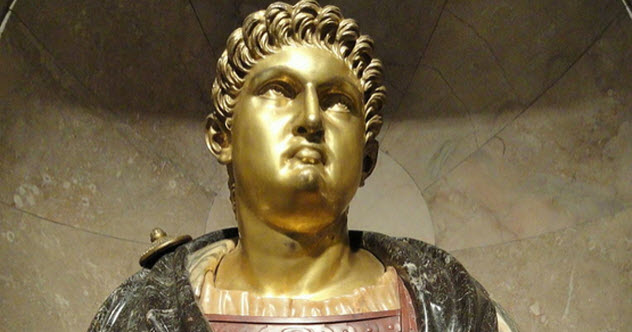
Roman history rarely whispers. It marches into the room wearing purple, overturns the furniture, and announces that the emperor may have poisoned his brother before dessert. Even by those standards, Nero’s life reads like a prestige television drama whose writers were repeatedly told to “make it less believable.”
Nero ruled the Roman Empire from A.D. 54 to 68 and became one of history’s favorite symbols of unchecked power. He has been accused of murdering relatives, humiliating senators, rigging athletic contests, persecuting Christians, and treating Rome as the stage set for his personal artistic career.
There is one important warning before the imperial curtain rises: much of Nero’s reputation comes from Tacitus, Suetonius, and Cassius Dio. These authors wrote after his death, relied partly on lost accounts, represented elite social circles, and sometimes disagreed with one another. Nero was neither an innocent victim of bad publicity nor necessarily guilty of every lurid detail attached to his name. The most responsible approach is to separate well-supported events from dramatic allegationsand admit when history has left us with a particularly smoky room.
Historical framing:
1. His Teenage Rival Apparently Died in the Middle of Dinner
Britannicus was the biological son of Emperor Claudius and therefore a dangerous alternative to Nero, Claudius’s adopted heir. In A.D. 55, only months after Nero took power, Britannicus collapsed during an imperial dinner and died before reaching his fourteenth birthday.
Tacitus describes an almost cinematic poisoning. Britannicus received a hot drink that had already been tasted for safety. When he asked for it to be cooled, poisoned water was allegedly added after the official taste test. Britannicus fell unconscious, while Nero calmly told the guests that the boy was experiencing one of his familiar seizures.
Suetonius adds an even darker subplot: Nero supposedly hired the poison specialist Locusta, tested stronger mixtures on animals, rewarded her with property, and allowed her to train students. The details cannot be independently confirmed, and natural illness remains theoretically possible. Still, Britannicus’s death removed a political rival with remarkable convenience. In Roman palaces, coincidence frequently arrived carrying a wine cup.
Britannicus accounts:
2. His Mother Survived a Murder BoatSo He Sent Assassins
Agrippina the Younger had engineered Nero’s rise, promoted his adoption by Claudius, and expected to retain substantial influence after he became emperor. As Nero asserted his independence, their partnership turned into a struggle between two people who understood Roman power far too well.
According to Tacitus, Nero’s circle designed a ship with a section intended to collapse at sea. Agrippina was invited to a warm family dinner, treated affectionately, and sent home aboard what amounted to an imperial booby trap. The vessel broke apartbut she survived, reportedly swimming or being helped to shore.
Nero then abandoned subtlety. Armed men were sent to her villa. Ancient tradition gives Agrippina a final line worthy of Shakespeare: she exposed her abdomen and ordered the killers to strike the womb that had produced Nero.
The exact engineering of the ship and the polished final speech may owe something to literary theater. Agrippina’s violent death in A.D. 59, however, is not seriously doubted. Nero subsequently claimed that she had plotted against him and died after her conspiracy was discovered. Apparently the official palace statement did not mention the collapsing yacht.
Agrippina accounts:
3. He Divorced Octavia, Framed Her, and Had Her Killed
Claudia Octavia was Nero’s first wife, Claudius’s daughter, and a living connection to the previous emperor. She was also popular with ordinary Romansan unfortunate quality when married to an increasingly suspicious autocrat.
Nero divorced Octavia on the grounds that she had not produced a child. She was then accused of adultery, even though the evidence was so weak that her enslaved attendants reportedly maintained her innocence under torture. When Octavia’s removal triggered public demonstrations, crowds celebrated a false rumor that Nero had taken her back. Statues of his new partner, Poppaea Sabina, were torn down, while images of Octavia were decorated with flowers.
The celebration was premature. Octavia was exiled and executed in A.D. 62. Ancient accounts say her veins were opened and, when death came too slowly, she was placed in a heated room. Her severed head was allegedly delivered to Poppaea.
Octavia’s fate reveals something colder than Nero’s famous theatrical excess. The state could manufacture a charge, torture subordinates for testimony, eliminate a politically inconvenient woman, and then vote religious thanksgivings. Bureaucracy, it turns out, can wear a toga and still be terrifying.
Octavia accounts:
4. He Was Accused of Killing His Pregnant Wife With a Kick
Poppaea Sabina became Nero’s wife after Octavia’s removal. In A.D. 65, while pregnant, Poppaea died suddenly. Tacitus, Suetonius, and Cassius Dio all connect her death to a violent outburst by Nero, commonly described as a kick to the abdomen following an argument.
It is one of the most repeated stories about the emperorand one historians should handle cautiously. The surviving writers were hostile to Nero, their versions differ, and pregnancy-related deaths were tragically common in the ancient world. Poppaea may have died from a miscarriage or another obstetric complication, with the kicking story added or sharpened later.
Nero’s subsequent behavior suggests genuine grief, although grief does not prove innocence. He gave Poppaea an unusually elaborate funeral, had her deified, and praised her beauty rather than following the Roman custom of cremation.
The honest verdict is uncomfortable: Nero may have caused her death in a fit of rage, but the precise accusation is not securely provable. History occasionally hands us a sensational headline and then misplaces the evidence folder.
Poppaea and source caution:
5. Audiences Were Allegedly Trapped at His Performances
Nero did not merely sponsor art. He wanted to be the art.
He trained as a singer, played the lyre, performed tragic roles, wrote poetry, and appeared publicly onstagebehavior that scandalized Roman aristocrats, who considered professional performance degrading for an emperor. Nero reportedly followed intense vocal routines, avoided foods that might harm his voice, and practiced while lying with a lead plate on his chest.
Suetonius claims that no one could leave while the emperor was singing, regardless of personal emergency. Some exhausted spectators supposedly pretended to be dead so they could be carried out, while one or more women gave birth inside the theater. Cassius Dio describes a corps of thousands known as the Augustiani, trained to lead carefully timed applause.
These anecdotes may be exaggerated for comic and moral effect, but they capture a genuine political problem. When the performer controls the courts, the army, and the execution list, applause stops being criticism and becomes survival equipment. Nero had effectively invented the mandatory company talent show, except declining the invitation could ruin considerably more than your weekend.
Performance accounts:
6. He Won an Olympic Race After Falling From His Chariot
Nero’s artistic ambitions expanded into athletics. During his tour of Greece, major festivals were rearranged so he could compete in several prestigious contests during the same visit. Musical events were added, schedules were adjusted, and the emperor returned with a mountain of prizes.
The most absurd episode occurred at Olympia. Nero entered a chariot race using a ten-horse team, an arrangement that apparently combined imperial ambition with a complete disregard for manageable steering. He was thrown from the vehicle, helped back into it, and failed to complete the race.
He was awarded the victory anyway.
Ancient reports claim Nero collected more than 1,800 crowns during his Greek tour. He rewarded Greece with privileges, granted favors to judges, and returned to Rome in a ceremonial procession modeled on a military triumph.
Technically, Nero did defeat every opponent brave enough to explain why the emperor had lost. It was the ancient world’s most efficient instant-replay system: the ruler watched the accident, reviewed the result, and declared himself magnificent.
Greek games:
7. He Had Sporus Castrated and Staged a Marriage
Among the most disturbing accounts of Nero’s private life is his treatment of Sporus, a young person whom ancient writers described as resembling Poppaea.
After Poppaea’s death, Nero reportedly had Sporus castrated, dressed in the clothing of an empress, and brought into a public marriage ceremony. Sporus was addressed as “Sabina,” Poppaea’s family name, and appeared beside Nero during public events. Cassius Dio says conventional wedding blessings were offered, including wishes that the couple might have childrena grotesque detail in light of what had been done to Sporus.
Ancient authors used the episode partly to attack Nero for violating Roman expectations of masculinity and social order. Modern readers should avoid turning Sporus into a punchline. Whatever ceremonial language surrounded the relationship, a ruler with absolute power had altered a young person’s body and assigned that person a role built around the memory of his dead wife.
The fiction-like element is not eccentric romance. It is the horrifying imbalance of power.
Sporus accounts:
8. Rome Burnedand His New Palace Made Him Look Guilty
The Great Fire of Rome began in July A.D. 64 and devastated much of the capital. The popular image shows Nero calmly “fiddling” while buildings collapse. That version is impossible in its familiar form because the fiddle did not yet exist.
Tacitus says Nero was away at Antium when the fire began and returned to organize relief. Public spaces were opened to refugees, food supplies were brought in, grain prices were reduced, and new building regulations required wider streets and more fire-resistant construction.
Yet rumors persisted that Nero had ordered the blaze or performed a song about the fall of Troy while watching it. His decisions after the disaster did little to quiet suspicion. On land cleared by the fire, he constructed the Domus Aurea, or Golden House, a sprawling palace complex with landscaped grounds, decorated halls, an artificial lake, innovative architecture, and a colossal image associated with the emperor.
Modern historians generally find no convincing evidence that Nero started the fire. But building a pleasure palace across devastated neighborhoods was a public-relations decision roughly equivalent to arriving at a disaster-relief meeting in a gold-plated chariot.
Fire and Domus Aurea:
9. Christians Were Turned Into Spectacles of Punishment
As suspicion surrounding the fire grew, Nero’s government blamed members of Rome’s small Christian community. Tacitus, who was not sympathetic to Christians, wrote that arrests led to further accusations and spectacular executions.
Some victims were reportedly covered in animal skins and killed by dogs. Others were crucified. Still others were burned at night to illuminate Nero’s gardens while the emperor presented entertainment to spectators.
The persecution appears to have been local to Rome rather than a coordinated empire-wide campaign. It was nevertheless historically significant. Christians remembered Nero as an archetypal persecutor, and later traditions associated his reign with the martyrdoms of Peter and Paul.
Tacitus adds a revealing detail: even Romans who disliked the Christians began to pity them because the punishments seemed designed not for public safety but for one man’s cruelty. Nero’s spectacle had overplayed its hand. When an audience starts sympathizing with the people you intended to dehumanize, even an emperor has lost control of the script.
Christian persecution:
10. His Final Hours Became His Last Performance
By A.D. 68, rebellions were spreading, military loyalty was collapsing, and the Senate declared Nero a public enemy. He fled Rome with only a small group of attendants and hid in a villa outside the city.
Suetonius depicts the former master of the Roman world pacing, hesitating, requesting that companions demonstrate suicide for him, and ordering a grave to be prepared. As soldiers approached, Nero drove a blade into his throat with assistance from his secretary, Epaphroditus.
His most famous lament is usually translated as, “What an artist dies in me!” Whether Nero truly said it or Suetonius supplied the perfect ending, the line has survived because it fits his public image almost too neatly. At the moment his dynasty, reign, and life collapsed, Nero supposedly mourned not the empire or his victims, but the loss of his own talent.
He died on June 9, A.D. 68, ending the Julio-Claudian dynasty and opening a period of civil war known as the Year of the Four Emperors. The ruler who had spent years demanding applause exited history with no reliable audience left.
Nero’s death:
Was Nero Truly the Monster of Legend?
Nero committed or authorized enough violence that he requires no fictional crimes to appear brutal. Britannicus, Agrippina, Octavia, political opponents, and persecuted Christians all cast long shadows over his reign.
At the same time, his reputation was shaped by authors who disliked his theatrical behavior, his attacks on senatorial privilege, and his style of rule. Some policies remained popular with ordinary Romans, while inscriptions, coins, architecture, and provincial evidence reveal a more complicated ruler than the caricature who did nothing except sing beside a burning city.
The responsible conclusion is not that Nero was secretly good. It is that ancient history demands source criticism. A genuine tyrant can also become the target of propaganda. A true crime can accumulate invented dialogue. A political execution can be remembered accurately even when the surrounding details are polished for maximum drama.
Nero’s story is more shocking than fiction precisely because it occupies that unstable border between fact and performance. The emperor staged his life as art, his enemies staged his memory as a warning, and two thousand years later, the audience is still arguing about which parts were scripted.
Experiencing Nero’s Rome Today: Walking Through the Aftermath
Entering the Domus Aurea
A modern encounter with Nero begins most vividly beneath the Oppian Hill, inside the surviving rooms of the Domus Aurea. The experience can feel strangely backward. What was once a sunlit palace now resembles an underground complex because later emperors filled and built over portions of it. Cool air, shadowed corridors, fragments of fresco, and enormous vaulted rooms make the site feel less like a luxurious residence than the buried dream of someone who expected architecture to obey his imagination.
The scale changes the way Nero’s extravagance is understood. Descriptions of gold, gemstones, water features, rotating ceilings, and landscaped grounds can sound like ancient gossip until the remaining concrete spaces begin to reveal the project’s ambition. You are not simply looking at expensive decoration. You are standing inside an attempt to redesign the center of Rome around one personality.
Looking Across the Colosseum Valley
Outside, the political reversal becomes visible. The Colosseum occupies land once associated with the artificial lake of Nero’s palace. The Flavian emperors who followed Nero transformed an imperial pleasure landscape into a monumental venue for public entertainment. It was architecture making an argument: this ground no longer belonged to one ruler’s private fantasy.
Standing between the Colosseum and the remains of Nero’s complex creates a rare physical experience of regime change. One dynasty built a lake and palace; the next filled the lake and built an amphitheater. Ancient governments did not merely issue statements about their predecessors. They edited the city.
Imagining the Fire From the Palatine
From the Palatine Hill, modern Rome spreads in layers of ruins, churches, roads, apartments, and traffic. Reconstructing the fire requires imagination because the first-century city has largely vanished. Yet the terrain helps explain why the disaster became inseparable from Nero. The imperial residences stood above densely built neighborhoods filled with timber, shops, warehouses, oil, and other combustible materials.
The experience encourages skepticism in both directions. It is easy to understand how an accidental fire could become uncontrollable. It is equally easy to understand why survivors became suspicious when the emperor’s new palace rose from the cleared landscape.
Hearing the Silence Behind the Stories
The most sobering experience is recognizing whose voices are absent. Britannicus, Octavia, Sporus, enslaved attendants, executed Christians, and displaced residents did not leave full personal narratives. Most surviving accounts were written by educated elite men. Their works are indispensable, but they decide where the spotlight falls and often assign motives to people who cannot answer.
Reading Nero on location therefore becomes an exercise in historical balance. Visitors can appreciate Roman engineering without admiring imperial domination. They can question hostile sources without excusing murder. They can enjoy the dark absurdity of a failed chariot racer receiving first prize while remembering that Nero’s world contained real coercion, torture, exile, and death.
Leaving With a More Complicated Nero
The strongest impression is not that every story is true or that every story is false. It is that power shaped both events and memory. Nero could force applause while alive; his enemies could shape the reviews after he died. Rome preserves traces of both performances.
A visitor leaves the ruins with an emperor who is harder to summarize. Nero was an artist and an autocrat, a popular entertainer and a political killer, a disaster administrator and the beneficiary of disaster, a historical person and a character created by generations of storytellers. The stones do not declare him innocent. They simply remind us that history is rarely as tidy as its villains.
Site and architectural context: