

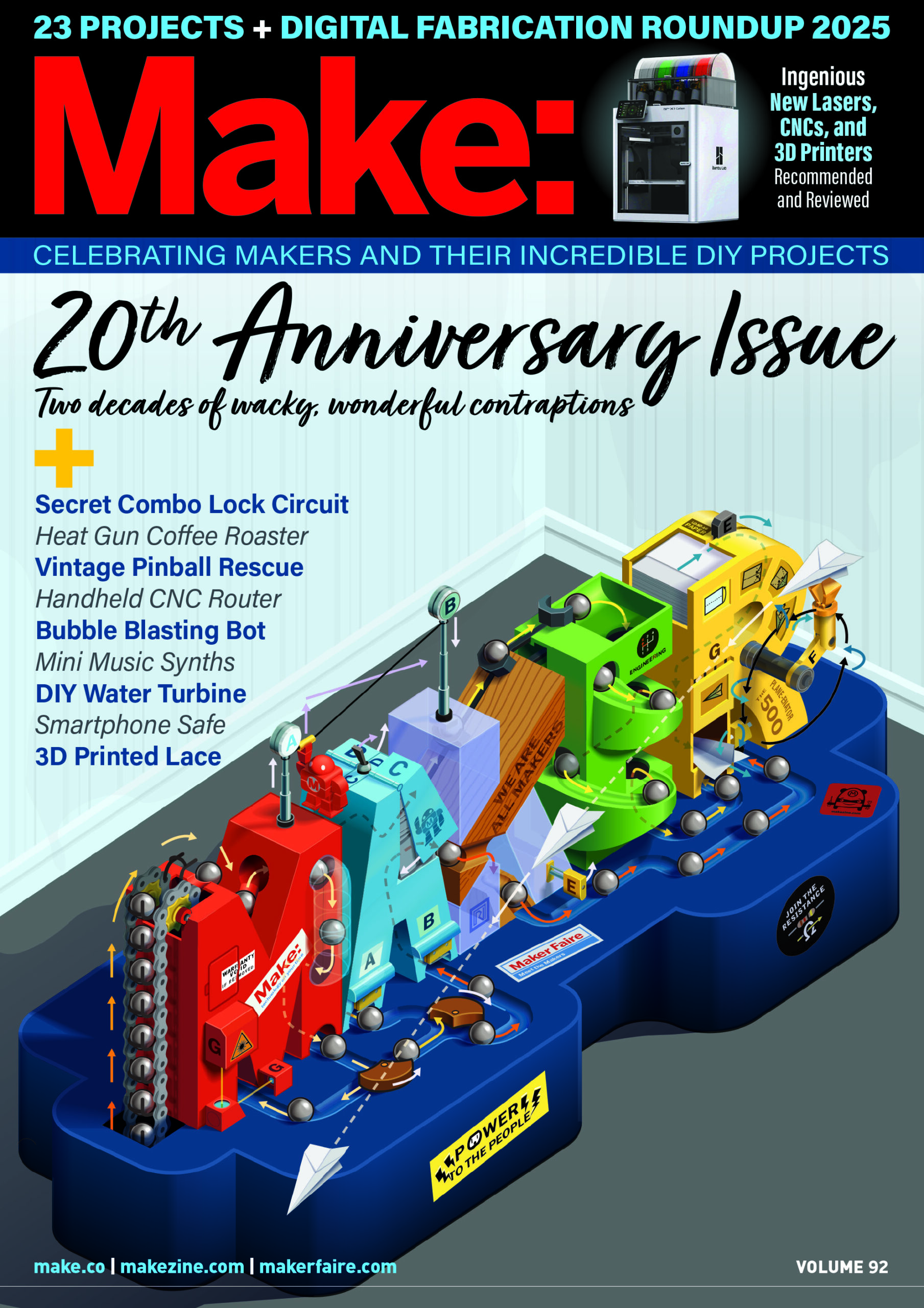
Twenty years is a long time in technology. In 2005, desktop 3D printers were exotic, hobby drones were barely learning to hover, and “smart home” often meant remembering to turn off the coffee maker. Through all that change, Make: magazine has kept championing one wonderfully stubborn idea: technology becomes more interesting when people can open it, modify it, and occasionally attach googly eyes to it.
Make: Volume 92, released as the magazine’s Spring 2025 issue, celebrates two decades of hands-on invention. It brings members of the original editorial team back together, revisits the growth of the Maker Movement, displays more than 90 past covers, and looks toward the future of digital fabrication. It also includes 23 projects, ranging from practical workshop builds to delightfully unnecessary machineswhich, in maker culture, is often the highest form of praise.
A 20th Anniversary Issue Built Around Making
The anniversary is more than an excuse to revisit old magazine covers. Volume 92 examines how a publication about experimental DIY technology helped nurture an international community of builders, educators, hackers, artists, engineers, and enthusiastic beginners.
When Make: launched in 2005, its early projects established a recognizable editorial formula: explain an inventive idea, show how it works, provide enough practical information to get started, and encourage readers to adapt the design. Early subjects included kite aerial photography, an inexpensive camera stabilizer, a multipurpose network cable, and a homemade magnetic-stripe reader.
Those projects now look like snapshots from another technological era, but the underlying method has aged well. Start with a problem or curiosity. Build a rough solution. Test it. Discover three problems you did not know existed. Improve the design. Then share what happened so someone else can make a better version.
The People Behind the First Issue Return
For the anniversary retrospective, members of the original magazine team offer a behind-the-scenes look at creating Volume 1. Their recollections help explain why Make: felt different from a conventional technology magazine. It did not merely describe new devices or tell readers what to buy. It treated readers as participants who could build their own tools, modify commercial products, and contribute ideas to a wider community.
The issue also includes reflections from technology publisher Tim O’Reilly and MIT professor Neil Gershenfeld, two influential figures in the development of modern digital culture and personal fabrication. Gershenfeld’s Fab Lab work helped expand access to computer-controlled manufacturing equipment around the world. His retrospective considers the growth of a network that now includes thousands of fabrication laboratories across roughly 150 countries.
Digital Fabrication Takes Center Stage
Volume 92 is both an anniversary edition and a digital fabrication guide. Its coverage follows the tools that have moved from industrial facilities into schools, makerspaces, small businesses, and increasingly ambitious home workshops.
Laser cutters, CNC routers, and 3D printers are no longer merely impressive machines in locked laboratories. They are accessible creative platforms. That does not mean they are toys, however. A laser cutter can turn a sheet of plywood into a precision enclosure, but it can also turn poor ventilation into an extremely bad afternoon.
Choosing Among Diode, CO2, and Fiber Lasers
The magazine compares the main types of laser machines and explains why wattage alone does not determine what a machine can process. Wavelength, material properties, enclosure design, ventilation, working area, and software support all matter.
- Diode lasers are relatively compact and affordable. They can engrave and cut selected woods, cardboard, leather, and opaque materials, but commonly struggle with clear acrylic and glass.
- CO2 lasers are popular for cutting wood and acrylic. They generally offer broader material capabilities, although they require appropriate cooling, exhaust systems, and maintenance.
- Fiber lasers are particularly useful for marking and engraving metals. They occupy a different niche from the typical craft-oriented desktop cutter.
The issue’s safety coverage is especially valuable. Many open-frame diode systems contain Class IV laser sources capable of causing permanent eye injury and creating fire hazards. Buyers should consider verified enclosures, functional interlocks, correct eye protection, proper exhaust, material compatibility, and access to emergency controls. A bargain is no longer a bargain if it tries to engrave your retinas.
New Directions in 3D Printing
Volume 92 surveys notable developments in filament and resin printing, including faster motion systems, improved calibration, built-in cameras, multicolor workflows, and more polished user experiences. It also looks beneath the shiny outer shells at the components that make modern fabrication equipment work.
One feature explores the motors, linear-motion parts, and control systems supplied by LDO Motors for innovative printers, CNC platforms, and kits. This component-level perspective is useful because reliable machines are not created by one glamorous feature. Accuracy depends on the less photogenic details: rigid frames, dependable motion hardware, consistent extrusion, sound firmware, and bearings that do not behave like they were lubricated with breakfast cereal.
The issue also asks what makers can do with older 3D printers. Instead of sending an outdated machine to an electronics recycling center, builders may reuse its frame, motors, rails, and controller to create a pen plotter, light-duty CNC tool, kinetic artwork, or specialized fabrication platform. Upcycling a printer encourages readers to see machinery as a collection of reusable systems rather than a sealed appliance with an expiration date.
A CNC Router That Corrects Its Own Path
Among the standout builds is a handheld CNC router designed to help keep cuts on track. The concept combines human control with computer-guided correction: the operator moves the tool across the workpiece while the machine adjusts the cutter’s position within a smaller range.
This approach occupies an intriguing middle ground. It provides more flexibility than a fixed CNC table while reducing the difficulty of following a precise route entirely by hand. The project demonstrates a recurring maker principle: automation does not always replace the user. Sometimes it acts like a very calm workshop partner who quietly fixes your wobbly steering.
Projects That Mix Practicality With Play
The anniversary features would make a respectable publication by themselves, but Volume 92 remains a project magazine. Its 23 builds move freely among food, fashion, electronics, renewable energy, music, robotics, and home automation.
The Wobble-Disk Coffee Roaster
The DIY coffee roaster turns a heat gun, an eight-cup flour sifter, part of a 13-inch pizza pan, and several fabricated components into a working roasting machine. Its wobbling mechanism helps keep green coffee beans moving so they heat more evenly.
The design can roast approximately 300 grams of beans in a typical cycle of about 12 to 20 minutes, depending on ambient temperature and the desired roast. More importantly, it shows how familiar objects can be rearranged into a purposeful system. Somewhere, a flour sifter is finally living its dream of becoming heavy equipment.
3D-Printed Lace Without Traditional Modeling
The 3D-printed lace project offers an accessible route into flexible textile fabrication. Readers can adapt suitable two-dimensional vector patterns and print them in flexible filament, such as TPU, without first mastering complex 3D-modeling software.
The resulting pieces can be used for garments, accessories, or decorative panels. This project illustrates how digital fabrication increasingly crosses traditional boundaries. A printer can be an engineering tool one day and a fashion workstation the next. The important step is understanding how line thickness, pattern connections, material flexibility, and print settings affect the finished textile.
The $50 Pico-Hydroelectric Turbine
A rugged water-turbine project demonstrates how everyday materials can be assembled into a small hydroelectric generator. Under suitable water-flow and pressure conditions, the design targets output of up to approximately 200 watts.
The project is compelling because it connects mechanical construction, fluid behavior, electrical generation, and energy management. Actual performance will depend heavily on the installation site, including water head, flow rate, pipe losses, generator efficiency, and local regulations. It is therefore best understood as an educational and site-dependent energy systemnot as permission to attack the nearest creek with PVC pipe.
Smartphone Safes and Electronic Locks
For readers whose phones mysteriously consume entire evenings, Volume 92 includes a timed smartphone safe built around the Oxocard Connect microcontroller. The idea turns digital well-being into a physical design problem: place the phone inside, activate the timer, and remove the option of “just checking one thing.”
A separate electronic-safe project uses rotary switches to set a combination and incorporates a delay intended to discourage rapid brute-force attempts. Both builds make security concepts tangible. Readers must consider input devices, state management, timing, mechanical construction, power loss, and failure behavior.
Bubble Robots, Binder Synths, and Tiny Games
The playful side of making receives plenty of room. A bubble-blowing companion robot combines a toy mechanism with a robotic arm. Portable music projects transform three-ring binder cases into compact systems containing synthesizers, effects, controllers, batteries, and carefully managed wiring.
Miniature tabletop games can be fabricated from a single piece of acrylic, while additional features explore radio-frequency connectors, LED installations, micro-scale artwork, and creative automation. These projects are not united by one technology. They are united by curiosityand by the conviction that an object becomes more memorable when its creator had to solve at least one ridiculous problem.
What Volume 92 Says About the Maker Movement
The issue’s historical and practical sections support the same conclusion: the Maker Movement is not defined by owning expensive equipment. It is defined by agency. A maker believes that objects and systems can be understood, repaired, changed, or recreated.
That philosophy has influenced schools, libraries, museums, community workshops, and small manufacturers. Maker-centered education emphasizes experimentation, collaboration, documentation, and iterative problem-solving. Students learn not only from a successful final object but also from prototypes that wobble, overheat, bind, leak, or launch a small component toward the ceiling.
Volume 92 also highlights sharing as an essential part of the culture. Published instructions, open design files, local clubs, makerspaces, and Maker Faire events allow individual experiments to become community knowledge. The magazine itself operates as a bridge between inspiration and execution: it shows what another person made while offering enough technical context to begin a new version.
Who Should Read Make: Volume 92?
This issue is particularly well suited to readers interested in digital fabrication, the history of DIY technology, or project-based learning. Longtime subscribers will find familiar names and a substantial retrospective. New readers receive a broad introduction to the magazine’s distinctive mixture of engineering, art, repair, and cheerful weirdness.
Beginners should expect a range of difficulty levels rather than 23 instant weekend victories. Some projects require only affordable materials and basic tools; others involve fabrication equipment, electronics knowledge, or careful mechanical assembly. The variety is part of the appeal. A reader may arrive for the 3D printers and unexpectedly leave planning a coffee roaster.
Conclusion: Twenty Years Old and Still Taking Things Apart
Make: Volume 92 succeeds because it treats its anniversary as a starting point rather than a retirement party. The issue honors the people and projects that shaped the magazine while examining safer lasers, smarter CNC tools, improved 3D printers, accessible electronics, and new ways to reuse existing hardware.
Its best projects balance useful information with an invitation to experiment. Readers are not expected to reproduce every design exactly. They are encouraged to understand the mechanism, adapt the materials, document the mistakes, and produce something personal.
After 20 years, the tools have become faster and more sophisticated, but the essential maker experience remains unchanged: an idea becomes a sketch, the sketch becomes a prototype, and the prototype becomes a slightly scorched lesson that works beautifully on version three.
Hands-On Experience: Spending a Weekend With Volume 92
The most useful way to approach this anniversary issue is not to read it as a catalog of machines you need to purchase. Treat it as a menu of experiments. Begin by marking projects according to what you already own, what you want to learn, and how much chaos your workbench can tolerate.
A practical first session might involve the 3D-printed lace project. It has a manageable material cost and introduces several transferable skills: cleaning vector artwork, checking whether lines connect, controlling first-layer adhesion, and tuning flexible filament. The first sample may be too stiff, too stringy, or fused into something resembling a futuristic drink coaster. That failed square is still useful because it reveals which variable should be changed next.
The experience becomes more mechanical with the coffee roaster. Before cutting any metal, lay out the parts and trace the movement of heat, air, beans, and rotating components. Ask where hot surfaces will be exposed, how chaff will escape, and how power can be disconnected quickly. Building the roaster is not merely a recipe; it is a compact systems-engineering exercise with a cup of coffee waiting at the end.
For an electronics afternoon, the timed smartphone safe offers an excellent combination of coding and physical construction. Prototype the timer and display before designing the enclosure. Test what happens if the power is removed. Decide whether the box should remain locked, reset, or provide a controlled emergency release. These edge cases are where a clever demonstration becomes a dependable object.
The bubble robot provides a different lesson. Its practical purpose is approximately zero, yet it may teach more about alignment, motor control, timing, and user engagement than a conventional tutorial. A bubble wand must enter the liquid at the right angle, clear the reservoir, meet the airflow, and repeat the motion reliably. When the machine finally releases a stream of bubbles, the result feels disproportionally satisfying. Engineering enjoys wearing a party hat.
Reading the laser section before using any engraving machine is another worthwhile exercise. Create a material log that records the machine, power, speed, number of passes, ventilation setup, and outcome. Confirm that every material is safe to process rather than relying on appearance or guesswork. Never leave an active cutter unattended, and do not bypass enclosures or interlocks to save a few seconds.
If you work with a family, classroom, or maker club, divide one project into roles. One person can research, another can prepare materials, another can document the build, and another can test the finished device. Rotate those roles for the next project. This prevents the most experienced builder from quietly doing everything while everyone else becomes an audience.
Keep a notebook nearby and record dimensions, wiring changes, failed settings, and unexpected behavior. Photographs of intermediate stages are often more valuable than a polished final image because they show how the object actually fits together. Add a short post-build review: what worked, what failed, what was changed, and what version two should do differently.
That process captures the strongest experience Volume 92 can provide. The magazine supplies plans and inspiration, but its real value appears when a reader begins making decisions. Completing one project is satisfying; understanding it well enough to modify, repair, and explain it is the better anniversary celebration.