

Forget movie zombies shuffling through abandoned malls. Nature has been running the original zombie franchise for millions of years, and honestly, Hollywood is late to the meeting. In the insect world, “zombie” does not mean a dead bug wearing a tiny torn shirt. It usually means an insect whose body, behavior, or survival instincts have been hijacked by a fungus, virus, worm, fly, or wasp with very specific plans.
These real-life zombie insects are not supernatural. They are examples of host manipulation, one of evolution’s strangest tricks. A parasite does not simply eat its host; it changes what the host does so the parasite can reproduce, spread, or protect its young. Sometimes the host climbs to a perfect spore-launching spot. Sometimes it guards the parasite like a confused security officer. Sometimes it walks into water, pretends to be a berry, or becomes a living lunchbox. Nature is beautiful, but it also occasionally needs a warning label.
This guide explores 10 of the most fascinating zombies of the insect world, from famous zombie ants and parasitic wasps to zombie cicadas, zombie caterpillars, and other nightmare fuel with six legs. The science is real, the examples are specific, and the humor is included because otherwise we would all need to stare silently at a wall for a while.
What Makes an Insect a “Zombie”?
In entomology, “zombie insect” is a catchy phrase rather than a formal scientific category. The common thread is that a parasite or pathogen alters an insect’s normal behavior in a way that benefits the manipulator. That manipulation may involve the nervous system, hormones, immune response, muscles, or sensory cues.
Not every parasite creates a zombie. A flea biting a dog is annoying, not cinematic. A fungus making an ant clamp onto a leaf before growing a stalk from its body? That gets a front-row seat in the zombie insect hall of fame. The best-known examples involve mind control parasites, zombie fungus, parasitoid wasps, and viruses that turn insects into mobile delivery systems.
10 Real Zombies of the Insect World
1. Zombie Ants Controlled by Ophiocordyceps Fungus
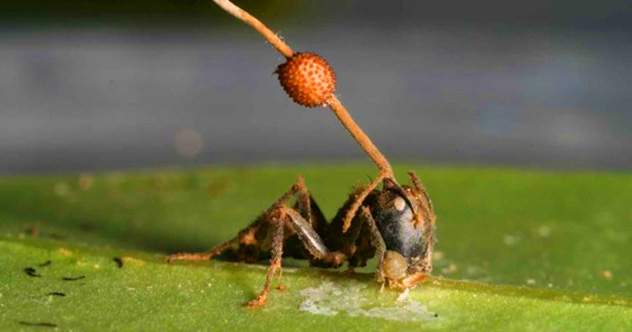
The celebrity of zombie insects is the carpenter ant infected by fungi in the Ophiocordyceps group. The fungus invades the ant’s body and eventually changes its behavior. Instead of moving normally with its colony, the infected ant wanders away, climbs vegetation, and clamps its jaws onto a leaf or twig. This final “death grip” places the ant in a humid, elevated location that helps the fungus grow and release spores.
After the ant dies, a fungal stalk may emerge from the body and produce spores that drift down to infect more ants. The result looks like someone wrote a horror scene and then handed the script to a biology professor. What makes zombie ants especially interesting is that the manipulation is precise. The fungus does not need the ant to behave randomly; it needs the ant to die in the right place, at the right height, under the right conditions.
Researchers have found that these fungi are often highly specialized. A fungus that manipulates one ant species may not successfully control another. That specificity suggests a long evolutionary arms race between parasite and host. In other words, the fungus is not simply “evil.” It is extremely picky evil.
2. Jewel Wasps Turning Cockroaches Into Walking Meals
The emerald jewel wasp, Ampulex compressa, is tiny, metallic, and stunningly prettylike jewelry with an extremely questionable hobby. Its target is the cockroach. The female wasp stings the roach twice: first to temporarily disable its front legs, then directly into a brain region involved in movement and escape behavior.
The cockroach is not fully paralyzed. That would be too simple. Instead, it loses much of its motivation to flee. The wasp then grabs the roach’s antenna and leads it like a dog on a leash into a burrow. There, the wasp lays an egg on the roach. When the larva hatches, it feeds on the still-living cockroach, carefully consuming it in a way that keeps the food supply fresh.
This is one of the clearest examples of a parasitic wasp using neurochemical control. The roach can move, but its decision-making has been hijacked. Somewhere in cockroach language, there is probably no polite word for this.
3. Baculovirus Zombie Caterpillars That Climb to Their Doom
Some caterpillars infected by baculoviruses develop what scientists call “tree-top disease.” The infected caterpillar climbs upward instead of staying hidden in lower foliage. At the top, it dies and liquefies, spreading virus particles over leaves below. Healthy caterpillars later eat contaminated foliage, and the virus gets a new generation of hosts.
The gruesome part is not just the liquefaction, although yes, that is plenty gruesome. The fascinating part is the behavioral shift. Caterpillars normally balance feeding with avoiding predators. A virus that pushes them upward changes that survival equation completely. The host becomes a sprinkler system for viral particles, which is efficient if you are the virus and deeply inconvenient if you are the caterpillar.
Baculoviruses are also important in agriculture because some are used as biological control agents against pest caterpillars. That makes them both creepy and useful, like a haunted vacuum cleaner that actually cleans the house.
4. Zombie Flies Hijacked by Entomophthora Fungus
Houseflies and fruit flies can be infected by fungi such as Entomophthora muscae. The fungus grows inside the fly, feeding on it while keeping the host alive long enough to complete the parasite’s plan. Near the end, the infected fly climbs to a raised surface, attaches itself, spreads its wings, and dies in a posture that helps the fungus launch spores.
In many cases, the dead fly looks as if it has been dusted with pale powder. That powder is made of fungal spores ready to infect the next unlucky fly. Some studies also show that healthy flies may be attracted to infected or recently killed flies, which helps the fungus spread further. Nature, apparently, looked at “bad dating decisions” and turned them into a reproductive strategy.
Zombie flies are especially useful to researchers because their behavior happens in a predictable sequence. That gives scientists a chance to study how pathogens interact with the nervous system, timing, metabolism, and behavior. The fly is doomed, but the science is alive and buzzing.
5. Massospora Zombie Cicadas: Flying Spore Shakers
Periodical cicadas already live strange lives. They spend 13 or 17 years underground, emerge in enormous numbers, sing loudly, mate, lay eggs, and die. Then Massospora cicadina arrives and says, “Cute life cycle. Mind if I make it weirder?”
This fungus infects cicadas and can replace part of the abdomen with a chalky mass of spores. Infected cicadas may continue flying and attempting to mate even after severe body damage. Male cicadas infected at certain stages may mimic female wing-flick signals, attracting other males and spreading the fungus through contact.
Because infected cicadas can move around while carrying spores, they have been nicknamed “flying salt shakers of death.” It is a dramatic phrase, but honestly, it earns the drama. The cicada’s body becomes a moving distribution system, and the fungus benefits from behavior that keeps the insect active and social.
6. Ladybug Bodyguards Controlled by Dinocampus Wasps
Ladybugs have excellent public relations. They are cute, helpful garden predators, and they look like someone painted tiny polka dots for morale. But even ladybugs can become zombies. The parasitoid wasp Dinocampus coccinellae lays an egg inside a ladybug. The wasp larva develops within the beetle, then emerges and spins a cocoon between the ladybug’s legs.
Here is where things get truly odd: the ladybug often remains alive, partly paralyzed, and twitching over the cocoon. Those movements may help deter predators that might otherwise eat the vulnerable wasp pupa. The ladybug becomes a living bodyguard for the parasite that just used its body as a nursery.
Some ladybugs can survive after the adult wasp emerges, which makes this zombie story slightly less final than others. Still, “I was forced to babysit the creature that grew inside me” is not exactly a cheerful recovery arc.
7. Glyptapanteles Wasps and the Caterpillar Security Guard
Wasps in the genus Glyptapanteles take the bodyguard strategy to another level. A female wasp injects eggs into a caterpillar. The larvae hatch and feed inside the host, avoiding vital organs for long enough to keep the caterpillar alive. Eventually, the larvae emerge from the caterpillar and spin cocoons nearby.
At this point, a normal caterpillar might crawl away, eat a leaf, and try not to think about what just happened. But infected caterpillars often stay near the wasp cocoons and defend them with violent body swings when predators approach. Research suggests that some larvae may remain behind inside the caterpillar, helping manipulate this guard behavior.
The result is a caterpillar transformed from prey into a security system. It does not eat normally. It does not continue its own development. It protects the parasite’s young until it dies. Somewhere, a wasp marketing team is calling this “premium childcare.”
8. Horsehair Worms Driving Crickets and Mantises Into Water
Horsehair worms, also called gordian worms, are long, threadlike parasites that develop inside insects such as crickets, grasshoppers, and sometimes mantises. Adult horsehair worms need water to reproduce. Their insect hosts, inconveniently, are usually land animals. The parasite solves this problem by manipulating the host to seek water and jump in.
Once the host reaches water, the worm emerges from the insect’s body. The scene can look impossible: a long, writhing worm leaving a much smaller cricket like a magic trick performed by a swamp. The insect may die, though some hosts survive the exit.
Scientists have studied changes in infected crickets’ behavior, including altered movement and responses to light or water-related cues. The exact mechanisms are complex, but the outcome is straightforward: the parasite turns a land insect into a taxi headed straight for the pond.
9. Lancet Liver Flukes Making Ants Climb Grass
The lancet liver fluke, Dicrocoelium dendriticum, has a complicated life cycle involving snails, ants, and grazing animals such as sheep or cattle. Infected ants can behave normally during warm parts of the day, but in cooler periods they may climb grass stems and clamp their jaws onto the vegetation.
This position makes the ant more likely to be eaten by a grazing animal. Once inside the grazer, the fluke can continue its life cycle. If the weather gets too hot, the ant may climb back down, which helps keep it alive for another opportunity. That detail makes the manipulation even more impressive. The parasite is not just pushing a big red “climb” button; it appears to influence behavior in a temperature-sensitive way.
The ant becomes bait, but not careless bait. It is bait with scheduling software.
10. Berry Ants Turned Into Bird Snacks
In tropical forests, the nematode Myrmeconema neotropicum infects certain canopy ants, including Cephalotes atratus. Infected ants develop swollen, bright red gastersthe rounded rear part of the bodythat resemble ripe berries. They may also move more slowly and hold the red gaster in a conspicuous position.
The likely goal is to trick fruit-eating birds into eating the infected ants. The birds then spread parasite eggs in their droppings, which ants may later collect and feed to larvae. It is a life cycle that depends on visual deception, behavior change, and the unfortunate fact that a red ant abdomen can look delicious if you are a bird shopping in the forest canopy.
Among zombie insects, berry ants are especially striking because the parasite changes both appearance and behavior. The ant is not merely controlled; it is redesigned into a snack advertisement.
Why Parasites Turn Insects Into Zombies
Host manipulation may look outrageous, but it usually serves one of several practical goals. The parasite may need to reach a better location, as with zombie ants and zombie flies climbing upward. It may need protection, as with ladybug and caterpillar bodyguards. It may need access to water, as with horsehair worms. Or it may need the host to be eaten by the next animal in the life cycle, as with liver flukes and berry ants.
These strategies evolve because they improve transmission. A parasite that can nudge its host into the right place at the right time has an advantage over one that simply waits and hopes. Evolution does not need a master plan; it only needs variations that work well enough to be repeated across generations.
For readers, the big takeaway is that “mind control” in insects is not magic. It is chemistry, anatomy, ecology, and timing. Parasites may affect neurotransmitters, hormones, immune signaling, muscle function, sensory processing, or gene expression. The details vary, but the theme is the same: the host’s normal behavior is rewritten to serve another organism’s survival.
Are Zombie Insects Dangerous to Humans?
For the most part, no. Zombie insect parasites are usually highly specialized. The fungus that manipulates ants is adapted to ants, not people. The jewel wasp targets cockroaches, not your uncle who refuses to ask for directions. Horsehair worms may look alarming, but they are not interested in turning humans into pond-seeking puppets.
That said, these systems matter. Some zombie-making pathogens affect agricultural pests, which can make them useful in biological control. Others affect pollinators or beneficial insects, which can raise ecological concerns. Studying them helps scientists understand nervous systems, parasite evolution, ecosystem balance, and pest management.
So no, you do not need to worry about becoming a fungus-controlled leaf-clamper after walking through the garden. But you may never look at a quiet ant, twitching ladybug, or oddly placed dead fly the same way again.
Field Notes and Everyday Experiences With Zombie Insects
You do not need a rainforest expedition or a white lab coat to appreciate the zombie insect world. Some of the best experiences begin with slowing down in ordinary places: a backyard garden, a porch light, a park trail, a compost pile, or the underside of a leaf. Once you know what to look for, the insect world becomes less like background noise and more like a tiny thriller series playing under your nose.
A gardener might first notice aphid mummies: small, swollen, tan or brown aphid shells left behind after parasitoid wasps develop inside them. They are not as dramatic as a fungus stalk bursting from an ant, but they are a quiet sign that natural pest control is already at work. Instead of reaching for insecticide immediately, an observant gardener may pause and realize that the garden has hired its own microscopic security team.
Porch lights can offer another strange classroom. Dead flies stuck to windows or walls sometimes show pale rings or powdery growth, which may indicate fungal activity. Most people wipe them away without a second thought. But if you look closely, the scene tells a story: the fly climbed, attached, died, and became a launchpad. It is not pretty, but it is biology with excellent stage direction.
In cicada years, the experience becomes louder and harder to ignore. Periodical cicadas emerge in overwhelming numbers, filling neighborhoods with buzzing, shells, wings, and confused pets. Finding a fungus-infected cicada is rarer, but it leaves an impression. The insect may still move despite obvious damage, making the phrase “zombie cicada” feel less like exaggeration and more like a field note written by someone who needed a deep breath.
Children often respond to these discoveries with the perfect mix of horror and curiosity. Adults usually pretend to be calm while quietly stepping backward. That reaction is useful. Zombie insects remind us that nature is not designed to be cute, simple, or polite. It is designed by survival. Every odd behavior has a cost, and every successful parasite has found a way to make another creature pay it.
For anyone interested in observing these phenomena responsibly, the best approach is simple: watch, photograph, and avoid disturbing the insects unless there is a clear safety or pest issue. Do not handle unknown fungi, parasites, or diseased insects with bare hands. Do not move potentially infected insects to new areas. If you keep bees or manage a garden, local extension services can help identify whether a parasite is harmless, beneficial, or worth monitoring.
The most memorable experience, though, is mental. Learning about zombie insects changes the way you see small lives. A caterpillar is not just a caterpillar. It may be a host, a meal, a battlefield, or an unwilling bodyguard. An ant on a blade of grass may not be lost; it may be following instructions written by a parasite. A ladybug may be doing more than resting. The insect world is not quiet. It is whispering weird secrets all day long.
Conclusion: The Real Zombie Apocalypse Is Tiny
The 10 zombies of the insect world prove that nature is far stranger than most horror fiction. Zombie ants, cockroaches led by jewel wasps, liquefying caterpillars, fungus-controlled flies, hyperactive cicadas, bodyguard ladybugs, enslaved caterpillars, water-seeking crickets, grass-clamping ants, and berry-mimicking ants all reveal the same unsettling truth: behavior is a biological tool, and parasites have learned how to use it.
These examples are not just gross curiosities. They help scientists understand evolution, ecology, nervous systems, disease transmission, and biological control. They also remind us that the smallest creatures often live the most dramatic lives. The next time someone says insects are boring, feel free to mention the wasp that walks a cockroach by its antenna. Conversation saved. Appetite possibly ruined.
Note: This article is synthesized from real entomology research and educational materials from reputable scientific, university, extension, and science journalism sources, including major U.S.-based institutions and publications. It is written as original web content for general readers and does not include source-link elements or citation placeholders.