

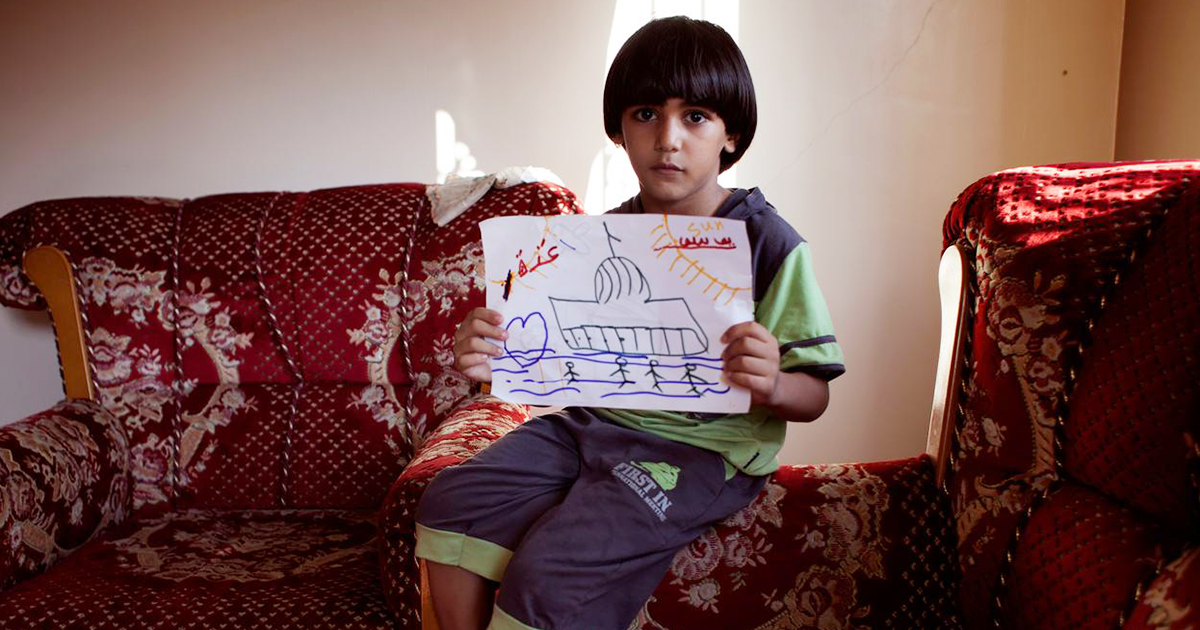
When adults discuss Gaza’s future, the conversation often arrives wearing a suit: reconstruction budgets, political frameworks, security arrangements, maps, deadlines and diplomatic language polished until every sharp edge disappears. Children answer differently. Give them paper, pencils, paint, clay or scraps rescued from rubble, and the future becomes immediate. It has a school with a roof. A hospital that feels calm. A bedroom with a door. Trees. Streetlights. A soccer field. Bread in an ordinary kitchen. Parents waiting for children to return from classnot searching for them after an explosion.
That is the emotional force behind The Gaza We Want, a UNICEF-supported initiative that invited children across the Gaza Strip to describe the place they hope to live in. More than 11,000 children contributed drawings, poems, models and other creative work, while 1,603 children ages 5 to 18 completed a structured questionnaire. The activities were voluntary, inclusive and designed to avoid asking participants to relive violence. Instead, children were asked to imagine dignity.
Their artwork is colorful, but it is not simple. These pictures function as testimony, planning documents and reminders that childhood is made from ordinary things. The children did not mainly ask for futuristic towers or fantasy kingdoms. They drew the basic architecture of a livable life.
A Future Drawn in Crayon, Cardboard and Hope
The children who participated came from all five Gaza governorates. Some worked in makeshift learning spaces or small art tents. Others created miniature neighborhoods from foam, paper, cardboard and whatever materials were available. One group of children ages 9 to 12 built a model they called “Peace Neighbourhood.” It included a school and playground, a hospital, a mosque, homes, roads, greenery and places to gather.
That model matters because it reveals how children understand recovery. Recovery is not one dramatic building rising from a field of ruins. It is a connected system. A child needs a home, but also a safe path to school. A school needs toilets, water, desks, books, laboratories and teachers. A hospital needs medicine and trained staff, but it also needs to feel safe enough for a frightened child to trust the room. A neighborhood needs lighting, trees and public spaces where people can meet without fear.
The drawings repeatedly returned to bright streets, flowers, the Mediterranean Sea, playgrounds, classrooms, intact houses and blue skies without military aircraft. These images should not be mistaken for decorative optimism. Their meaning comes from contrast. A clean street is powerful when rubble has filled daily routes. A classroom desk becomes a symbol when schooling has been interrupted. A tree is not merely a tree when green space, shade and normal outdoor play have become difficult to find.
What Gaza’s Children Said They Need First
Across the artwork and questionnaire responses, the same priorities appeared again and again. Children placed safety and shelter at the beginning of recovery. They wanted permanent homes, stable buildings and nights in which sleep is not broken by fear. Next came real schoolsbuildings with walls, roofs, furniture, clean water, bathrooms, libraries, technology and room to play.
They also asked for functioning hospitals, medicines, rehabilitation services and psychological support. Beyond immediate survival, they imagined parks, sports fields, universities, cultural centers and places of remembrance. Their answers created a remarkably practical sequence: first protect life, then restore stability, and finally rebuild the institutions through which a community can grow.
Safety That Can Be Felt, Not Merely Announced
For a child, safety is physical and sensory. It means not flinching at every loud sound. It means knowing where family members are. It means walking to school, sleeping in the same place for more than a few nights and believing that a roof will remain overhead.
UNICEF reported in early 2026 that approximately 800,000 children in Gaza remained displaced, many living in crowded and unsanitary conditions. In that setting, a drawing of a sturdy house is not a real-estate wish. It is a request for predictability, privacy and the ability to stop living from one emergency to the next.
Schools That Restore More Than Lessons
Education emerged as one of the clearest themes. Children asked for permanent schools rather than tents and improvised classrooms. They described kind teachers, libraries, science laboratories, computers, playgrounds and sports facilities.
These details show that children do not view education as worksheets alone. School is also routine, friendship, identity and protection. It is where a child begins to imagine becoming a doctor, engineer, teacher, writer or artist. When education disappears, children lose not only lessons but also one of the main structures connecting the present to the future.
World Bank assessments have described the collapse of Gaza’s formal education system and enormous damage to educational infrastructure. Temporary learning spaces have reached some children, but they cannot by themselves replace a complete, accessible and inclusive school system.
Reopening schools must therefore mean more than unlocking doors. It must include learning recovery, disability access, safe drinking water, sanitation, nutrition, mental-health services, teacher support and protection from further violence.
Health Care for Bodies and Frightened Minds
The children’s imagined hospitals are not cold institutions. They have gardens, enough medicine, listening doctors, quick treatment and rooms that do not feel terrifying. That combination is significant. It joins physical treatment with emotional healing.
Humanitarian health organizations have documented how injuries, displacement, bereavement, chronic stress and repeated exposure to violence overlap. A broken bone may heal while fear remains. A child may appear physically recovered yet continue experiencing nightmares, withdrawal, difficulty concentrating or panic at particular sounds.
Psychological care was among the most widely requested priorities in the UNICEF questionnaire. The World Health Organization has also reported a severe mental-health and psychosocial-support crisis in Gaza.
Creative activities can provide expression, connection and temporary relief, but a drawing session is not a replacement for physical safety, family stability, trained counselors, clinical care and long-term community support. Crayons can open a door; they cannot rebuild the entire house by themselves.
Why the Ordinary Details Matter Most
Adults sometimes praise children for being resilient and then quietly ask resilience to perform the work that institutions have failed to do. The drawings resist that mistake. They show strength, but they also show needs.
A child who draws flowers amid destruction is not saying that flowers solve destruction. The picture says that beauty, play and peace remain necessary even after adults have made them difficult to reach.
Consider the recurring idea of a bedroom. To someone living in stable housing, a child wanting a private room may sound pleasantly ordinary. In prolonged displacement, it represents privacy, continuity, personal belongings and a place where the nervous system might finally lower its guard.
The same is true of streetlights. On an infrastructure plan, lighting is a technical line item. In a child’s drawing, it means being able to move after sunset without darkness adding another layer of danger.
Bread also appears as a symbol of home. Not emergency rations and not a distribution line, but bread being prepared in a family kitchen. It represents food security, domestic rhythm, memory and the return of ordinary mornings.
In this way, the children’s artwork turns large policy categorieshousing, sanitation, food systems, public health and educationinto lived experience.
Drawing as Expression, Participation and Evidence
Children do not always communicate through formal interviews, especially when language feels too small or when direct questions risk reopening painful memories. Drawing, play, modeling and storytelling can offer nonverbal routes into a child’s ideas.
Child-development specialists emphasize that creative activities can help children express feelings and organize experiences, particularly when trusted adults provide calm, structure and choice. However, the meaning of a picture should not be diagnosed from a distance. A dark color does not automatically prove depression, and an aircraft in a drawing does not provide a complete psychological assessment.
The importance of The Gaza We Want also goes beyond emotional expression. It is an exercise in civic participation.
Article 12 of the Convention on the Rights of the Child recognizes that children should be able to express views on matters affecting them and that those views should receive appropriate weight. Reconstruction plainly affects children. They will use the homes, schools, clinics, parks, transit routes and water systems being planned.
Listening to them is not a sentimental bonus added after engineers and officials finish their work. It is part of designing places that function for the people who will live there.
Meaningful participation requires more than displaying drawings at an international conference. Children should be told how their ideas are being used. Planners should return with revised proposals. Girls, boys, younger children, adolescents, children with disabilities, displaced children and children without parental care must all be represented.
Participation should remain safe, voluntary, accessible and ongoing. Otherwise, consultation becomes a photograph rather than a process.
A Child-Centered Blueprint for Rebuilding Gaza
The children’s pictures suggest several practical principles for reconstruction.
Build Connected Neighborhoods
Housing should not be treated as an isolated construction project. Homes need schools, clinics, water, electricity, transportation, markets, public spaces and safe walking routes. Housing without those systems leaves families surviving rather than living.
Design for Disability Access From the Beginning
Children with disabilities participated in the initiative, and future reconstruction must include them. Ramps, accessible toilets, smooth pathways, rehabilitation services, inclusive classrooms and assistive technology should be standard features rather than expensive additions made later.
Use Schools as Community Recovery Hubs
A rebuilt school can combine education with meals, health screening, recreation, psychological support, family services and safe referral systems. Teachers will need support as well. Many educators have endured the same losses, fear and displacement as their students.
Protect the Right to Play
Playgrounds and sports fields may appear less urgent than hospitals or water lines, but play is part of healthy development. It helps children practice cooperation, regain confidence, move their bodies and experience moments not organized around survival.
A recovery plan with no safe place to play is a plan that has misunderstood childhood.
Preserve Memory Without Trapping Children Inside It
Some participants imagined memorials and cultural centers alongside parks and universities. That balance is important. Communities need ways to remember people and places that were lost, while children also need permission to imagine identities larger than victimhood.
A library, theater, art studio or university says that Gaza’s future contains scholarship, creativity, employment and public lifenot only ruins and humanitarian aid.
The Drawings Are Hopeful, but They Are Also Demands
It is tempting to look at children’s art and stop at inspiration. That would be the comfortable reading. The more honest reading is that these pictures contain standards by which future decisions can be judged.
Does a reconstruction plan keep families together? Does it restore education quickly and safely? Does it include mental-health care? Can children with disabilities use the buildings? Are neighborhoods green, walkable and connected? Can children play without fear? Were young people consulted again after the first exhibition ended?
The artwork does not settle the political questions surrounding Gaza. It does not erase the wider Israeli-Palestinian conflict, the Hamas-led attack of October 7, 2023, the hostage crisis or the immense devastation caused by Israel’s subsequent military campaign.
It does, however, clarify what policy language often obscures: children are not an abstract “future generation.” They are living through the consequences of decisions being made now.
Their visions are striking because they are both modest and enormous. A safe school should be ordinary. So should a hospital with medicine, a house with a bedroom, a park with trees and a night sky that invites stargazing.
In Gaza, children have had to draw these basics as dreams. The moral test for adults is whether those dreams remain picturesor become places.
Experiences Behind the Pictures: Encountering the Future Children Drew
Looking at these drawings is an experience of moving between two timelines at once. The first timeline is the present: damaged buildings, displacement, temporary shelters, interrupted schooling, grief and uncertainty. The second is the future children insist on placing beside it.
A brightly colored school may sit on paper only inches from a dark aircraft. Flowers may border a road leading away from rubble. The viewer is asked to hold destruction and possibility in the same frame without allowing one to cancel the other.
For children making the art, the experience can provide something rare: an activity centered not on what happened to them, but on what they believe should happen next.
That distinction matters. Trauma-sensitive participation does not demand a detailed retelling of the worst day of a child’s life. It offers choice. A participant can draw a garden, build a model hospital, write about a classroom or simply color a sky. The child controls what enters the picture.
The documented experience of 14-year-old Mayar illustrates this carefully. Injured during the war and frightened by the sound of airstrikes, she reported feeling mentally better while participating in the activity.
Her response should not be exaggerated into a claim that art erased trauma. What it demonstrates is smaller and more credible: being heard, working creatively and imagining a safe environment can create a moment of relief and agency.
There is also the experience of the facilitatorthe teacher, counselor, artist or protection worker sitting nearby. The most useful role is not to interpret every color as a diagnosis. It is to create a predictable space, provide materials, answer questions honestly, respect silence, notice distress and connect children with additional support when needed.
A drawing belongs first to the child who made it. Adults should approach it with curiosity rather than treating it as a puzzle they can solve from a distance.
For planners, the experience should be humbling. Children’s models expose how fragmented adult planning can become. One organization discusses water, another education, another housing and another protection. A child draws all of them together on one sheet because that is how life is actually lived.
A home is not safe when the road to school is dangerous. A school is not functional without toilets and clean water. A hospital cannot fully heal a child who returns to an unstable shelter. The artwork quietly redraws the organizational chart.
For readers far from Gaza, encountering the drawings can interrupt the numbing effect of statistics. Large numbers are necessary for measuring humanitarian need, but they are difficult to imagine. A picture of one desired bedroom, one classroom or one row of trees restores human scale.
It does not tell the entire story, and the children should never be reduced to symbols. Each data point represents a person with preferences, humor, talent, routines, friendships and plans.
Finally, there is the experience of responsibility. Once children have explained what safety looks like, adults cannot honestly claim not to know. Their priorities are visible: protect life, keep families together, restore homes, reopen schools, repair health care, provide psychological support, include disability access, rebuild public space and allow children to participate throughout the process.
Hope is present in these works, but it is not passive. It arrives with a blueprint attached.