

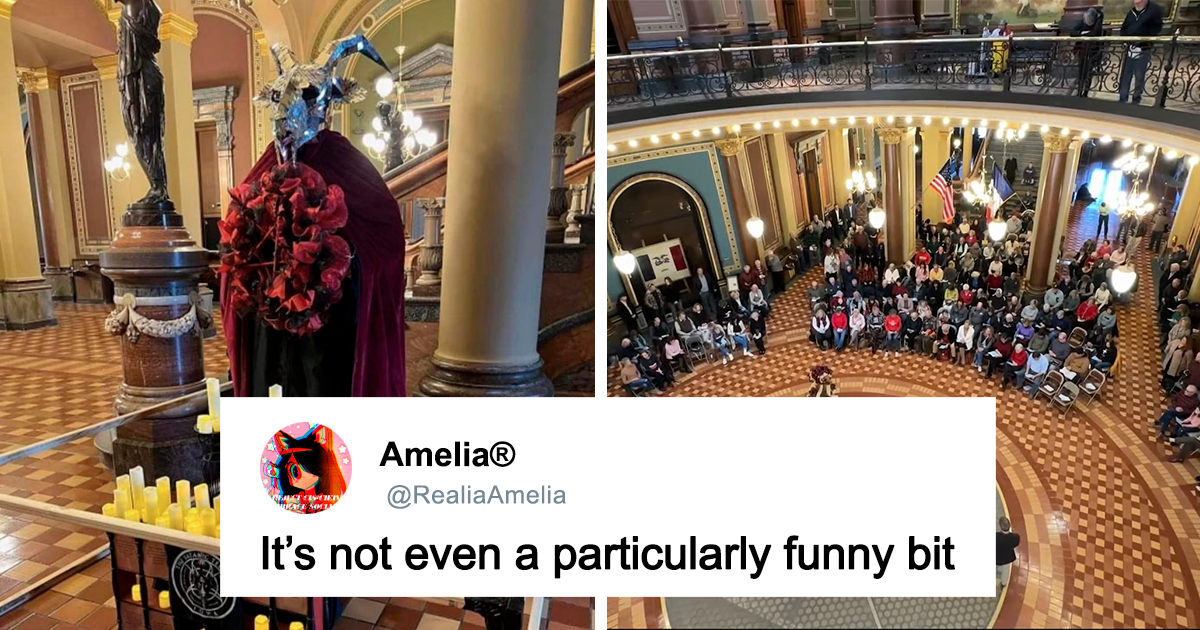
In December 2023, the Iowa State Capitol became the unlikely stage for a national argument about religion, free speech, public property, holiday displays, and America’s remarkable ability to turn one statue into a full-blown constitutional food fight. The controversy began when The Satanic Temple of Iowa placed a holiday display inside the Capitol building in Des Moines. The display included an altar, electric candles, the group’s seal, its seven fundamental tenets, and a red-cloaked figure associated with Baphomet.
To some visitors, it was a shocking and offensive symbol that had no place in a government building during the Christmas season. To others, it was a legally permitted religious display protected by the First Amendment. And to plenty of people online, it was yet another reminder that when government opens the door to religious expression, it cannot politely ask only the “comfortable” religions to step inside and wipe their shoes.
The phrase “sick and disgusting” captured the intensity of the backlash. But the story is more complicated than outrage alone. The Iowa Capitol Satanic display became a test case for a bigger American question: should public buildings allow religious displays at all, and if they do, who gets to decide which beliefs are acceptable?
What Happened At The Iowa State Capitol?
The Satanic Temple of Iowa received permission to place its display inside the Iowa State Capitol during the holiday season. The installation drew attention almost immediately because of its visual style: a mirrored ram’s head, red fabric, candles, and religious language from The Satanic Temple’s own belief system. It was not subtle. It was not trying to blend in beside the poinsettias. It was designed to be seen.
The group said the display represented religious freedom and equal access to public forums. The Satanic Temple, despite its name, describes itself as a non-theistic religious organization. Its members generally do not worship a literal Satan. Instead, the group uses Satan as a symbol of rebellion against arbitrary authority, personal liberty, reason, and the separation of church and state. That explanation did not calm everyone down. In fact, for some critics, it made the whole thing feel even more like a legal loophole wearing horns.
The display was approved under rules that allowed outside groups to apply for temporary displays at the Capitol. According to public explanations from Iowa officials and lawmakers, such displays were required to be temporary, independent, and clearly not endorsed by the state. In other words, the Capitol was not saying, “Happy holidays from Iowa and Baphomet.” It was saying, “This group applied, met the rules, and here we are.”
Why The Display Sparked So Much Anger
The backlash was immediate because the display touched several cultural nerves at once. First, it appeared during the Christmas season, when many Americans expect public holiday displays to include nativity scenes, Christmas trees, menorahs, or other familiar symbols. Second, the imagery was intentionally provocative to people raised in Christian traditions. Third, it appeared in a state government building, which made the debate feel less like a private religious expression and more like a public endorsement, even though legally those are not the same thing.
Some conservative lawmakers and religious visitors called the display evil, offensive, or blasphemous. Iowa Rep. Brad Sherman publicly argued that it should be removed and called for legislation that would prevent similar Satanic displays on state property in the future. Other critics said that even if the display was technically allowed, it violated the spirit of the season and the values of many Iowans.
But not every Republican response was the same. Iowa Rep. Jon Dunwell, who is also a Christian minister, said he found the display objectionable as a matter of faith but still did not want the government deciding which religions count and which do not. That position annoyed some conservatives, impressed some civil libertarians, and gave everyone else a headachethe usual sign that a First Amendment issue has entered the chat.
Governor Kim Reynolds Responded With Prayer, Not Removal
Iowa Gov. Kim Reynolds also criticized the display, calling it objectionable, but she did not order it removed. Instead, she encouraged people of faith to respond with prayer and to recognize the nativity scene also displayed at the Capitol. Her response landed in the middle of a deeply divided debate. Supporters of free speech saw it as a practical acknowledgment that government cannot favor one religion over another. Critics saw it as too passive, arguing that state leaders should have blocked the display entirely.
This is where the Iowa Satanic altar controversy became bigger than one holiday installation. If the state allows a nativity scene, can it reject a Satanic Temple display simply because the imagery offends the majority? If the answer is yes, then government officials become referees of religious legitimacy. If the answer is no, then public spaces may host displays that many citizens find deeply uncomfortable. Neither option fits neatly on a bumper sticker, which is rude of constitutional law.
The First Amendment Problem Nobody Could Ignore
The core legal issue was not whether most Iowans liked the display. The core issue was whether the state had created a public forum for outside displays. If a government body allows private religious groups to place temporary displays in a public building, it generally cannot discriminate based on viewpoint. That means popular faiths and unpopular faiths may both receive protection.
This is why several observers argued that the simplest solution is not to ban one unpopular display, but to rethink whether state buildings should host private religious displays at all. A public forum can be inclusive, but inclusivity often comes with surprises. Once the door is open, the guest list may include people wearing Christmas sweaters, people lighting menorahs, people quoting scripture, people quoting secular humanists, and occasionally a red-cloaked goat-headed figure that sends cable news producers sprinting for their phones.
Public Forum Versus Government Endorsement
A key distinction is whether a display represents the government’s message or a private group’s message. Supporters of the Satanic Temple’s right to display argued that the installation was private expression in a public forum. Critics argued that ordinary visitors would still associate it with the Capitol because of its location. That gap between legal theory and public perception is where many church-state conflicts become explosive.
To lawyers, a disclaimer saying “this is not endorsed by the state” matters. To a shocked visitor walking past candles and a Baphomet figure near holiday decorations, the emotional reaction may arrive long before the legal analysis. People do not usually pause in a rotunda and say, “Ah yes, viewpoint neutrality under public forum doctrine.” They say, “What on earth is that?” sometimes with extra punctuation.
The Display Was Later Destroyed
The controversy escalated when the display was vandalized and damaged beyond repair. Michael Cassidy, a Mississippi man and former Republican political candidate, was accused of destroying the Baphomet statue. He was initially charged with criminal mischief, and the case later drew additional attention when prosecutors treated the incident through the lens of religiously motivated damage. Cassidy eventually accepted a plea deal in 2024, pleading guilty to misdemeanor criminal mischief while a hate crime charge was dropped.
For supporters of the display, the vandalism proved exactly why unpopular religious expression needs protection. For critics of the display, Cassidy became a symbol of someone taking action where officials would not. That division revealed the uncomfortable truth at the center of the case: Americans often love free speech in theory, but the theory gets wobbly when the speech looks like something they would rather toss into a locked basement.
What The Satanic Temple Was Trying To Say
The Satanic Temple has a long history of using public displays and legal challenges to make a point about religious equality and government neutrality. Its strategy is often simple: if a government allows Christian symbols in a public space, the group requests equal access. The result forces officials to choose between allowing many forms of religious expression or limiting religious displays more broadly.
The Iowa display followed that pattern. The group’s leaders said the goal was not simply to offend Christians, but to demonstrate that public religious forums must be open to minority religions too. Critics did not buy that explanation, seeing the display as intentionally inflammatory. Both interpretations can be true at once. A display can be legally protected, politically strategic, and emotionally provocative. The Constitution does not require religious expression to be cozy, tasteful, or approved by the nearest aunt with a casserole.
Online Reaction: Outrage, Sarcasm, And Constitutional Side-Eye
Online reactions ranged from fury to applause. Some commenters called the altar “sick and disgusting,” while others argued that the controversy exposed a double standard. If Christian displays are welcome in public buildings, they said, then minority religious displays must also be welcome. If the public does not want Satanic Temple displays, then perhaps government buildings should avoid hosting religious displays altogether.
That argument became one of the most common responses on Reddit and other platforms. Many people said they personally preferred a strict separation of church and state. Others praised The Satanic Temple for using the rules as written. Some conservative users said the display mocked Christianity and should never have been approved. The internet, being the internet, handled this delicate constitutional debate with all the grace of a raccoon in a dishwasher.
Why This Story Went National
The Iowa Capitol Satanic display became national news because it fit into several larger debates already happening in the United States. Religious liberty, Christian nationalism, public school prayer, Ten Commandments displays, abortion rights, LGBTQ rights, and the role of religion in government have all become major political flashpoints. The Iowa altar was not an isolated oddity; it was a bright red symbol dropped into an already heated national argument.
It also arrived during the Republican presidential primary season, when Iowa was receiving intense political attention. That timing helped turn a statehouse display into a national culture-war headline. Politicians, commentators, activists, and social media users all found something in the story that supported their existing worldview. For some, it showed moral decline. For others, it showed the danger of mixing government and religion. For still others, it showed that public forum rules should be reviewed before the next holiday season turns into a constitutional escape room.
The Bigger Lesson: Equal Access Is Easy Until It Gets Uncomfortable
The most important lesson from the Iowa State Capitol Satanic altar controversy is that equal access sounds simple until it applies to a group people dislike. Religious freedom is not tested by popular beliefs. It is tested by unpopular ones. A government that protects only majority religion is not protecting religious liberty; it is managing religious preference.
At the same time, public reaction matters. Many Iowans were genuinely offended. Their anger should not be dismissed as ignorance. Religious symbols carry deep meaning, and for Christians, Satanic imagery can feel hostile, not merely different. The challenge is that hurt feelings alone cannot be the standard for government censorship. In a pluralistic country, someone’s sacred symbol may be another person’s provocation, and someone’s provocation may be another person’s protected expression.
Should Religious Displays Be Allowed In State Capitols?
There are three realistic approaches. First, states can allow a wide range of private displays and accept the controversy that comes with viewpoint neutrality. Second, they can limit displays to secular government-sponsored decorations, such as winter scenes or general holiday décor. Third, they can allow religious displays but risk lawsuits whenever officials reject a group based on belief or viewpoint.
The Iowa controversy suggests that the first option is legally cleaner but politically messy. The second option is less dramatic but may disappoint religious communities. The third option is where lawsuits are born, raised, and sent to college. For public officials, the safest rule is usually the clearest rule: either create a genuinely open forum or do not create one at all.
Experiences And Reflections Related To The Iowa Capitol Satanic Altar
Anyone who has ever walked through a public building during the holidays knows that displays can feel surprisingly personal. A nativity scene may remind one visitor of childhood church services, candlelight hymns, and grandparents who always saved the good cookies for Christmas Eve. A menorah may remind another person of family, resilience, and tradition. A secular winter display may simply make someone wonder why the fake snow always looks like shredded packing material. Public spaces collect these emotional reactions whether officials intend them or not.
That is why the Iowa Satanic altar felt so intense. People were not reacting only to a statue. They were reacting to what they thought the statue meant. For some Christians, the Baphomet figure represented direct opposition to their faith. Seeing it inside a Capitol building felt like a spiritual insult wearing a visitor badge. For members and supporters of The Satanic Temple, the display represented equal treatment under the law. Seeing it approved meant that minority beliefs could stand in the same public space as majority beliefs, even when unpopular.
A useful way to understand the controversy is to imagine being a parent walking through the Capitol with a child. The child points at the display and asks, “What is that?” One parent might feel angry that the question has to be answered at all. Another might see it as a teaching moment about religious diversity and free speech. A third might say, “That is why we read signs before touching things,” and keep moving toward the exit. The same moment can produce fear, curiosity, irritation, or civic education depending on the person experiencing it.
There is also a lesson here for anyone who participates in online debates. Social media often turns complex disputes into teams: good versus evil, freedom versus censorship, faith versus mockery. But real civic life is usually messier. A person can dislike the display and still oppose vandalism. A person can support The Satanic Temple’s legal right to display and still think public buildings should avoid religious installations. A person can be deeply religious and still believe the government should not decide which religious views deserve space.
The Iowa incident is a reminder that democracy requires emotional discipline. Not every offensive symbol should be smashed. Not every legal right must be exercised gently. Not every public controversy can be solved by yelling “First Amendment” louder than the other person yells “blasphemy.” The hard work is learning to live with speech we dislike while building rules that treat citizens fairly. That work is not glamorous. It does not trend as easily as a red-cloaked statue. But it is the difference between a public square and a shouting match with marble floors.
Conclusion
The Satanic altar at the Iowa State Capitol became a national controversy because it forced Americans to confront the real meaning of religious freedom. The display offended many people, especially Christians who saw it as hostile to their faith. But its approval also highlighted a basic constitutional principle: when government opens public space to religious expression, it cannot easily pick favorites.
The strongest takeaway is not that everyone should like the display. Many people never will. The stronger point is that public rules must be consistent. If a Capitol welcomes private religious displays, it must prepare for beliefs that challenge, irritate, or unsettle the majority. If officials want to avoid that outcome, they may need to keep government spaces religiously neutral. Either way, the Iowa debate proves that free speech is not a decoration. It is a stress test, and in December 2023, Iowa’s test arrived wearing a red cape.
Note: This article is written for informational and editorial purposes, based on publicly reported events and official statements surrounding the Iowa State Capitol Satanic Temple display controversy.