

Some years arrive with a neat vocabulary already packed and labeled. The COVID-19 pandemic did not. Suddenly, ordinary conversations required terms for elbow greetings, improvised haircuts, masked grocery runs, video-call exhaustion, and the suspicious emotional weight of an empty toilet-paper aisle. English gave us “social distancing,” “lockdown,” and “Zoom fatigue.” German, meanwhile, did what German does beautifully: it snapped familiar words together like linguistic building blocks and produced expressions so precise that they felt like tiny comic strips.
Researchers at the Leibniz Institute for the German Language documented more than 1,200 coronavirus-related German expressions during the first year of the crisis. The surge was remarkable because many of these terms were coined informally in newspapers, conversations, and social media rather than delivered by an official committee wearing extremely serious glasses. German grammar makes compounding nouns especially productive, allowing speakers to name a new experience almost as quickly as it appears. Many creations were temporary, but together they formed a verbal time capsule of pandemic life.
The seven German pandemic words below became especially memorable because each translates into an instantly recognizable scene. Imagine them as illustrated panels: funny at first glance, slightly sad on the second, and uncomfortably familiar by the third.
Why German Pandemic Words Felt So Accurate
German compound words can compress an entire situation into one label. Instead of explaining, “I met a friend outside, stayed several feet away, and drank a beer while trying not to make the evening feel medically supervised,” a speaker could say Abstandsbier. One word, one image, no assembly manual required.
That precision mattered during a crisis. Naming an unfamiliar feeling can make it easier to discuss, joke about, and share. Linguists involved in documenting the new vocabulary noted that language helps people communicate fear and uncertainty. The words were not merely cute inventions; they also reflected public-health rules, social tension, loneliness, anxiety, creativity, and the stubborn desire to remain connected.
1. Schnutenpulli: The “Snout Sweater”
Literal idea: A sweater for the snout.
Schnutenpulli is a playful nickname for a face mask. Schnute refers informally to a mouth, muzzle, or pout, while Pulli is short for pullover. Put them together and the mask becomes a cozy little garment for the lower half of your face.
What the Illustration Captures
Picture a person pulling a tiny knitted turtleneck over the nose and mouth while the ears perform the thankless engineering work. The joke works because masks became clothing, equipment, etiquette, and social signals all at once. People coordinated them with outfits, kept spares in cars, and discovered that glasses could fog at the speed of human breath.
The word also softens an object associated with danger. Public-health guidance in 2020 paired mask use with physical distancing, reduced close contact, hand hygiene, and other preventive measures. Calling a mask a “snout sweater” did not change its purpose, but it made a strange daily ritual feel a little more ordinary.
2. CoronaFußgruß: The Corona Foot Greeting
Literal idea: A coronavirus-era greeting performed with the feet.
When handshakes suddenly felt like tiny biological contracts nobody wanted to sign, people experimented with alternatives. There was the elbow bump, the distant wave, the solemn nod, and the awkward foot tap known as CoronaFußgruß. Two people gently touched shoes while attempting not to lose balance or dignity.
What the Illustration Captures
An ideal drawing shows two formally dressed adults extending one foot like cautious flamingos. Their upper bodies lean away, their faces say, “This is normal now,” and neither appears fully convinced.
The word is funny because greetings are automatic. Before the pandemic, a hand often moved before the brain had time to review epidemiological conditions. The foot greeting turned a split-second social reflex into choreography. Yet it also revealed something warm: even when touch was restricted, people kept inventing ways to say hello. One linguist involved in the pandemic-word project highlighted the term because it expressed the human need for connection despite physical distance.
3. Abstandsbier: The Socially Distanced Beer
Literal idea: A distance beer.
Abstand means distance, and Bier means beer. The result describes having a drink with friends while remaining physically separated. It was the pandemic version of happy hour: fewer crowded tables, more patio chairs arranged like pieces on a very cautious chessboard.
What the Illustration Captures
Imagine two friends sitting at opposite ends of a park bench, each holding a bottle and shouting conversational details that would normally remain private. Between them is enough empty space to accommodate a small marching band.
Abstandsbier captures the compromise at the heart of pandemic social life. People wanted companionship but also wanted to reduce risk. The result was a new etiquette built around outdoor meetings, smaller groups, open windows, spaced seating, and weather forecasts treated with the seriousness of legal documents. The beer was familiar; the geometry was new.
4. Gesichtskondom: The “Face Condom”
Literal idea: A protective covering for the face.
Gesicht means face and Kondom means condom. The expression is blunt, cheeky, and impossible to misunderstand. Like Schnutenpulli, it refers to a face mask, but the emotional tone is completely different. One sounds knitted by a kind grandmother; the other sounds invented by a comedian at closing time.
What the Illustration Captures
The obvious visual is a masked face presented like a consumer-safety diagram, perhaps with an exaggerated label reading “protects you and others.” The humor comes from transferring the idea of barrier protection from one part of the body to another.
This term also shows how competing nicknames frame the same object. A mask could be described affectionately, clinically, sarcastically, or politically. German pandemic vocabulary included multiple compounds for masks because masks were never merely pieces of fabric. They became symbols of responsibility, inconvenience, identity, conflict, fashion, and the universal discovery that one ear loop always vanishes at the worst possible moment. NPR’s discussion of the new vocabulary noted that vivid compounds such as Gesichtskondom created memorable images from familiar words.
5. Hamsteritis: The Urge to Panic-Buy
Literal idea: A hamster-like condition.
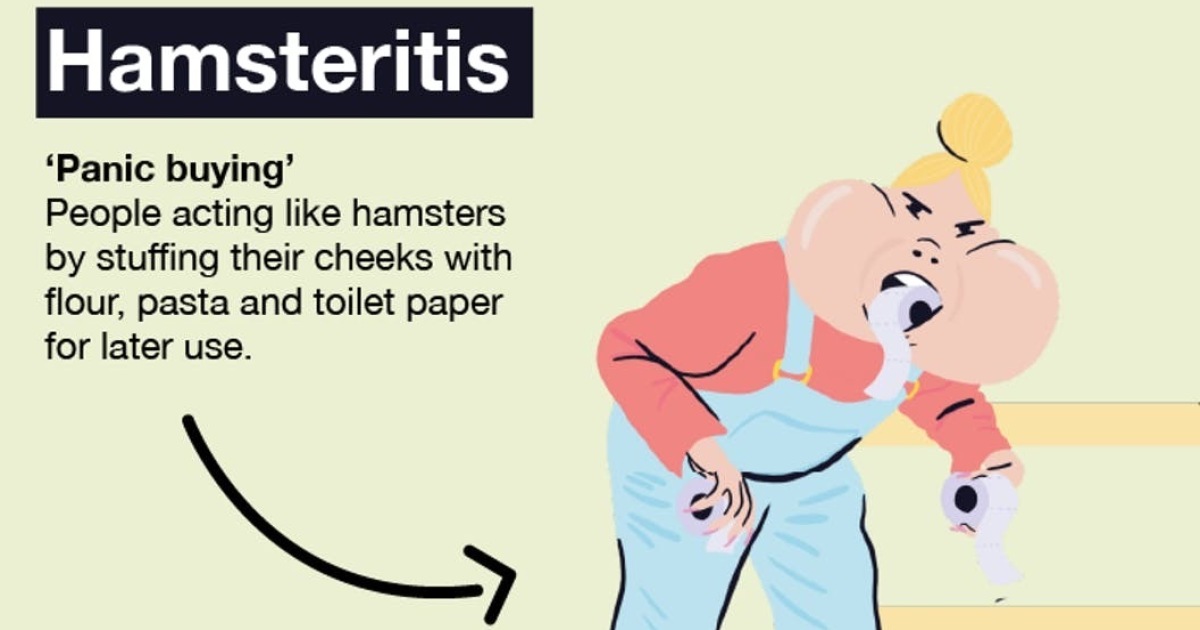
Hamsteritis describes the frenzy of stockpiling groceries and household supplies. The image is perfect: shoppers behaved like hamsters stuffing their cheeks for an uncertain winter, except the cheeks were shopping carts and the treasured seeds were pasta, flour, canned beans, and an amount of toilet paper normally associated with a midsize hotel.
What the Illustration Captures
Visualize a human-sized hamster pushing a cart piled so high that only its anxious eyes remain visible. Behind it, an empty shelf displays one lonely can of something nobody liked even before civilization felt fragile.
Panic buying often feeds itself. A shopper sees bare shelves, interprets them as proof of scarcity, and buys extra when supplies reappear. The next shopper then encounters fewer goods and repeats the cycle. Research on pandemic purchasing has associated this behavior with perceived threats, uncertainty, anxiety, social influence, anticipated scarcity, and the desire to regain a sense of control. The German term makes the behavior comic without pretending the fear behind it was imaginary.
6. Coronafrisur: The Lockdown Hairstyle
Literal idea: A coronavirus hairstyle.
When salons closed or felt unsafe, hair kept growing with absolutely no respect for government schedules. Coronafrisur became a label for overgrown bangs, improvised buzz cuts, accidental mullets, visible roots, and home-color experiments that began with optimism and ended with hats.
What the Illustration Captures
A strong illustration might show a video-call participant who looks polished from the shoulders down while a magnificent storm system occupies the top of the head. Nearby sit kitchen scissors, a tutorial paused at the most misleading moment, and a family member holding clippers with the confidence of someone who has watched nearly four minutes of online instruction.
The lockdown hairstyle became a social equalizer. Executives, teachers, celebrities, neighbors, and news anchors all revealed that professional grooming depends heavily on professionals. Yet Coronafrisur also carried a gentler message: standards relaxed. People saw one another’s natural hair, gray roots, uneven cuts, and domestic realities. Perfection briefly lost its appointment.
7. Coronaangst: Anxiety in the Age of COVID-19
Literal idea: Coronavirus anxiety.
Angst already feels at home in English, but Coronaangst gave pandemic worry a specific address. It could mean fear of infection, concern for vulnerable relatives, stress about employment, dread of crowded spaces, uncertainty about changing rules, or the exhausting habit of interpreting every throat tickle as the opening scene of a medical drama.
What the Illustration Captures
Imagine a person surrounded by floating icons: a thermometer, a notification alert, a grocery cart, a mask, a graph, a closed sign, and a phone displaying twelve unread family messages. The character is safe at home but mentally standing in the middle of every possible emergency.
This is the least comic word on the list because the experience was widespread and consequential. Psychological research found increases in loneliness during the pandemic, while public surveys documented isolation, disrupted routines, technology burnout, and simultaneous negative experiences and unexpected silver linings. Naming the anxiety did not solve it, but it separated a shared historical pressure from private personal failure.
What These Seven Words Reveal About Pandemic Life
Together, the words move through the emotional landscape of the pandemic. Schnutenpulli and Gesichtskondom turn protective equipment into humor. CoronaFußgruß and Abstandsbier show people redesigning social contact. Hamsteritis captures fear expressed through consumption. Coronafrisur records the collapse of grooming routines. Coronaangst names the pressure beneath everything else.
They also demonstrate why illustrated language can be so effective. A literal translation creates an instant visual metaphor. Once you hear “snout sweater,” you see it. Once you hear “distance beer,” you can practically measure the gap between the chairs. The image makes the term memorable, while the term gives the image cultural context.
Not every pandemic coinage will survive. Many neologisms flare up because a particular moment needs them and disappear when that moment passes. That does not make them failures. Temporary words can document temporary worlds. They preserve what official timelines often miss: the comedy of foot greetings, the drama of amateur bangs, and the strange comfort of discovering that millions of people were worried about the same empty shelf.
A 500-Word Pandemic Experience: Living Inside the Vocabulary
The following is a composite scene based on common pandemic routines, not one individual’s diary.
The morning begins with a search for the Schnutenpulli. It is not on the hook, not in the coat pocket, and not beside the keys. After several minutes, it appears around one wrist, where it has apparently been waiting with the quiet confidence of an object that knows it controls the entire outing. A second mask goes into the bag because experience has taught everyone that masks attract coffee spills, broken straps, and sudden disappearance.
At the grocery store, the entrance has arrows, distance markers, sanitizer, and a sign whose font becomes larger each week. The shopping list says milk, eggs, and rice. The cart says prepare for the fall of Rome. One glance at a half-empty pasta shelf activates a mild case of Hamsteritis. Three boxes seem sensible. Four boxes seem responsible. Five boxes feel like a personality change. After a private negotiation, two boxes enter the cart, along with enough snacks to survive either quarantine or a long movie.
Outside, a familiar neighbor approaches. Both people begin the old handshake movement, remember reality, and convert it into a CoronaFußgruß. The shoes touch. One person wobbles. The other pretends not to notice. It is less elegant than a handshake but more memorable, and for a second the absurdity cuts through the tension.
Work starts at the kitchen table. The first video meeting includes a frozen screen, an accidental interruption by a pet, and the sentence “You’re muted” delivered with the weary rhythm of a national anthem. The camera shows a respectable shirt and a Coronafrisur that has developed an independent foreign policy. A self-administered haircut is considered, then postponed after remembering what happened to a friend’s bangs.
By late afternoon, notifications have accumulated: case numbers, rule changes, canceled plans, health advice, rumors, corrections to rumors, and a relative’s message beginning with “I saw online that…” Coronaangst arrives quietly. It is not one fear but a stack of small uncertainties. Is the cough from dry air? Is the store crowded? Is everyone being careful? When will normal return, and will anyone recognize it when it does?
In the evening, two friends meet outdoors for an Abstandsbier. Their chairs are far apart, the weather is colder than advertised, and conversation requires occasional shouting. Still, the meeting feels luxurious. They compare home-office disasters, admire each other’s ridiculous hair, and discuss the strange range of names people have invented for masks, including Gesichtskondom, which causes both to laugh hard enough to fog their glasses.
Nothing dramatic happens. That is precisely the point. Pandemic life was often made from ordinary actions placed under extraordinary pressure: buying groceries, greeting neighbors, doing a job, worrying about family, and trying to see a friend. The German compounds work because they do not summarize the crisis from a distance. They enter the kitchen, the store, the sidewalk, and the park. They name the small scenes in which history was actually lived.
Conclusion
The best pandemic vocabulary did more than label rules. It captured behavior, emotion, and visual comedy in compact form. These seven German words remain memorable because they transform abstract disruption into recognizable human scenes: a mask becomes a sweater, a greeting moves to the feet, a drink acquires geometry, shopping becomes hamster behavior, hair stages a rebellion, and anxiety finally gets a name.
Looking back, the words offer both humor and evidence. They remind us that people respond to upheaval by adapting routines, inventing rituals, and making language work overtime. A crisis may rewrite daily life, but humans will still find a phrase for the awkward partsand, whenever possible, turn that phrase into a joke.
Note: These expressions were widely discussed pandemic-era compounds and informal coinages. Usage, spelling, and tone can vary, and not every term became a permanent standard-dictionary entry.