

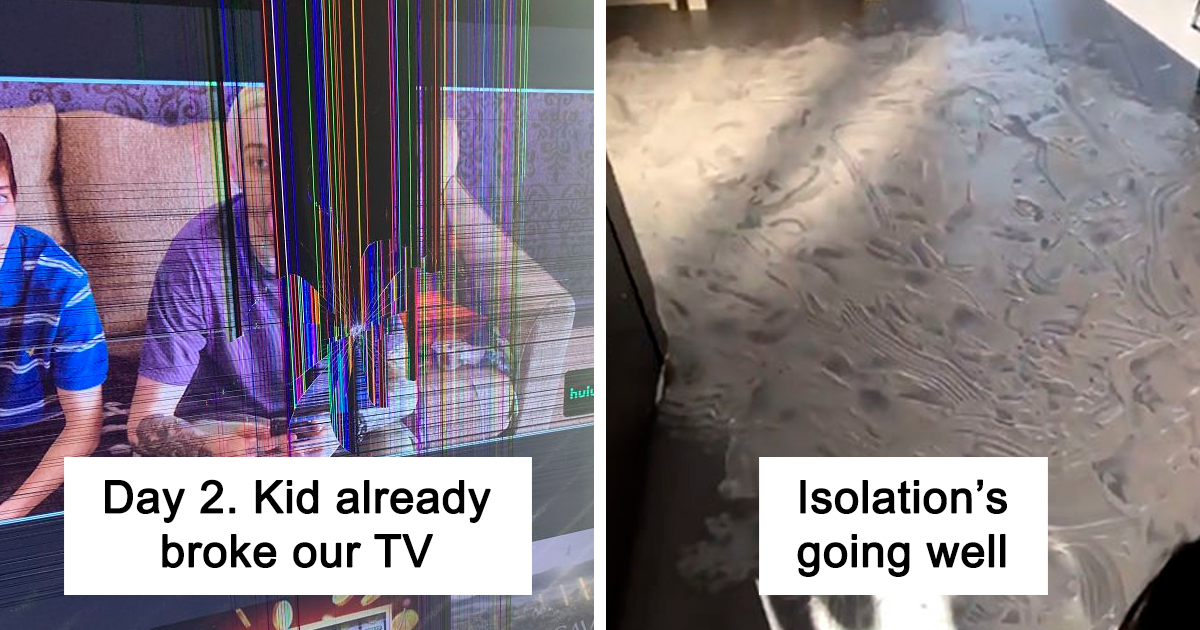
In spring 2020, millions of parents discovered that “staying home with the family” sounded considerably more relaxing before the family was home every hour of every day. Schools closed, offices moved onto laptops, playgrounds emptied, and living rooms became classrooms, cafeterias, conference rooms, art studios, and occasionally low-budget disaster zones.
Parents responded in the most internet-friendly way possible: they photographed the chaos. Social media filled with homemade haircuts, interrupted video meetings, unusual homeschooling arrangements, exhausted adults, and children who treated quarantine as an unlimited research grant for bad ideas. Collections of funny quarantine parenting pictures quickly became popular because they showed both the struggles and unexpected joys of families sharing the same space around the clock.
The humor was rooted in a very real upheaval. About 93% of parents with K–12 children said their kids experienced some online instruction during the pandemic. Meanwhile, 72% reported that their children spent more time looking at screens, and 39% became less strict about recreational screen-time rules. In other words, the tablet was no longer just entertainment. It was a teacher, babysitter, library, lunch companion, and emergency peace treaty.
These 30 funny quarantine parenting moments capture what happened when children had unlimited access to their homes, their parents, and several containers of washable paint that turned out to be emotionally washable but not physically washable.
30 Hilarious Quarantine Parenting Pictures We Can All Understand
-
1. The Home Office Hostage Situation
A parent attempts to join a serious video meeting while a small face slowly rises behind the laptop screen. The child says nothing. The child simply watches, like a tiny supervisor investigating why the household employee has not prepared snacks.
-
2. A Social-Distancing Lesson With Mixed Results
One dad carefully explains the importance of personal space. Five minutes later, his son is sitting directly on his head. Technically, the child listened. He simply rejected the proposal after reviewing its effect on climbing opportunities.
-
3. The First Homemade Haircut
A child discovers scissors and decides that professional barbers are an unnecessary luxury. The finished hairstyle includes one short side, one mysterious patch, and bangs that appear to have been designed during an earthquake.
-
4. Homeschooling Begins With Confidence
The kitchen table is organized with sharpened pencils, color-coded folders, healthy snacks, and an ambitious daily schedule. Twenty minutes later, one child is under the table, another is crying over fractions, and the parent is quietly searching for boarding schools.
-
5. The Teacher Appreciation Transformation
A handwritten sign reads, “Teachers deserve a million dollars.” It was reportedly created shortly after a parent spent 45 minutes explaining a worksheet problem while the child repeatedly insisted, “That isn’t how my teacher does it.”
-
6. When the Flour Became a Sensory Activity
The parent leaves the kitchen for approximately 18 seconds. Upon returning, every surface is white. The children proudly announce that they have been baking, although there is no food and the dog now resembles a powdered donut.
-
7. Day Three: The Living Room Fort
Blankets, couch cushions, dining chairs, and approximately 70 clothespins have been used to construct a private residence in the middle of the living room. The children refuse to clean it because the structure is now “a historic castle.”
-
8. Day Ten: The Fort Becomes a Nation
The blanket castle now has its own government, currency, border policy, and snack tax. Adults may enter only after presenting two cookies and agreeing not to mention homework.
-
9. The Extremely Honest Daily Schedule
A parent replaces an unrealistic homeschool plan with a more accurate version: wake up, negotiate breakfast, locate missing charger, restart Wi-Fi, argue about pants, attend Zoom class, apologize to teacher, distribute snacks, repeat until bedtime.
-
10. Working From Home, Featuring a Live Dinosaur
During a professional presentation, a child wearing an inflatable dinosaur costume walks through the background. Nobody on the call mentions it because everyone else has already seen stranger things in their own homes.
-
11. The Silent Child Warning System
Experienced parents know that screaming usually means ordinary play. Silence means somebody has found permanent markers. The photograph shows a parent sprinting down a hallway with the urgency of a bomb-disposal specialist.
-
12. The Wall Becomes a Canvas
A young artist creates a floor-to-ceiling mural featuring a purple sun, several unidentified animals, and the artist’s full name. Signing the work was an admirable commitment to creative ownership, although it weakened the defense during questioning.
-
13. The Laptop Repair Apprenticeship
After hearing “I’m bored” for the 400th time, a parent presents the kids with an old computer and several screwdrivers. The picture shows them completely focused, surrounded by tiny components that may never become a computer again.
-
14. Physical Education Gets Creative
The family obstacle course involves couch cushions, laundry baskets, masking-tape lines, and a rule requiring competitors to crawl beneath the dining table. The children love it. The downstairs neighbor has submitted a formal complaint.
-
15. The Refrigerator Security Upgrade
After serving breakfast, a second breakfast, a snack, lunch, another snack, and something called “pre-dinner,” one parent places a handwritten sign on the refrigerator: “The kitchen is closed. Please contact management tomorrow.”
-
16. Business Casual Takes on a New Meaning
A mother attends a video conference wearing a blazer over pajamas while her toddler sits beside her dressed as a firefighter. Both outfits are appropriate for the emergencies unfolding in their respective workplaces.
-
17. The Family Pet Requests Reassignment
The cat is photographed hiding behind a curtain after being placed in a toy stroller, invited to three tea parties, and enrolled in kindergarten. Before quarantine, the cat believed daytime belonged to cats. That belief has been destroyed.
-
18. Screen-Time Rules Quietly Surrender
A child sits before a tablet, television, laptop, and handheld game at the same time. The parent looks at the camera with the calm expression of someone who once had principles but now has a deadline.
-
19. The “Educational” Baking Project
The family plans to practice math by measuring ingredients. The children eat the chocolate chips, spill the milk, and lose interest before the oven is preheated. The lesson becomes an advanced seminar in patience and kitchen sanitation.
-
20. When a Child Discovers Tape
A toddler uses an entire roll of tape to attach toys, pillows, and one confused sibling to the floor. The parent must decide whether to intervene or enjoy the first three minutes of quiet experienced all week.
-
21. The Indoor Camping Expedition
The family pitches a tent in the living room to create a memorable adventure. By midnight, the children are sleeping in the parents’ bed, one parent is on the couch, and the tent has been claimed by the dog.
-
22. Recess in a Very Small Backyard
A child runs around a lawn approximately the size of a bath towel while a parent counts laps. By lap 47, the child has enough energy for another 47. The parent begins questioning the scientific basis of exhaustion.
-
23. The DIY Spa Experience
A preschooler covers her face with lotion, applies several hair clips, and wraps herself in toilet paper. She calls it a spa day. Her parent calls it the reason the family has no moisturizer left.
-
24. The Zoom Class Wardrobe
From the waist up, the student appears prepared for school in a neat shirt. Below the desk are superhero pajama pants, fuzzy slippers, and a blanket. Remote learning briefly made every child a television news anchor.
-
25. The Parent’s Secret Snack Is Discovered
A photograph captures a child staring through a cracked pantry door while a parent quietly eats chocolate. The expression says, “You told us there were no snacks,” and a household scandal is clearly moments away.
-
26. The Homemade Science Experiment
The instructions called for baking soda, vinegar, and a small container. The children used extra ingredients and the largest bowl available. The resulting eruption reaches the ceiling, proving that enthusiasm is not a recognized unit of measurement.
-
27. The Child Who Joined the Conference Call
A six-year-old appears on camera and asks the parent’s boss why everyone is talking so much. It is the most efficient performance review conducted all quarter, and several coworkers appear to agree with the assessment.
-
28. Laundry Basket Transportation Services
One sibling sits in a laundry basket while another pulls it through the hallway at dangerous speed. Their parent photographs the scene because stopping it would require standing up, and standing up is currently outside the available energy budget.
-
29. The End-of-Day Living Room
Toys cover the floor, cushions lean against walls, art supplies occupy the table, and a single sock hangs from a lamp. The exhausted parent stands in the doorway wondering whether cleaning is worthwhile when morning is only eight hours away.
-
30. The Family Portrait That Says Everything
The children grin proudly beside their latest project. One parent has paint on their face. The other is holding cold coffee and staring into the distance. Nobody is dressed for the same season, but everyone survived another day together.
Why Funny Quarantine Parenting Pictures Became So Relatable
The funniest images were not polished family portraits. They showed cereal on the floor, children interrupting meetings, homework battles, exhausted parents, and homes that looked thoroughly lived in. During a period filled with uncertainty, these imperfect photographs gave families permission to stop pretending everything was under control.
That feeling was especially familiar to parents working remotely. Half of teleworking parents with children under 18 said completing work without interruptions had become difficult during the early pandemic, compared with only 20% of remote workers without minor children. The wandering toddler in the background of a video meeting was not an isolated comedy sketch. It was practically a national coworker.
Humor also helped parents find community. A photo of a disastrous haircut or failed craft project reassured other adults that their own household was not uniquely chaotic. Someone else had also abandoned the color-coded schedule. Someone else had served cereal for dinner. Someone else had discovered that a closed bathroom door was apparently an invitation to begin an urgent conversation.
What Parents Actually Experienced Behind the Funny Photos
The Home Became Every Place at Once
Before quarantine, different locations created useful boundaries. Children learned at school, adults worked at offices, families relaxed at home, and everybody occasionally went somewhere else. Once those boundaries disappeared, the same kitchen table might host a math lesson at 9 a.m., a staff meeting at 10 a.m., a craft project at noon, and dinner beneath a thin but noticeable layer of glitter.
That overlap created funny scenes, but it also demanded constant mental switching. A parent could move from employee to teacher to cook to technology technician in less than five minutes. U.S. Census Bureau reporting found that households with children were disproportionately affected by pandemic disruptions, with working mothers often carrying a particularly heavy share of schooling and child-care responsibilities.
Homeschooling Was Not the Same as School at Home
Many families began remote learning with ambitious plans. They printed schedules, created designated workstations, and imagined calm mornings filled with educational progress. Reality depended on internet access, devices, children’s ages, learning needs, work schedules, and how long anyone could tolerate hearing the phrase “Your microphone is muted.”
Parents also gained a new appreciation for teachers. Explaining elementary-school math can be surprisingly humbling, especially when the method adults remember using has apparently been retired by international agreement. Families learned that teaching requires more than knowing an answer. It requires explaining the answer while 25 students need help, the projector refuses to cooperate, and somebody is sharpening a pencil for suspiciously long.
Routines Helped, but Flexibility Saved the Day
Predictable meals, bedtimes, lessons, and breaks could give children a sense of stability. Organizations including the American Psychological Association, the CDC, the American Academy of Pediatrics, and Child Trends emphasized the value of age-appropriate explanations, emotional support, manageable routines, movement, sleep, and realistic expectations during major disruptions.
Yet successful families were not necessarily the ones following perfect schedules. They were often the ones able to adjust. A difficult school morning might become an outdoor break. A complicated dinner might become sandwiches. A carefully planned craft might become a cardboard-box spaceship with no educational objective beyond keeping everyone peacefully occupied.
Screen Time Became More Complicated
Parents had spent years hearing that children needed less screen time. Then school, friendships, music lessons, birthday parties, and visits with relatives all moved online. Screens could increase inactivity and disrupt routines, but they also provided education, social connection, entertainment, and precious breathing room for adults trying to keep their jobs.
The practical lesson was that context mattered. A video call with grandparents was not identical to hours of random scrolling. An educational game was different from a device used at bedtime. Most importantly, parents did not need another reason to feel guilty during an emergency. They needed workable decisions for their actual households.
The Laughter Did Not Erase the Hard Parts
Funny photos captured only a fraction of the experience. Families also faced illness, financial pressure, isolation, learning difficulties, disrupted child care, and concerns about mental health. CDC data from 2020 showed elevated proportions of mental-health-related emergency department visits among school-age children and adolescents, highlighting the seriousness of the broader disruption.
Still, laughter had value. It did not minimize the crisis; it gave people a manageable way to acknowledge absurd moments inside it. Parents could be tired and grateful, frustrated and amused, worried and deeply attached to the small humans climbing across their keyboards. Those emotions were not contradictory. They were simply family life under extraordinary pressure.
Conclusion: The Pictures Were Funny Because They Were True
The best funny pics from parents stuck in quarantine with their kids worked because they required almost no explanation. One look at a badly trimmed head, a destroyed kitchen, or a toddler invading a conference call told the entire story.
Quarantine parenting was messy, exhausting, creative, affectionate, and frequently ridiculous. Parents improvised classrooms, invented games, relaxed old rules, discovered new limits, and learned that children can become bored approximately four minutes after completing an activity they begged to try.
Years later, these images remain more than internet jokes. They are snapshots of families adapting in real time. The backgrounds may contain laundry mountains and abandoned worksheets, but they also show resilience, connection, and the uniquely parental ability to take a photograph before cleaning up the disaster.